Canadian Registration Number (CRN): The Ultimate Engineering & Compliance Guide 2026
The Canadian Registration Number (CRN) is a unique identification number issued by a Canadian provincial regulatory authority to confirm that the design of a pressure vessel, boiler, or pressure fitting complies with the applicable safety standards. In the Canadian engineering landscape, achieving a Canadian Registration Number (CRN) is a mandatory requirement for any pressure-retaining equipment operating at pressures exceeding 15 psi (103 kPa), ensuring the safety and integrity of industrial installations across all provinces.
Quick Definition: What is a CRN?
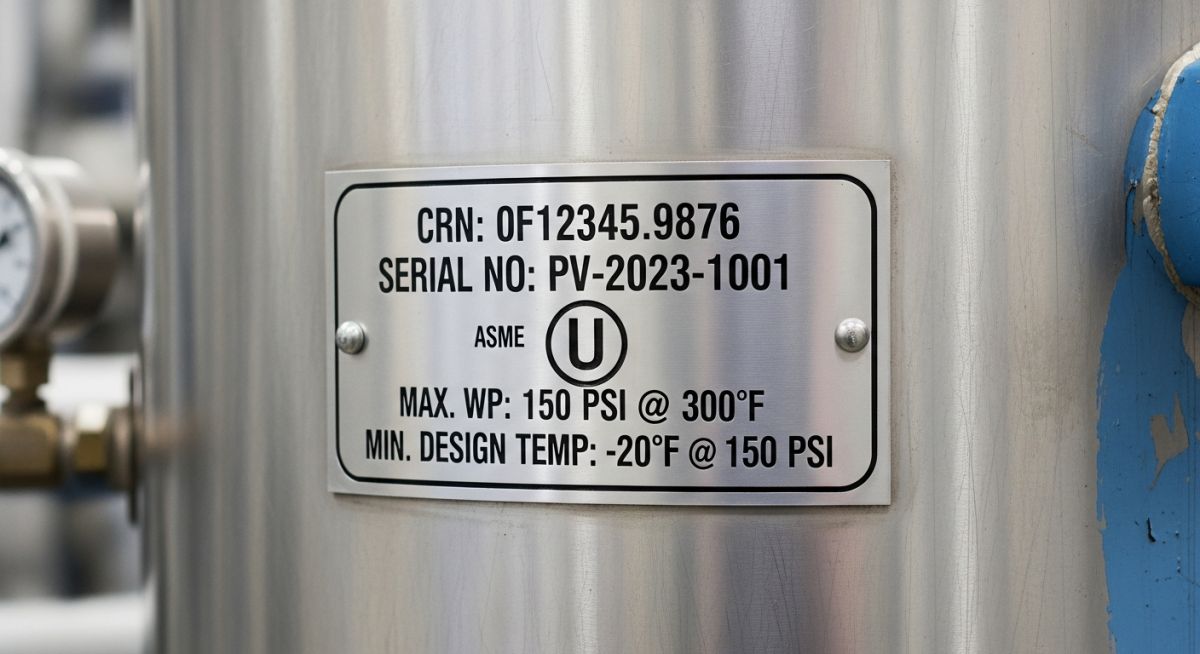
A Canadian Registration Number (CRN) is an alphanumeric string assigned to a pressure equipment design that has been reviewed and accepted by a provincial safety authority. It signifies that the design meets the CSA B51 standard and is legally authorized for installation and operation within a specific Canadian province or territory.
Table of Contents
Regulatory Knowledge Check: CRN Standards
Complete Course on
Piping Engineering
Check Now
Key Features
- 125+ Hours Content
- 500+ Recorded Lectures
- 20+ Years Exp.
- Lifetime Access
Coverage
- Codes & Standards
- Layouts & Design
- Material Eng.
- Stress Analysis
The Engineering Significance of CRN (CSA B51 Compliance)
The Canadian Registration Number (CRN) is more than just a regulatory hurdle; it is a fundamental safety protocol established under the CSA B51 Standard (Boiler, Pressure Vessel, and Pressure Piping Code). In Canada, pressure equipment that is not properly registered is considered illegal for operation, leading to immediate site shutdowns, voided insurance policies, and severe legal liabilities for the owner.
Why Does Engineering Registration Matter?
- Design Validation: A provincial safety authority engineer reviews all Pressure Vessel Design Registration documents, including stress calculations and material specifications, to ensure they meet the ASME Code.
- Public Safety: By standardizing registration, Canada ensures that high-pressure equipment installed in a refinery in Alberta meets the same safety threshold as one in a hospital in Ontario.
- Jurisdictional Requirement: Each province has its own safety act (e.g., Ontario’s Technical Standards and Safety Act), and the CRN is the mechanism used to enforce these laws.
Decoding the CRN Format: What the Digits Mean
To an untrained eye, a Canadian Registration Number (CRN) looks like a random string of characters. However, every digit provides critical information regarding the equipment type and the provinces where it is legally registered.

Figure 1: Breakdown of a typical CRN (e.g., 0B1234.567R1).
Structure of a CRN Alphanumeric String
A typical registration number follows this pattern: [Letter] [Sequential Number] . [Provincial Digits]. Let’s break down each segment:
- 1. The Category Letter: For fittings, the CRN starts with a ‘0’ followed by a category letter (A through H). For vessels, the string usually starts with a letter indicating the type of vessel or simply the sequential number.
- 2. The Sequential Number: A unique 4 to 6 digit number assigned to that specific design by the first registering province.
- 3. The Decimal Point: Acts as the separator between the design identification and the Jurisdictional Requirements.
- 4. The Provincial Digits: The digit immediately following the decimal indicates the primary province of registration. Any subsequent digits represent Reciprocal Registration in other provinces.
Provincial Decimal Codes Table
| Digit | Province / Territory | Authority |
|---|---|---|
| .1 | British Columbia | Technical Safety BC |
| .2 | Alberta | ABSA |
| .3 | Saskatchewan | TSASK |
| .4 | Manitoba | Inspection and Technical Services |
| .5 | Ontario | TSSA |
| .6 | Quebec | RBQ |
| .7 | New Brunswick | Technical Inspection Services |
| .C | All Provinces | Canada-wide Registration |
Example: A CRN of B1234.521 indicates the design was first registered in Ontario (.5), then reciprocally registered in Alberta (.2) and British Columbia (.1).
Scope of Registration: Vessels, Fittings, and Piping
Not all engineering components require a Canadian Registration Number (CRN). Under CSA B51, registration is categorized by the type of equipment and its pressure-retaining volume. Understanding these distinctions is vital to avoid over-engineering or non-compliance.
Pressure Vessel CRN Requirements
Any Pressure Vessel design with a volume greater than 1.5 cubic feet (42.5 liters) and an operating pressure above 15 psi must be registered. This includes heat exchangers, air receivers, and chemical reactors. The submission must include ASME Section VIII calculations and detailed fabrication drawings.
Fitting CRN Numbers (Categories A through H)
Fittings are the most common components requiring registration. They are grouped into eight categories (A to H). If a fitting design changes even slightly, a new Fitting CRN Number or a revision to the existing one is required.
| Category | Description | Common Examples |
|---|---|---|
| Category A | Pipe Fittings | Couplings, Tees, Elbows, Plugs |
| Category B | Flanges | All Flange types |
| Category C | Valves | Gate, Globe, Ball, Butterfly |
| Category D | Expansion Joints | Flexible Connections, Hose Assemblies |
| Category E | Strainers & Filters | Y-Strainers, Basket Filters |
| Category F | Measuring Devices | Pressure Gauges, Level Glasses |
| Category G | Safety Relief Devices | Rupture Discs, Relief Valves |
| Category H | Pressure Components | Manifolds, Small Volumes (< 1.5 ft3) |
Safety Authorities Associated with Canadian Registration Number (CRN)
Canada does not have a single federal agency for pressure equipment. Instead, each province manages its own Jurisdictional Requirements through specific safety authorities. If you want a “National CRN,” you must navigate the Reciprocal Registration process starting with your primary province.

TSSA (Ontario)
Technical Standards and Safety Authority. One of the busiest jurisdictions for CRN reviews in 2026.
ABSA (Alberta)
Alberta Boilers Safety Association. Known for strict adherence to ASME and CSA standards for oil and gas equipment.
Technical Safety BC (British Columbia)
Manages the registration and inspection of boilers and pressure vessels across BC.
RBQ (Quebec)
Régie du bâtiment du Québec. Requires documentation in French or bilingual formats for certain submissions.
Steps for Getting a CRN Number
Obtaining a Canadian Registration Number (CRN) is a formal legal process that typically takes between 4 to 12 weeks, depending on the complexity of the design and the backlog of the jurisdiction.
Design Preparation
Prepare ASME Section VIII calculations, detailed drawings with dimensions/materials, and a Statutory Declaration form (for fittings).
Primary Submission
Submit the package to the “Province of First Entry” (usually where the equipment is being used or the manufacturer is located).
Technical Review
A professional engineer (P.Eng) at the authority reviews the design. If errors are found, “Proof Testing” or design modifications may be requested.
Registration & Reciprocity
Once approved, the primary CRN is issued. You can then apply for Reciprocal Registration in other provinces using the primary approval as a baseline.
EPCLand YouTube Channel
2,500+ Videos • Daily Updates
CRN Requirement & Provincial Code Finder
In the Canadian regulatory landscape of 2026, determining whether your equipment requires a Canadian Registration Number (CRN) is the first step in compliance. Use this engineering tool to check the status of your pressure equipment based on CSA B51 guidelines and identify the correct provincial decimal code.
CRN Compliance & Jurisdiction Tool (2026 Edition)
Note: CSA B51 threshold is typically 15 psi.
Note: Threshold for vessels is usually 1.5 ft3.
Differences between CRN and CSA Certification
A common point of confusion for international manufacturers entering the Canadian market is the difference between a Canadian Registration Number (CRN) and CSA Certification. While both are related to Canadian safety, they govern entirely different engineering scopes.
CRN (Pressure Focus)
- ▶ Governing Code: CSA B51 (Boiler, Pressure Vessel, and Pressure Piping Code).
- ▶ Scope: Pressure-retaining integrity of vessels and fittings.
- ▶ Approval: Issued by Provincial Safety Authorities (TSSA, ABSA, etc.).
- ▶ Identification: A design-specific alphanumeric string stamped on the nameplate.
CSA (Product Focus)
- ▶ Governing Code: CSA Electrical Code or CSA Gas Code.
- ▶ Scope: Electrical safety, combustion safety, and overall product performance.
- ▶ Approval: Issued by the Canadian Standards Association (a private certification body).
- ▶ Identification: The “CSA” logo found on consumer and industrial goods.
Pro-Tip: If you are manufacturing a boiler, you likely need BOTH. The pressure vessel part requires a CRN, while the burner and electrical controls require CSA certification.
Case Study: National Registration for Multi-Province Projects
Regulatory Engineering Analysis | 2026 Project Review
Project Visual: Navigating the 13 different jurisdictions for a Canada-wide (.C) registration.
The Challenge
A European manufacturer designed a standardized filter housing (Category E) to be sold to the oil and gas market in Alberta (ABSA) and the mining market in Ontario (TSSA).
Obstacle:
The manufacturer assumed a single ASME U-Stamp would suffice. However, TSSA requested localized stress analysis for nozzle loading, while ABSA demanded Proof Testing data for the quick-opening closure.
The Engineering Fix
The Epcland compliance team standardized the submission package using the Reciprocal Registration path. We obtained the primary registration from Alberta (the most stringent jurisdiction for this type) first.
- • Consolidated all provincial forms into a single “National” application package.
- • Performed Finite Element Analysis (FEA) to satisfy TSSA nozzle load requirements.
- • Successfully achieved a National CRN (ending in .5C).
Market Access
100% Canada-Wide
Time to Approval
14 Weeks
Legal Status
Verified for 2026
Frequently Asked Questions (FAQ)
Does a Canadian Registration Number (CRN) ever expire? ▼
Can an ASME U-Stamp replace the need for a CRN in Canada? ▼
What are the revision requirements for existing CRN numbers? ▼
Is a CRN required for used pressure vessels being moved into a new province? ▼
Conclusion: Mastering CRN Compliance
Navigating the Canadian Registration Number (CRN) system is a critical competency for any engineer or manufacturer operating in the Canadian pressure equipment market. By understanding the CSA B51 standards, decoding the alphanumeric provincial codes, and following the correct Reciprocal Registration paths, you ensure that your projects are not only legally compliant but also engineered for maximum safety. In 2026, as jurisdictions become more digitally integrated, staying ahead of documentation requirements is the best way to prevent costly project delays and ensure a smooth path to operational approval.

Related posts:
![High-grade industrial Wing Nut Types and Applications for mechanical assemblies.]()
Wing Nut Types and Applications: The 2026 Engineering Guide
![Industrial Monorail Crane Systems installed in a modern manufacturing plant 2026.]()
Monorail Crane Systems: Design, Types & 2026 Standards Guide
![Lead engineer performing a Factory Acceptance Test FAT on an industrial skid system 2026]()
Factory Acceptance Test FAT: The 2026 Engineering Guide to Zero-Defect Delivery
![Professional engineering workspace showing a Basis of Design document layout for a 2026 project.]()
Basis of Design: How to Write a BOD for Engineering Projects in 2026
![Industrial Flare Knockout Drum Sizing and installation in a refinery relief system.]()
Flare Knockout Drum Sizing: Design & API 521 Standards (2026 Guide)
![Advanced Reboiler Control Systems in a modern petrochemical refinery 2026.]()
Reboiler Control Systems: Engineering Guide to Precision Control 2026