ASME B31.3 vs B31.12 Guide
Navigating the “Code Break” for Hydrogen Projects.
The debate of ASME B31.3 vs B31.12 is the single most defining engineering challenge for the booming Hydrogen sector in 2026. While B31.3 has historically been the “Bible” of process piping, the emergence of B31.12 as a dedicated Hydrogen Piping and Pipelines standard has created a complex compliance landscape. Engineers must now decide whether to apply the general rigor of Process Piping rules or submit to the specific material penalties and embrittlement factors mandated by B31.12.
The Core Difference
ASME B31.3 (Process Piping) is a general code for refineries and chemical plants, treating Hydrogen as just another hazardous fluid (often under Chapter IX).
ASME B31.12 (Hydrogen Piping and Pipelines) is a dedicated code that explicitly addresses hydrogen embrittlement by introducing a mandatory “Material Performance Factor” (Hf), which often results in thicker pipe walls compared to B31.3.
⚡ Test Your H2 Code Knowledge
Score: 0/5
Complete Course on
Piping Engineering
Check Now
Key Features
- 125+ Hours Content
- 500+ Recorded Lectures
- 20+ Years Exp.
- Lifetime Access
Coverage
- Codes & Standards
- Layouts & Design
- Material Eng.
- Stress Analysis
ASME B31.3 vs B31.12: Scope and the “Overlap Zone”
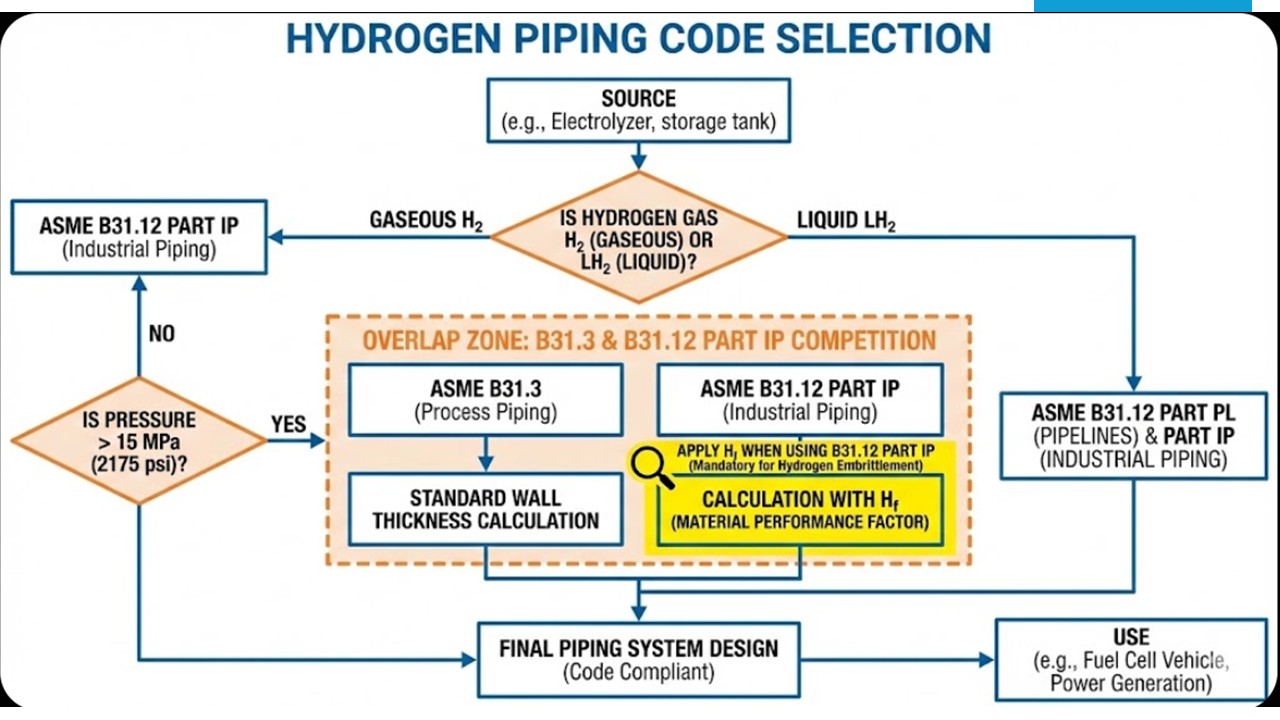
The most common question in 2026 engineering kick-off meetings is: “Where does B31.3 stop and B31.12 begin?”
ASME B31.12 is divided into two distinct parts:
- Part GR: General Requirements.
- Part IP (Industrial Piping): Covers piping within plant boundaries (Refineries, Electrolyzer Plants). This is the direct competitor to ASME B31.3.
- Part PL (Pipelines): Covers cross-country transmission lines. This competes with ASME B31.8 (Gas Transmission).
For plant engineers, the conflict lies between ASME B31.3 and B31.12 Part IP. While B31.3 allows for Hydrogen design (often invoking Chapter IX for high pressure), B31.12 is the preferred standard for pure hydrogen service because it explicitly mandates material safeguards against embrittlement that B31.3 might leave to the designer’s discretion.
The Cost of Safety: Material Performance Factor ($H_f$)
The defining characteristic of ASME B31.12 is the introduction of the Material Performance Factor ($H_f$). In standard B31.3 design, you use the full Allowable Stress ($S$) of the material. In B31.12 (specifically Part PL, and effectively built into the tables of Part IP), the strength of the steel is “derated” based on its susceptibility to Hydrogen Embrittlement.
B31.12 (Part PL) Wall Thickness Concept
Ranges from 1.0 (Low Strength) to ~0.87 (High Strength).
As steel strength increases (e.g., X70), H_f decreases, negating the benefit of higher grade steel.
The Engineering Consequence: If you try to use high-strength carbon steel (e.g., API 5L X70) to save weight, ASME B31.12 penalizes you with a low $H_f$ factor, forcing you to thicken the wall anyway. This is to keep stress levels below the threshold where hydrogen-induced cracking occurs. ASME B31.3 does not have this automatic penalty, placing the burden of “suitability for service” entirely on the Materials Engineer.
Detailed Comparison: ASME B31.3 vs B31.12
Below is the 2026 snapshot comparison for Industrial Piping applications.
| Feature | ASME B31.3 (Process Piping) | ASME B31.12 (Part IP) |
|---|---|---|
| Hydrogen Coverage | Covered as a “fluid service.” Often Chapter IX for High Pressure. | Dedicated code. Specific rules for embrittlement control. |
| Allowable Stress | Table A-1 (Standard). | Table IP-2.2.9 (Restricted/Derated based on H2 pressure). |
| Materials (CS) | Commonly A106 Gr B, A333 Gr 6. | Restricted hardness (< 22 HRC). Limits on Carbon Equivalent (CE). |
| PWHT (Heat Treat) | Based on thickness (> 19mm typically). | Often mandatory for ALL thicknesses in high-pressure H2 to reduce hardness. |
| Design Life | Implicit / Owner specified. | Explicit. Can be designed for finite life based on fracture mechanics. |
*Note: B31.12 Part IP is generally more conservative (costlier) than B31.3 but offers higher assurance against hydrogen attack.
Case Study: ASME B31.3 vs B31.12 in Green Hydrogen Design
Resolving a $2M compliance conflict on a 500MW Electrolyzer Project (Rotterdam, 2025).
📂 Project Data
- Project: Green H2 Expansion
- Service: 99.9% H2 @ 30 Bar
- Material: Carbon Steel (A106 Gr B)
- EPC Proposal: ASME B31.3 (Standard)
- Licensor Demand: ASME B31.12 Part IP
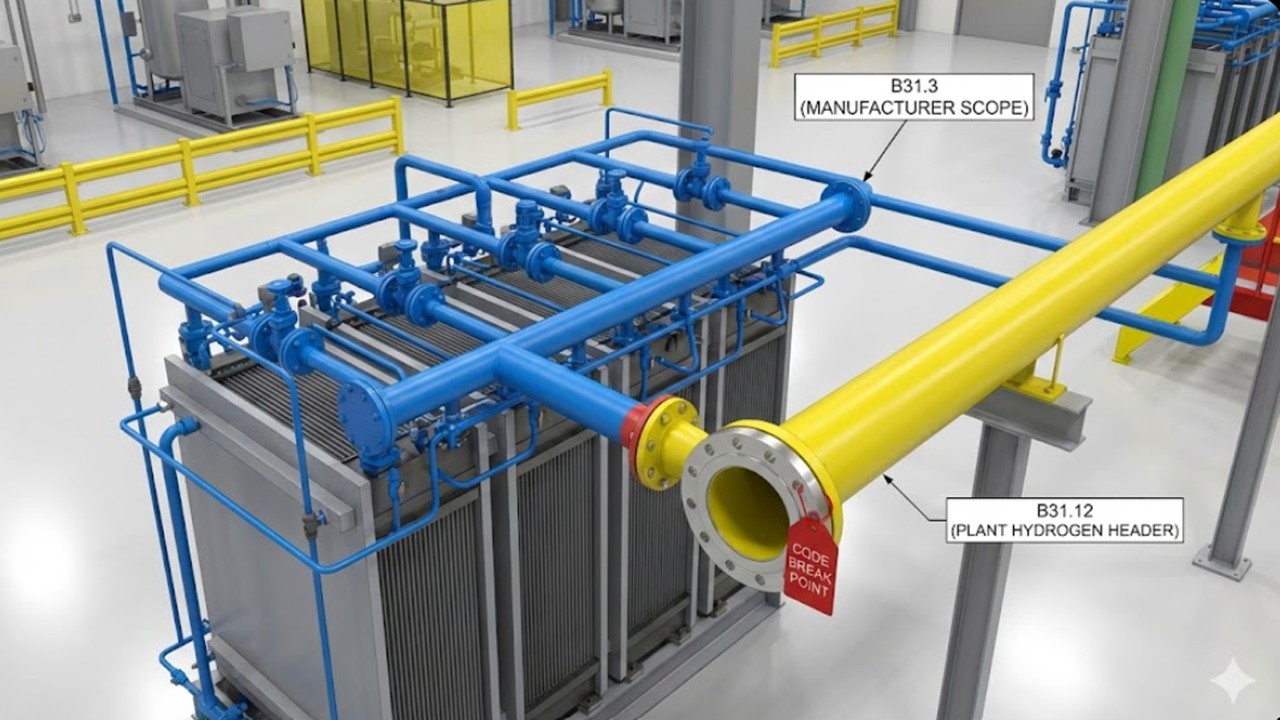
The “Code Break” Dispute
The EPC contractor bid the project assuming standard ASME B31.3 rules. Their welding procedure (WPS) did not include Post Weld Heat Treatment (PWHT) for the thin-wall (Sch 40) piping, as B31.3 exempts P-No 1 steels from PWHT below 19mm thickness.
The Conflict: The Technology Licensor rejected the design. They argued that under ASME B31.12 Part IP, purely hydrogen piping often requires stricter hardness controls (< 22 HRC) to prevent Hydrogen Induced Cracking (HIC), regardless of thickness. The B31.3 design was deemed "unsafe" for long-term embrittlement resistance.
Engineering Resolution
The team conducted a “Fitness for Service” audit comparing ASME B31.3 vs B31.12 requirements.
- Code Selection: The facility was designated as ASME B31.12 Part IP for all lines with >10% H2 partial pressure.
- Fabrication Impact: The EPC had to implement PWHT on all field welds, even on 4-inch Sch 40 lines, to guarantee the Heat Affected Zone (HAZ) hardness remained below 22 HRC.
- Materials: A106 Gr B was retained, but with a restricted Carbon Equivalent (CE < 0.43) procured directly from the mill.
📉 Result & Impact
Adopting B31.12 Part IP
+15% Cost
Increase in welding/QA budget
Zero Risk
of HIC Failure in 20 Years
EPCLand YouTube Channel
2,500+ Videos • Daily Updates
Frequently Asked Questions
Can I use ASME B31.3 for Hydrogen Piping instead of B31.12?
It depends on the owner’s specification and local jurisdiction. ASME B31.3 allows for hydrogen design (typically treating it as a flammable fluid, potentially invoking Chapter IX for high pressure). However, ASME B31.12 is the specific code for Hydrogen. In 2026, most major Licensors and detailed specs require B31.12 Part IP for pure hydrogen service to ensure embrittlement is explicitly managed via the material performance factor ($H_f$).
What is the “Material Performance Factor” (Hf) in B31.12?
The Material Performance Factor ($H_f$) is a penalty factor used in ASME B31.12 calculations. It reduces the allowable stress of the pipe material to account for the degradation of mechanical properties (loss of ductility) caused by hydrogen embrittlement. B31.3 does not use this factor, leaving the responsibility of material suitability entirely to the engineer.
Does B31.12 apply to hydrogen blends (e.g., 20% H2 in Natural Gas)?
Generally, ASME B31.12 applies to piping with hydrogen concentrations greater than 10% by volume. Below this threshold (typical for early-stage natural gas blending), existing codes like ASME B31.8 (Gas Transmission) or B31.3 may be deemed acceptable, provided a fracture mechanics assessment proves the material can withstand the partial pressure of hydrogen.
Why is Post Weld Heat Treatment (PWHT) more common in B31.12?
Hydrogen embrittlement is exacerbated by hard microstructures (Martensite). While ASME B31.3 allows exemptions for thin-wall carbon steel, ASME B31.12 often mandates PWHT regardless of thickness to ensure the weld Heat Affected Zone (HAZ) remains soft (typically < 22 HRC), preventing delayed hydrogen cracking.
Final Verdict: Selecting the Right Code
The choice between ASME B31.3 vs B31.12 is no longer just a technical preference—it is a strategic project decision. As shown in our case study, opting for B31.12 Part IP provides a robust, code-stamped defense against hydrogen embrittlement, but it comes with a measurable cost premium in fabrication (PWHT) and material wall thickness.
For 2026 Hydrogen projects, the industry best practice is clear: use ASME B31.3 for general process streams where H2 is a minor component, but switch strictly to ASME B31.12 for pure hydrogen generation, storage, and transport lines to ensure long-term asset integrity.

Related posts:
![High-grade industrial Wing Nut Types and Applications for mechanical assemblies.]()
Wing Nut Types and Applications: The 2026 Engineering Guide
![Industrial Monorail Crane Systems installed in a modern manufacturing plant 2026.]()
Monorail Crane Systems: Design, Types & 2026 Standards Guide
![Lead engineer performing a Factory Acceptance Test FAT on an industrial skid system 2026]()
Factory Acceptance Test FAT: The 2026 Engineering Guide to Zero-Defect Delivery
![Professional engineering workspace showing a Basis of Design document layout for a 2026 project.]()
Basis of Design: How to Write a BOD for Engineering Projects in 2026
![Industrial Flare Knockout Drum Sizing and installation in a refinery relief system.]()
Flare Knockout Drum Sizing: Design & API 521 Standards (2026 Guide)
![Advanced Reboiler Control Systems in a modern petrochemical refinery 2026.]()
Reboiler Control Systems: Engineering Guide to Precision Control 2026