ASME B31.3 vs B31.1 Impact Testing: The 2026 Engineering Comparison

The distinction between ASME B31.3 vs B31.1 Impact Testing protocols is one of the most critical safety demarcations in industrial engineering. While both codes aim to prevent catastrophic equipment failure, they approach low-temperature service with fundamentally different philosophies. Power Piping (B31.1) generally relies on fixed temperature cutoffs, whereas Process Piping (B31.3) employs a sophisticated matrix of material curves, stress ratios, and thickness calculations to determine **Minimum Design Metal Temperature (MDMT)**. This guide clarifies the nuances to ensure your 2026 projects remain compliant and safe.
Core Difference at a Glance
The trigger for mandatory Charpy V-Notch toughness verification depends on the governing code:
- ⚡ ASME B31.1 (Power): Simple Cutoff. Impact testing is rarely required unless the temperature drops below a fixed limit (typically -20°F / -29°C) for general carbon steels.
- 🧪 ASME B31.3 (Process): Complex Variable. Testing is determined by the “UCS-66 style” curves (Table 323.2.2A). You can operate at very low temps without testing IF your stress ratio is low or wall thickness is thin.
⚡ Code Compliance Quiz: 2026 Edition
Loading Quiz…
Complete Course on
Piping Engineering
Check Now
Key Features
- 125+ Hours Content
- 500+ Recorded Lectures
- 20+ Years Exp.
- Lifetime Access
Coverage
- Codes & Standards
- Layouts & Design
- Material Eng.
- Stress Analysis
The Philosophy Gap: Water vs. Hydrocarbons
To truly grasp the ASME B31.3 vs B31.1 Impact Testing divergence, one must look at the fluids they govern. B31.1 typically handles steam and water—fluids that freeze at 32°F (0°C). Therefore, operation below -20°F is rare in power plants, making deep cryogenic rules unnecessary. Conversely, B31.3 handles hydrocarbons like ethylene or LNG, which remain liquid at -150°F, necessitating a robust framework for brittle fracture prevention.
ASME B31.1 (Power): The Simple Cutoff
The Power Piping code prefers simplicity. For standard Carbon Steels (like A106 Gr. B or A53), the Power piping code exemption is straightforward: if the Minimum Design Metal Temperature (MDMT) is at or above -20°F (-29°C), no impact testing is required.
If the temperature drops below this threshold, B31.1 generally mandates testing without the complex “escape clauses” found in B31.3. There are fewer opportunities to use stress analysis to avoid the lab.
ASME B31.3 (Process): The Curve Matrix
In the B31.3 world, determining ASME B31.3 vs B31.1 Impact Testing requirements involves a multi-step engineering analysis using B31.3 Table 323.2.2A (and Figure 323.2.2A). The code acknowledges that not all steels are created equal.

Materials are grouped into four curves (A, B, C, D) based on their inherent toughness. Curve A (e.g., A53 pipe) is the most brittle and requires testing at warmer temperatures. Curve D (e.g., A333 Low Temp pipe) is the toughest and is exempt down to -50°F (-45°C) or lower depending on thickness.
The “Stress Ratio” Loophole in B31.3
The most significant differentiator in ASME B31.3 vs B31.1 Impact Testing is the Stress ratio reduction factor. B31.3 allows engineers to lower the allowable MDMT (making it colder) without testing, provided the pipe is not fully stressed.
If your piping system operates at low pressure (e.g., a vent line), the hoop stress is low. The code permits you to “credit” this extra capacity against the temperature risk.
Governing Concept: Stress Ratio
Ratio = Spressure / Sallowable
- Spressure = Max operating stress (hoop)
- Sallowable = Allowable stress at temp
Head-to-Head: B31.1 vs B31.3 Parameters
This table summarizes the technical parameters defining the ASME B31.3 vs B31.1 Impact Testing landscape for 2026.
| Parameter | ASME B31.1 (Power) | ASME B31.3 (Process) |
|---|---|---|
| Standard Cutoff (CS) | -20°F (-29°C) Fixed | Variable (-20°F to -55°F) based on Curve |
| Exemption Curves | Generally None (Simplistic) | B31.3 Table 323.2.2A (Complex) |
| Stress Ratio Credit | Limited / Not Standard | Extensive (Can lower MDMT significantly) |
| Material Traceability | Moderate | High (Heat treatment condition matters) |
*Comparison reflects general Carbon Steel requirements. Austenitic Stainless Steels differ in both codes.
Field Engineering Report
Case Study: The Cogeneration Compliance Trap
Asset Profile
- Facility: 800MW Combined Cycle Plant
- Line: 12″ High Pressure Fuel Gas
- Material: ASTM A106 Gr. B (Sch 40)
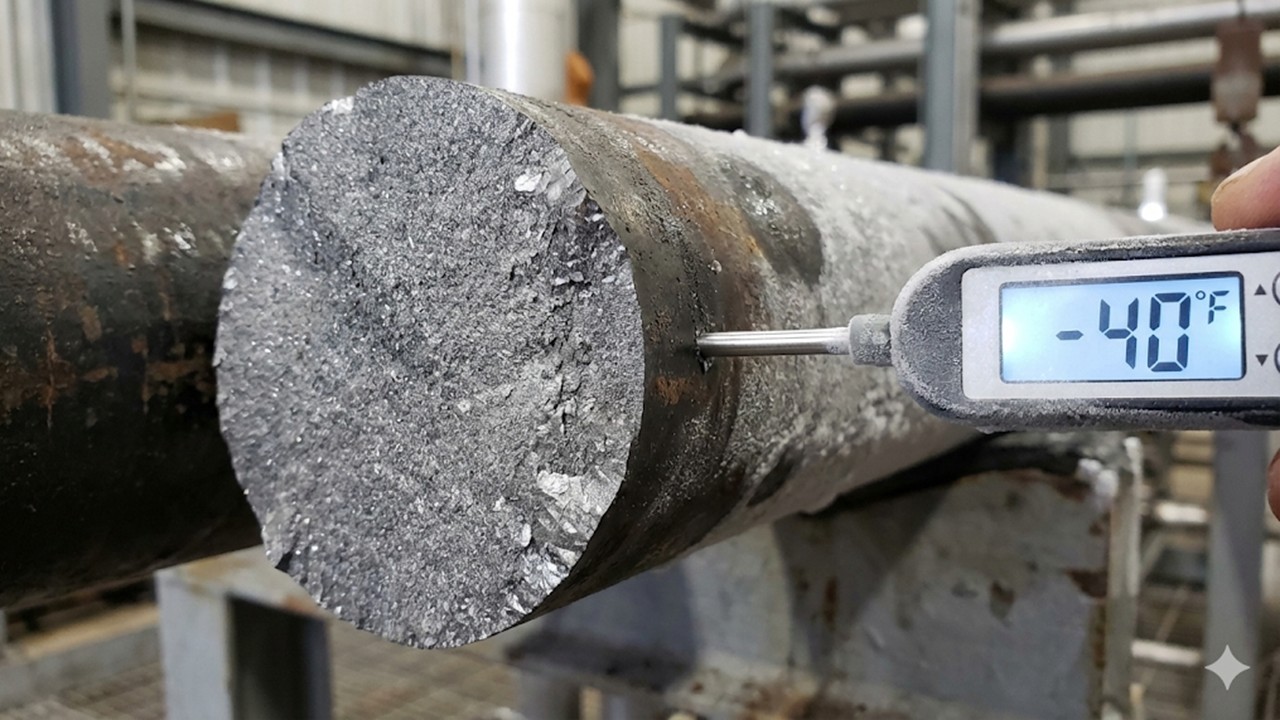
- Ambient Low: -40°F (-40°C)
The Conflict
- Applied Code: ASME B31.1 (Initially)
- Required Code: ASME B31.3 (Audit Finding)
- Status: Non-Conformance (NCR)
The Challenge: “Power” Logic in a “Process” Line
During a 2026 compliance audit of a newly commissioned Cogeneration plant in Minnesota, an auditor flagged the Fuel Gas Supply line. The EPC contractor had treated the entire facility as a “Power Plant” under ASME B31.1. Consequently, they installed standard A106 Grade B pipe, assuming it was safe down to the typical B31.1 cutoff of -20°F.
However, the fuel gas conditioning skid fell under the jurisdiction of ASME B31.3 due to the chemical processing involved. The problem? The site’s Minimum Design Metal Temperature (MDMT) was -40°F.
Under B31.1 logic, the pipe simply failed the -20°F cutoff. Under B31.3 logic, A106 Grade B is a “Curve B” material. At 0.406″ wall thickness, the exemption temperature is approximately -7°F. Operating at -40°F without Charpy V-Notch toughness verification constituted a critical safety violation, posing a massive risk of brittle fracture.
The Solution: Applying B31.3 Advanced Math
Replacing the installed pipe with Low-Temp A333 Grade 6 would have cost over $150,000 in downtime and labor. Instead, the engineering team utilized the flexibility of ASME B31.3 vs B31.1 Impact Testing rules—specifically the Stress Ratio.
- Step 1 (Stress Analysis): The line was designed for 700 PSIG (to match the flange rating) but the maximum operating pressure was only 250 PSIG.
- Step 2 (Calculation): The Hoop Stress was calculated at roughly 35% of the allowable stress (Stress Ratio = 0.35).
- Step 3 (Reduction Credit): According to B31.3 Figure 323.2.2B, a stress ratio of 0.35 allows a reduction in the MDMT of approximately 80°F (44°C).
Verification & Result
The Math Saved the Pipe:
Base Exemption (Curve B): -7°F
Minus Stress Credit: -80°F
New Allowable MDMT: -87°F.
Since the site ambient was -40°F, the system was fully compliant with B31.3 without cutting a single piece of steel. This case highlights a key difference: while B31.1 is rigid, B31.3 provides engineers with calculation-based pathways to ensure brittle fracture prevention without unnecessary material costs.
EPCLand YouTube Channel
2,500+ Videos • Daily Updates
Frequently Asked Questions: B31.1 vs B31.3 Compliance
Why is ASME B31.3 stricter on impact testing than B31.1?
It comes down to the fluid service. B31.1 governs Power Piping (Steam/Water/Condensate), which typically operates hot. B31.3 governs Process Piping (Refinery/Chemical), handling hazardous fluids that may be refrigerated or depressurized rapidly (Joule-Thomson effect). The ASME B31.3 vs B31.1 Impact Testing rules reflect the higher risk of brittle fracture in hydrocarbon processing.
What is the “Stress Ratio Reduction” rule?
Found primarily in B31.3 (and Section VIII), the Stress ratio reduction factor allows you to operate a pipe below its standard exemption temperature if it is not fully stressed. If the hoop stress is less than the allowable stress (Ratio < 1.0), you can lower the Minimum Design Metal Temperature (MDMT) significantly without performing physical lab tests.
How do I find the B31.3 impact test exemption table?
You need to reference B31.3 Table 323.2.2A. This table assigns common materials (like A106, A333, A312) to specific curves (A, B, C, or D). You then compare your wall thickness and MDMT against Figure 323.2.2A to see if you fall in the “Impact Testing Required” or “Exempt” zone.
Is there a standard Power Piping code exemption for Carbon Steel?
Yes. The general Power piping code exemption for standard Carbon Steels is -20°F (-29°C). If the fluid temperature remains above this limit, B31.1 typically does not require impact testing. This is far simpler than the B31.3 approach but less flexible for extreme cold applications.

Related posts:
![High-grade industrial Wing Nut Types and Applications for mechanical assemblies.]()
Wing Nut Types and Applications: The 2026 Engineering Guide
![Industrial Monorail Crane Systems installed in a modern manufacturing plant 2026.]()
Monorail Crane Systems: Design, Types & 2026 Standards Guide
![Lead engineer performing a Factory Acceptance Test FAT on an industrial skid system 2026]()
Factory Acceptance Test FAT: The 2026 Engineering Guide to Zero-Defect Delivery
![Professional engineering workspace showing a Basis of Design document layout for a 2026 project.]()
Basis of Design: How to Write a BOD for Engineering Projects in 2026
![Industrial Flare Knockout Drum Sizing and installation in a refinery relief system.]()
Flare Knockout Drum Sizing: Design & API 521 Standards (2026 Guide)
![Advanced Reboiler Control Systems in a modern petrochemical refinery 2026.]()
Reboiler Control Systems: Engineering Guide to Precision Control 2026