ASME B31.3 2024 Changes & Updates
The definitive guide to the new Sustained Stress and Leak Testing rules.
The **ASME B31.3 2024 Changes** mark a significant shift in how process piping is analyzed, fabricated, and tested, impacting every phase from detailed engineering to construction turnover. With the 2024 edition now fully enforced in 2026 projects, engineers must adapt to stricter default stress indices, new warnings for carbon steel flanges at low temperatures, and highly beneficial exemptions for leak testing reassembly. Ignoring these updates can lead to both conservative over-design and costly field rework.
What is the focus of the 2024 Edition?
The 2024 Edition of ASME B31.3 places a heavy emphasis on harmonizing stress analysis with modern research (via ASME B31J integration), refining low-temperature material toughness requirements (Note 65), and optimizing construction workflows by clarifying leak testing exemptions for flanged joints.
⚡ Test Your 2024 Code Knowledge
Score: 0/5
Complete Course on
Piping Engineering
Check Now
Key Features
- 125+ Hours Content
- 500+ Recorded Lectures
- 20+ Years Exp.
- Lifetime Access
Coverage
- Codes & Standards
- Layouts & Design
- Material Eng.
- Stress Analysis
Stress Analysis Updates in ASME B31.3 2024 Changes
The most impactful engineering shift in the **ASME B31.3 2024 Changes** continues the migration away from the historical Appendix D and towards the more rigorous **ASME B31J** (Standard Method for Test and Calculation of Pipe Stress Factors).
Specifically, Paragraph 320 (Analysis of Sustained Loads) has been refined. In previous editions, engineers often defaulted to a Sustained Stress Index of 0.75i. The 2024 edition enforces stricter adherence to calculated indices ($S_s$), often resulting in higher calculated stresses at intersections like trunnions and unreinforced tees.
Sustained Stress Equation (Simplified)
Leak Testing & Assembly: The Para 345.2.3 Update
One of the most practical **ASME B31.3 2024 Changes** is the clarification in Paragraph 345.2.3 regarding Piping Subassemblies. Previously, ambiguity led Field QA/QC managers to demand re-hydrotests whenever a pre-tested spool was bolted into a line. The code now clearly permits the assembly of pre-tested subassemblies without a final system hydrotest, provided strict assembly controls are met.
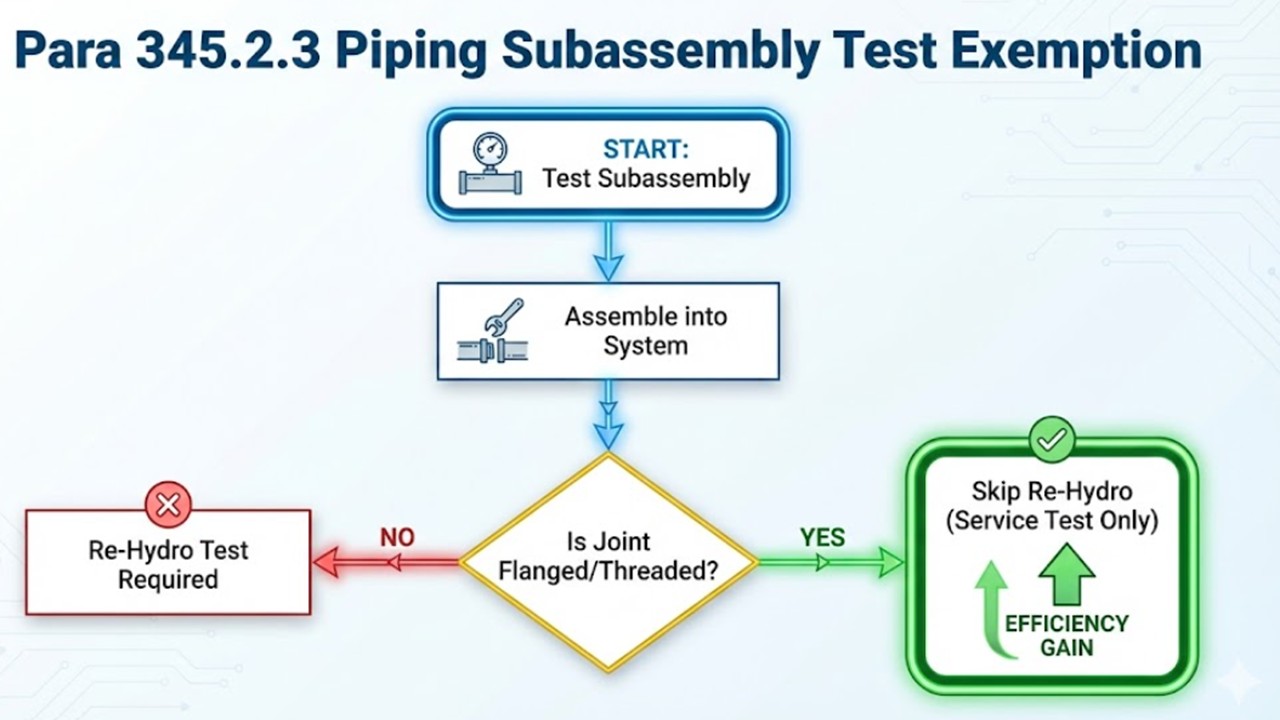
This change significantly reduces turnaround duration. Instead of filling, pressurizing, and draining an entire circuit (which requires blinding off equipment), crews can rely on the “Service Test” (Leak test at operating pressure) for the final closure welds or flanged joints, assuming the spools were tested in the shop.
Material Updates: The A105 Note 65 Controversy
Perhaps the most debated topic in the **ASME B31.3 2024 Changes** is the treatment of ASTM A105 Carbon Steel Flanges. For decades, A105 was the workhorse material for standard piping. However, its uncontrolled microstructure has led to brittle fracture incidents in colder climates.
Table A-1 Note 65 was added/strengthened to warn designers. It highlights that ASTM A105 does not require mandatory impact testing, and its behavior at its Minimum Design Metal Temperature (MDMT) of -29°C (-20°F) can be unpredictable.
| Feature | Pre-2022/2024 Approach | 2024/2026 Approach |
|---|---|---|
| ASTM A105 Usage | Used freely down to -29°C (-20°F) without question. | Restricted/Warned (Note 65). Recommendation to use A350 LF2 for < 0°C. |
| Sustained Stress Index | 0.75i (Conservative simplification). | Strict calculation per B31J (Typically 1.0). |
| Subassembly Testing | Ambiguous; often required system re-test. | Explicitly exempts pre-tested spools (Para 345.2.3). |
| High Pressure H2 | General Chapter IX rules. | New material performance factors for Hydrogen embrittlement. |
*Designers should audit their Pipe Specifications (PMS) to ensure A105 is not specified for low-temperature service in new 2026 projects.
Case Study: ASME B31.3 2024 Changes in Action – Turnaround Optimization
Leveraging new Para 345.2.3 rules to save 72 critical path hours during a Texas Refinery Turnaround (Oct 2025).
📂 Project Data
- Facility: Corpus Christi Refinery, USA
- Unit: Naphtha Splitter Overhead
- Fluid Service: Normal Fluid Service (Hydrocarbon)
- Constraint: Strict 30-Day Outage Window
- Code Edition: ASME B31.3 (2024 Edition)
The Schedule Bottleneck
The project involved replacing 200 feet of 24-inch overhead piping. The spools were fabricated and hydrotested off-site. However, the legacy Quality Control (QC) plan demanded a final pneumatic or hydrostatic system test after installation to verify the field flanged joints.
Impact: Setting up blinds, filling the column with water (or sourcing vast nitrogen for pneumatic testing), and subsequent drying would add 3 days to the critical path, pushing the startup beyond the deadline.
The 2024 Code Solution
The Piping Engineer intervened, referencing the **ASME B31.3 2024 Changes** to Paragraph 345.2.3(c) (Subassemblies).
- Code Verification: The code now explicitly states that if subassemblies are previously tested, the final connecting joints (flanged/threaded) do not require a pressure test if strict assembly controls are used.
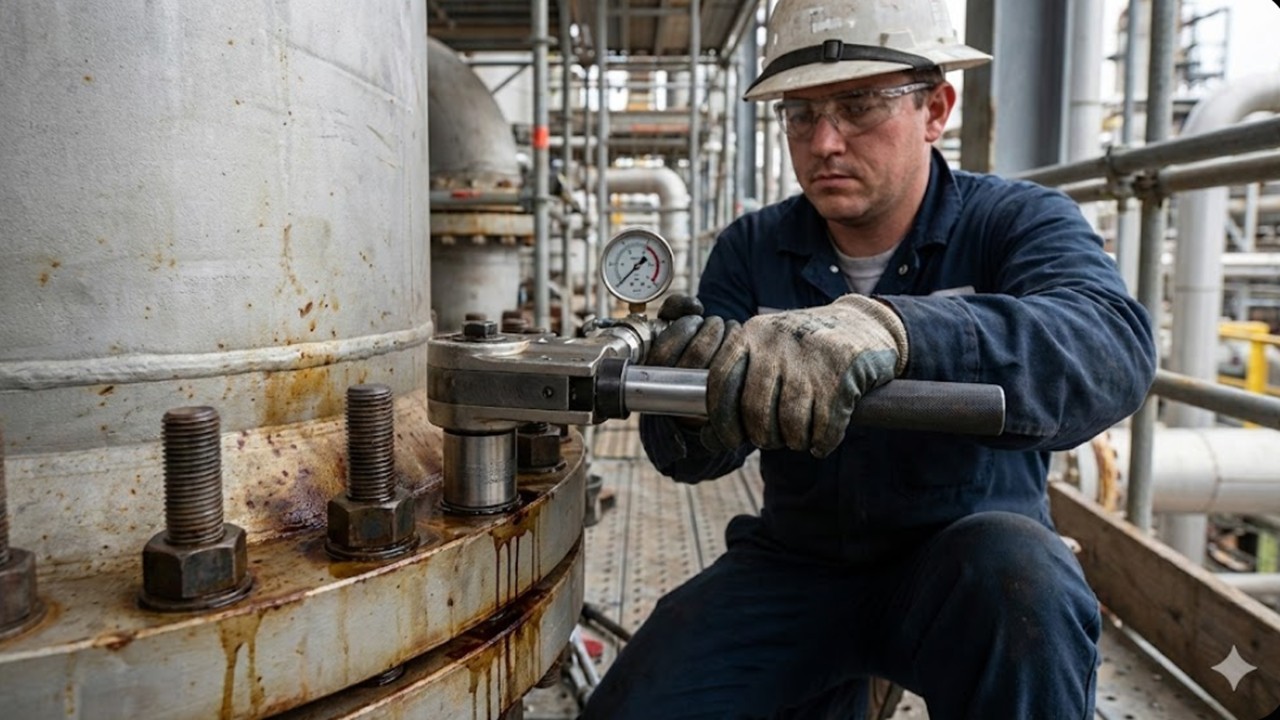
- Implementation: The team utilized ASME PCC-1 compliant hydraulic torquing for all field flanges.
- Verification: An “In-Service Leak Test” (Initial Service Leak Test) was performed during startup as permitted by Category D/Normal rules for closure joints.
📉 Result & ROI
Turnaround Performance Data
72 Hours Saved
Avoided critical path delay
$150,000+
Production loss prevented
EPCLand YouTube Channel
2,500+ Videos • Daily Updates
Frequently Asked Questions
What are the most critical ASME B31.3 2024 Changes?
The ASME B31.3 2024 Changes prioritize safety and modern analysis. Key updates include the strict adoption of ASME B31J for stress intensification factors (SIFs), new warnings (Note 65) regarding ASTM A105 carbon steel toughness at low temperatures, and highly beneficial exemptions for leak testing reassembly (Para 345.2.3) to streamline construction.
Does the 2024 edition require me to re-analyze old piping systems?
Generally, no. Piping codes are not retroactive. Existing systems built to previous editions (e.g., 2020 or 2022) remain compliant unless they undergo significant alteration, repair, or relocation. However, any new modifications to an old line must comply with the current ASME B31.3 2024 rules enforced at the time of design.
Why is ASTM A105 Carbon Steel now restricted at low temperatures?
ASTM A105 is a forging specification without mandatory impact testing. The 2024 edition added specific notes warning that its grain structure may result in low toughness at its historical minimum temperature of -29°C (-20°F). For safety in 2026 designs, engineers are encouraged to specify ASTM A350 LF2 for cold climates to prevent brittle fracture.
Can I use ASME B31J SIFs with older B31.3 editions?
Yes. While the 2024 edition mandates (or strongly steers toward) B31J, previous editions allowed “more rigorous analysis.” Using the B31J SIFs in older projects is considered a technical upgrade and is permitted, though it may result in higher calculated stresses than the old Appendix D method.
Final Thoughts: Adapting to the New Standard
The ASME B31.3 2024 Changes represent more than just minor text edits; they signal a fundamental shift towards higher-fidelity engineering. The integration of ASME B31J eliminates the “rule of thumb” era for stress analysis, while the pragmatic updates to leak testing (Para 345.2.3) empower construction teams to work smarter, not harder.
As we move through 2026, ensuring your Pipe Material Specifications (PMS) reflect the new A105 warnings and your QA/QC manuals adopt the new assembly exemptions is crucial. Ignoring these updates doesn’t just risk code non-compliance—it leaves money and safety margins on the table.
