Introduction
API Certification Process (ICP): Step-by-Step Guide (2026)
The API Certification Process (ICP): Step-by-Step Guide is the definitive roadmap for engineering professionals seeking to validate their expertise in the oil and gas industry. Whether you are aiming for the “Big Three” (API 510 Pressure Vessels, API 570 Piping, or API 653 Storage Tanks) or specialized certifications, obtaining an Individual Certification Program (ICP) credential is a proven career accelerator, often correlating with a 20-30% salary increase for QA/QC inspectors.
What is the API ICP?
The API Individual Certification Program (ICP) is an independent evaluation that verifies an inspector’s knowledge of industry codes (ASME/API) and inspection practices. Unlike the API Monogram (which certifies a manufacturing facility), the ICP certifies the individual. It is recognized globally as the gold standard for asset integrity professionals.
⚡ Quick Navigation
🧪 API Candidate Readiness Check
Question 1 of 51. Which API standard specifically covers the “In-Service Inspection of Pressure Vessels”?
Complete Course on
Piping Engineering
Check Now
Key Features
- 125+ Hours Content
- 500+ Recorded Lectures
- 20+ Years Exp.
- Lifetime Access
Coverage
- Codes & Standards
- Layouts & Design
- Material Eng.
- Stress Analysis

Step 1: Determine Your Eligibility
The barrier to entry for the “Big Three” (API 510, 570, 653) is high by design. The American Petroleum Institute prioritizes practical field experience over theoretical knowledge. Before you even visit the API ICP application portal login page, you must verify that your combination of education and industry experience meets the strict API 510 570 653 prerequisites.
API uses a sliding scale: the higher your level of formal education in a technical field, the less field experience is required.
| Education Level | Required Experience | Description of Experience |
|---|---|---|
| B.S. in Engineering | 1 Year | Supervision or performance of inspection activities. |
| 2-Year Tech Degree | 2 Years | Must be in a related technical field (e.g., Welding, Mechanical). |
| High School Diploma / GED | 3 Years | Full-time experience in inspection or operation/repair. |
| No High School Diploma | 5+ Years | Allowed for API 653/570 in some cases; check specific program rules. |
Step 2: The ICP Portal & Scheduling
Once you have gathered your employment verification letters (signed by a supervisor), the next step is the digital application. API processes applications in “Windows” relative to exam dates. Applying early prevents late fees.

Navigating Prometric
API does not administer the exams directly. They partner with Prometric testing centers globally. Prometric exam scheduling for API opens only after your ICP application is approved and you receive an “Exam Authorization ID.”
- Seat Availability: Seats fill up fast. Schedule immediately upon receiving authorization.
- Exam Windows: Exams are not on-demand. They occur in specific 2-3 week windows roughly 3 times per year per program.
- Remote Proctoring: Some lower-stakes exams offer remote options, but the core 510/570/653 typically require a physical center presence for security.
Step 3: The Exam Structure
Morning: Closed Book
Usually 2.5 to 3 hours. Tests recall of fundamental concepts, welding processes, NDE methods, and safety rules that an inspector must know by heart without referencing a code book.
Afternoon: Open Book
Usually 3.5 to 4 hours. You are provided with PDF versions of the codes (ASME Sec VIII, B31.3, API 571, etc.) on the computer. Questions involve calculations (corrosion rates, remaining life, MAWP) and finding obscure code clauses.
Investment: API Exam Fees & Costs (2026)
Budgeting is crucial. The API exam fees and preparation costs 2026 have adjusted for inflation. Note that API members (companies) get a discount, but most individuals pay the non-member rate.
| Expense Category | Estimated Cost (USD) | Notes |
|---|---|---|
| Exam Fee (Non-Member) | USD 960 – 1,000 | Per attempt. Retakes are approx USD 300-400. |
| Exam Fee (API Member) | USD 760 – 800 | Requires valid corporate membership ID. |
| Code Books / Documents | USD 1,500+ | Cost of purchasing official ASME/API PDFs/Hardcopies. |
| Training Course (Optional) | USD 1,000 – 2,500 | Highly recommended for Open Book strategy. |
The Big Picture: Understanding API Certification Types
Before diving deeper into the exam portal, it is crucial to understand the broader API ecosystem. The American Petroleum Institute sets strict standards that apply to two distinct entities: the Products/Companies that manufacture equipment, and the Professionals who inspect it.
Safety & Ops
Validates that both equipment and personnel meet rigorous safety and operational criteria to prevent catastrophic failures.
Standardization
Creates a unified baseline for manufacturing and inspection processes globally, reducing variability.
Market Trust
Builds instant credibility with major operators (Shell, ExxonMobil) who mandate API compliance.
Breakdown: Which Certification Do You Need?
| Certification Type | Target Audience | Purpose |
|---|---|---|
| API Monogram Licensing | Manufacturers | Product certification for equipment (e.g., Valves, Pipes) made to API standards. |
| API Q1 & Q2 | Organizations | Quality Management Systems for Manufacturing (Q1) and Service Providers (Q2). |
| Individual Certification (ICP) | Inspectors / Engineers | Professional credential verifying technical knowledge (e.g., API 510, 570). |
🏢 For Companies (Monogram/Q1)
-
1. Determine Eligibility
Select standard (e.g., API 6A for Wellhead, API 650 for Tanks).
-
2. Develop QMS
Implement systems compliant with API Q1 or Q2.
-
3. Apply & Audit
Submit manuals. An official API auditor assesses the facility.
-
4. Certification
Valid for 3 years (with annual surveillance audits).
👷 For Individuals (ICP)
-
1. Eligibility Check
Verify Education + Experience matrix (as detailed above).
-
2. Apply & Register
Submit application via API ICP Portal.
-
3. Pass Exam
Take computer-based test at Prometric. Results in 6-8 weeks.
-
4. Get Certified
Valid for 3 years. Recertification required.
Real-World Impact & Considerations
Why It Matters
Major oil companies like Shell, ExxonMobil, and Reliance Industries typically mandate API-certified vendors and personnel. In this competitive landscape, holding an API certificate isn’t just a “nice-to-have”—it is a necessity for bidding on contracts or entering a site.
Key Considerations
- Cost: Budget for audits (companies) or training/exam fees (individuals).
- Time: Company certification can take 6-12 months; Individuals typically need 3-6 months prep.
- Renewal: It is not a one-time event. Continuous compliance and improvement are mandatory.
| Benefit | For Companies | For Individuals |
|---|---|---|
| Market Credibility | Boosts client confidence & sales | Proof of technical competence |
| Global Recognition | Meets international trade norms | Opens global job opportunities |
| Competitive Edge | Helps win lucrative contracts | Enhances promotion & salary potential |
EPCLand YouTube Channel
2,500+ Videos • Daily Updates
Case Study: The “Career Jump” – From NDE Tech to API 510 Inspector
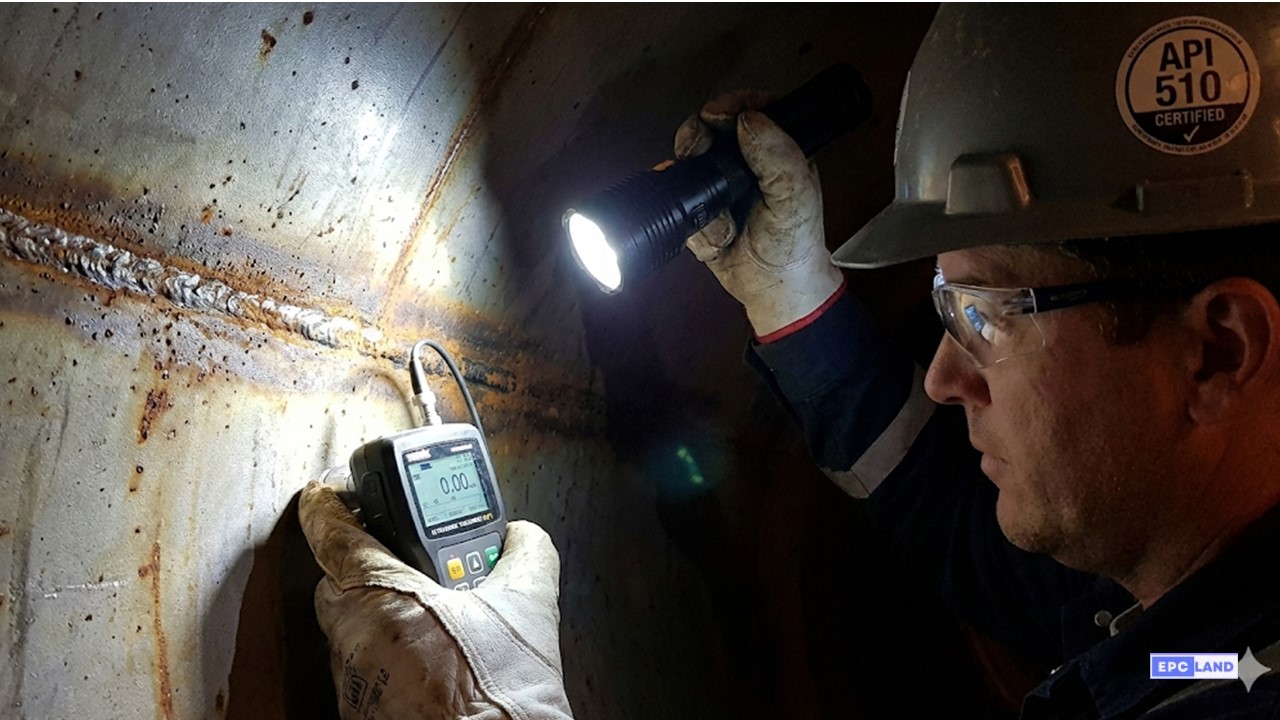
Candidate Profile: “Mark S.” – 3 Years Experience, High School Diploma
📋 Candidate Roadmap
Starting Position:
Level II UT/MT Technician
Education Level:
High School Diploma (No Degree)
Target Certification:
API 510 (Pressure Vessels)
Timeline:
4 Months (Study + Application)
The Challenge: Navigating the “Gray Area” of Experience
Mark worked for a valve manufacturing shop that held an API Monogram license. While his employer was certified to manufacture equipment, Mark mistakenly believed this automatically qualified him for the Individual Certification Program (ICP). He needed to distinguish between API Monogram vs Individual Certification—one certifies the company’s product, while the ICP certifies the person’s competence.
With only a High School Diploma, the API 510 570 653 prerequisites required Mark to prove 3 years of full-time experience specifically in “inspection activities.” His initial application was flagged for audit because he listed generic “welding” tasks. API requires proof that the candidate has been inspecting, determining corrosion rates, or calculating remaining life—not just operating tools.
Execution: The Application Pivot
Mark revised his employment verification letter. Instead of “Performed UT testing,” he rewrote his experience to align with the API 510 Body of Knowledge: “Performed thickness monitoring and corrosion rate calculations on in-service vessels under the supervision of the Senior Inspector.” This specific phrasing satisfied the ICP reviewers.
Strategy: The 3-Pass Method
Once approved, Mark used the Prometric exam scheduling for API tool to book a seat 90 days out. During the exam, he utilized the “3-Pass Method”:
1. Pass 1: Answer all immediate “know-it” questions (Closed Book).
2. Pass 2: Tackle the calculations that take < 2 minutes.
3. Pass 3: Use the remaining time for deep-dive code lookups in the Open Book PDF.
Result: ROI & Retention
Mark passed with a score of 82% (Passing is ~70%). Immediately upon certification, he negotiated a role transfer from “Technician” to “Authorized Inspector,” resulting in a 22% salary increase.
However, the journey didn’t end there. To maintain his new status, Mark had to set a calendar reminder for 3 years later. He learned that API certification recertification requirements are strict: inspectors must demonstrate continued active employment in the field. Failure to document this every 3 years results in a lapse, forcing the candidate to retake the grueling exam—a costly mistake he planned to avoid.
Key Takeaway
Documentation is half the battle. Your experience description in the ICP portal must mirror the definitions found in the respective API code (e.g., API 510 Section 3 definitions). General descriptions lead to audits and delays.
Frequently Asked Questions
What is the difference between API Monogram and Individual Certification?
API Monogram vs Individual Certification is a common confusion. The API Monogram is a facility-level license (e.g., API 6D for valves, API 5L for pipes) allowing a manufacturer to stamp the API logo on products. The Individual Certification Program (ICP) (e.g., API 510, 570) certifies a person’s knowledge and competency to inspect those assets. You cannot apply for a Monogram as a person.
How strictly are the API 510/570/653 prerequisites enforced?
Very strictly. API audits a percentage of all applications. If selected for an audit, you must provide direct contact information for your supervisors to verify the API 510 570 653 prerequisites. Falsifying experience can result in a permanent ban from the API ICP program. If you lack the exact years, consider the API 1169 (Pipeline Inspector) or API 577 (Welding Inspection) which often have lower entry barriers.
What are the API certification recertification requirements?
Recertification occurs every 3 years. You must apply via the portal and prove you have been actively engaged in inspection practices for at least 20% of the time during that period. Every 6 years, the requirements increase: you must typically take a short “Web Quiz” to review new code changes. If your certification lapses, you must retake the full exam.
Can I reschedule my Prometric exam if I’m not ready?
Yes, but fees apply. Prometric exam scheduling for API allows changes up to 30 days before the exam without penalty. Between 5-29 days, there is a fee (approx. USD 70). If you cancel within 5 days or fail to show up, you forfeit the entire exam fee.
Final Career Advice
The API Certification Process (ICP) is an investment of time, money, and mental energy, but the returns are tangible. In an industry increasingly focused on asset integrity and safety, holding an API 510, 570, or 653 card is the ultimate proof of competence. Start gathering your experience letters today—the exam window waits for no one.

Related posts:
![Industrial Types of Condensers and heat exchangers in a thermal power plant.]()
Types of Condensers: Engineering Guide & Selection Criteria 2026
![High-performance aerospace turbine components manufactured from Titanium Alloys Grade 5.]()
Titanium Alloys: Applications, Types, Grades, and Engineering Standards 2026
![Heavy duty stainless steel RTJ Flange with precision machined groove for high pressure oil and gas applications.]()
RTJ Flange Guide: High-Pressure Sealing Mastery 2026
![Advanced industrial Process Control monitoring system in a modern chemical plant.]()
Process Control: Engineering Guide to System Stability 2026
![High-pressure Hydrogen Vessel safety data visualization for a refueling station 2026.]()
Hydrogen Vessel Blast Radius: Engineering Safety Guide 2026
![Engineering diagram of Hydrogen Separation Distance Calculation for high-pressure storage.]()
Hydrogen Separation Distance Calculation: Engineering Guide 2026