API 610 Pumps vs ANSI Centrifugal Pumps: The Complete 2026 Engineering Guide
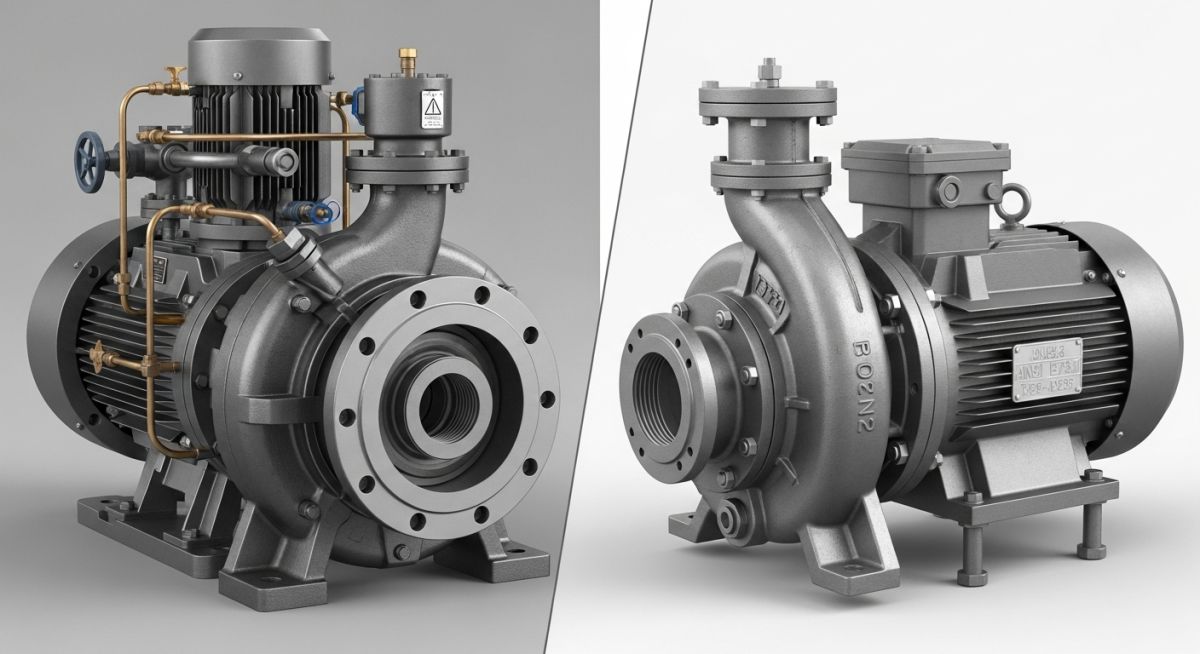
Selecting between API 610 Pumps vs ANSI Centrifugal Pumps is one of the most critical decisions in process plant design, impacting both capital expenditure and long-term reliability. While ANSI pumps (governed by ASME B73.1) offer a cost-effective solution for general chemical processing, API 610 pumps provide the structural integrity required for high-temperature, high-pressure hydrocarbon environments. This guide breaks down the technical nuances, standards, and selection criteria for these two essential industrial pump types.
Quick Comparison: API 610 vs ANSI
The primary difference between API 610 Pumps vs ANSI Centrifugal Pumps lies in their design rigor. ANSI pumps focus on dimensional interchangeability and lower costs for non-critical chemical services. API 610 pumps are engineered for safety and reliability in hazardous refinery services, featuring centerline mounting, higher pressure ratings, and superior thermal expansion management.
Table of Contents
- What is an API 610 Pump for Heavy-Duty Process Applications?
- What is an ANSI Centrifugal Pump (ASME B73.1) for Chemical Service?
- Key Differences: API 610 Pumps vs ANSI Centrifugal Pumps
- Choosing the Right Pump Type: API 610 or ANSI Centrifugal Pumps?
- Expert Insights on API 610 Pumps vs ANSI Centrifugal Pumps Maintenance
Technical Knowledge Check: Pump Standards
1. Which mounting style is standard for API 610 OH2 pumps to handle thermal expansion?
Complete Course on
Piping Engineering
Check Now
Key Features
- 125+ Hours Content
- 500+ Recorded Lectures
- 20+ Years Exp.
- Lifetime Access
Coverage
- Codes & Standards
- Layouts & Design
- Material Eng.
- Stress Analysis
What is an API 610 Pump for Heavy-Duty Process Applications?
An API 610 Pump is a centrifugal pump specifically engineered to meet the stringent requirements of the American Petroleum Institute’s Standard 610 (currently ISO 13709). These pumps are the workhorses of the Hydrocarbon Processing Industry (HPI), designed to handle explosive, toxic, and high-temperature fluids safely. Unlike standard industrial pumps, API 610 units are built for a minimum service life of 20 years, with a mandate for at least 3 years of continuous operation without maintenance.
Design Characteristics of API 610 Centrifugal Pumps
The design philosophy of API 610 centers on structural integrity. One of the most common configurations is the OH2 Centerline Mounted Pump. By supporting the pump casing at its horizontal centerline, thermal expansion occurs radially from the shaft center. This prevents the pump from “growing” upward and causing shaft misalignment when handling fluids exceeding 300 degrees Fahrenheit (150 degrees Celsius).
- Heavier Castings: API casings are thicker to handle higher Pump Casing Pressure Ratings and increased nozzle loads from piping expansion.
- Vibration Control: Strict limits on vibration ensure bearing longevity and seal performance under extreme conditions.
- Seal Compatibility: These pumps must accommodate API 682 Mechanical Seals, which provide standardized flush plans for hazardous leakage containment.

What is an ANSI Centrifugal Pump (ASME B73.1) for Chemical Service?
The ANSI Centrifugal Pump is a horizontal, end-suction, single-stage pump that complies with the ASME B73.1 Pump Standards. Originally developed for the chemical industry, the hallmark of the ANSI pump is dimensional interchangeability. This means an ANSI pump from “Manufacturer A” can be replaced by one from “Manufacturer B” without requiring any modifications to the piping, baseplate, or coupling location.
Dimensional Interchangeability of ANSI Pumps
In the context of API 610 Pumps vs ANSI Centrifugal Pumps, the ANSI design is significantly more flexible for general industrial use. They are typically foot-mounted, which is acceptable for lower temperature ranges common in water treatment, pulp and paper, and chemical batching.
| Feature | ASME B73.1 (ANSI) | API 610 |
|---|---|---|
| Standard Mounting | Foot Mounted | Centerline Mounted |
| Interchangeability | Dimensional (Across Brands) | Functional (Standard Specific) |
| Max Temp (Typical) | 300 oF (150 oC) | 800 oF (425 oC) |
While the ANSI pump offers lower initial capital costs, it lacks the robust internal clearances and shaft stiffness found in API designs. For non-critical services where the fluid is non-flammable and pressures are below 275 PSIG (19 bar), the ANSI pump remains the industry standard for cost-efficiency.
Key Differences: API 610 Pumps vs ANSI Centrifugal Pumps
When evaluating API 610 Pumps vs ANSI Centrifugal Pumps, the primary divergence is found in the mechanical design margin. API 610 pumps are built to withstand significantly higher stresses, whereas ANSI pumps are optimized for economic efficiency in less demanding environments like general chemical or water utility services.
Pressure and Temperature Limits Comparison
One of the most drastic differences lies in the Pump Casing Pressure Ratings. A standard ANSI B73.1 pump is generally limited to a maximum working pressure of approximately 275 PSIG (19 bar) at ambient temperature. In contrast, API 610 pumps are designed for a minimum of 600 PSIG (40 bar) and can be engineered to exceed 1000 PSIG for specific refinery applications.
Casing Support and Shaft Deflection Standards
Shaft stability is a critical factor for seal longevity. API 610 mandates a maximum shaft deflection of 0.002 inches (0.05 mm) at the primary seal face under the most adverse operating conditions. ANSI standards are less restrictive, which can lead to shorter Mean Time Between Failure (MTBF) when the pump is operated away from its Best Efficiency Point (BEP). Furthermore, API 610 pumps always utilize API 682 Mechanical Seals, which are heavy-duty cartridges designed for 25,000 hours of continuous service.
| Engineering Parameter | ANSI (ASME B73.1) | API 610 |
|---|---|---|
| Flange Rating | Class 150 or 300 | Class 300, 600, or Higher |
| Bearing Life (L10) | 17,500 Hours | 25,000 to 40,000 Hours |
| Thermal Expansion Management | Limited (Foot Mount) | Superior (Centerline Mount) |
| Hydrostatic Test Pressure | 1.5 x Maximum Pressure | 2.0 x Maximum Pressure |
Choosing the Right Pump Type: API 610 or ANSI Centrifugal Pumps?
The selection process for API 610 Pumps vs ANSI Centrifugal Pumps is usually dictated by the fluid properties and the criticality of the process. In the Hydrocarbon Processing Industry (HPI), safety regulations often mandate API 610 regardless of the pressure, simply because of the pump’s ability to contain hazardous leaks during a fire or mechanical failure.
Criticality Analysis and Risk Assessment
When deciding which standard to apply, engineers should consider the “Cost of Failure.” If a pump failure leads to a plant-wide shutdown costing millions of USD per day, the initial investment in an API 610 pump is easily justified. However, for a backup cooling water pump in a non-hazardous area, an ANSI centrifugal pump offers the best ROI.
Key decision triggers for choosing API over ANSI in 2026 include:
- Fluid temperature exceeding 350 oF (175 oC).
- Discharge pressure exceeding 350 PSIG (24 bar).
- Specific gravity of fluid less than 0.70.
- Fluids that are highly toxic, carcinogenic, or environmentally hazardous.
Expert Insights on API 610 Pumps vs ANSI Centrifugal Pumps Maintenance
Total Cost of Ownership (TCO) Comparison
While the purchase price of an API 610 pump can be 3 to 5 times higher than a comparable ANSI pump, the Total Cost of Ownership often tells a different story. Because API pumps have stricter vibration limits and more robust bearing housings (often including oil mist lubrication), their maintenance intervals are significantly longer. In high-stakes applications, the higher MTBF of an API unit results in lower long-term costs by avoiding emergency repairs and lost production time.
API 610 Pumps vs ANSI Centrifugal Pumps Selection Calculator
Use this engineering tool to determine if your application requires the robustness of an API 610 standard pump or if a cost-effective ANSI B73.1 pump is sufficient.
Advanced API 682 Seal Flush Plans for API 610 vs ANSI Pump Integration
In the engineering of API 610 Pumps vs ANSI Centrifugal Pumps, the mechanical seal system is often the most complex sub-component. While ANSI pumps traditionally utilize simpler, component-style seals or basic cartridges, API 610 pumps strictly require API 682 Mechanical Seals. These seals are designed as heavy-duty cartridges with standardized flush plans to ensure zero leakage of hazardous hydrocarbons into the atmosphere.

Pressurized vs Non-Pressurized Barrier Fluids
The choice of seal flush plan depends heavily on the Pump Casing Pressure Ratings and the volatility of the pumped fluid. In 2026, the industry has shifted toward dual-seal arrangements for all critical services.
- Plan 52 (Non-Pressurized Buffer Fluid): Common in ANSI pumps handling moderately hazardous chemicals. The buffer fluid is maintained at a pressure lower than the seal chamber pressure. If the inner seal fails, the process fluid leaks into the buffer liquid, which is then detected by a pressure or level switch in the reservoir.
- Plan 53 (Pressurized Barrier Fluid): Mandatory for high-criticality API 610 applications where zero process leakage is required. The barrier fluid is pressurized (often via a bladder accumulator in Plan 53B) to a level higher than the seal chamber pressure. This ensures that any seal face wear results in clean barrier fluid leaking into the process, rather than hazardous fluid leaking out.
| Flush Plan | Seal Configuration | Standard Application | Safety Level |
|---|---|---|---|
| API Plan 11 | Single Seal | ANSI (General Service) | Basic |
| API Plan 52 | Dual Unpressurized | ANSI / API (Low Risk) | High (Containment) |
| API Plan 53A/B/C | Dual Pressurized | API 610 (Hazardous) | Maximum (Zero Leakage) |
Seal Chamber Dimensions and Cooling
A critical engineering constraint when comparing API 610 Pumps vs ANSI Centrifugal Pumps is the seal chamber size. API 610 mandates “enlarged” seal chambers that allow for better circulation of flush fluids and accommodate heavier, multi-spring cartridge seals. While some high-spec ANSI pumps offer “Big Bore” seal chambers, they often lack the integrated cooling jackets found on API 610 OH2 units, which are vital for maintaining seal face stability at temperatures above 400 oF (204 oC).
Don’t miss this video related to Pumps
Summary: Master Piping Engineering with our complete 125+ hour Certification Course: ……
Case Study: Optimizing Reliability with API 610 Pumps vs ANSI Centrifugal Pumps
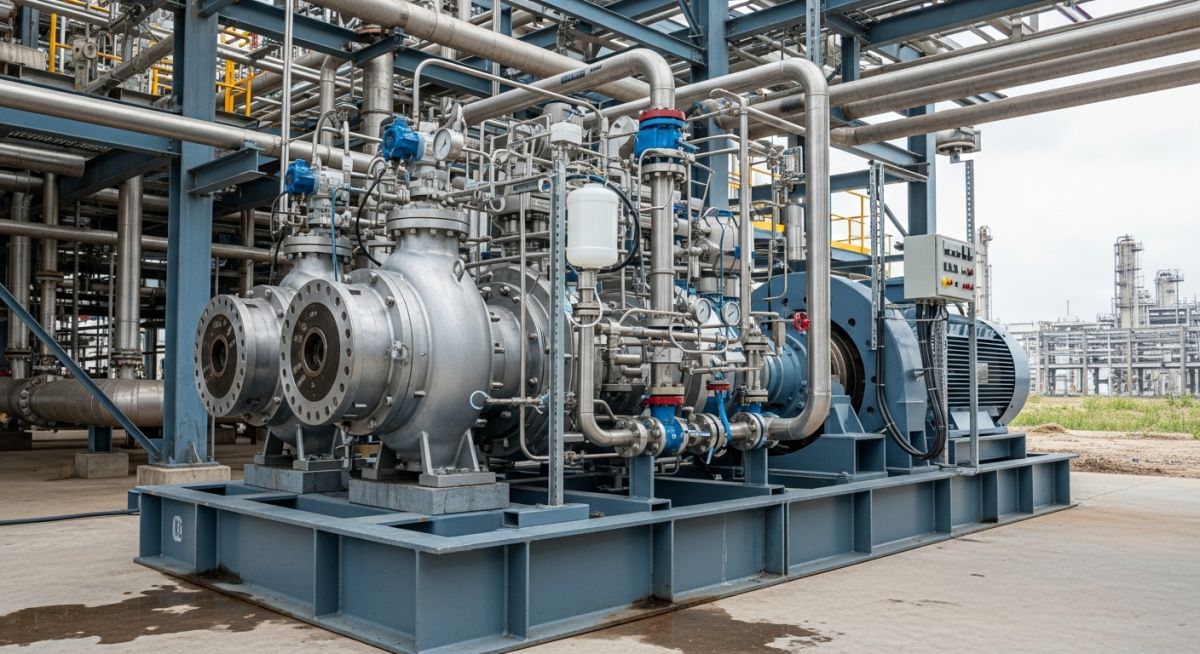
Project Data
- Facility Type: Midstream Fractionation Plant
- Fluid: De-ethanized bottoms (Hydrocarbons)
- Operating Temperature: 385 oF (196 oC)
- Original Equipment: 3x High-Spec ANSI B73.1 Foot-Mounted Pumps
- Initial Capital Saving: 145,000 USD
Failure Analysis
Within 6 months of commissioning, the ANSI units experienced recurring mechanical seal failures and bearing seizures. Engineering root cause analysis (RCA) revealed that the foot-mounted design could not accommodate the thermal expansion at 385 oF. The casing “grew” vertically, causing a shaft misalignment of 0.015 inches, far exceeding the allowable limits for the internal couplings.
The Engineering Fix
The facility replaced the ANSI units with API 610 OH2 Centerline Mounted Pumps. Unlike the previous units, the API 610 pumps were supported at the horizontal centerline, allowing thermal expansion to occur symmetrically around the shaft. Additionally, the new pumps utilized API 682 Plan 53B pressurized dual seals to handle the volatile nature of the fluid.
Lessons Learned
- Temperature is the Deciding Factor: Foot-mounted ANSI pumps should rarely be used above 300 oF regardless of their material upgrades.
- MTBF Improvement: The Mean Time Between Failure (MTBF) increased from 4 months (ANSI) to over 48 months (API) after the upgrade.
- Life Cycle Costing: While the API pumps cost more upfront, the facility recouped the investment in 14 months through reduced maintenance and zero unplanned downtime.
Frequently Asked Questions
Can an ANSI pump ever be used in a refinery?
Yes, ANSI centrifugal pumps are frequently used in refineries for non-critical, non-hazardous utility services such as cooling water, wastewater treatment, or chemical dosing of additives. However, they are generally prohibited for use in “process” hydrocarbon services where temperatures exceed 300 oF or where the fluid is highly flammable, as they lack the structural safety features of API 610 Pumps.
What is the significance of Centerline Mounting in API pumps?
OH2 Centerline Mounted Pumps are designed to handle high thermal loads. By supporting the casing at the centerline, the pump expands equally in the upward and downward directions when heated. This keeps the pump shaft perfectly aligned with the motor shaft, preventing seal failure and bearing wear that common foot-mounted ASME B73.1 Pump Standards would experience at high temperatures.
Why are API 610 pumps significantly more expensive?
The cost difference between API 610 Pumps vs ANSI Centrifugal Pumps stems from engineering rigor. API pumps require heavier castings, more expensive metallurgy, stricter vibration testing, and the inclusion of high-end API 682 Mechanical Seals. Furthermore, the documentation and QA/QC requirements for API pumps are far more extensive to ensure a 20-year design life.
How does MTBF differ between these two standards?
The Mean Time Between Failure (MTBF) for a properly maintained API 610 pump is typically 3 to 5 years in heavy-duty service. In contrast, an ANSI pump in the same harsh environment might fail every 6 to 12 months. However, in light chemical service, an ANSI pump’s MTBF is highly acceptable, making it the more economical choice for those specific applications.
📚 Recommended Resources: Pumps
Read these Guides
🎓 Advanced Training



Related posts:
![High-grade industrial Wing Nut Types and Applications for mechanical assemblies.]()
Wing Nut Types and Applications: The 2026 Engineering Guide
![Industrial Monorail Crane Systems installed in a modern manufacturing plant 2026.]()
Monorail Crane Systems: Design, Types & 2026 Standards Guide
![Lead engineer performing a Factory Acceptance Test FAT on an industrial skid system 2026]()
Factory Acceptance Test FAT: The 2026 Engineering Guide to Zero-Defect Delivery
![Professional engineering workspace showing a Basis of Design document layout for a 2026 project.]()
Basis of Design: How to Write a BOD for Engineering Projects in 2026
![Industrial Flare Knockout Drum Sizing and installation in a refinery relief system.]()
Flare Knockout Drum Sizing: Design & API 521 Standards (2026 Guide)
![Advanced Reboiler Control Systems in a modern petrochemical refinery 2026.]()
Reboiler Control Systems: Engineering Guide to Precision Control 2026