The Strategic Advantages of FEED in EPC Project Execution: A 2026 Guide

Figure 1: Multidisciplinary engineering team reviewing P&IDs during the FEED phase.
The advantages of FEED in EPC Project lifecycles are often the deciding factor between a profitable asset and a financial disaster. In the complex world of industrial construction, Front End Engineering Design (FEED) serves as the bridge between conceptualization and execution, defining the technical requirements that safeguard the Final Investment Decision (FID).
What are the Advantages of FEED?
The primary advantages of FEED in EPC Project planning include establishing a precise cost estimate (typically +/- 10%), identifying significant technical risks early, and defining the project schedule. By completing approximately 20-30% of the engineering work upfront, FEED minimizes change orders during construction and provides the robust data required for a secure Final Investment Decision (FID).
Whether you are managing a Greenfield refinery or a Brownfield revamp, skipping this critical phase often leads to schedule slippage and budget overruns. The following guide details the seven specific benefits that justify the investment in robust front-end loading.
Table of Contents
Quiz: Are you ready for FEED?
Complete Course on
Piping Engineering
Check Now
Key Features
- 125+ Hours Content
- 500+ Recorded Lectures
- 20+ Years Exp.
- Lifetime Access
Coverage
- Codes & Standards
- Layouts & Design
- Material Eng.
- Stress Analysis
1. What is Front End Engineering Design (FEED)?
Front End Engineering Design (FEED), often referred to in the industry as FEL 3 (Front End Loading), is the critical engineering phase that occurs after the Conceptual Design (FEL 2) and before the Detailed Engineering and Construction (EPC) phase. While conceptual design assesses feasibility, FEED is about “definition.”
The primary objective of the FEED phase is to freeze the design basis and scope. It provides the necessary engineering data to establish a Total Installed Cost (TIC) estimate with high accuracy. This package forms the technical backbone of the EPC bidding process, ensuring that contractors are bidding on a well-defined scope rather than vague concepts.

The Golden Rule of FEED
It costs $1 to fix an error in the Concept phase, $10 in the FEED phase, $100 in the Detailed Engineering phase, and over $1,000 during Construction. Investing in high-quality FEED is widely regarded as the most effective form of EPC Project Risk Mitigation available to owners.
2. The 7 Critical Benefits of FEED in EPC Projects
While many project sponsors view FEED as an “overhead cost,” empirical data suggests that projects with poor front-end definition suffer 20% more cost growth than those with excellent definition. Here are the specific engineering advantages.
2.1. Accuracy in Cost Estimation (+/- 10%)
The most tangible advantage of a completed FEED package is the refinement of the capital cost estimate.
- Budget Certainty: Moves the estimate from a Class 4 (+/- 30%) to a Class 3 or Class 2 estimate (typically +/- 10% to 15%).
- Funding Approval: This level of accuracy is mandatory for boards to grant the Final Investment Decision (FID).
- Bankability: Lenders require this certainty to underwrite project finance loans for large infrastructure projects.
2.2. Early Risk Identification & HAZOP Integration
Safety and operability cannot be “added on” later; they must be designed in. FEED is the phase where major safety reviews occur.
During this phase, the engineering team conducts a Hazard and Operability Study (HAZOP) on the P&IDs. This identifies potential hazards such as over-pressure, chemical reactions, or control failures before equipment is ordered. Catching a need for a larger relief valve or an additional flare header during FEED costs pennies compared to retrofitting it on site.
2.3. Reducing Schedule Slippage & Change Orders
Change orders are the primary cause of friction between Owners and EPC Contractors. A robust FEED package minimizes these by defining the scope clearly.
Without FEED
Scope is fluid. Contractor assumes “Standard Specs.” Owner clarifies requirements during construction, leading to massive Variation Orders (VOs) and delays.
With FEED
Scope is frozen. Contractor bids on fixed quantities. Changes are limited to unforeseen site conditions, keeping the schedule on track.
2.4. Procurement Strategy & Long Lead Items (LLI)
Supply chain disruptions are a reality in 2026. A major advantage of FEED is the identification and specification of Long Lead Items (LLIs)—equipment like Compressors, High-Pressure Reactors, or exotic alloy piping that take 12-24 months to fabricate.
By finalizing the data sheets for these items during FEED, the project team can place orders before the main EPC contractor is even mobilized, safeguarding the critical path of the schedule.
2.5. Regulatory Compliance & HSE Standards
Environmental regulations are stricter than ever. FEED allows engineers to model emissions, effluent discharge, and noise levels against local statutory limits. Discovering during FEED that a scrubber is required for compliance is a manageable engineering task; discovering it during commissioning is a project-killing disaster.
2.6. Improved Constructability
Modern FEED execution often involves “Simultaneous Engineering” where construction managers review Plot Plans and 3D models early. This supports Advanced Work Packaging (AWP), ensuring that when the EPC phase starts, the design is actually buildable without massive field modifications.
2.7. Ensuring a Solid Final Investment Decision (FID)
Ultimately, the output of FEED is the “decision package.” It provides the board of directors with the confidence that the technical solution is sound, the risks are quantified, and the cost is within the +/- 10% range. Without a high-quality FEED, reaching FID is essentially gambling with company capital.
3. FEED vs. Pre-FEED vs. Detailed Engineering
Understanding the boundaries between these phases is crucial for contract management. The table below outlines the specific differences in deliverables and accuracy.
| Phase / Parameter | Pre-FEED (FEL 2) | FEED (FEL 3) | Detailed Engineering (EPC) |
|---|---|---|---|
| Primary Objective | Select the single best option (Feasibility) | Define the scope & cost (Definition) | Produce “Issued for Construction” docs |
| Cost Accuracy (TIC) | +/- 30% to 50% (Class 4) | +/- 10% to 15% (Class 3) | +/- 5% to 10% (Class 1/2) |
| Engineering Progress | 1% to 2% complete | 20% to 30% complete | 100% complete |
| Key Deliverable | Block Flow Diagrams | P&IDs, Plot Plan, Equip Specs | Isometrics, Loop Diagrams, Civils |
| Risk Profile | High | Moderate (Identified) | Low (Managed) |
4. Key Deliverables of a Robust FEED Package
To achieve the TIC Cost Estimation accuracy required, a FEED package must be comprehensive. It is not just a report; it is a stack of technical drawings and documents.
Process & Safety
- Process Flow Diagrams (PFDs) with Heat & Material Balance.
- Piping & Instrumentation Diagrams (P&IDs) – typically 80% frozen.
- Process Description and Operating Philosophy.
- HAZOP Report and Action Items.
- Relief Load Calculation Report.
Mechanical & Piping
- Equipment Data Sheets (for all major equipment).
- Overall Plot Plan and Equipment Layout.
- Preliminary Piping Material Specifications (PMS).
- Tie-in List (for Brownfield projects).
- 3D Model (usually at 30% maturity).
Estimating the ROI of FEED
The value of FEED can be calculated by looking at the cost avoidance during the Execution phase. The Total Installed Cost (TIC) is influenced heavily by the design maturity factor (Dm).
// FEED ROI CONCEPT FORMULA
TICprojected = Base Cost × (1 + ContingencyFEED)
Where:
- Base Cost = ∑ (Equipment + Bulk Materials + Labor)
- ContingencyNo_FEED ≈ 30% to 50%
- ContingencyWith_FEED ≈ 10% to 15%
Note: A 20% reduction in contingency on a $100M project saves $20M—far exceeding the typical $2M-$3M cost of the FEED study itself.
FEED ROI Estimator
Calculate the potential savings by investing in Front End Engineering Design (FEED) vs. proceeding with undefined scope.
Cost of FEED Investment
$3.00 M
Project Cost (NO FEED Risk)
$135.00 M
Includes 35% Contingency
Project Cost (WITH FEED)
$113.00 M
Includes FEED Cost + 10% Contingency
Is Your Project Ready for FEED?
The FEL 2 / Gate 2 Readiness Checklist
Entering the FEED phase prematurely is a common cause of “churn”—where the engineering team spins its wheels waiting for decisions. Before mobilizing a FEED contractor, ensure these Gate 2 Deliverables are complete:
Technical Prerequisites
- ✓ Technology Selected: Licensor packages must be identified. You cannot “FEED” two different process technologies.
- ✓ Site Location Frozen: The plot location, soil conditions, and met-ocean data must be available.
- ✓ Feedstock Defined: Composition and availability of raw materials (gas, oil, power) must be confirmed.
- ✓ Capacity Fixed: The nameplate capacity (e.g., 100,000 BPD) cannot change after FEED starts.
Commercial & Regulatory
- ✓ Funding Strategy: Budget for the FEED study itself (2-3% of TIC) must be approved.
- ✓ Offtake Agreements: Preliminary MOUs for selling the product should be in place to justify the project.
- ✓ Permitting Plan: A roadmap for Environmental Impact Assessments (EIA) must be established.
Warning: Starting FEED without “Freezing” the Technology Selection will result in a 30-50% cost overrun due to rework in the P&IDs and Layouts.
Don’t miss this video related to Advantages of FEED in EPC Project

Summary: Master Piping Engineering with our complete 125+ hour Certification Course: ……
5. FEED Contract Strategies & Contractor Benefits
Choosing the right commercial model for the FEED phase is as important as the engineering itself. Unlike the construction phase, where Lump Sum Turn Key (LSTK) is common, FEED requires flexibility to define the unknown.
Reimbursable (Time & Materials)
The Owner pays for man-hours spent. This encourages the contractor to focus on quality and optimization rather than cutting corners to save hours.
Open Book Estimate (OBE)
The FEED contractor converts to EPC. They share all cost data transparently. This reduces the “Risk Premium” added to the final bid.
Lump Sum (LSTK)
Generally poor for FEED. Contractors will minimize engineering hours to protect profit, often resulting in a shallow, undefined design package.
Why EPC Contractors Prefer Good FEED
While Owners benefit from cost certainty, EPC Contractors also gain significant advantages from a robust FEED package:
- Bid Accuracy: They can calculate material quantities (MTOs) accurately, avoiding the need to add massive “unknown risk” buffers to their price.
- Execution Velocity: With the scope defined, they can order materials immediately upon award, improving cash flow.
- Dispute Reduction: A clear scope means fewer arguments over “is this included?” versus “is this a change order?”
6. Best Practices: The Internal Phases of FEED
A successful FEED is not a linear sprint; it is an iterative process governed by “Model Reviews.” These are the critical checkpoints that define the maturity of the engineering.
The 30% Model Review (Layout Freeze)
Goal: Agree on the Plot Plan and major equipment locations.
Best Practice: Involve Operations & Maintenance staff here to ensure accessibility. Do not proceed until the plot plan is signed off.
The 60% Model Review (Piping & Safety)
Goal: Review piping routes, structural steel, and safety access.
Best Practice: This coincides with the HAZOP Study. Action items from HAZOP must be incorporated into the model immediately.
The 90% Model Review (IFD Issue)
Goal: Final clash check and commentary before “Issued for Design” (IFD).
Best Practice: Focus on instrument locations, cable trays, and small bore piping. This model becomes the basis for the EPC Bid Package.
Case Study: The $12M Cost of Skipping FEED
The Scenario: A mid-sized refinery operator decided to “fast-track” a Diesel Hydrotreater (DHT) revamp to meet new sulfur regulations. To save time and an estimated $1.5M in upfront engineering costs, they bypassed a formal FEED phase, moving directly from a conceptual feasibility study to Detailed Engineering & Construction (EPC) with a “Unit Rate” contract.
The Failure Points
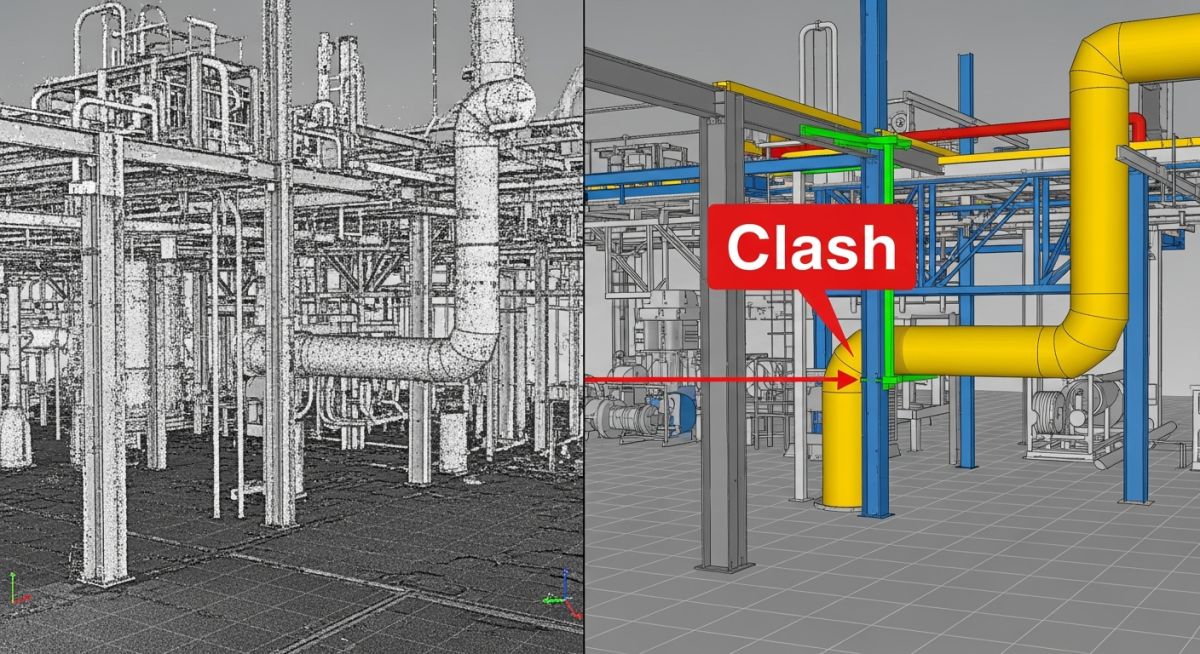
- ✖ No 3D Laser Scan: The design relied on 1985 “As-Built” drawings, which did not show modifications made over the last 40 years.
- ✖ Undefined Tie-ins: 14 critical tie-in points were inaccessible without scaffolding that blocked emergency routes, violating safety codes.
- ✖ Long Lead Items Delayed: The metallurgical study (usually done in FEED) was skipped. Late discovery of H2 partial pressure requirements forced a material upgrade from Carbon Steel to Cr-Mo alloy, adding 6 months to valve delivery.
The Financial Impact
Field Change Orders
+$12.4 Million
Due to 2,500+ field weld re-works.
Schedule Delay
5 Months
Missed the regulatory deadline.
Total ROI Loss
-22%
The Correct FEED Approach
Had a proper FEED been executed, a Laser Point Cloud Survey would have been overlaid on the 3D model. Software like Navisworks would have auto-detected the clashes virtually. The tie-in locations would have been physically verified during the FEL 3 site survey, and the material metallurgy would have been frozen in the Piping Material Specification (PMS) before purchasing began. The cost of this FEED? Approximately $800k—saving $12M in rework.
Frequently Asked Questions (FAQ)
What is the difference between Basic Engineering and FEED?
While the terms are often used interchangeably, Basic Engineering usually refers to the technical design aspect (P&IDs, Heat & Mass Balance), whereas FEED (Front End Engineering Design) is a broader project management scope. FEED includes Basic Engineering plus the execution planning, cost estimation, procurement strategy, and risk assessment required for the Final Investment Decision (FID).
How long does a typical FEED study take to complete?
The duration depends on project complexity. For a standard process unit (e.g., $100M CAPEX), a FEED study typically lasts 4 to 8 months. Mega-projects ($1B+) may require 12 to 18 months of front-end definition to reach the necessary maturity for a Class 3 estimate.
Who typically performs the FEED package?
FEED is usually performed by a specialized engineering consultancy or an EPC contractor (under a reimbursable contract). In many cases, the company that performs the FEED is excluded from bidding on the EPC phase to maintain neutrality, although “Open Book Estimate” (OBE) strategies allow the FEED contractor to roll over into execution.
Does FEED eliminate all project risks?
No, FEED does not eliminate all risk, but it reduces Technical and Commercial risk to a manageable level. By identifying hazards (HAZOP) and defining scope, it removes the “unknown unknowns.” However, execution risks like weather delays, geopolitical shifts, or labor strikes still remain and must be managed during the EPC phase.
Conclusion: The Foundation of Project Success
The advantages of FEED in EPC Project environments are undeniable. In 2026, where material costs fluctuate and timelines are compressed, skipping the Definition Phase is no longer a shortcut—it is a liability.
By investing 2-3% of your project budget upfront in a rigorous FEL 3 process, you secure a +/- 10% cost estimate, freeze your scope, and safeguard your schedule. Remember the engineering adage: “You pay for the design sooner or later, but it costs ten times more later.”

Related posts:
![High-grade industrial Wing Nut Types and Applications for mechanical assemblies.]()
Wing Nut Types and Applications: The 2026 Engineering Guide
![Industrial Monorail Crane Systems installed in a modern manufacturing plant 2026.]()
Monorail Crane Systems: Design, Types & 2026 Standards Guide
![Lead engineer performing a Factory Acceptance Test FAT on an industrial skid system 2026]()
Factory Acceptance Test FAT: The 2026 Engineering Guide to Zero-Defect Delivery
![Professional engineering workspace showing a Basis of Design document layout for a 2026 project.]()
Basis of Design: How to Write a BOD for Engineering Projects in 2026
![Industrial Flare Knockout Drum Sizing and installation in a refinery relief system.]()
Flare Knockout Drum Sizing: Design & API 521 Standards (2026 Guide)
![Advanced Reboiler Control Systems in a modern petrochemical refinery 2026.]()
Reboiler Control Systems: Engineering Guide to Precision Control 2026