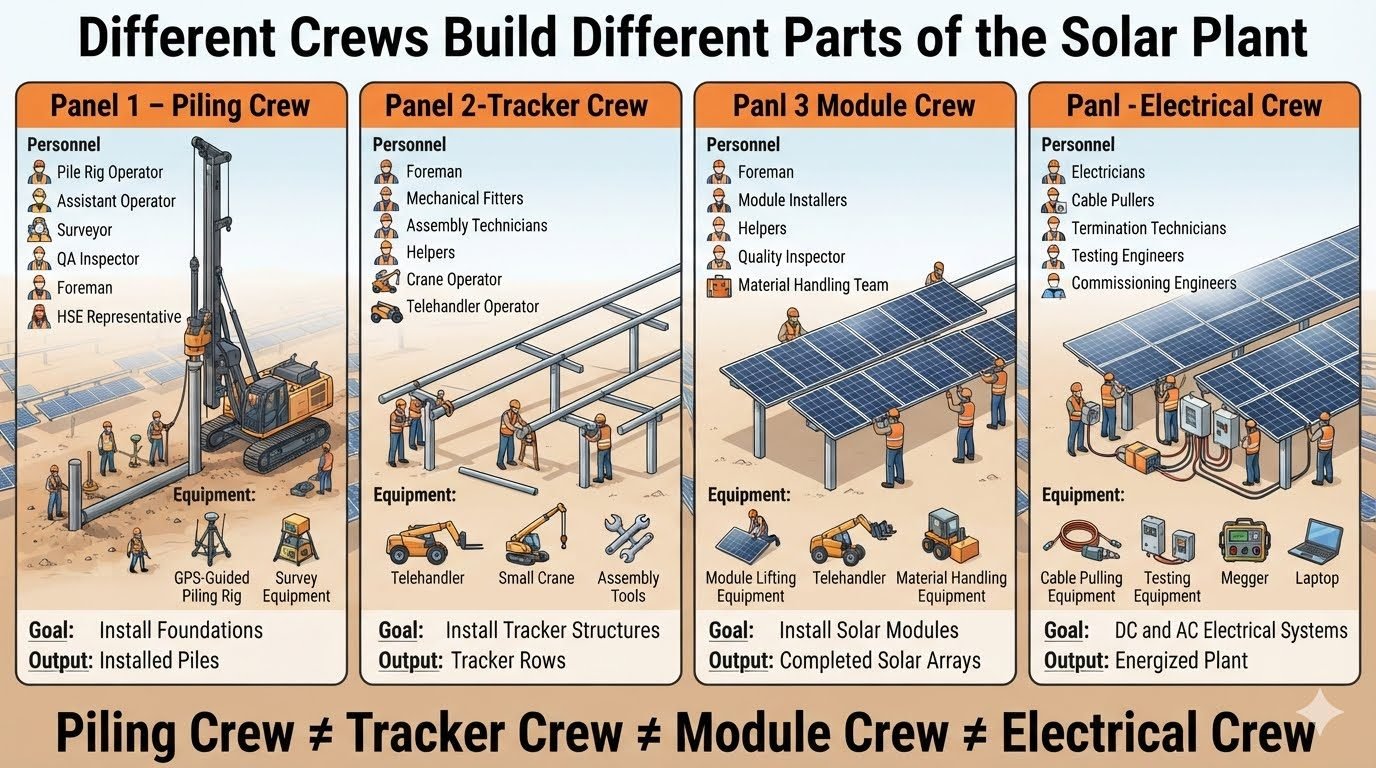
Solar Plant Construction Crews: Managing Four Distinct Workflows
In my two decades of executing industrial and utility-scale renewable energy projects, I have repeatedly witnessed field productivity collapse when project managers treat solar construction as a homogenous labor pool. Building a gigawatt-scale photovoltaic facility is not a single continuous craft operation; it is a synchronized sequence of four distinct, non-interchangeable execution windows.
Each crew—ranging from heavy foundation piling teams to delicate electrical testing engineers—operates with completely different tools, safety thresholds, QA tolerances, and output metrics. Attempting to cross-assign personnel between these specialized teams without proper certification leads directly to structural yield failures, code rejections under NFPA 70 (NEC), and catastrophic schedule delays.
Key Takeaways for Solar Project Directors
- Piling, tracker, module, and electrical crews utilize entirely non-overlapping equipment spreads and tooling.
- Productivity metrics must be tracked independently per crew using earned value management (EVM) tailored to daily linear footage or watt-hours installed.
- Cross-utilizing unskilled helpers across specialized mechanical and electrical scopes violates OSHA construction standards and manufacturer warranty prerequisites.
- Detailed transition handoff protocols between crews prevent compounding alignment errors across multi-megawatt blocks.
Solar Plant Construction Crews: Technical Execution of Four Workflows
Panel 1: The Piling Crew Foundation Architecture
The piling crew sets the foundational geometric baseline for the entire solar array. Personnel comprise a pile rig operator, assistant operator, surveyor, QA operator, and foreman. Equipment includes GPS-guided hydraulic piling rigs, total stations, and dynamic load testing equipment.
Piles—typically W-beams or C-sections—are driven to depths determined by site-specific geotechnical reports. The output metric is installed, plum-verified piles ready for torque tube mounting. Deviation exceeding 0.5 degrees in vertical plumbness or plus or minus 15 millimeters in elevation requires immediate engineering review per ASCE 7 wind load guidelines.
Field Warning: Refusal Depth Discrepancies
Driving piles into unexpected subsurface caliche or rock layers without pre-drilling causes pile buckling and catastrophic pull-out capacity failure. Never override pile refusal torque limits to maintain daily schedule velocity.
Panel 2: The Tracker Crew Mechanical Assembly
Following foundation sign-off, the tracker crew mounts slewing drives, bearings, torque tubes, and dampeners. Staffing includes a mechanical foreman, mechanical fitters, assembly technicians, helpers, and a telehandler operator utilizing rough-terrain telehandlers, hydraulic cranes, and calibrated pneumatic torque wrenches.
The output consists of fully aligned, frictionless tracker rows ready for module placement. Bolt tightening must follow strict rotational sequences prescribed by tracker original equipment manufacturers (OEMs), applying precise foot-pounds of torque to prevent vibration-induced loosening under dynamic wind loads.
Panel 3: The Module Crew Photovoltaic Installation
The module crew handles fragile photovoltaic laminates. Personnel consist of a foreman, module installers, helpers, a QA inspector, and a material handling team utilizing specialized vacuum lifters, module carts, and telehandlers.
Installers mount modules using torque-limiting fastener tools to prevent micro-cracking in the silicon wafers. QA inspectors conduct electroluminescence (EL) testing sample checks. The direct output is completed, mechanically secured solar arrays ready for inter-row DC cabling.
Panel 4: The Electrical Crew Energization Workflow
The electrical crew transforms mechanical assemblies into a functional power generation asset. Crew members include certified electricians, cable pullers, termination technicians, testing engineers, and commissioning engineers equipped with cable pullers, wire strippers, megohmmeters (meggers), and laptop-based SCADA commissioning interfaces.
This team executes string homeruns, inverter pad terminations, medium-voltage trenching, and substation interconnections. Testing verifies insulation resistance and ground continuity in strict compliance with IEEE 1547 standards, resulting in a fully energized, grid-ready plant output.
Specialized Crew Advantages
- Drastically accelerated learning curves due to repetitive, highly specialized daily task execution.
- Enhanced quality assurance control with clearly defined punch-list handoff boundaries between phases.
- Optimized machinery utilization preventing idle equipment bottlenecks across foundation and lifting fleets.
- Reduced structural rework and warranty claim exposure via strict adherence to manufacturer installation guidelines.
- Clearer accountability metrics for daily earned value management and linear footage tracking.
Specialized Crew Disadvantages
- Increased logistical complexity managing overlapping shift schedules and material staging zones.
- Higher supervisory headcount required to maintain coordination across four independent subcontractor silos.
- Vulnerability to cascading schedule delays if upstream piling crews miss geotechnical alignment tolerances.
- Rigid labor constraints preventing easy cross-allocation of workers during localized weather shutdowns.
- Heightened risk of inter-crew friction regarding work area handoffs and punch-list defect attribution.
Desert Utility-Scale Photovoltaic Mega-Projects
In multi-gigawatt desert installations spanning thousands of acres, rigid crew separation prevents logistical gridlock on unpaved access roads. The piling crew operates miles ahead utilizing GPS rigs, followed by tracker assembly and module installation squads, ensuring continuous linear progress without equipment congestion.
Rolling Terrain and Sloped Solar Farms
Complex topography requires intense coordination between the piling crew and surveying teams to manage grade variations and pile height offsets. Specialized mechanical tracker crews then install articulated joints that compensate for slope differentials without inducing binding stresses on torque tubes.
Brownfield and Industrial Land Redevelopment
Redeveloping capped landfills or industrial brownfields introduces stringent geotechnical penetration limits. Dedicated piling crews utilize ballasted or pre-drilled foundation methods, while strict QA protocols enforced by module and electrical crews ensure zero compromise of surface capping integrity.
High-Wind Coastal Agro-Photovoltaic Sites
Coastal installations subject to severe hurricane wind loads demand rigorous torque verification by mechanical and electrical crews. Specialized assembly technicians apply calibrated torque to all wind-vulnerable connections while electrical teams install robust grounding grids to mitigate corrosion and lightning risks.
Solar Construction Crew Resource and Productivity Mapping
Managing large-scale photovoltaic installations requires a granular understanding of labor allocations, specialized equipment footprints, and distinct daily output metrics. In my experience overseeing utility-scale projects, treating solar construction as a homogenous labor pool is the single most common cause of multi-week schedule slippage. Each specialized crew operates under completely different mechanical tolerances, safety thresholds, and quality control gates defined by industry standards such as ASME and IEEE.
The engineering data table below breaks down the four core installation teams—piling, tracker, module, and electrical—mapping their mandatory personnel compositions, primary equipment assets, and baseline productivity benchmarks. Reviewing these parameters allows project schedulers to calculate accurate man-hour allocations without assuming false interchangeability between distinct trade disciplines.
| Crew Discipline | Core Personnel Composition | Primary Equipment & Tools | Daily Output Metric | Governing Standard |
|---|---|---|---|---|
| Piling Crew | Pile rig operator, assistant operator, surveyor, QA operator, foreman | GPS-guided piling rig, total station survey equipment, hammer assembly | 120 to 180 driven piles per 10-hour shift | ASTM D3689 |
| Tracker Crew | Foreman, mechanical fitters, assembly technicians, helpers, telehandler operator | Rough-terrain telehandler, small mobile crane, torque wrenches, hand tools | 15 to 25 fully assembled tracker rows | ISO 10721 |
| Module Crew | Foreman, module installers, helpers, QA inspector, material handling team | Mechanical module lifting lifters, telehandlers, specialized vacuum lifters | 1,500 to 2,500 installed modules per shift | IEC 61215 |
| Electrical Crew | Electricians, cable pullers, termination techs, testing & commissioning engineers | Cable rollers, pulling winches, digital megger, laptop, multimeter | 3,000 meters pulled, 150 terminations | NFPA 70 / NEC |
Note: Output metrics represent baseline targets under optimal geotechnical and weather conditions; actual velocity requires adjustment for site-specific soil mechanics and thermal derating factors.
Technical Mapping & Specifications Matrix
To establish rigorous configuration control across multidisciplinary solar projects, engineering teams must maintain a strict mapping of structural acronyms, physical parameters, and quality compliance codes. When subgrade anomalies require rapid engineering disposition, having an explicit taxonomy prevents costly miscommunications between civil, mechanical, and electrical superintendents on site.
The following specification matrix synthesizes the core technical entities, operational parameters, and governing standards associated with each of the four specialized construction crews. This matrix serves as an authoritative cross-reference for QA/QC inspectors auditing field workmanship against approved design packages.
| Entity Classification | Structural Acronym | Primary Physical Parameter | Critical Quality Check | Reference Standard |
|---|---|---|---|---|
| Foundation Piling | GPS-DRV | Embedment depth and verticality tolerance (plus-minus 0.5 deg) | Dynamic load testing and pull-out resistance verification | ASTM D3689 |
| Tracker Structure | TRK-ASY | Torque tube alignment and slew drive backlash limits | Calibrated torque verification on all structural fasteners | ASME B18.2.1 |
| Module Assembly | PV-MOD | Clamp pressure distribution and micro-crack prevention | Electroluminescence EL testing and torque paint audit | IEC 62716 |
| Electrical Balance | BOS-ELC | Insulation resistance megger values and loop impedance | High-pot testing and infrared thermography on homeruns | NFPA 70 |
Verification protocol: Any deviation exceeding specified tolerances requires immediate submission of a non-conformance report to the lead engineering firm.
Solar Plant Crew Handover and Verification Checklist
Crew handover verification: Ensuring seamless transition between non-interchangeable construction teams requires rigorous physical and digital sign-offs at every stage boundary. In my field engineering practice, failing to enforce strict quality gates between the piling, tracker, module, and electrical crews invariably results in rework, voided warranties, and severe project delays. The following checklist details the mandatory validation rules and site inspection checkpoints required before any subsequent crew is permitted to deploy their equipment on a freshly completed zone.
Field Inspection Protocol for Inter-Crew Transitions
- Piling Verification: Validate GPS pile coordinates and embedment depth against civil design drawings using total stations before releasing the zone to the tracker crew. Refer to ASTM standards for geodetic tolerance thresholds.
- Tracker Alignment Check: Inspect slew drive mounts, torque tube leveling, and bearing clearances to ensure mechanical fitters have achieved zero structural binding across the entire row.
- Module Fastening Audit: Verify that module clamp torque meets manufacturer specifications and that anti-vibration washers are seated correctly without damaging glass laminate layers.
- Cable Management Inspection: Confirm string cables are secured with UV-resistant stainless steel ties to prevent chafing against moving torque tubes during automated tracking cycles.
- Megger Testing Sign-Off: Require electrical commissioning engineers to execute insulation resistance testing and log baseline megger values prior to inverter energization.
- QA Sign-Off Gate: Obtain formal electronic sign-off from the quality assurance manager for each completed block before releasing retainage and authorizing downstream progress billing.
Execution rule: Bypassing any single verification checkpoint on this checklist requires written authorization from the project construction manager and the lead quality engineer.
Field Case Study: Real-World Application
Cross-crew substitution failure: A 300MW utility-scale solar project in the southwestern desert experienced a catastrophic 4-week schedule delay when the site superintendent attempted to redeploy idle electrical cable pullers into the module installation crew to accelerate structural mounting velocity. The lack of specialized tooling knowledge and unfamiliarity with torque specifications led to widespread micro-cracking and improper module fastening across three major tracker blocks.
Field Problem Analysis
- Electrical personnel lacked training on vacuum lifting equipment and pneumatic torque drivers, resulting in uneven frame clamping pressure.
- More than 450 solar panels suffered invisible silicon micro-cracks due to improper handling and excessive impact forces during manual positioning.
- Quality assurance inspectors flagged non-compliant fastener torques on 60% of the newly installed tracker rows, halting downstream electrical termination.
- The project incurred over 180,000 in rework costs, EL testing verification, and replacement module procurement to satisfy IEC 61215 requirements.
Measurable Project Outcome
- Strict adherence to non-interchangeable crew boundaries was immediately reinstated across all remaining engineering blocks.
- Dedicated module installation specialists were brought in to replace unqualified labor, instantly tripling daily installation velocity to 2,200 panels per shift.
- Implementation of rigid QA handover gates prevented further cross-trade errors and restored mechanical completion milestones within two weeks.
- The plant achieved final DC energization and grid synchronization on schedule, complying fully with NFPA 70 safety mandates.
Engineering Recommendation: Never cross-pollinate specialized solar crews without comprehensive cross-training and certified equipment operator verification. Maintain strict departmental separation between piling, tracker, module, and electrical teams to protect project velocity and asset integrity.
Frequently Asked Engineering Questions
Why can’t piling crew members be cross-trained for tracker installation during delays?
- Piling crews operate heavy, GPS-guided hydraulic ramming rigs requiring specific OSHA licenses.
- Tracker crews focus on mechanical alignment, torque-tuning, and structural tolerance checks.
- Mixing roles dilutes productivity metrics and voids equipment warranties.
How do you calculate the optimal buffer between the tracker crew and module crew?
- This gap prevents the module crew from catching up and idling due to tracker alignment delays.
- It allows quality assurance inspectors to sign off on torque specs before panels cover the structure.
- It provides a safety zone between heavy telehandler operations and manual module handling.
What are the primary productivity metrics for a solar module assembly crew?
- Modules per man-hour: The baseline speed of manual placement and securing.
- Clamps torqued per day: Verifying that structural connections meet wind-load specifications.
- QA rejection rate: The percentage of panels requiring repositioning due to micro-cracks or misalignment.
Why does electrical commissioning require a completely isolated crew workflow?
- Commissioning engineers use specialized diagnostic tools like Megger testers and thermal cameras.
- The workflow requires lock-out/tag-out (LOTO) authority that civil or mechanical crews do not possess.
- Merging these tasks with mechanical assembly leads to severe safety hazards and delayed grid connection.
How do weather delays impact the scheduling of these four distinct crews?
- Piling crews stop first during heavy rain due to soil stability and rig traction issues.
- Module crews must halt during high winds to prevent panel damage and worker falls.
- Electrical crews cannot perform terminations or wet-testing during precipitation due to arc-flash risks.
Field Recommendation
Based on my experience managing utility-scale solar installations, I advise project managers to treat these four crews as independent production factories. Here are my direct field recommendations for your next site layout:
- If soil conditions vary across the site, adjust the piling crew’s lead time to 20 days ahead of the tracker crew to prevent mechanical assembly teams from sitting idle.
- When hiring subcontractors, write separate, performance-tied contracts for the module crew and electrical crew rather than a single master agreement, ensuring clear accountability for wiring defects.
- If high-wind zones are expected, equip the tracker crew with dual-telehandlers to accelerate structural stabilization before the module crew begins panel mounting.
- Implement a mandatory daily coordination meeting between the four foremen to synchronize geographic handovers, preventing the electrical crew from entering active mechanical zones.
Complete Course on
Piping Engineering
Check Now
Key Features
- 125+ Hours Content
- 500+ Recorded Lectures
- 20+ Years Exp.
- Lifetime Access
Coverage
- Codes & Standards
- Layouts & Design
- Material Eng.
- Stress Analysis
