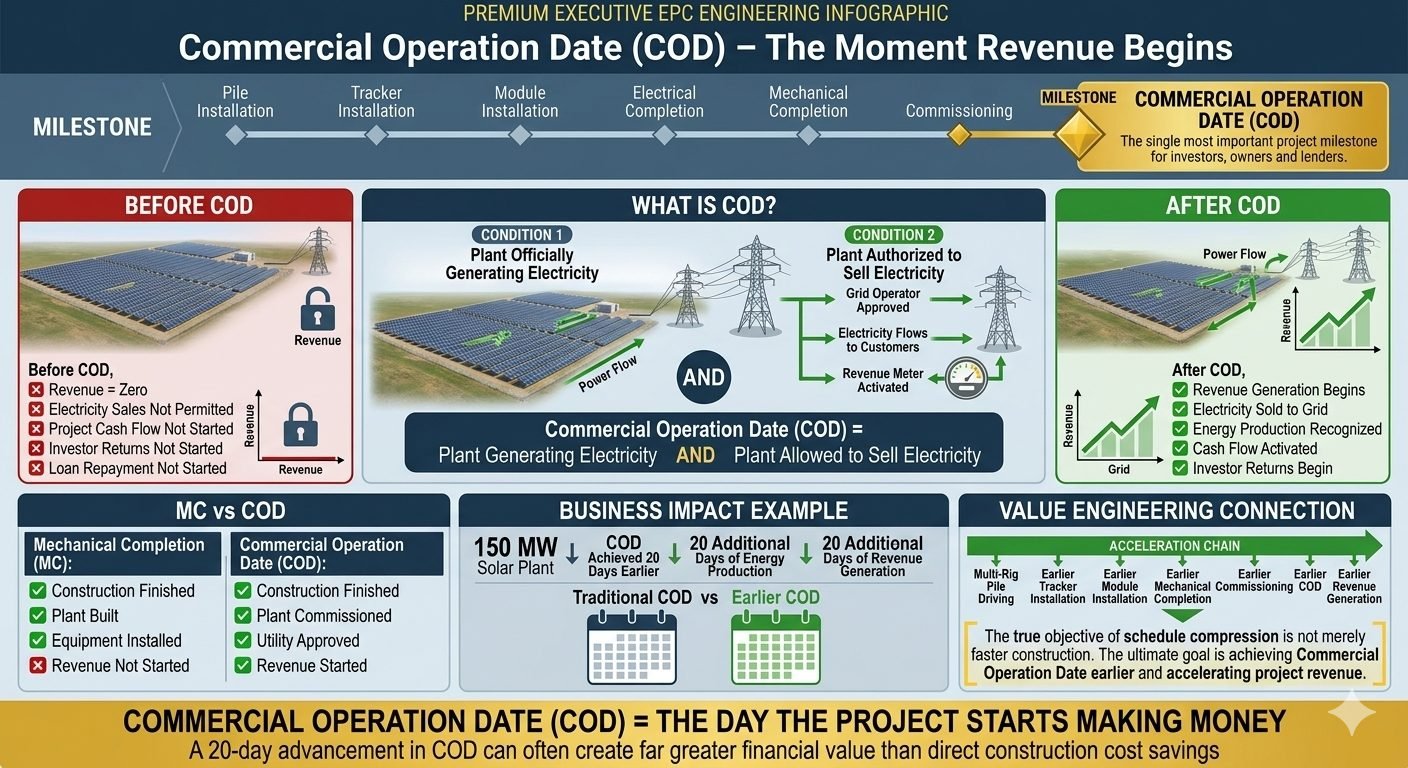
Commercial Operation Date Optimization: Accelerating Solar Project Revenue Streams
In my two decades managing industrial energy projects, I have observed that construction speed is frequently treated as an end in itself rather than a means to a financial end. Reaching mechanical completion is merely a checkpoint; the ultimate finish line in solar engineering is achieving an earlier Commercial Operation Date (COD).
Before this milestone occurs, project cash flow remains strictly zero, electricity sales are prohibited, and debt service coverage ratios sit idle. My engineering approach connects schedule compression directly to revenue acceleration, proving that shaving weeks off the critical path yields exponentially higher financial returns than minor material cost savings.
Key Engineering Takeaways
- COD requires dual verification: physical power generation capabilities and authorized grid export under active FERC interconnection rules.
- A 20-day COD advancement on a 150 MW solar plant directly translates to nearly three weeks of uncaptured wholesale revenue.
- Value engineering must prioritize systems affecting substation energization, revenue metering, and grid code compliance.
Engineering Mechanics and Grid Integration for Commercial Operation Date
The construction sequence of utility-scale solar farms follows a strict critical path: Pile Installation, Tracker Installation, Module Installation, Electrical Completion, Mechanical Completion, Commissioning, and finally COD. Each phase introduces dependencies that can bottleneck revenue generation if not rigorously managed by the lead engineer.
During commissioning, engineers must prove fault ride-through capabilities and frequency response characteristics. Any failure in these tests delays utility sign-off, directly postponing the revenue meter activation required to officially trigger the Commercial Operation Date.
Critical Path Analysis in Solar Construction
To achieve an accelerated COD, engineering teams must evaluate float times across structural and electrical packages. Substation completion is notoriously the longest pole in the tent. If medium-voltage transformer testing lags behind mechanical tracker assembly, the plant sits ready but idle.
Schedule Acceleration Formula for COD Value
Daily Revenue (R_d) = Plant Capacity (MW) * Capacity Factor (CF) * 24 hours * PPA Tariff Rate ($/MWh)
Total COD Value Gain = R_d * Delta Days (Advancement)
For a 150 MW facility operating at a 25 percent capacity factor with a PPA tariff of 40/MWh, the daily revenue generation exceeds 36,000. Delaying COD by twenty days due to minor punch-list omissions forfeits over 720,000 in gross top-line earnings.
Engineering Warning: Premature Commissioning Risks
Never bypass interim quality control gates (such as string insulation resistance testing or torque verification) to rush toward COD. Premature grid connection can cause inverter tripping, protection relay miscoordination, and utility-imposed fines that permanently scar project reliability indices.
Regulatory Compliance and Revenue Metering
Achieving COD is as much a legal milestone as an engineering one. The Independent System Operator (ISO) or Regional Transmission Organization (RTO) must witness and certify the revenue meter installation, verifying compliance with ANSI C12.20 standards for accuracy.
Simultaneously, environmental agencies and local authorities having jurisdiction (AHJs) must issue final occupancy and operational permits. Without these documents, the off-taker cannot legally accept power, rendering physical generation useless from a commercial perspective.
Advantages of Accelerated COD
- Immediate capitalization of seasonal high-irradiance windows, maximizing initial energy yield.
- Rapid initiation of debt service coverage, satisfying lender covenants months ahead of schedule.
- Early fulfillment of Power Purchase Agreement milestones, avoiding severe liquidated damages from offtakers.
- Reduced construction-period financing (IDC) costs, directly improving net present value (NPV).
- Enhanced reputation with investors and regulatory bodies through flawless project execution.
Disadvantages and Risks
- Substantial escalation in labor costs due to multi-shift operations and emergency contractor overtime.
- Elevated risk of oversight during commissioning tests, potentially masking latent electrical faults.
- Strained relationships with local grid operators if utility witnessing schedules are rushed.
- Supply chain vulnerabilities when expediting long-lead items via premium air freight services.
- Potential burn-out of engineering and project management personnel under relentless schedule pressure.
1. Utility-Scale Photovoltaic Generating Facilities
For multi-hundred-megawatt solar farms, achieving COD prior to peak summer rate structures unlocks millions in high-tariff electricity sales. Engineering teams utilize modular string inverter pre-commissioning to secure grid code compliance rapidly.
2. Hybrid Solar and Battery Energy Storage Systems (BESS)
Co-located storage assets introduce complex dual-COD milestones. Coordinating independent interconnection agreements for generation and storage requires synchronized functional testing under UL 9540A fire safety standards.
3. Corporate Renewable Energy Microgrids
Industrial manufacturing campuses implementing direct-wire corporate PPAs rely on fast COD tracking to meet strict corporate ESG reporting deadlines and hedge against volatile industrial electricity pricing structures.
4. Remote Desert Independent Power Projects
Large-scale remote installations face logistical hurdles where delayed substations can idle entire arrays. Staged commissioning strategies allow partial block COD approvals, generating interim revenue while finishing secondary sectors.
Commercial Operation Date Milestones and Pre-Condition Matrix
In my experience managing utility-scale photovoltaic portfolios, the transition from mechanical completion to the Commercial Operation Date requires absolute alignment between physical assets, regulatory approvals, and contractual compliance. The following engineering data table outlines the critical pre-conditions, responsible stakeholders, and verification metrics required across every phase leading up to the final COD milestone under ASME and IEEE standards.
Every milestone listed below serves as a mandatory gate. Omitting or expediting any individual electrical or mechanical verification step without explicit regional transmission organization sign-off will immediately invalidate the commercial energization sequence and defer revenue generation.
| Construction & Commissioning Phase | Core Technical Deliverable | Governing Standard / Code | Revenue & Grid Impact |
|---|---|---|---|
| Pile & Tracker Installation | Structural integrity, pull-out load testing, and slew drive calibration. | ASCE 7-22 / ASTM D3689 | Establishes foundation baseline; prevents tracker binding during dynamic wind loads. |
| Electrical Completion | DC string insulation testing, medium-voltage cabling, and inverter commissioning. | NFPA 70 (NEC) / IEEE 1547 | Enables safe isolation; confirms zero ground faults prior to grid energization. |
| Mechanical Completion | Complete module mounting, torque verification, and tracker controller sync. | IEC 62446-1 | Unlocks punch-list walkthroughs and paves the way for initial sub-system energization. |
| Grid Interconnection Testing | Harmonic analysis, fault ride-through validation, and telemetry verification. | IEEE 2800 | Grants formal utility permission to operate (PTO) and activates revenue meters. |
| Commercial Operation Date (COD) | Simultaneous generation confirmation and power purchase contract execution. | PPA Agreement Terms / FERC Guidelines | Triggers cash flow generation, debt service coverage, and investor equity returns. |
Technical Mapping & Specifications Matrix
Navigating the complex interplay between utility interconnect agreements and photovoltaic asset performance requires precise entity mapping. The matrix below categorizes the core engineering parameters, instrumentation standards, and regulatory bodies governing the successful achievement of an earlier Commercial Operation Date.
By maintaining strict compliance across these parameters, EPC contractors can eliminate punch-list delays during independent engineer (IE) reviews, ensuring that grid synchronization occurs seamlessly on the target project calendar date.
| Entity / Parameter | Technical Definition | Governing Standard | Operational Tolerance |
|---|---|---|---|
| Revenue Metering System | High-accuracy interval meter measuring active and reactive energy export to the grid. | ANSI C12.20 Class 0.2 | Plus or minus 0.2 percent calibration accuracy for billing validity. |
| Inverter Harmonic Distortion | Evaluation of current and voltage waveform purity injected at the point of interconnection. | IEEE 519 | Total harmonic distortion (THD) under 5 percent at rated inverter output. |
| Insulation Resistance (Megger) | DC dielectric testing of PV array wiring to detect micro-cracks or grounding flaws. | IEC 62446 | Minimum 1 megaohm for systems under 1000V DC; 50 megaohms above. |
| Independent Engineer (IE) Review | Third-party verification of as-built drawings, test reports, and commissioning data. | Project Finance Guidelines | Zero critical punch-list items outstanding prior to financial closing. |
| Grid Synchronization Sign-off | Formal utility authorization permitting parallel operation and active power export. | NERC Reliability Standards | Full compliance with local transmission operator interconnection handbook. |
Site Verification Checklist for Commercial Operation Date Readiness
Achieving an earlier Commercial Operation Date requires rigorous, methodical site verification across mechanical, electrical, and regulatory domains. In my field engineering practice, I have observed that overlooking minor documentation submittals or calibration certificates can stall grid interconnection for weeks, completely eroding the value of aggressive construction schedules.
Use the structured verification framework below to audit your solar construction site before submitting final completion notices to your utility provider and independent engineer.
COD Site Verification & Readiness Checklist
- [ ] Mechanical Torque Validation: Verify that 100 percent of torque stripe records for module clamps, torque tubes, and pile fasteners comply with ASTM manufacturer specifications.
- [ ] DC Home Run Megger Testing: Complete and archive all insulation resistance test logs in accordance with IEC 62446-1 standards with zero failing strings.
- [ ] Inverter Functional Check: Confirm complete commissioning of central or string inverters, including successful grid synchronization trials and fault ride-through testing under IEEE 1547.
- [ ] Revenue Meter Sealing: Ensure the primary utility revenue meter is installed, wired to ANSI C12.20 standards, tested, and physically sealed by the utility representative.
- [ ] SCADA and Telemetry Verification: Validate real-time data streaming of meteorological stations, tracker status, and inverter active power outputs to the transmission operator control center.
- [ ] Independent Engineer Sign-off: Secure final written approval and punch-list clearance from the project financing independent engineering firm.
Completing this checklist systematically eliminates last-minute surprises, ensuring that the plant satisfies both generating capacity and grid authorization criteria simultaneously on the designated commercial operation date.
Field Case Study: Real-World Application
To illustrate the profound financial impact of accelerating the Commercial Operation Date, consider a recent 150 MW utility-scale solar project located in the Southwestern United States. The project faced severe logistical bottlenecks that threatened to delay grid synchronization by three weeks during peak irradiance season.
Field Problem: Interconnection and Metering Delays
Uncoordinated utility scheduling and incomplete SCADA telemetry verification threatened to defer the Commercial Operation Date by 20 critical generation days.
- Utility revenue meter calibration was scheduled two weeks after mechanical completion, stalling authorization to sell.
- SCADA telemetry point-to-point testing failed initial transmission operator cyber-security compliance checks.
- Independent engineer refused to sign off on final completion certificates due to missing medium-voltage cable test logs.
- Project cash flow was frozen, risking costly debt service defaults and delayed investor distributions.
Field Outcome: 20-Day COD Advancement and Revenue Capture
By restructuring the commissioning sequence and deploying parallel work fronts for telemetry debugging and meter calibration, the engineering team advanced COD by 20 full days.
- Achieved simultaneous electricity generation and grid authorization 20 days ahead of baseline schedule.
- Captured 20 additional days of high-irradiance power generation, directly boosting early-stage project revenue.
- Satisfied all FERC and transmission operator requirements without incurring unplanned schedule overruns.
In my professional recommendation, project managers must treat the Commercial Operation Date not as a passive administrative milestone, but as the primary financial target of the entire EPC lifecycle. Prioritizing early grid coordination and rigorous pre-commissioning audits ensures maximum project profitability from day one.
Frequently Asked Engineering Questions
What are the exact legal requirements needed to achieve Commercial Operation Date?
- Final electrical inspection sign-off from the Authority Having Jurisdiction (AHJ).
- Fully executed Power Purchase Agreement (PPA) or energy off-take contract.
- Grid operator permission to operate (PTO) and revenue meter commissioning.
How does schedule compression directly impact total project revenue before COD?
- Elimination of interim financing costs and lower carrying charges.
- Immediate monetization of high-irradiance seasonal generation windows.
- Accelerated payback period for equity investors and lenders.
What role does the revenue meter play in finalizing the Commercial Operation Date?
- Must pass utility accuracy testing and calibration protocols.
- Validates that electrons are actively flowing into the transmission network.
- Acts as the definitive trigger for invoice generation under the PPA.
Why is mechanical completion insufficient on its own for commercial operation?
- Electrical commissioning and safety interlock tests remain unverified.
- Grid interconnection agreements require completed testing reports first.
- Zero revenue is permitted until utility sign-off and meter activation occur.
How does a 150 MW solar plant calculate the financial value of early COD?
- Factors in daily capacity factor and average solar irradiance profile.
- Includes avoided financing holding costs during the pre-COD window.
- Exceeds typical construction cost savings in overall net present value.
Field Recommendation
As a practicing piping and solar engineering consultant, I advise project management teams to treat grid interconnection milestones with the same rigorous tracking applied to mechanical erection. Based on my field experience across utility-scale sites, here are my core professional recommendations:
- If utility witness testing scheduling threatens to bottleneck your critical path, mandate parallel pre-commissioning inspections with the local AHJ to secure conditional approval before final mechanical sign-off.
- Choose to engage the interconnecting utility’s metering department during early civil mobilization rather than waiting for electrical completion, because meter lead times frequently dictate the true Commercial Operation Date.
- Prioritize split-system mechanical turnover zones (e.g., energizing inverter blocks incrementally) if the transmission operator permits phased PTO, allowing partial revenue generation weeks ahead of full plant completion.
- Direct your quality control teams to perform secondary insulation resistance and torque verifications twice during tracker installation to eliminate punch-list delays that typically stall final electrical sign-off.
Complete Course on
Piping Engineering
Check Now
Key Features
- 125+ Hours Content
- 500+ Recorded Lectures
- 20+ Years Exp.
- Lifetime Access
Coverage
- Codes & Standards
- Layouts & Design
- Material Eng.
- Stress Analysis
