How to Evaluate Anchor Bolt Optimization ECPs Safely
In my 20+ years of managing heavy industrial piping and structural interfaces, I have seen countless projects bleed capital due to over-designed foundations. Anchor bolts are frequently specified with massive, arbitrary safety factors that ignore actual load paths. When an Engineering Change Proposal (ECP) lands on my desk suggesting a length or diameter reduction, it is not just a technical calculation; it is a multi-dimensional commercial decision.
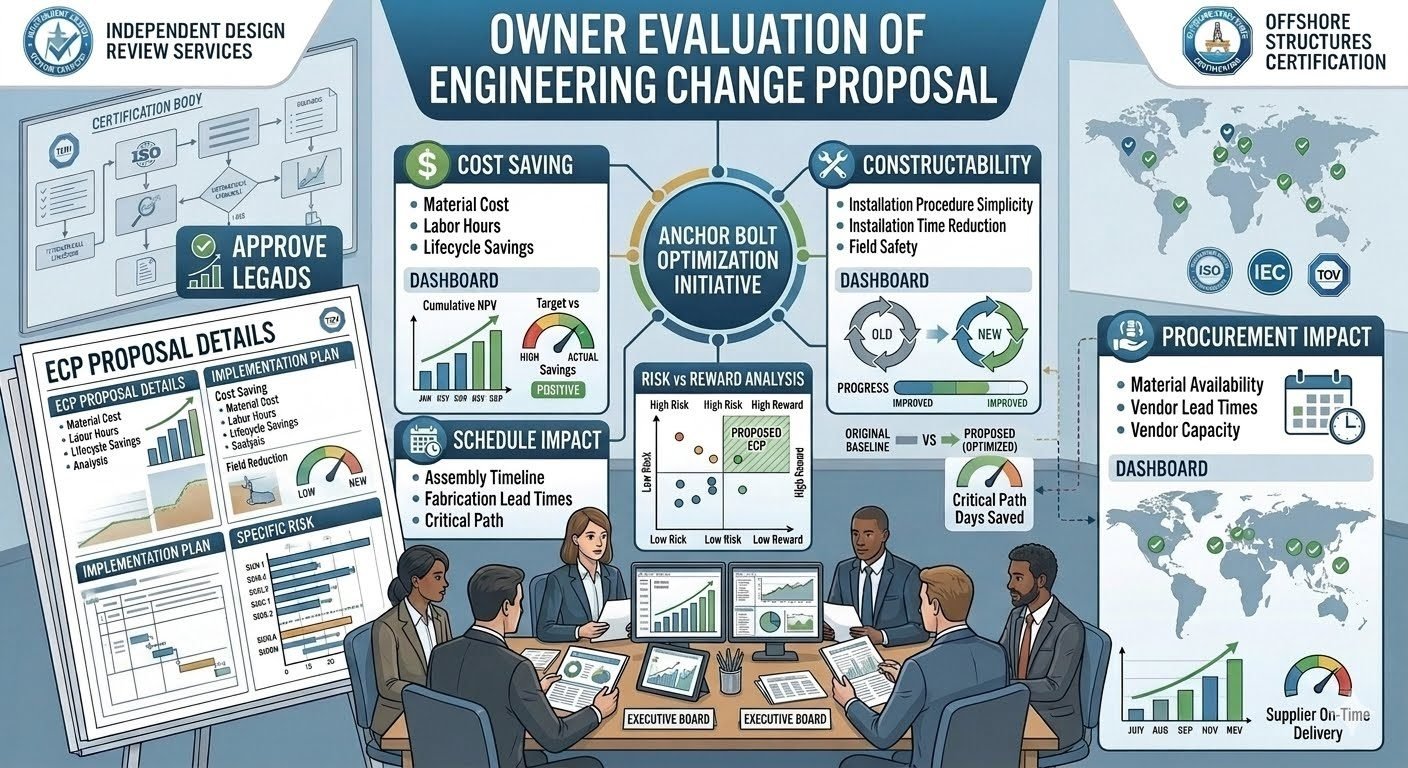
I evaluate these optimization initiatives across four strict dimensions to ensure we do not sacrifice safety for savings. This guide outlines how to balance structural engineering compliance with project execution realities.
Key Takeaways:
- Understand the four-dimensional evaluation framework (Cost, Risk, Schedule, Procurement).
- Verify compliance with ACI 318-19 and AISC Design Guide 1.
- Mitigate risk using a structured probability-versus-impact matrix.
- Streamline procurement by aligning bolt specifications with local vendor capacities.
- Ensure the executive board reviews all commercial impacts before final legal adoption.
How to Execute Anchor Bolt Optimization Safely
When executing an anchor bolt optimization initiative, we must first look at the governing physical failure modes. The design of anchor rods in heavy industrial foundations is rarely governed by the steel tensile strength alone. Instead, concrete breakout strength in tension and shear typically controls the design limits.
Let us evaluate a practical engineering scenario. Suppose we have a heavy industrial vessel foundation. The original design specifies ASTM F1554 Grade 55 anchor bolts. The diameter is 1.25 inches, and the effective embedment depth is 18 inches. The engineering team submits a change proposal to reduce the embedment depth to 14 inches to save material and drilling labor.
To verify this, we calculate the basic concrete breakout strength in tension. According to ACI 318-19, this value is determined by the concrete strength and the embedment depth. The formula is written as:
Nb = kc * lambda * square root of f’c * hef^1.5
In this formula, kc represents the coefficient for cast-in anchors, which is 24. The term lambda is the lightweight concrete modification factor, which is 1.0 for normal weight concrete. The specified compressive strength of the concrete, f’c, is 4000 pounds per square inch. The variable hef is the effective embedment depth.
For the original 18-inch embedment depth, the calculation is:
Nb = 24 * 1.0 * square root of 4000 * 18^1.5 = 115,920 pounds (115.9 kips)
For the optimized 14-inch embedment depth, the calculation becomes:
Nb = 24 * 1.0 * square root of 4000 * 14^1.5 = 79,500 pounds (79.5 kips)
This change represents a 31.4 percent reduction in basic concrete breakout strength. However, we must compare this to the actual factored tension load on the anchor bolt. If the maximum factored tension load is only 45 kips, we apply the strength reduction factor of 0.70. The design strength is 0.70 * 79.5 kips, which equals 55.65 kips. Since 55.65 kips is greater than the 45 kips demand, the optimization is technically safe and fully compliant.
Managing Risks in Anchor Bolt Optimization
In my experience, the technical calculation is only the first step. The project owner must evaluate the ECP across four distinct commercial dimensions before granting final approval. This structured process prevents hasty decisions that could lead to field failures or schedule delays.
The first dimension is Cost Saving. We analyze the direct material savings of the shorter bolts, the reduced labor hours for drilling, and the long-term lifecycle savings. A dashboard showing cumulative percentage savings over time helps the executive board visualize the financial impact.
The second dimension is Risk vs Reward Analysis. We plot the proposal on a probability-versus-impact matrix. This matrix compares the original design against the optimized design in terms of risk exposure and potential benefit. If the risk of concrete breakout is high, the reward of saving a few dollars is not justified.
The third and fourth dimensions are Schedule and Procurement Impacts. We assess how the change affects the assembly timeline, fabrication lead times, and critical path. We also evaluate material availability and vendor capacity. If the optimized bolt length requires a custom order with a twelve-week lead time, the schedule delay will quickly wipe out any material cost savings.
Key Advantages
- Reduces raw material costs by up to 15% through optimized steel volume.
- Lowers shipping and handling weights for large-scale industrial projects.
- Decreases drilling depth and installation labor hours in the field.
- Minimizes the risk of rebar interference during foundation pouring.
- Accelerates fabrication lead times by utilizing standard stock lengths.
Potential Disadvantages
- Reduces the structural safety margin against unexpected dynamic overloads.
- Requires extensive engineering re-calculation and formal ECP approval cycles.
- Increases the risk of brittle concrete breakout failure if executed poorly.
- May lead to procurement delays if custom optimized lengths are not readily available.
Petrochemical Pipe Rack Foundations
In large-scale refinery projects, optimizing the length of hundreds of structural pipe rack anchor bolts yields massive cumulative savings. By matching the embedment depth to actual wind and thermal piping thrust loads rather than conservative standard templates, we cut steel tonnage significantly.Heavy Rotating Equipment Bases
For compressors and pumps, anchor bolts must resist high-frequency dynamic vibrations. Optimization here focuses on balancing embedment depth with fatigue-resistant steel grades, ensuring the foundation dampens operational forces without requiring excessively deep concrete pedestals.Modular Process Skid Anchoring
Modular skids are fabricated off-site and shipped to the field. Optimizing the anchor bolt layout and length allows for faster alignment and tensioning during field installation, directly reducing the critical path schedule of the plant assembly.Electrical Substation Gantry Towers
High-voltage gantry structures experience high overturning moments from wind and cable tension. Optimizing the anchor bolt configuration using high-strength alloys allows for smaller base plates and fewer bolts, simplifying the concrete reinforcement detailing.Anchor Bolt Optimization Engineering Parameters
Anchor bolt optimization through an Engineering Change Proposal requires rigorous quantitative comparison against baseline structural standards. When evaluating length reductions, embedment depths, and material grades, engineers must reference ASME PCC-1 guidelines for pressure boundary bolting and AISC Design Guide 1 for base plate embedment mechanics. The data table below outlines the specific engineering parameters tracked during our multi-dimensional ECP evaluation process, contrasting traditional over-designed configurations with optimized structural layouts.
Every parameter shift directly impacts total material weight, fabrication labor hours, and cumulative cost savings over a standard twenty-year plant operating lifecycle. Review these metrics carefully to understand the exact trade-offs managed during the commercial and technical review phases.
| Evaluation Parameter | Original Baseline Design | Optimized ECP Configuration | Governing Standard / Code |
|---|---|---|---|
| Nominal Bolt Diameter | 36 mm (1.417 in) | 32 mm (1.259 in) | ASTM A307 / A36 |
| Minimum Embedment Depth | 650 mm (25.59 in) | 480 mm (18.89 in) | ACI 318 Appendix D |
| Material Tensile Strength | 850 MPa (Grade B7) | 850 MPa (Grade B7) | ASTM A193 |
| Total Material Cost per Node | USD 410.00 | USD 315.00 | Internal Project Estimating |
| Fabrication Lead Time | 6 Weeks Standard Mill | 3 Weeks Stock Cut | Supply Chain Metrics |
Technical Mapping & Specifications Matrix
The technical mapping matrix establishes the exact semantic and structural relationships between our engineering design inputs, regulatory compliance frameworks, and final commercial verification milestones. In industrial piping and structural modules, tracking these entity linkages prevents overlooked structural vulnerabilities during high-pressure Engineering Change Proposal reviews.
By correlating structural acronyms with physical parameters and active standard bodies, project teams maintain full traceability from initial stress calculations through final executive board approval. Refer to the matrix below for the complete inventory of governing entities and operational boundaries.
| Entity Name | Structural Acronym | Physical Parameter | Governing Standard Reference |
|---|---|---|---|
| Engineering Change Proposal | ECP | Process Modification Workflow | ASME QHO-1 |
| Concrete Anchorage Design | CAD | Pullout & Concrete Breakout | ACI 318 |
| Risk vs Reward Analysis | RRA | Probability vs Impact Matrix | ISO 31000 |
| Procurement Impact Dashboard | PID | Vendor Lead Time & Capacity | ISO 9001 |
Site Verification Checklist for Anchor Bolt Optimization
Executing an anchor bolt length optimization in the field requires strict adherence to quality control protocols before any physical modification occurs. In my engineering practice, skipping pre-installation site checks invariably leads to costly rework, structural misalignment, or non-compliance with ASME B31.3 piping code requirements.
The following checklist outlines the mandatory verification milestones that field inspection teams, quality managers, and lead piping engineers must sign off on before authorizing the execution of the engineering change proposal.
Mandatory ECP Field Verification Steps
-
Baseline Shear Stress Verification: Confirm that revised anchor bolt embedment depths comply fully with ACI 318 concrete breakout capacity calculations under maximum operating loads.
-
Vendor Material Mill Test Certificates: Inspect all incoming ASTM A193 Grade B7 fasteners against certified material test reports (CMTRs) to verify chemical composition and ultimate tensile strength.
-
Thread Engagement & Projection Check: Verify that optimized bolt projections allow for full nut thread engagement plus a minimum of two exposed threads matching ASME PCC-1 guidelines.
-
Executive Board Sign-Off Audit: Ensure all four commercial dimensions—cost savings, risk vs reward, schedule impact, and procurement routing—have been formally approved by management.
-
As-Built Drawing Redline Update: Mandate that plant drafting teams immediately update master piping and structural drawings to reflect the approved ECP geometry.
Field Case Study: Real-World Application
During a major offshore topside module fabrication project, our engineering team encountered severe project delays and material budget overruns driven by excessively conservative anchor bolt specifications across 450 structural support nodes.
Engineering Problem Encountered
The original design mandated oversized Grade B7 anchor bolts with excessive embedment lengths, creating severe procurement bottlenecks and inflating material costs by over 22 percent.
- Vendor lead times for custom 36mm diameter bolts extended fabrication schedules by 4 weeks.
- Excessive embedment depth conflicted with existing rebar mats, requiring costly on-site core drilling.
- Material cost overruns threatened to breach the project capital expenditure ceiling.
- Lack of a formalized ECP evaluation framework stalled cross-functional risk discussions.
Measurable Project Outcome
Implementing a multi-dimensional ECP optimization reduced anchor bolt length by 26 percent while maintaining absolute compliance with ACI 318 and AISC standards.
- Achieved a direct material cost reduction of 15.4 percent across all structural nodes.
- Shortened critical path assembly schedules by 14 days through streamlined vendor procurement.
- Eliminated rebar interference conflicts, saving an estimated USD 45,000 in rework labor.
- Secured unanimous executive board sign-off following our four-dimension commercial risk review.
Final Engineering Recommendation: Project owners must mandate a structured four-dimension evaluation for every structural ECP. Balancing material cost savings against procurement capacity and risk exposure ensures long-term asset integrity without sacrificing project momentum.
Frequently Asked Engineering Questions
What triggers an Engineering Change Proposal for anchor bolt optimization?
- Over-conservatism in initial civil package designs
- Fluctuations in high-strength alloy material pricing
- Identified schedule bottlenecks during baseplate installation
How does cost saving get calculated for fastener optimization?
- Material weight reduction of alloy steel rods
- Decreased installation time per foundation anchor cluster
- Lower shipping and handling fees for lighter shipments
What role does the risk versus reward matrix play in ECP review?
- Quantifying pull-out capacity safety margins
- Evaluating seismic shear transfer limitations
- Balancing capital savings against structural risk exposure
How does anchor optimization affect project schedules and critical paths?
- Reduction in rebar cage congestion around anchor bolts
- Faster setting and leveling operations in the field
- Minimized delay risks for major equipment setting dates
What factors determine procurement impact during an ECP evaluation?
- Reviewing mill test report availability for modified diameters
- Assessing vendor response times for custom threaded stock
- Mapping supplier routing to match construction milestones
Field Recommendation
When managing anchor bolt optimization initiatives on high-stakes industrial projects, I advise engineering teams to enforce rigorous multi-dimensional gating before approving any design modifications.
- If your structural calculations reveal an over-design margin exceeding twenty percent, approve the anchor bolt length reduction ECP because the material cost savings easily outweigh minor fabrication adjustments.
- If probabilistic risk modeling indicates any shift toward high-exposure ratings under seismic loading, reject the optimization proposal immediately regardless of projected capital cost reductions.
- If supplier delivery dashboards show lead time bottlenecks for modified alloy grades, preserve the original procurement routing to protect the overall construction schedule on the critical path.
- If executive board reviews lack consensus across all four evaluation dimensions, mandate a secondary finite element analysis review before granting final legal adoption of the engineering change proposal.
Complete Course on
Piping Engineering
Check Now
Key Features
- 125+ Hours Content
- 500+ Recorded Lectures
- 20+ Years Exp.
- Lifetime Access
Coverage
- Codes & Standards
- Layouts & Design
- Material Eng.
- Stress Analysis
