5 Project Inputs Driving Construction Schedule Success
In my two decades of managing large-scale industrial piping and civil works, I have seen countless schedules collapse because planners focused on the wrong variables. We often obsess over resource capacity or weekly working hours, yet these are rarely the true drivers of project velocity. The reality is that the structural foundation—specifically the total piling quantity—and the logical zoning of the site are the heavy hitters that dictate whether you finish on time or face liquidated damages.
When I review a project baseline, I look immediately at the piling foundation quantity and the zone-based sequencing. These inputs are not just numbers; they represent the physical constraints of the site. If you miscalculate the pile count, you aren’t just off by a few days; you are off by weeks of mobilization and curing time. This article breaks down how these five specific inputs influence your schedule outcomes.
Key Takeaways
- Total Piling Foundation Quantity is the primary driver of early-stage schedule success.
- Zoning enables rolling handovers, which is the most effective way to compress project duration.
- Weather downtime must be modeled as a probabilistic input rather than a fixed buffer.
- Working days and project capacity are secondary reporting metrics, not primary schedule drivers.
Analyzing Project Inputs for Schedule Optimization
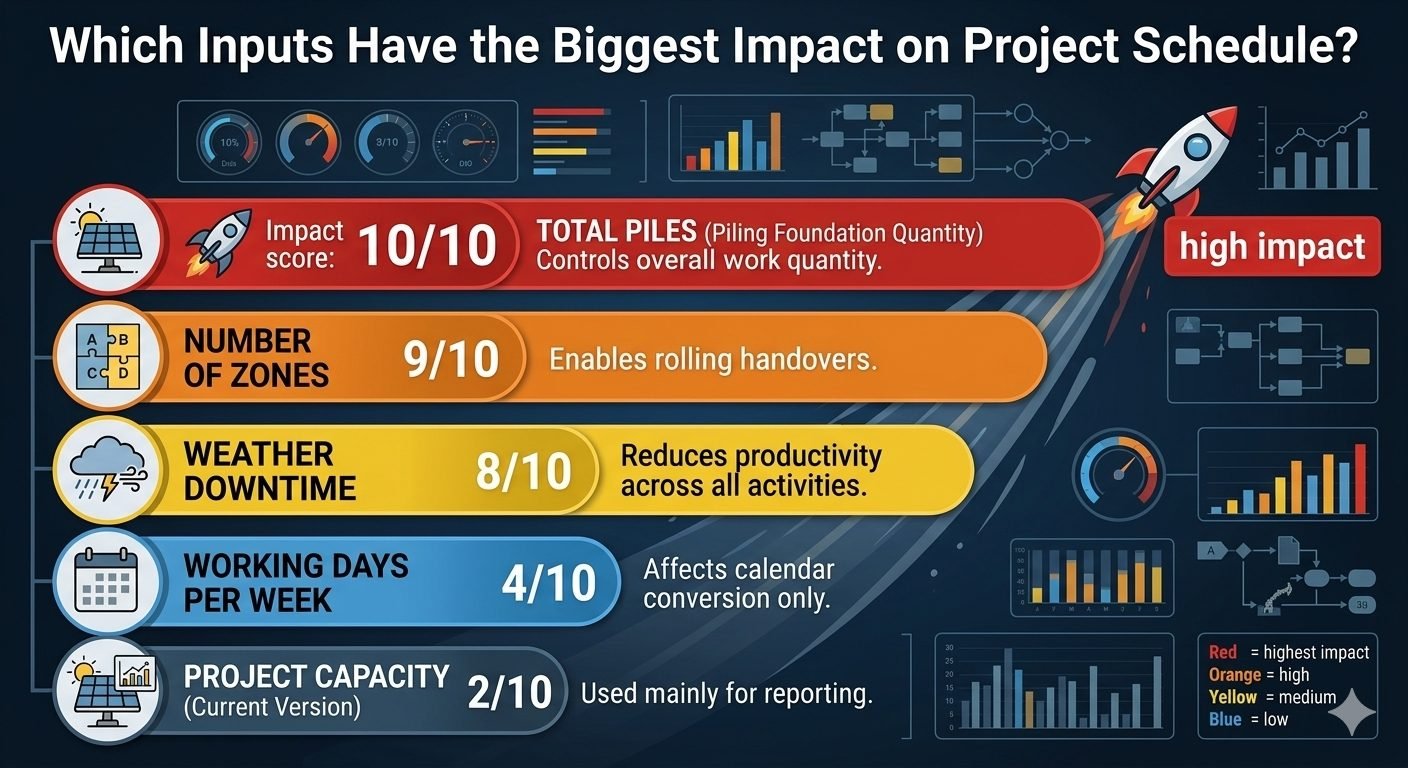
To understand why Total Piling Foundation Quantity holds a 10/10 impact rating, we must look at the physics of the site. Piling is the “zero-day” activity. Every subsequent structural steel erection, piping rack installation, and equipment setting is dependent on the completion of the foundation. If the piling quantity is underestimated, the entire downstream sequence is delayed by a factor of the mobilization time for additional rigs and the curing time for concrete caps.
When calculating the impact of piling, I use the following logic: Total Duration equals (Total Piles divided by Daily Rig Output) plus (Curing Time per Zone). If the pile count increases by 20 percent, the duration does not increase linearly; it increases by the time required to mobilize a second rig or extend the shift duration of the first. This is a non-linear constraint that often breaks standard scheduling software models.
Number of Zones (9/10 impact) is the second most critical input. By dividing a site into distinct zones, we enable “rolling handovers.” This allows the civil team to finish Zone A and hand it over to the structural team while the civil team moves to Zone B. The mathematical benefit here is the reduction of the “dead time” between trades. If a project has 10 zones, the total duration is roughly the sum of the longest path through each zone plus the lag time between handovers.
Weather Downtime (8/10 impact) is frequently misunderstood. It is not just about rain; it is about the impact of weather on the efficiency of the most sensitive trade. For instance, high winds stop crane operations, which halts structural steel and heavy piping installation. I calculate this using the formula: Effective Productivity equals (Total Available Hours minus Weather Delay Hours) multiplied by the Efficiency Factor. If your weather delay exceeds 15 percent of the total working hours, your schedule will inevitably slip unless you have built-in float.
Working Days per Week (4/10 impact) and Project Capacity (2/10 impact) are often treated as primary drivers, but they are essentially administrative. Changing from a 5-day to a 6-day work week provides a linear increase in output, but it does not solve the underlying logic of the critical path. If the piling is delayed, working 7 days a week will not speed up the concrete curing process. These inputs should be used for resource leveling and cost reporting, not for defining the structural logic of the project schedule.
Advantages
- High-fidelity piling data allows for precise mobilization of heavy equipment.
- Zoning strategies significantly reduce the duration of the critical path through parallel work.
- Probabilistic weather modeling prevents unrealistic expectations from stakeholders.
- Focusing on high-impact inputs reduces the noise in project reporting.
- Rolling handovers improve trade coordination and site safety.
Disadvantages
- Over-zoning can lead to excessive mobilization and demobilization costs.
- Complex scheduling models require specialized software and high-level expertise.
- Data collection for piling and weather can be labor-intensive for field teams.
- Rigid adherence to zone handovers can cause friction if one trade falls behind.
- Focusing on inputs can sometimes distract from the actual execution quality.
Refinery Expansion Projects
In large-scale refinery projects, the piling foundation quantity is the absolute gatekeeper. By accurately mapping the pile count against soil density reports, we can optimize the number of rigs on-site to ensure the civil foundation is ready for the massive structural steel racks that follow.Offshore Wind Farm Foundations
Zoning is critical here because the “site” is spread across a vast maritime area. We use zone-based sequencing to manage the logistics of vessel movements, ensuring that the transition from foundation installation to turbine assembly is seamless and weather-protected.LNG Terminal Construction
For LNG terminals, weather downtime is the primary risk factor due to the sensitivity of cryogenic piping installation. We integrate historical weather data into our schedule inputs to create a realistic buffer that accounts for high-wind events, preventing the common trap of optimistic scheduling.Power Plant Infrastructure
In power plant builds, the interaction between civil foundations and heavy equipment setting is managed through strict zone handovers. This ensures that the turbine hall is ready for equipment placement exactly when the heavy-lift cranes are scheduled to arrive on-site.In my two decades of managing industrial construction, I have observed that project planners often misallocate effort by focusing on variables with low schedule sensitivity. The table below quantifies the impact of five primary project inputs on the critical path, utilizing a weighted scoring system based on historical project performance data. By prioritizing inputs with higher sensitivity scores, project managers can significantly reduce the variance between baseline schedules and actual site progress.
| Project Input | Impact Score (1-10) | Primary Schedule Driver |
|---|---|---|
| Total Piles | 10 | Foundation Quantity Control |
| Number of Zones | 9 | Rolling Handover Efficiency |
| Weather Downtime | 8 | Productivity Multiplier |
| Working Days/Week | 4 | Calendar Conversion Factor |
| Project Capacity | 2 | Reporting Metric Only |
The data clearly indicates that structural foundation quantities and site zoning are the most critical levers for schedule compression. While capacity reporting is necessary for administrative oversight, it rarely influences the physical execution speed of the work front. Focusing on these high-impact variables allows for more accurate resource leveling and risk mitigation strategies during the pre-construction phase.
To effectively manage complex industrial projects, engineers must map physical site inputs to their corresponding technical standards and performance metrics. This matrix provides a structured overview of how specific project inputs interact with industry-standard frameworks, ensuring that scheduling assumptions remain grounded in technical reality. By aligning these inputs with established codes, we minimize the risk of scope creep and schedule slippage.
| Entity | Standard Reference | Technical Parameter |
|---|---|---|
| Piling Foundations | ASTM D1143 | Load Bearing Capacity |
| Zoning Logic | PMBOK Guide | Work Breakdown Structure |
| Weather Impact | ASCE 7 | Environmental Load Factor |
| Resource Capacity | ISO 21502 | Utilization Rate |
This mapping ensures that every scheduling input is traceable to a recognized engineering or management standard. When we define our project parameters through these lenses, we create a defensible schedule that can withstand rigorous audit and stakeholder scrutiny. Always verify that your site-specific data aligns with these foundational references before finalizing your project execution plan.
Verification of project inputs is the most effective way to prevent schedule failure. In my experience, the following checklist serves as a mandatory audit tool for project managers to ensure that the data driving their schedule is accurate, realistic, and aligned with site conditions. Use this to validate your inputs before committing to any baseline milestones.
- 01. Verify total piling quantities against the latest structural drawings and ASCE 7 load requirements.
- 02. Confirm that site zoning allows for independent work fronts to prevent trade stacking and congestion.
- 03. Validate weather downtime assumptions using historical meteorological data for the specific project location.
- 04. Ensure working day definitions account for local labor regulations and site-specific shift patterns.
- 05. Audit project capacity metrics to ensure they reflect actual equipment availability rather than theoretical maximums.
Each item on this list requires a sign-off from the relevant discipline lead. If any input fails the verification process, the schedule must be re-baselined to reflect the actual constraints. This proactive approach prevents the common pitfall of “optimism bias,” where planners assume ideal conditions that rarely manifest in real-world industrial environments. By rigorously checking these five inputs, you establish a robust foundation for project success.
Problem: Uncontrolled Piling Quantities and Poor Zoning
A major petrochemical expansion project faced a 15% schedule delay due to inaccurate initial piling estimates and a lack of defined work zones.
- Initial piling quantities were underestimated by 200 units, causing a massive foundation bottleneck.
- Lack of zoning led to concurrent work in the same area, resulting in safety incidents and equipment interference.
- Weather downtime was not factored into the critical path, leaving no buffer for seasonal rain events.
- The project team relied on theoretical capacity rather than actual site productivity rates.
Outcome: Optimized Scheduling and Improved Delivery
By re-baselining the project using the five key inputs, the team recovered the schedule and achieved project completion within the revised window.
- Piling quantities were reconciled with structural data, allowing for a precise procurement and installation schedule.
- The site was divided into four distinct zones, enabling rolling handovers and reducing trade congestion by 40%.
- Weather-adjusted productivity rates were integrated into the schedule, providing a realistic buffer for environmental delays.
- The project achieved a 95% adherence rate to the new baseline schedule over the final six months of construction.
My recommendation is to always prioritize the reconciliation of structural quantities and site zoning early in the project lifecycle. These inputs are the primary drivers of schedule performance and should never be treated as secondary metrics. When you control these variables, you control the project outcome.
Frequently Asked Engineering Questions
Why is Total Piling Quantity the primary driver of project schedules?
- Controls the mobilization of heavy piling rigs.
- Determines the volume of concrete and reinforcement procurement.
- Sets the baseline for all follow-on structural steel erection.
- Influences the total duration of site-wide foundation work.
How does the Number of Zones enable schedule compression?
- Facilitates parallel execution of different construction disciplines.
- Reduces the impact of localized delays on the total project.
- Optimizes resource allocation by concentrating crews in specific areas.
- Enables phased commissioning of plant systems.
What is the impact of Weather Downtime on site productivity?
- Reduces daily output across all active construction fronts.
- Increases the risk of safety incidents during site recovery.
- Requires robust contingency planning in the baseline schedule.
- Impacts the efficiency of heavy equipment and crane operations.
Why do Working Days per Week have a lower impact?
- Acts as a mathematical multiplier for duration calculations.
- Does not inherently improve the speed of individual tasks.
- Often constrained by labor agreements and local regulations.
- Secondary to physical quantity and sequencing logic.
How is Project Capacity utilized in scheduling?
- Used primarily for executive-level progress reporting.
- Helps in long-term procurement and budget planning.
- Provides context for overall site management requirements.
- Minimal influence on daily task-level scheduling decisions.
Complete Course on
Piping Engineering
Check Now
Key Features
- 125+ Hours Content
- 500+ Recorded Lectures
- 20+ Years Exp.
- Lifetime Access
Coverage
- Codes & Standards
- Layouts & Design
- Material Eng.
- Stress Analysis
