What is CE Marking? Requirements, Steps, and Engineering Compliance
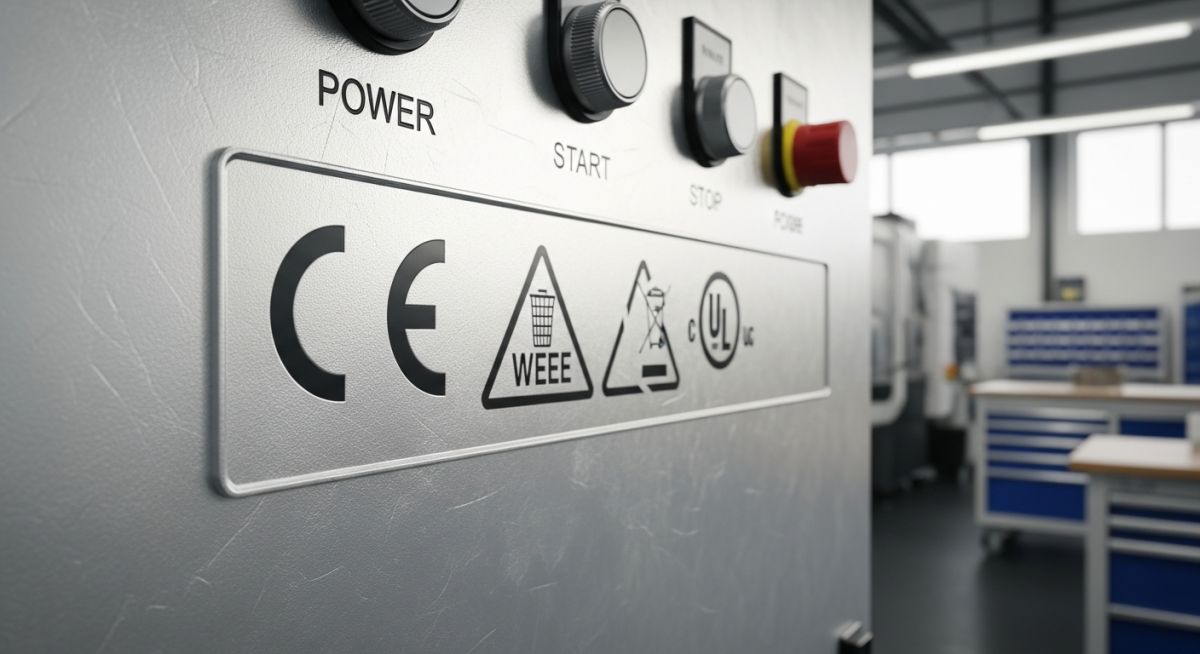
In my 20-plus years of designing and commissioning industrial piping systems and modular process skids, I have seen many brilliant engineering designs stall at the European border. The culprit is almost always a misunderstanding of the CE Marking process. CE stands for Conformité Européenne (European Conformity). It is not a quality mark, nor is it a certification of origin. Instead, it is a manufacturer’s declaration that the product meets all applicable European Union (EU) safety, health, and environmental protection requirements.
When you are exporting heavy machinery, pressure vessels, or integrated piping networks to the European Economic Area (EEA), obtaining this mark is a legal prerequisite. Without it, your equipment will be impounded at customs, and your project will face catastrophic delays. Let me guide you through the technical realities of this compliance framework from an engineer’s perspective.
Key Engineering Takeaways
- Legal Passport: The CE mark acts as a trade passport, allowing free movement of goods within the 30 member states of the EEA.
- Directive Alignment: Industrial equipment often falls under multiple directives simultaneously, such as the Pressure Equipment Directive (PED) and the Machinery Directive.
- Technical File Ownership: The manufacturer retains ultimate legal responsibility for compiling and maintaining the technical documentation for at least ten years after the product is placed on the market.
Understanding CE Marking Directives and Technical Requirements
CE Marking Directives: The legislative frameworks established by the European Union that dictate the safety requirements and conformity assessment procedures for industrial machinery, pressure equipment, and electrical systems.
To successfully apply the CE mark, we must first identify which EU directives apply to our equipment. For industrial plant design, the most common directives include:
- Pressure Equipment Directive (PED) 2014/68/EU: Applies to the design, manufacture, and conformity assessment of pressure equipment and assemblies with a maximum allowable pressure PS greater than 0.5 bar.
- Machinery Directive 2006/42/EC: Covers machinery, interchangeable equipment, safety components, and lifting accessories.
- Low Voltage Directive (LVD) 2014/35/EU: Applies to electrical equipment designed for use with a voltage rating of between 50 and 1000 Volts AC, and between 75 and 1500 Volts DC.
- ATEX Directive 2014/34/EU: Covers equipment and protective systems intended for use in potentially explosive atmospheres.
Engineering Calculation: PED Hazard Categorization
Let us look at how we classify a pressure vessel under the PED. The hazard category (Category I to IV) determines whether we can self-certify or if we must involve a Notified Body. The classification depends on:
- The state of the fluid (Gas or Liquid).
- The fluid group (Group 1: Hazardous/Explosive; Group 2: Non-hazardous).
- The vessel volume (V in liters) or piping nominal size (DN).
- The maximum allowable pressure (PS in bar).
Let us calculate the hazard category for a nitrogen gas receiver (Group 2 Gas) operating under the following parameters:
Maximum Allowable Pressure (PS) = 12 bar
Volume (V) = 250 Liters
Calculation of Pressure-Volume Product (PS x V):
PS x V = 12 bar * 250 Liters = 3000 bar-liters
According to PED Annex II, Table 2 (Gases of Group 2):
– If PS x V is greater than 50 bar-liters and less than or equal to 1000 bar-liters, and PS is greater than 1000 bar, it falls under specific limits.
– For our values (PS = 12 bar, PS x V = 3000 bar-liters), because PS x V is greater than 1000 bar-liters and PS is greater than 4 bar, the vessel falls squarely into Category II.
This means self-certification is not permitted. We must engage a registered Notified Body to perform design examination and production surveillance.
For detailed guidelines on harmonized standards, you can consult the official European Commission CE Marking Portal.
Table 1: PED 2014/68/EU Hazard Categories for Group 2 Gases
The table below outlines the threshold limits for vessels containing Group 2 gases (such as air, nitrogen, and steam) to determine the required level of third-party intervention.
| Volume V (Liters) | Pressure PS (bar) | PS x V Product | Conformity Category | Notified Body Required? |
|---|---|---|---|---|
| V ≤ 1 | Any | Any | Sound Engineering Practice (SEP) | No (CE mark forbidden) |
| V > 1 | PS ≤ 0.5 | Any | Sound Engineering Practice (SEP) | No (CE mark forbidden) |
| V > 1 | PS > 0.5 | 50 < PS x V ≤ 200 | Category I | No (Self-Declaration) |
| V > 1 | PS > 0.5 | 200 < PS x V ≤ 1000 | Category II | Yes (Module A2/D1/E1) |
| V > 1 | PS > 0.5 | 1000 < PS x V ≤ 3000 | Category III | Yes (Module B+D/B+F/G) |
| V > 1 | PS > 0.5 | PS x V > 3000 | Category IV | Yes (Module B+D/G) |
Table 2: Technical Mapping & Specifications Matrix
This matrix maps common industrial equipment types to their primary EU directives, harmonized standards, and conformity assessment routes.
| Equipment Type | Primary Directive | Harmonized Standards | Conformity Route | Key Technical Deliverable |
|---|---|---|---|---|
| Shell Boilers | PED 2014/68/EU | EN 12953 | Category IV (Notified Body) | Design Examination Certificate |
| Industrial Pumps | Machinery 2006/42/EC | EN ISO 12100 / EN 809 | Self-Declaration (Category I) | Risk Assessment File |
| Control Panels | LVD 2014/35/EU | EN 60204-1 | Self-Declaration | Electrical Test Reports |
| Process Piping Skids | PED & Machinery | EN 13480 / EN ISO 12100 | Assembly Assessment | Global Declaration of Conformity |
Executing the CE Marking Verification Process
CE Marking Verification: The systematic engineering protocol used to validate that physical assemblies, technical files, and manufacturing controls align with applicable European harmonized standards before declaration.
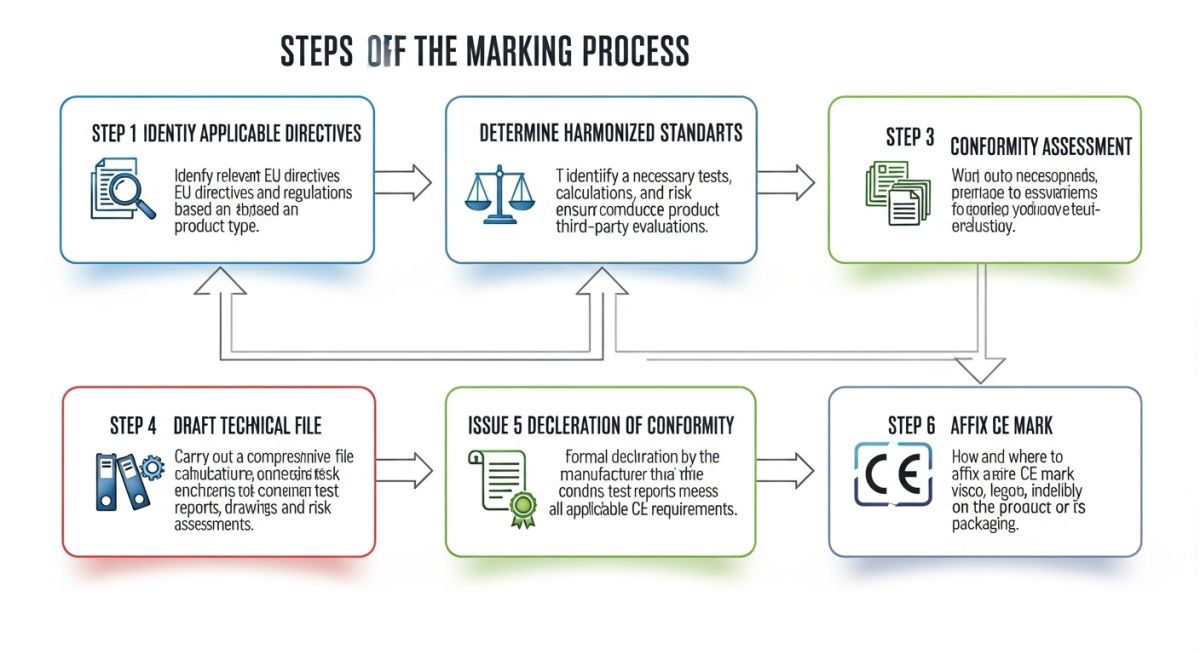
Before you sign the Declaration of Conformity (DoC) and apply the physical CE label to your equipment, you must complete a rigorous verification process. This checklist represents the exact workflow I use on-site to ensure compliance and prevent costly customs delays.
On-Site CE Compliance Verification Checklist
Confirm all applicable directives (PED, Machinery, LVD, ATEX, EMC) have been identified based on operating parameters and environmental conditions.
Verify that the design calculations reference current harmonized European standards (e.g., EN 13445 for pressure vessels, EN 13480 for metallic piping) rather than solely ASME codes.
Ensure a formal, documented risk assessment has been conducted, identifying hazards, evaluating risks, and implementing mitigation measures (inherently safe design, safeguarding, or user warnings).
Assemble the technical file containing: general drawings, electrical schematics, design calculations, material test certificates (EN 10204 Type 3.1/3.2), NDT reports, and operating manuals translated into the destination country’s language.
For high-hazard equipment (e.g., PED Category II, III, IV), verify that a registered Notified Body has reviewed the design, witnessed pressure tests, and issued the appropriate conformity certificates.
Inspect the physical nameplate. It must permanently display: the CE logo (minimum 5mm height), manufacturer name and address, model/serial number, year of construction, and the 4-digit identification number of the Notified Body (if involved).
For more details on compiling technical files, refer to the ISO 12100 Risk Assessment Standard.
Field Case Study: Real-World Application
The Problem: Customs Rejection of a Chemical Dosing Skid
A North American manufacturer shipped a modular chemical dosing skid to a refinery in Germany. The skid included piping, pumps, control panels, and a small chemical storage tank. Although the individual components were high-quality and ASME-compliant, the manufacturer applied a CE mark to the control panel only, assuming it covered the entire skid.
Upon arrival at the port of Hamburg, German customs officials impounded the skid. They noted that the integrated piping network operated at 15 bar and contained hazardous chemicals (Group 1 Fluid), which classified the piping assembly under PED Category II. Because the manufacturer had not compiled a global technical file, performed a risk assessment, or involved a Notified Body for the integrated assembly, the skid was denied entry.
The Outcome: Remediation and Compliance
I was brought in to resolve the impasse. We immediately halted the project and executed the following recovery steps:
- We performed a retrospective PED hazard categorization, confirming the piping fell under Category II.
- We engaged a European Notified Body to perform a field inspection, review the weld procedures (WPS/PQR), and witness non-destructive testing (NDT) on-site at the port warehouse.
- We compiled a comprehensive Technical File, including a formal risk assessment according to EN ISO 12100.
- The Notified Body issued a conformity certificate, allowing the manufacturer to issue a global Declaration of Conformity and apply the CE mark with the Notified Body’s 4-digit ID.
The skid was released after a 4-week delay, costing the manufacturer over 45,000 in storage fees, engineering consulting, and expedited Notified Body audits.
My Recommendation: Always perform a multi-directive compliance review during the Front-End Engineering Design (FEED) phase. Retrofitting compliance after fabrication is exponentially more expensive than designing for compliance from day one.
Frequently Asked Engineering Questions
What is the full form of CE and what does it mean?
Can an engineer self-certify a product for CE Marking?
What is the role of a Notified Body in the CE process?
Is ASME certification equivalent to CE Marking?
What documents must be included in the Technical File?
How long must a manufacturer keep the Technical File?
Complete Course on
Piping Engineering
Check Now
Key Features
- 125+ Hours Content
- 500+ Recorded Lectures
- 20+ Years Exp.
- Lifetime Access
Coverage
- Codes & Standards
- Layouts & Design
- Material Eng.
- Stress Analysis