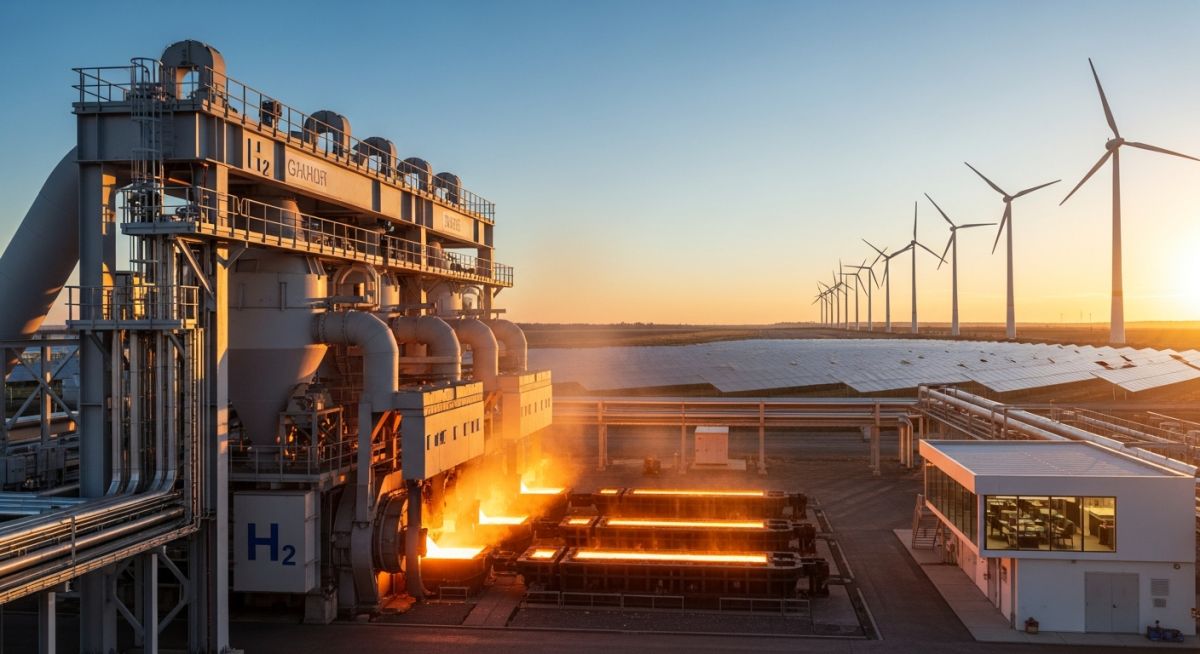
What is Green Steel and How is Green Steel Made?
In my 20-plus years of designing high-pressure piping systems and heavy industrial plants, I have watched the steel industry struggle with its massive carbon footprint. Traditional blast furnaces are thermodynamic monsters, responsible for roughly 8 percent of global carbon dioxide emissions. But the tide is turning. I am currently working on piping layouts for some of the world’s first commercial-scale hydrogen-based direct reduction plants. What we are seeing is not just an incremental upgrade; it is a complete metallurgical revolution.
To understand this shift, we must look past the marketing buzzwords. True decarbonization requires replacing fossil carbon at the molecular level. By substituting metallurgical coal with green hydrogen, we can transform iron ore into pure iron while emitting nothing but water vapor. This article breaks down the exact chemical, thermodynamic, and mechanical engineering realities of this transition.
Key Engineering Takeaways
- Hydrogen replaces carbon monoxide as the reducing agent, yielding water vapor instead of carbon dioxide.
- Electric Arc Furnaces (EAF) run on renewable electricity to melt direct reduced iron (DRI) and scrap steel.
- Piping systems must be redesigned to handle high-pressure, high-temperature hydrogen gas safely without embrittlement.
How is Green Steel Made via Hydrogen?
The heart of traditional steelmaking is the Blast Furnace-Basic Oxygen Furnace (BF-BOF) route. In this process, coke (derived from coal) acts as both the fuel and the reducing agent. The carbon monoxide (CO) gas generated from burning coke strips oxygen from the iron ore (Fe2O3), producing liquid hot metal and massive amounts of carbon dioxide (CO2).
In a hydrogen-based Direct Reduced Iron (H2-DRI) plant, we completely bypass this carbon-heavy step. Instead of a blast furnace, we use a vertical shaft furnace. Green hydrogen gas (H2) is preheated and injected into the furnace. As it flows upward through the falling iron ore pellets, a gas-solid reduction reaction occurs.
Hydrogen Reduction: Fe2O3 + 3 H2 -> 2 Fe + 3 H2O (Highly Endothermic)
Because the hydrogen reduction reaction is highly endothermic, it requires a continuous input of thermal energy to maintain the reaction zone between 800 and 900 degrees Celsius. This is where my experience in piping design becomes critical. The piping systems feeding the shaft furnace must handle high-velocity, high-temperature hydrogen gas.
Once the iron ore is reduced in the shaft furnace, it emerges as solid Direct Reduced Iron (DRI), also known as sponge iron. This sponge iron is then transferred directly to an Electric Arc Furnace (EAF). The EAF uses high-power electric arcs generated by carbon electrodes to melt the solid DRI along with recycled steel scrap. By powering these electrodes with 100% renewable energy (wind, solar, or hydro), the entire melting and refining process is decarbonized.
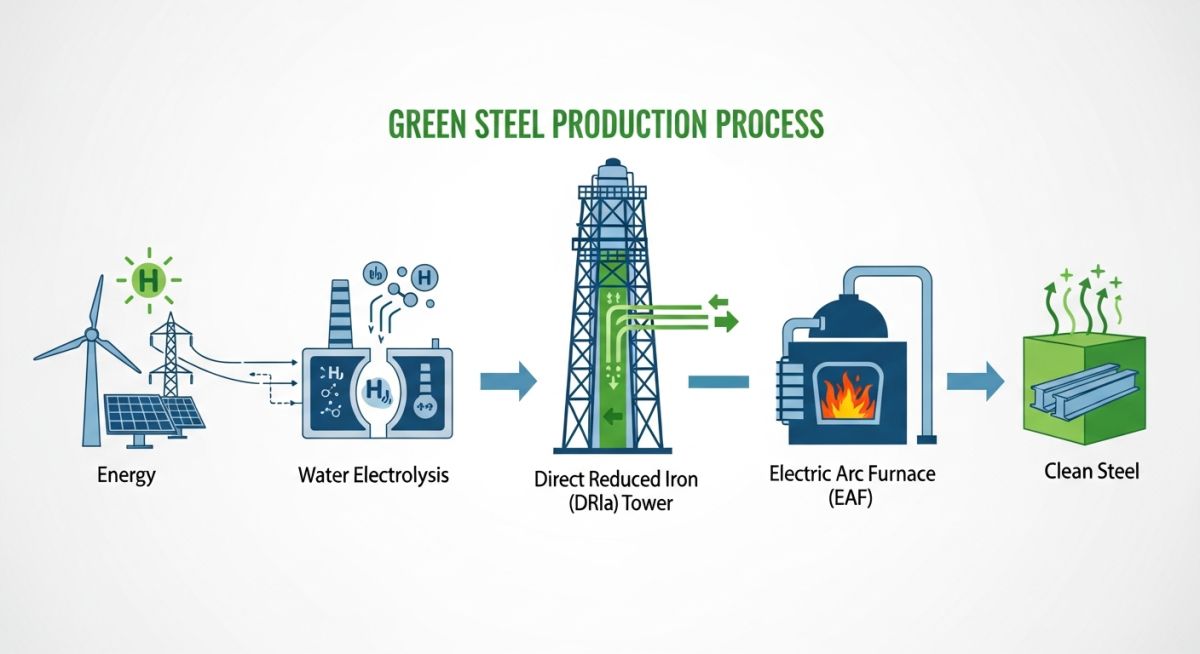
To transport the massive volumes of hydrogen required for a commercial-scale plant, the piping network must be designed in accordance with ASME B31.12. This code governs hydrogen piping and pipelines, specifying strict limits on material hardness, welding procedures, and non-destructive testing (NDT) to mitigate the risk of hydrogen embrittlement.
Comparing Traditional and Green Steel Processes
To fully appreciate the engineering shift, we must look at the raw numbers. The table below contrasts the traditional coal-based blast furnace route with the emerging hydrogen-based direct reduction route.
| Parameter | Traditional BF-BOF Route | Hydrogen DRI-EAF Route |
|---|---|---|
| Primary Energy Source | Metallurgical Coal / Coke | Renewable Electricity |
| Primary Reducing Agent | Carbon Monoxide (CO) | Green Hydrogen (H2) |
| CO2 Emissions (per ton of steel) | 1.8 to 2.2 tons CO2 | Less than 0.1 tons CO2 |
| By-product of Reduction | Carbon Dioxide (CO2) Gas | Water Vapor (H2O) |
| Piping Material Class | Standard Carbon Steel (ASME B31.3) | High-Alloy Stainless / Cr-Mo (ASME B31.12) |
Technical Mapping & Specifications Matrix
Implementing these systems requires a deep understanding of the technical entities and standards involved. The following matrix maps out the core components of a green steel facility.
| Entity / Acronym | Technical Definition | Design Parameter | Standard Reference |
|---|---|---|---|
| H2-DRI | Hydrogen Direct Reduced Iron | Metallization rate greater than 94% | ISO 11258 |
| EAF | Electric Arc Furnace | Power density: 600-800 kVA/ton | NFPA 70 |
| PEM Electrolyzer | Proton Exchange Membrane | Operating pressure: 30-50 bar | ISO 22734 |
| HTHA Piping | High-Temperature Hydrogen Piping | Max temperature: 900 degrees Celsius | API RP 941 |
How to Verify Green Steel Quality?
As an engineer, I am naturally skeptical of green labels. A bridge or a high-pressure pipeline does not care about carbon footprints; it cares about yield strength, tensile strength, and fracture toughness. We must ensure that steel produced via hydrogen reduction meets the exact same rigorous mechanical standards as traditional steel.
Site Verification Checklist
-
Mechanical Property Testing: Conduct tensile testing and Charpy V-notch impact testing to confirm yield strength, ultimate tensile strength, and low-temperature ductility.
-
Hydrogen Source Auditing: Review the Environmental Product Declaration (EPD) to verify that the hydrogen used was certified green (produced via water electrolysis using renewable energy) under ISO 14067.
-
Microstructural Analysis: Perform metallographic analysis to check for micro-voids or hydrogen-induced cracking (HIC) if the steel was exposed to hydrogen during processing.
Field Case Study: Real-World Application
The Problem: Micro-Cracking in Hydrogen-DRI Slabs
During the commissioning of an early-stage hydrogen-DRI pilot plant in northern Europe, a structural steel fabricator noticed micro-cracking along the bend radii of heavy structural sections during cold-forming. The steel met all standard chemical specifications on paper, but the physical cracking persisted, halting production.
The Outcome: Thermal Degassing & Process Optimization
I was brought in to audit the fabrication and metallurgical process. We discovered that the pilot plant had not fully baked out the residual hydrogen from the DRI briquettes before melting them in the EAF. This led to hydrogen entrapment in the final cast slabs. We implemented a strict thermal degassing protocol at 250 degrees Celsius for 4 hours post-casting, which completely eliminated the micro-cracking and restored full ductility.
This case highlights a critical lesson: transitioning to green technology requires a deep understanding of the physical chemistry involved. You cannot simply swap out coal for hydrogen without adjusting your thermal and degassing protocols downstream.
Frequently Asked Engineering Questions
Is green steel structurally identical to traditional steel?
What is the role of green hydrogen in steelmaking?
How does an Electric Arc Furnace (EAF) differ from a Blast Furnace?
What are the main piping challenges in hydrogen-based steel plants?
How is the carbon footprint of green steel certified?
What is the cost premium for green steel today?
===
Complete Course on
Piping Engineering
Check Now
Key Features
- 125+ Hours Content
- 500+ Recorded Lectures
- 20+ Years Exp.
- Lifetime Access
Coverage
- Codes & Standards
- Layouts & Design
- Material Eng.
- Stress Analysis

