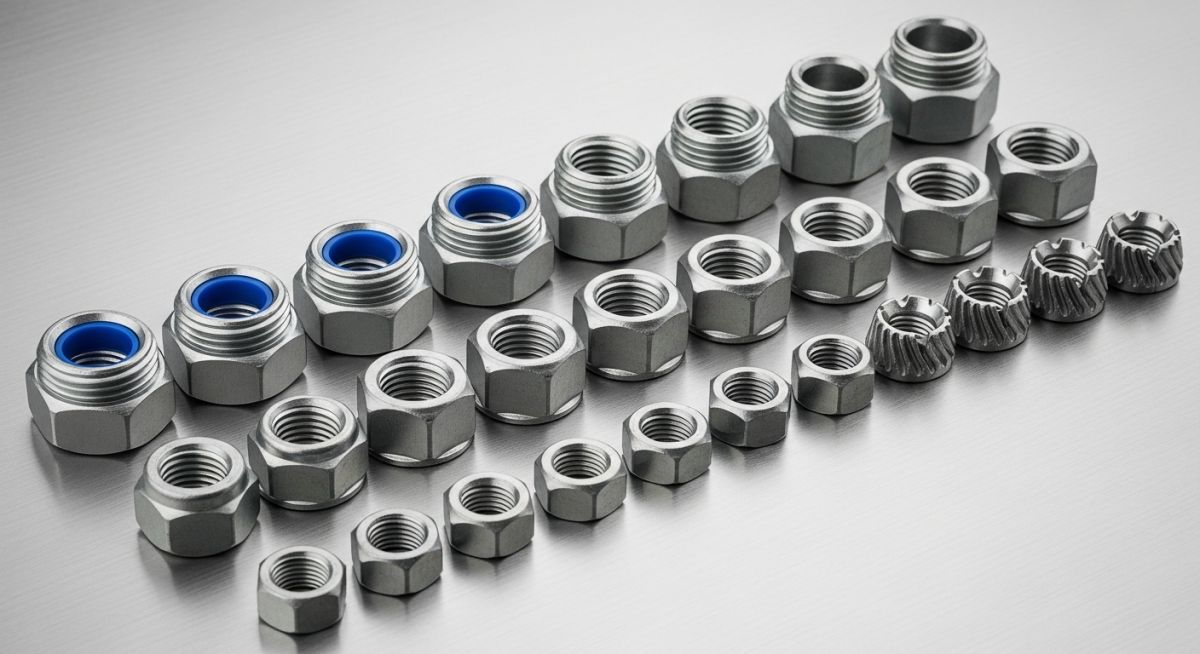
What Are Lock Nuts and How Do They Work
In my 20 years of piping and mechanical engineering, I have seen minor components cause catastrophic plant shutdowns. A single standard hex nut backing off a high-vibration pump skid can lead to structural failure, fluid release, or severe equipment damage. That is where lock nuts come in. I will share my field experience on how these critical fasteners maintain joint integrity under extreme cyclic stress, detailing their mechanics, types, and selection criteria.
Key Engineering Takeaways
- Understand the fundamental difference between prevailing torque and free-spinning locking mechanisms.
- Learn why nylon insert lock nuts have strict temperature limitations and must never be reused.
- Master the torque compensation calculations required when using prevailing torque fasteners.
- Identify the correct lock nut type for high-temperature, high-vibration piping and structural applications.
Prevailing Torque Mechanics: The physical resistance generated by friction-inducing elements within the nut thread profile that prevents rotation even in the absence of axial clamping force, governed by ASME B18.16.6.
To understand how lock nuts resist vibrational loosening, we must look at the physics of thread contact. In a standard bolted joint, the resistance to loosening is almost entirely dependent on the axial preload. When dynamic transverse vibration occurs, the relative motion between the mating threads momentarily reduces the friction coefficient to near zero, causing the nut to back off.
The Physics of Prevailing Torque
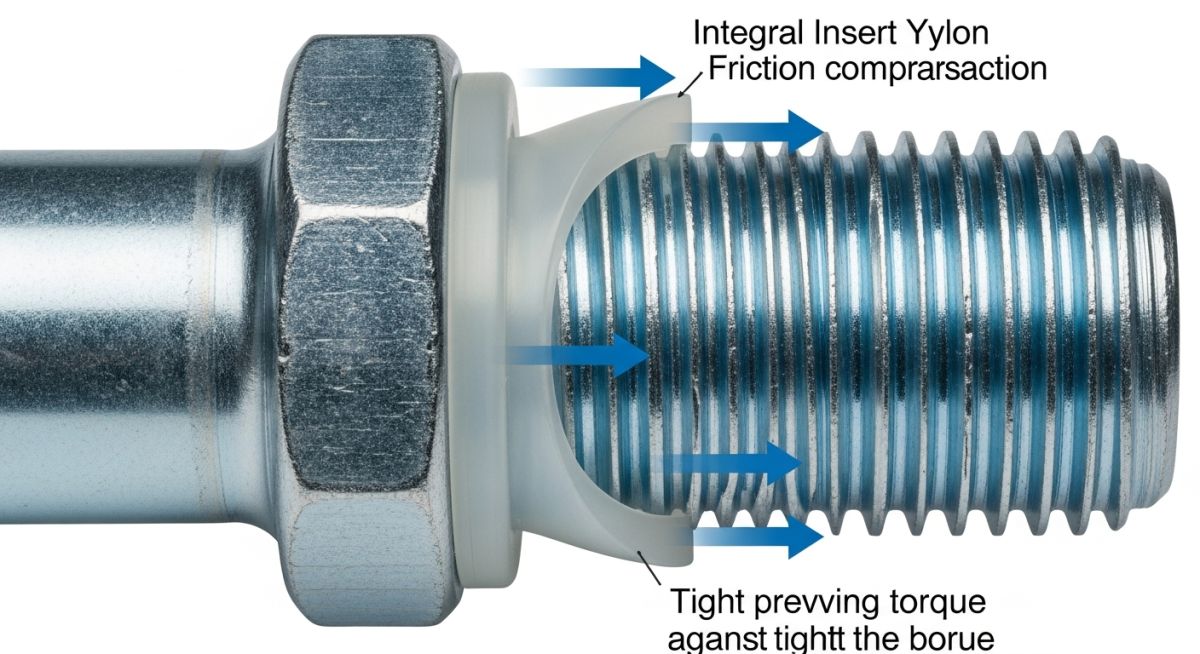
Prevailing torque lock nuts introduce a continuous friction force that is independent of the bolt preload. This is achieved through two primary methods: elastic deformation (such as nylon inserts) or plastic deformation of the nut threads (all-metal distorted thread nuts).
Torque Calculation Adjustments
When installing prevailing torque lock nuts, the standard torque formula must be modified. The prevailing torque (Tp) must be added to the calculated clamp torque (Tc) to achieve the target bolt preload.
Where:
– T_total is the total installation torque.
– K is the torque coefficient (friction factor).
– D is the nominal bolt diameter.
– F is the target bolt tension (preload).
– T_p is the measured prevailing torque of the nut during the free-spinning run-on phase.
Failure to account for T_p results in under-tensioned bolts, which is the leading cause of joint failure in high-vibration piping systems.
Fastener Performance Metrics: The standardized torque and proof load limits defined for prevailing torque fasteners to ensure structural reliability under dynamic loads.
| Lock Nut Type | Temperature Limit | Vibration Resistance | Reusability | Standard Specification |
|---|---|---|---|---|
| Nylon Insert | -40°C to 120°C | High | Very Low (Single Use Preferred) | ISO 7040 / ASME B18.16.6 |
| All-Metal Distorted Thread | -50°C to 300°C | Very High | Moderate (Up to 5 times) | ASME B18.16.6 / DIN 980 |
| Castle Nut (with Cotter Pin) | Limited only by material | Absolute (Mechanical Lock) | High (Replace Pin Only) | ASME B18.2.2 / DIN 935 |
| Serrated Flange Nut | Limited only by material | Moderate to High | Low (Damages mating surface) | ASME B18.21.1 |
| Technical Entity | Acronym | Physical Parameter | Reference Standard |
|---|---|---|---|
| Prevailing Torque | Tp | Newton-meters (Nm) / Inch-pounds | ISO 2320 |
| Clamp Load | Fi | Kilonewtons (kN) / Pounds-force | ASME PCC-1 |
| Thread Pitch Diameter | d2 | Millimeters (mm) / Inches | ASME B1.1 |
Quality Assurance Protocol: The systematic field verification steps required to guarantee correct installation torque and thread engagement for prevailing torque fasteners.
Before signing off on any high-vibration piping skid or structural connection, my field teams must execute this verification protocol. Skipping even one step can compromise the integrity of the joint.
Field Verification Steps
-
Verify Nut Grade Compatibility: Ensure the lock nut strength grade matches or exceeds the companion bolt grade (e.g., Grade 8 nut with Grade 8 bolt) per ASTM A563.
-
Inspect Nylon Inserts: Check for any pre-existing thermal or mechanical damage to the polymer ring before installation.
-
Measure Prevailing Torque (Tp): Spin the nut onto the bolt by hand until the locking element engages, then use a dial torque wrench to measure the run-on torque before it bottoms out.
-
Confirm Thread Engagement: Ensure at least two full threads extend past the top of the lock nut after final torque application.
-
Document Torque Values: Record the final adjusted torque (Tc + Tp) in the quality control log for traceability.
Field Case Study: Real-World Application
The Problem: Chronic Loosening on Reciprocating Compressor Skids
At a natural gas processing facility, a critical reciprocating compressor skid experienced chronic structural bolt loosening. The original design utilized standard hex nuts with split lock washers. Within 45 days of continuous operation, the high-frequency vibration caused the split washers to flatten and the nuts to back off, resulting in severe shaft misalignment and a costly unscheduled shutdown.
The Solution: Transition to All-Metal Prevailing Torque Lock Nuts
I led the engineering team to redesign the joint. We eliminated the split lock washers and replaced the standard nuts with all-metal distorted thread lock nuts (Stover style) conforming to ASME B18.16.6 Grade C. We recalculated the installation torque to account for the prevailing torque of the new nuts. After 24 months of continuous operation, zero bolt loosening or alignment drift was recorded.
My direct recommendation for any high-vibration, high-temperature application is to completely avoid split lock washers. They do not provide reliable locking under dynamic loads. Instead, specify all-metal prevailing torque lock nuts to ensure long-term joint integrity.
Frequently Asked Engineering Questions
Can nylon insert lock nuts be reused in critical piping systems?
What is the maximum operating temperature for nylon lock nuts?
How do all-metal prevailing torque nuts differ from nylon insert nuts?
Why must I adjust my torque wrench settings when using lock nuts?
Are split lock washers a reliable alternative to lock nuts?
What standard governs the testing of prevailing torque lock nuts?
Complete Course on
Piping Engineering
Check Now
Key Features
- 125+ Hours Content
- 500+ Recorded Lectures
- 20+ Years Exp.
- Lifetime Access
Coverage
- Codes & Standards
- Layouts & Design
- Material Eng.
- Stress Analysis
