Wing Nut Types and Applications: The 2026 Engineering Guide to Butterfly Fasteners

Imagine you are on a high-pressure offshore rig, and a critical sensor housing needs immediate inspection. Searching for a specific wrench in a crowded toolbox while wearing heavy gloves isn’t just an inconvenience—it’s a safety risk and a source of operational downtime. This is where Wing Nut Types and Applications become the unsung heroes of mechanical design. By providing a tool-free, high-leverage fastening solution, these components transform complex maintenance tasks into simple, hand-operated maneuvers. This guide will navigate you through the technical nuances of material selection and the critical 2026 standards ensuring your assemblies remain secure under vibration.
Key Takeaways
- Understanding the distinction between ASME B18.6.9 Type A, B, and C classifications for structural integrity.
- Selecting the right Wing Nut Types and Applications based on torque requirements and environmental corrosion factors.
- Optimizing maintenance workflows by integrating hand-tightened fasteners in non-critical load-bearing paths.
What are Wing Nut Types and Applications?
Wing Nut Types and Applications refer to a category of specialized fasteners featuring two “wings” for manual tightening without tools. Major types include Type A (Cold Forged), Type B (Hot Forged), and Type C (Die Cast). They are primarily used in applications requiring frequent disassembly, such as access panels, adjustment brackets, and consumer electronics.
“In over two decades of EPC project management, I’ve seen wing nuts fail not because of the design, but because of poor material selection in high-vibration environments. For 2026, we are seeing a major shift toward nylon-insert wing nuts to prevent backing off in industrial HVAC systems.”
– Atul Singla, Founder
Complete Course on
Piping Engineering
Check Now
Key Features
- 125+ Hours Content
- 500+ Recorded Lectures
- 20+ Years Exp.
- Lifetime Access
Coverage
- Codes & Standards
- Layouts & Design
- Material Eng.
- Stress Analysis
Fastener Engineering Quiz: Wing Nut Mastery
Test your knowledge on Wing Nut Types and Applications per 2026 standards.
Question 1 of 5
Which ASME B18.6.9 classification refers to a Cold Forged wing nut?
Mechanical Characteristics of Wing Nut Types and Applications
The engineering profile of Wing Nut Types and Applications is defined by the unique dual-wing geometry which acts as an integrated lever. Unlike standard fasteners that require external mechanical advantage via wrenches, wing nuts utilize the user’s grip strength to generate clamping force. In 2026, the structural integrity of these components is largely dictated by ASME B18.6.9 standards, which specify the required wing spread and height to ensure adequate torque can be applied without wing deformation.
Key characteristics include internal threading—typically ranging from coarse (UNC) to fine (UNF) pitches—and a specialized collar or “boss” that provides a bearing surface against the mating part. This surface area is critical in Wing Nut Types and Applications to prevent localized material crushing on softer substrates like plastics or thin-gauge sheet metal. The 2026 iterations often feature enhanced fillet radii at the wing-to-body junction to mitigate stress concentrations that historically led to wing shear under high-impact loading.
How They Work: The Physics of Manual Torque in Wing Nuts
The functional principle behind Wing Nut Types and Applications is the conversion of rotational force into linear clamping force through the screw thread mechanism. By extending the radius of the point where force is applied (the wings), these fasteners allow a human hand to generate sufficient torque to secure a joint. This mechanical advantage is proportional to the wing span; however, engineers must balance wing length with spatial constraints within the assembly.
In precision engineering, the “working” phase involves achieving a snug fit that prevents axial movement while remaining below the yield strength of the wing material. Because Wing Nut Types and Applications are often subjected to frequent cycles of tightening and loosening, the thread galling resistance of the chosen alloy is a primary operational factor. For high-cycle applications, 2026 designs often incorporate dry-film lubricants or specialized coatings to maintain consistent friction coefficients over the component’s lifespan.
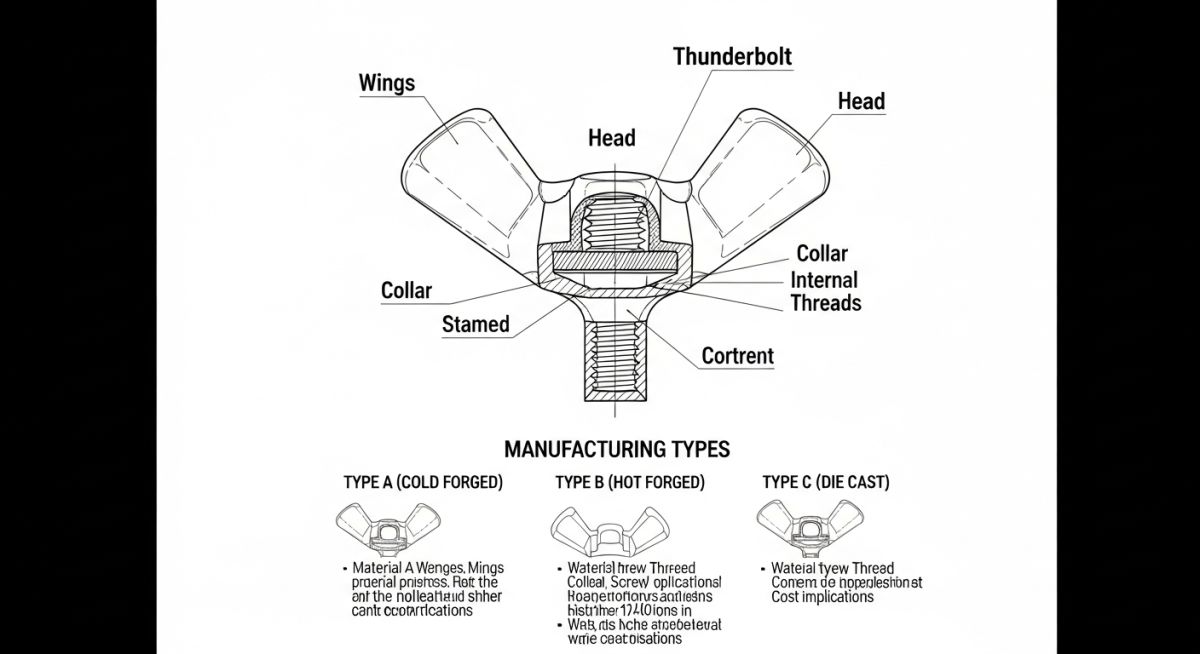
Classification: Exploring Different Wing Nut Types and Applications
Classification of Wing Nut Types and Applications is standardized to ensure interchangeability across global supply chains. The most prevalent system categorizes them by their manufacturing process, which directly impacts their grain structure and load-bearing capacity:
- Type A (Cold Forged): These are the most robust Wing Nut Types and Applications. Produced at room temperature, the metal undergoes work hardening, resulting in superior tensile strength and a smooth, aesthetically pleasing finish. They are the standard for 2026 structural assemblies.
- Type B (Hot Forged): Manufactured by heating the metal before forming, these nuts are typically used for larger diameters where cold forming would require excessive force. They offer excellent ductility but may require additional machining for precise thread tolerances.
- Type C (Die Cast): Commonly made from zinc or aluminum alloys, these are used in light-duty Wing Nut Types and Applications. While cost-effective, they possess lower fatigue resistance compared to forged variants and are best suited for consumer goods and non-structural covers.
Material Selection for Various Wing Nut Types and Applications
Selecting the correct metallurgy for Wing Nut Types and Applications is a critical engineering decision that balances tensile strength, corrosion resistance, and thermal expansion coefficients. In 2026, the industry has standardized on specific alloys to meet the rigorous demands of automated assembly lines and harsh environmental exposure. While carbon steel remains the economic baseline, the shift toward high-performance polymers and marine-grade stainless steels has accelerated for specialized Wing Nut Types and Applications.
For heavy-duty industrial use, ASTM A194 grade materials are often cross-referenced to ensure that the internal threads of the wing nut do not strip under the localized pressure of manual over-tightening. In the aerospace and medical sectors, Titanium Wing Nut Types and Applications are increasingly utilized due to their high strength-to-weight ratio and biocompatibility. Furthermore, the 2026 manufacturing landscape emphasizes RoHS compliance, ensuring that protective coatings like hexavalent chromium are replaced by safer, trivalent zinc or organic flake finishes.
Standard Sizing: ASME and ISO Specs for Wing Nuts
Dimensional accuracy is governed by ASME B18.6.9 for imperial units and DIN 315 for metric equivalents. These standards define the “wing spread”—the total width from tip to tip—and the “height,” which ensures the wings provide enough clearance for a human thumb and forefinger. When specifying Wing Nut Types and Applications, engineers must account for the thread fit (typically Class 2B for general applications) to ensure smooth manual operation without excessive wobble.
| Property | Type A (Cold Forged) | Type B (Hot Forged) | Type C (Die Cast) |
|---|---|---|---|
| Standard | ASME B18.6.9 | ASME B18.6.9 | ASME B18.6.9 |
| Material Integrity | High (Work Hardened) | Medium (Ductile) | Low (Brittle) |
| Typical Alloys | Steel, Stainless 304/316 | Carbon Steel, Brass | Zinc, Aluminum |
| Surface Finish | Superior/Bright | Industrial/Rougher | Smooth/Matte |
Industrial Wing Nut Types and Applications in 2026
In the current 2026 industrial environment, Wing Nut Types and Applications have moved beyond simple consumer hardware into specialized roles. In the renewable energy sector, they are used for solar tracker adjustments where seasonal tilt changes require tool-free precision. Within the chemical processing industry, heavy-series wing nuts are utilized on ISO-standardized pressure vessel covers that require frequent cleaning and inspection.
The 2026 trend also highlights the rise of “Smart Wing Nuts” integrated with RFID tags for asset tracking in massive logistics hubs. Whether it is securing a battery compartment in an EV charging station or a simple household lighting fixture, the diversity of Wing Nut Types and Applications ensures that human-machine interaction remains efficient and accessible.
EPCLand YouTube Channel
2,500+ Videos • Daily Updates
Wing Nut Torque & Tension Estimator (2026)
Estimate the clamping force generated by manual tightening of various Wing Nut Types and Applications based on finger-tight torque averages.
Estimated Clamping Force
Newtons (N)
Calculation based on 2026 K-factor coefficient of 0.20 (Standard Dry Steel).
Case Study: Choosing Between Wing Nut Types and Applications for Plant Retrofits
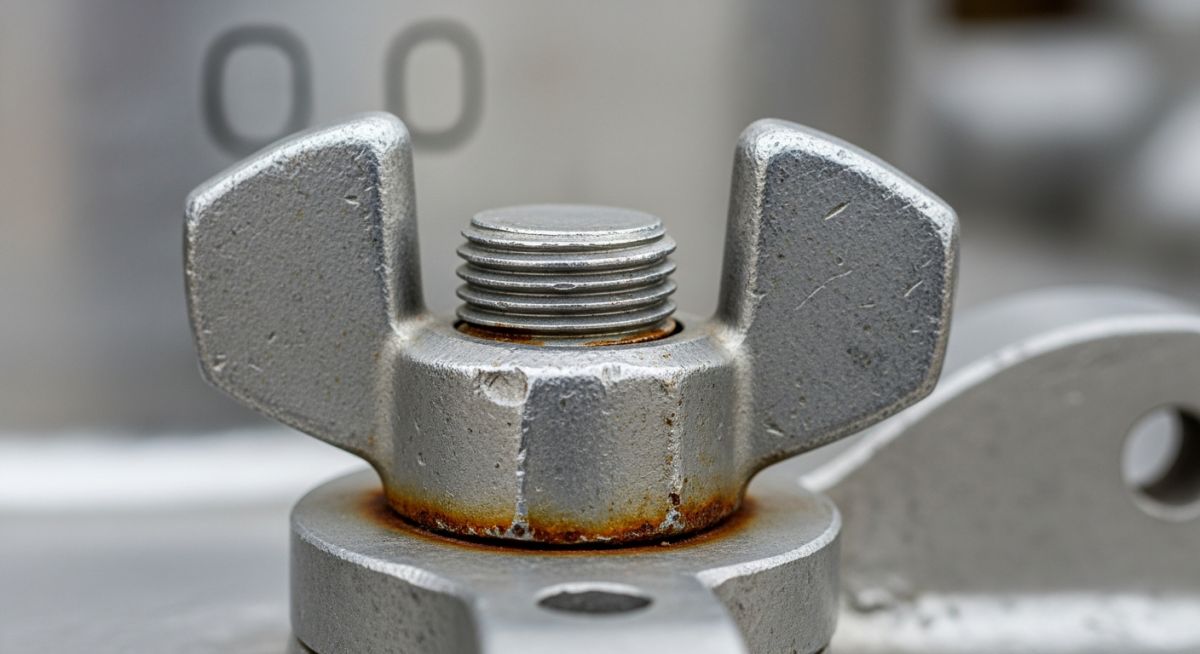
Sector
Wastewater Treatment
Challenge
Corrosion & Frequency
Solution
Type A 316 SS Wing Nuts
The Challenge: Rapid Access vs. Hostile Environment
In a 2026 municipal wastewater facility upgrade, engineers faced a bottleneck at the primary filtration stage. The access hatches for the debris screens required tool-assisted hex bolt removal twice per shift. The presence of hydrogen sulfide (H2S) and high humidity caused standard galvanized bolts to seize, increasing downtime by 40% over three months.
The Implementation: Engineering Wing Nut Types and Applications
The technical team transitioned to Type A Cold-Forged 316 Stainless Steel Wing Nuts. Unlike the previous hex bolts, these Wing Nut Types and Applications allowed operators to perform manual inspections without retrieving heavy tools from the maintenance shop. The decision to use Type A (Cold Forged) over Type C (Die Cast) was critical; the high vibration from the centrifugal pumps would have caused fatigue cracking in die-cast zinc variants within weeks.
Key Technical Outcome:
- Inspection Time: Reduced from 15 minutes to 45 seconds per hatch.
- Corrosion Resistance: Zero thread galling reported after 12 months of exposure.
- Cost Impact: 22% reduction in operational labor costs for the filtration unit.
This case confirms that selecting specific Wing Nut Types and Applications based on manufacturing process (Forging vs. Casting) and metallurgical grade is essential for industrial reliability in 2026.
