Monorail Crane Systems: Engineering Guide to Types, Components, and 2026 Standards
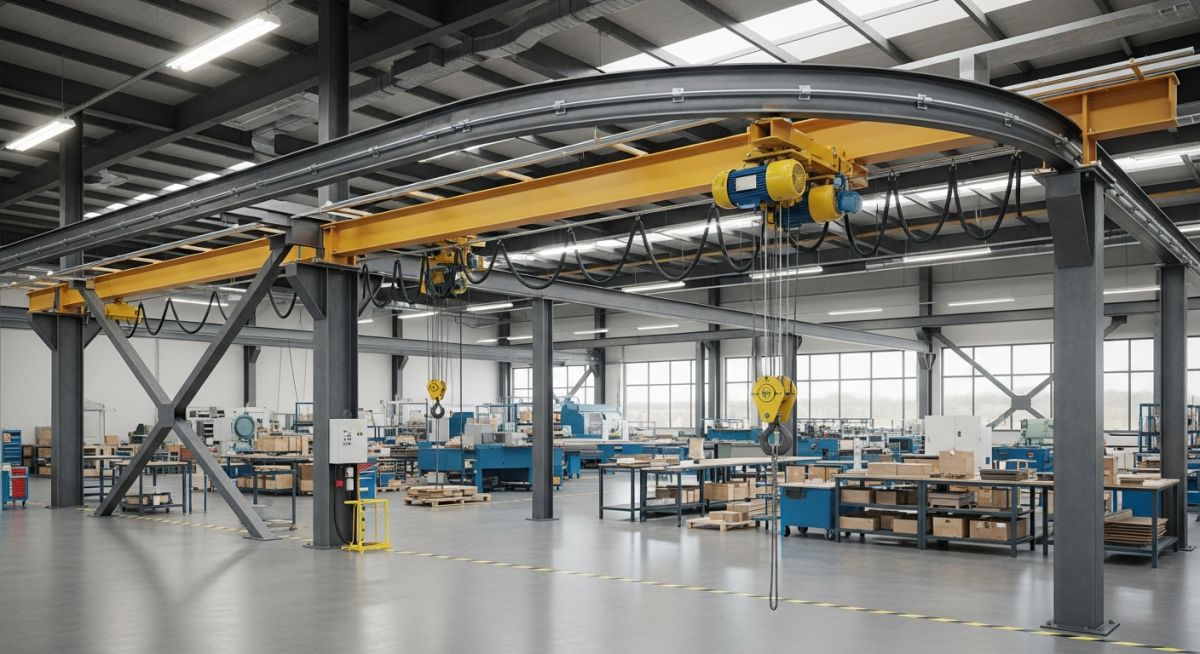
You are facing a critical bottleneck on the production floor: a high-volume assembly line that requires precise part positioning, but your facility lacks the structural footprint for a full-span bridge crane. Every minute of manual handling increases safety risks and drags down your OEE (Overall Equipment Effectiveness). Monorail Crane Systems offer the surgical precision needed to navigate tight corridors and fixed production paths without sacrificing vertical clearance.
This guide provides a deep technical dive into selecting, specifying, and maintaining Monorail Crane Systems to ensure your facility meets the rigorous safety and throughput demands of 2026.
Key Takeaways
- Optimized Pathing: Learn how curved tracks and switches allow Monorail Crane Systems to navigate complex facility layouts.
- Compliance Standards: Essential updates on ASME B30.11 and MMA (Monorail Manufacturers Association) 2026 requirements.
- Component Selection: How to choose between I-beams and patented tracks for maximum hoist longevity.
What is a Monorail Crane System?
Monorail Crane Systems are specialized overhead lifting solutions consisting of a single stationary beam (track) and a moving hoist. Unlike bridge cranes, they follow a fixed path—straight or curved—making them ideal for point-to-point material handling, painting lines, and high-duty cycle production environments in 2026.
Founder’s Insight
“In my 20 years of plant design, I’ve seen engineers over-specify bridge cranes when Monorail Crane Systems would have cost 40% less while providing higher cycle speeds. The secret is in the track selection; patented track systems consistently outperform standard structural beams in high-wear applications.”
— Atul Singla
Table of Contents
- 1. What are Monorail Crane Systems?
- 2. Industrial Applications of Overhead Monorail Crane Systems
- 3. Primary Types of Monorail Crane Systems
- 4. Essential Monorail Crane Systems Components
- 5. Key Characteristic Features of Monorail Crane Systems
- 6. Engineering Advantages of Monorail Crane Systems
- 7. Technical Specifications for Monorail Hoists
- 8. Global Codes and Standards for Monorail Crane Systems
Complete Course on
Piping Engineering
Check Now
Key Features
- 125+ Hours Content
- 500+ Recorded Lectures
- 20+ Years Exp.
- Lifetime Access
Coverage
- Codes & Standards
- Layouts & Design
- Material Eng.
- Stress Analysis
Technical Knowledge Check
Question 1 of 5Which standard primarily governs the design and safety of Monorail Crane Systems under-hung from a single track?
What are Monorail Crane Systems?
At their core, Monorail Crane Systems represent a streamlined class of overhead material handling equipment where a hoist and trolley travel along a single, stationary beam. Unlike the multi-axis movement of bridge cranes, Monorail Crane Systems are engineered for linear or fixed-path transportation. This design philosophy prioritizes vertical efficiency and lateral space conservation, making them the superior choice for high-speed production lines and tight industrial corridors in 2026.
The engineering logic behind Monorail Crane Systems rests on the interaction between the track profile and the trolley wheels. Modern systems often utilize ASME B30.11 compliant tracks, which can be either standard structural I-beams (S-shapes) or "Patented Track" systems. While structural beams are cost-effective, Patented Tracks are manufactured from high-carbon steel with a hardened lower flange, significantly reducing rolling resistance and extending the service life of the Monorail Crane Systems by up to 300%.
Industrial Applications of Overhead Monorail Crane Systems
The versatility of Monorail Crane Systems allows them to be integrated into nearly every sector of heavy industry. Their ability to negotiate curves and switches makes them indispensable for "process-flow" environments where a load must travel through multiple workstations without being unhooked. In 2026, we see Monorail Crane Systems dominating the following sectors:
- Automotive Painting and Coating: Continuous loops of Monorail Crane Systems transport chassis through dip tanks and drying ovens with millimetric precision.
- Wastewater Treatment: Used for the precise vertical extraction of heavy submersible pumps in areas where floor-mounted cranes are obstructed by piping and valves.
- Foundry Operations: Handling molten metal ladles where the high heat resistance of all-steel Monorail Crane Systems provides a safety margin that fabric-belt systems cannot match.
- Cleanroom Environments: Specialized stainless-steel Monorail Crane Systems provide non-contaminating lifting for semiconductor and pharmaceutical manufacturing.
Technical Breakdown: Anatomy of a Modern Monorail System
Primary Types of Monorail Crane Systems
When specifying Monorail Crane Systems, the configuration is dictated by the facility's structural ceiling capacity and the intended duty cycle. The two most prominent categories found in modern facilities are:
Ceiling-Mounted Systems
These Monorail Crane Systems are suspended directly from the building’s roof trusses or support beams. They offer the cleanest floor layout, maximizing space for forklifts and pedestrian traffic, but require a rigorous structural audit to ensure the building can handle the dynamic live loads.
Freestanding Systems
Utilizing goal-post style support columns, these Monorail Crane Systems are independent of the building structure. They are ideal for facilities with light-duty roofs or for temporary workstations where the entire Monorail Crane System may need to be relocated in the future.
Essential Monorail Crane Systems Components
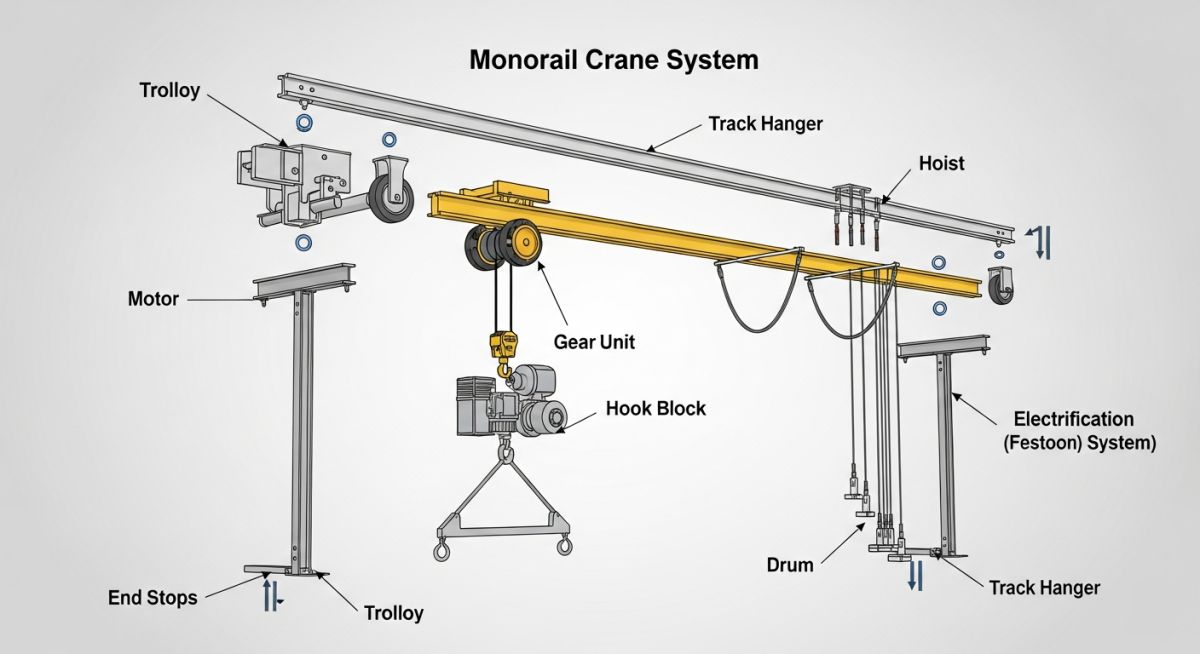
The reliability of Monorail Crane Systems is defined by the synergy of its mechanical sub-assemblies. In 2026, engineering specifications have shifted toward modularity, allowing for rapid component replacement without decommissioning the entire track. A high-performance Monorail Crane System consists of the runway beam, the trolley assembly, the hoist unit, and the electrification system.
Critical attention must be paid to "End Stops." These are not merely bumpers but safety-critical mechanical energy absorbers designed to decelerate a fully loaded trolley at maximum travel speed. According to MMA (Monorail Manufacturers Association) guidelines, these must be capable of withstanding the impact force without permanent deformation of the Monorail Crane Systems track.
Key Characteristic Features of Monorail Crane Systems
Modern Monorail Crane Systems are distinguished by their "Branching Capabilities." Unlike standard cranes, monorails utilize switches (glide-type or tongue-type) and turntables. These features allow a single hoist to navigate through a complex "tree" of tracks, effectively serving dozens of individual workstations from a single main line.
- Variable Frequency Drives (VFDs): Standard in 2026 Monorail Crane Systems, VFDs provide "soft-start" and "soft-stop" functionality, critical for transporting delicate or liquid loads.
- Automated Indexing: Integration with PLC systems allows Monorail Crane Systems to move to pre-programmed positions along the track with +/- 5mm accuracy.
- Articulating Trolleys: Specialized trolleys designed to negotiate tight radii (as small as 4 feet) without binding or excessive flange wear.
Engineering Advantages of Monorail Crane Systems
| Feature | Monorail Crane Systems | Bridge Cranes |
|---|---|---|
| Path Flexibility | Curved, Branched, Linear | Rectangular Only |
| Installation Cost | Lower (Fewer supports) | Higher (Full runway structure) |
| Floor Space Impact | Minimal (Ceiling suspended) | Moderate to High |
| Cycle Speed | Higher (Optimized flow) | Standard |
Technical Specifications for Monorail Hoists
Selecting the correct hoist for Monorail Crane Systems requires an analysis of "Duty Cycle" as defined by ASME HMI (Hoist Manufacturers Institute). For example, an H4 duty rating is required for heavy-duty production where the hoist operates at 50% or more of its rated capacity for sustained periods.
Crucial metrics for 2026 Monorail Crane Systems specifications include: 1. Maximum Wheel Load: The pressure exerted by the trolley wheels on the track flange. 2. Headroom Requirement: The distance from the bottom of the track to the hook at its highest point. 3. Lift Speed: Typically ranging from 10 to 32 FPM (feet per minute) depending on the motor gearing.
Global Codes and Standards for Monorail Crane Systems
Compliance in 2026 is governed by three primary pillars of safety. Every Monorail Crane System must be designed, tested, and maintained according to:
ASME B30.11
The "Bible" of Monorail Safety. Covers construction, installation, inspection, and maintenance of underhung crane and monorail systems.
OSHA 1910.179
Mandates the legal requirements for daily inspections and load testing (125% of rated capacity) for Monorail Crane Systems.
CMAA Spec 70/74
Defines crane service classes (Class A-F), ensuring the structural design matches the frequency of use.
Monorail System Load Calculator
Calculate Total Design Load and Required Beam Capacity (2026 Safety Factors)
Static Load
0 lbs
Total Design Load (DL)
0 lbs
Note: This calculator follows Monorail Crane Systems engineering approximations. Always consult a certified structural engineer for final beam sizing and building attachment points.
EPCLand YouTube Channel
2,500+ Videos • Daily Updates
Case Study: Retrofitting Monorail Crane Systems for 2026 Aerospace Logistics
Aerospace Components Plant
Zero-Floor Space for Forklifts
Ceiling-Hung Monorail Crane Systems
The Problem: 45% Productivity Loss
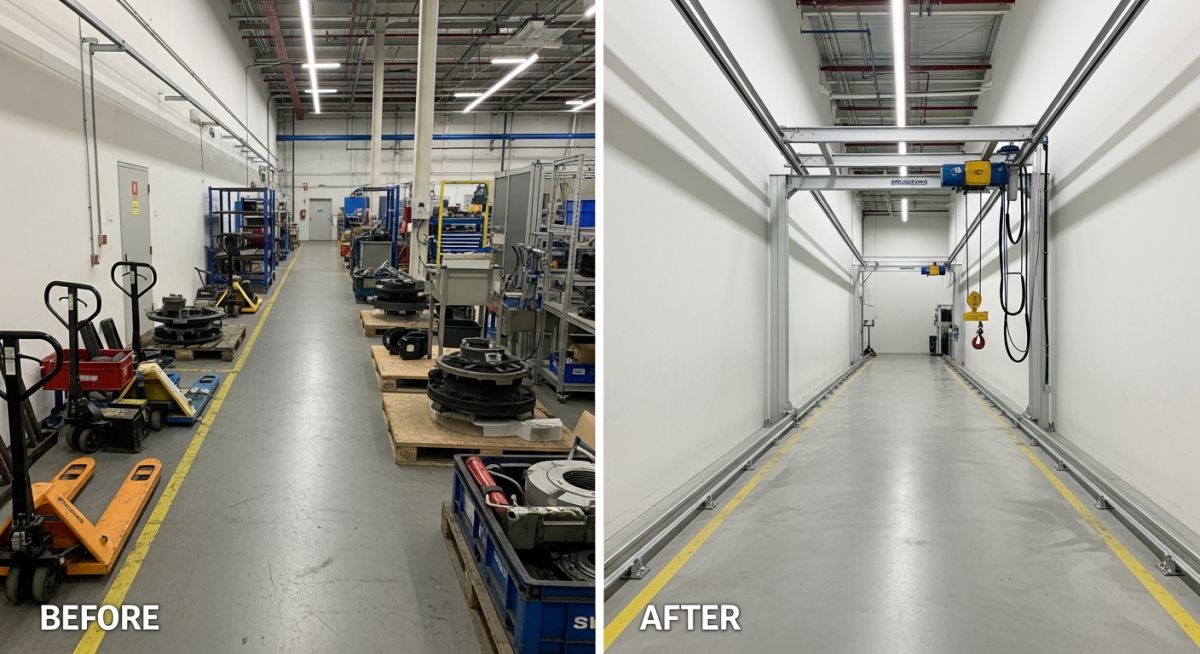
An aerospace manufacturer in 2026 faced a major hurdle: their turbine blade assembly line was congested with floor-mounted jib cranes that blocked forklift access. The lack of continuous flow meant that parts had to be manually transferred between three different workstations, resulting in high labor costs and increased risk of damage to high-value components.
The Implementation
The engineering team designed a Monorail Crane System featuring a 250-foot "loop" track using Patented Track technology. This allowed a single 2-ton hoist to transport components from the degreasing station, through the inspection booth, and directly to the final packaging area without ever setting the load on the ground.
Engineering Results:
- 35% Increase in part throughput
- Zero floor-space interference
- 60% Reduction in manual handling
- ROI achieved in 14 months
"By switching to Monorail Crane Systems, we eliminated the 'stop-and-start' nature of our assembly process. The ability to traverse curves and workstations seamlessly transformed our facility's OEE scores."
— Lead Plant Engineer, 2026 Project Review
