What are Flowlines in Oil and Gas? Flowlines vs Pipelines Explained
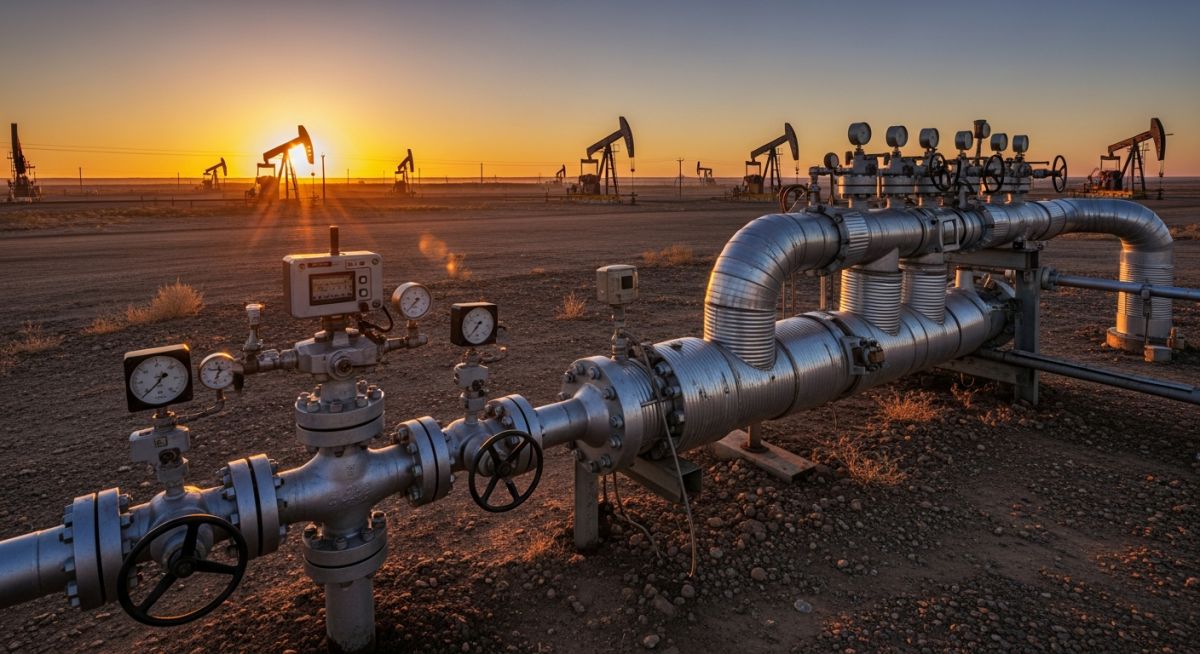
You are standing at a remote wellhead in the Permian Basin. A 4-inch pipe carries a violent, surging mix of crude oil, natural gas, and corrosive saltwater directly from the formation. Is this a pipeline? Not exactly. If you apply standard transmission pipeline codes here, you risk catastrophic fatigue failure or massive over-expenditure. In the high-stakes world of midstream engineering, confusing Flowlines vs Pipelines isn’t just a semantic error—it’s a multi-million dollar design flaw. This guide breaks down the critical boundaries, codes, and mechanical requirements you need to master in 2026.
Key Engineering Takeaways
- Functional Boundary: Flowlines connect the wellhead to the initial processing facility; pipelines transport stabilized products to market.
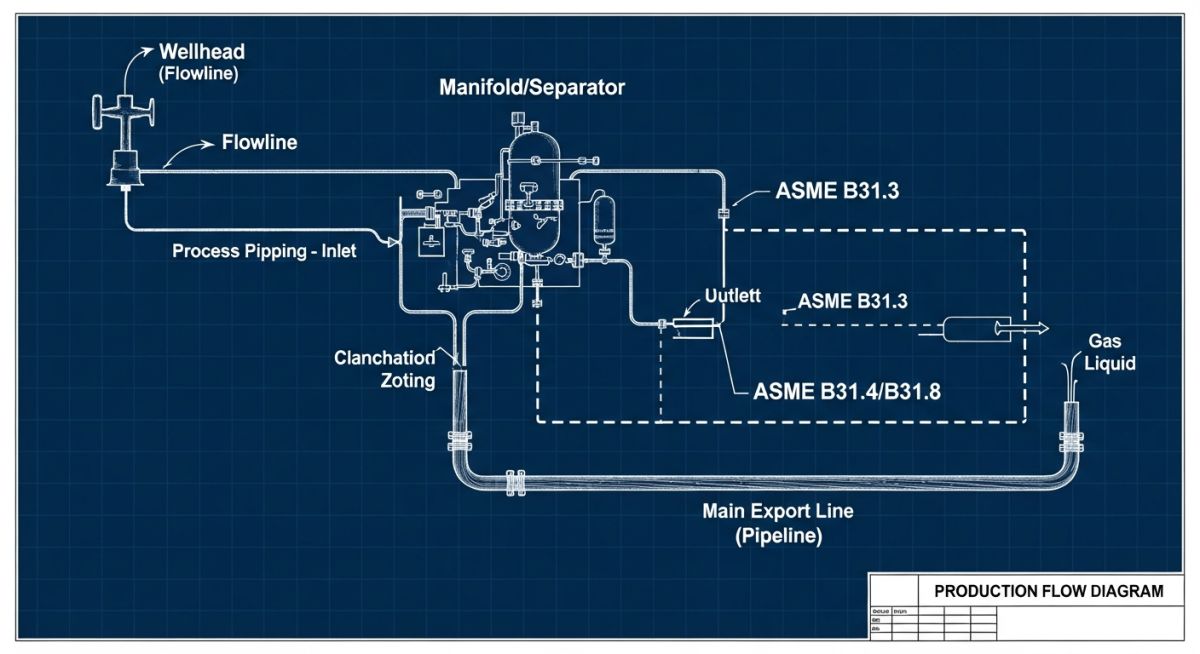
- Code Governance: Flowlines often fall under ASME B31.3 (Process Piping), while pipelines strictly follow ASME B31.4 or B31.8.
- Fluid Dynamics: Flowlines must handle multiphase, untreated fluids, whereas pipelines typically transport “on-spec” single-phase fluids.
What is the difference between Flowlines vs Pipelines?
The primary difference between Flowlines vs Pipelines lies in their position within the production chain. A flowline transports raw, multiphase fluids from a wellhead to a manifold or separator. A pipeline carries treated, single-phase fluids over long distances between facilities or to end-users, following transmission safety standards.
“In my 20 years of field inspections, the most common oversight is failing to account for the slugging and thermal cycling inherent in flowlines. Unlike the steady-state flow of a cross-country pipeline, flowlines are dynamic ‘living’ systems that require robust flexibility analysis.”
— Atul Singla, Founder of EPCLand
Table of Contents
Complete Course on
Piping Engineering
Check Now
Key Features
- 125+ Hours Content
- 500+ Recorded Lectures
- 20+ Years Exp.
- Lifetime Access
Coverage
- Codes & Standards
- Layouts & Design
- Material Eng.
- Stress Analysis
Engineering Challenge: Flowlines vs Pipelines
Question 1 of 5Which ASME code is most frequently applied to the design of complex wellhead flowlines within a processing facility boundary?
Defining Flowlines vs Pipelines in Midstream Infrastructure
To master the distinction of Flowlines vs Pipelines, one must first look at the direction of the molecular journey. In the upstream sector, a flowline is the very first arterial connection in the production network. It is the conduit that links a single wellhead to a gathering manifold, separator, or storage tank. Because the fluid exiting the well is "raw," it often contains a turbulent mixture of hydrocarbons, saline formation water, and abrasive solids like sand. This necessitates a design focus on erosion-corrosion resistance and the ability to handle fluctuating pressures that would destabilize a standard transmission line.
Conversely, a pipeline—specifically a transmission or trunk line—operates as the heavy-duty logistics arm of the industry. Once the raw fluid from the flowline has been processed, dehydrated, and "sweetened" at a central facility, it enters the pipeline. These systems are governed by strict purity specifications to protect the integrity of the long-distance network. While a flowline might only span a few hundred meters or several kilometers within a single field, a pipeline can traverse entire continents, necessitating a different regulatory framework under the ASME B31.4 Standard for liquids or B31.8 for gas.
Top 9 Design Considerations for Flowlines vs Pipelines
1. Temperature and Pressure of Flowlines
The thermodynamics of Flowlines vs Pipelines are starkly different. Flowlines receive fluids at reservoir temperatures, which can exceed 100°C (212°F). This extreme heat causes significant longitudinal expansion, which must be managed to prevent "upheaval buckling" if buried, or flange leaks at the wellhead. In contrast, transmission pipelines usually operate near ambient soil or water temperatures because the fluid has been cooled during processing. Pressure management is equally critical; flowlines must be rated for the Full Wellhead Shut-In Pressure (WHSIP) to ensure safety in the event of a downstream blockage.
2. Flowline Design Codes (ASME B31.3 vs B31.4/B31.8)
One of the most debated topics in Flowlines vs Pipelines engineering is code selection. Many operators choose ASME B31.3 (Process Piping) for flowlines because it provides a more conservative approach to wall thickness and fatigue analysis, which is vital for the multiphase, slug-prone flow of raw wells. Once the fluid passes the "fence-line" of a processing plant and enters the commercial transport phase, the jurisdiction shifts to B31.4 or B31.8, which are optimized for long-distance efficiency and lower safety factors in remote, non-populated areas.
3. Mechanical Strength and Material Selection
Material selection in Flowlines vs Pipelines is driven by chemistry. Flowlines often require exotic alloys or Corrosion Resistant Alloys (CRA) like Duplex Stainless Steel or internal plastic liners to survive the aggressive H2S (Sour Service) and CO2 environments of raw production. Pipelines, carrying stabilized and inhibited products, typically utilize high-strength carbon steel (API 5L X65 or X70). The mechanical strength of a flowline must also account for the physical impact of "slugs"—large masses of liquid followed by high-velocity gas—which create significant momentum changes at every 90-degree bend.
4. Flowline Routing and Topography
When evaluating Flowlines vs Pipelines routing, flowlines are slaves to the wellhead location. They often traverse rugged, unprepared terrain directly from the drilling pad. This requires detailed spans analysis and support design to prevent sagging. Pipelines, however, benefit from strategic route surveying to avoid steep inclines and minimize the number of river or road crossings, utilizing Horizontal Directional Drilling (HDD) for long-distance stability.
5. Expansion Loops and Thermal Management
Because flowlines operate at high reservoir temperatures, they utilize "L-type" or "U-type" expansion loops to absorb thermal growth. In the Flowlines vs Pipelines comparison, pipelines usually rely on the natural flexibility of long straight runs or the soil restraint of being buried to manage minimal temperature fluctuations. For subsea flowlines, "Lazy-S" or "Wave" configurations are essential to prevent fatigue from riser movement and thermal cycling.
6. Hook-ups and Installation Methods
The hook-up phase for a flowline involves complex "tie-ins" to the wellhead Christmas tree, often requiring flexible jumpers or specialized flanges. Pipeline installation is a factory-like process of "stringing, bending, and welding" across vast distances. For 2026 projects, integrated sensors are now standard in flowline hook-ups to monitor real-time sand production and erosion rates.
Technical Differences: Flowlines vs Pipelines Performance
The technical performance of Flowlines vs Pipelines is governed by international standards. Flowlines must adhere to API Spec 17J for flexible variants or API 5L for rigid steel, but with more stringent testing requirements for impact toughness. According to the American Petroleum Institute (API), the design life of a flowline is typically shorter (10-15 years) compared to the 25-50 year lifecycle expected of a major transmission pipeline.
| Feature | Flowlines | Pipelines |
|---|---|---|
| Fluid Type | Raw, Multiphase (Oil/Gas/Water/Sand) | Treated, Single-phase (Sales Grade) |
| Primary Code | ASME B31.3 / API 17J | ASME B31.4 / B31.8 |
| Pressure Profile | Fluctuating (Wellhead Pressure) | Regulated (Compressor/Pump Station) |
| Corrosion Risk | Extreme (H2S, CO2, Chlorides) | Low to Moderate (Controlled) |
| Typical Diameter | 2" to 12" | 12" to 48"+ |
Flowlines vs Pipelines: Wall Thickness Estimator (ASME B31.3/B31.4)
Compare the theoretical wall thickness requirements for a flowline (B31.3) versus a pipeline (B31.4) using simplified 2026 Barlow's Formula parameters.
Subsea Applications: Flowlines vs Pipelines Offshore
Managing Multiphase Fatigue in North Sea Flowlines vs Pipelines
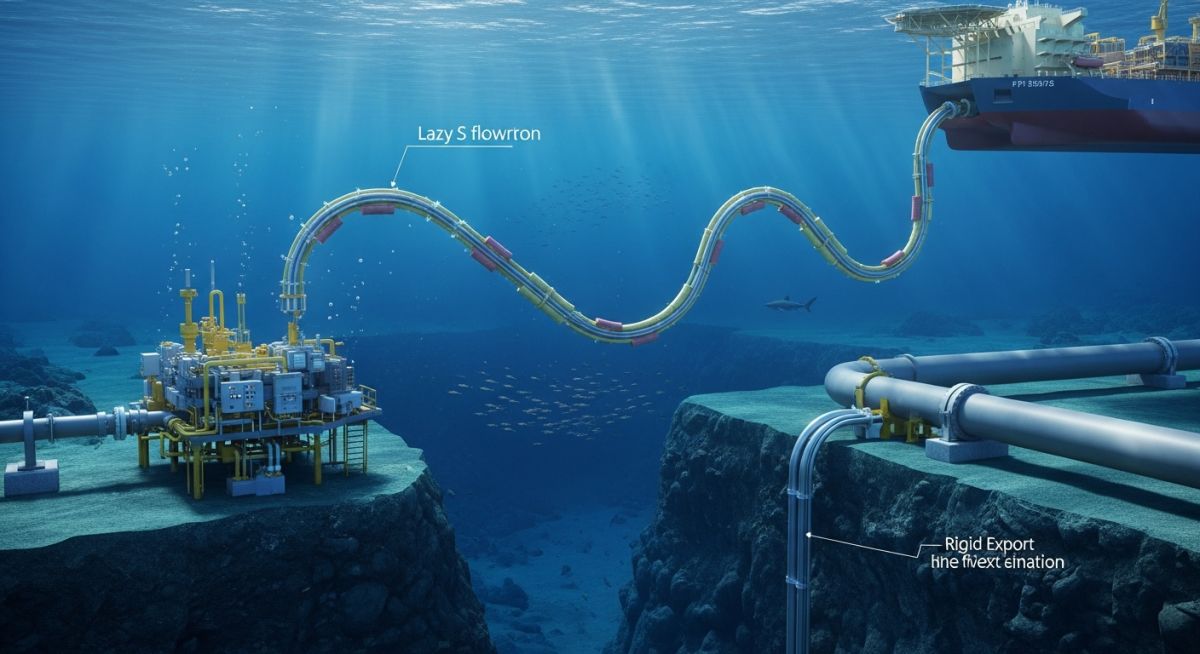
In a 2026 North Sea brownfield expansion, an operator faced a critical decision regarding a 5km subsea tie-back. The fluid was a high-gas-ratio (GOR) hydrocarbon stream at 95°C. Initially, the project team debated classifying the entire run as a Pipeline to utilize thinner walls and reduce material costs under ISO 13623 / ASME B31.8.
However, transient flow modeling revealed severe "slugging" potential at the base of the riser. By correctly classifying the segment from the subsea tree to the first stage separator as a Flowline under API 17J and ASME B31.3, the engineers implemented a flexible pipe solution with integrated fiber-optic strain monitoring. This design choice accounted for the dynamic stresses that a standard rigid pipeline would have failed to withstand within 3 years of service.
Technical Outcome
- Material: Switched from X65 Carbon Steel to High-Strength Flexible Composite.
- Pressure: Validated for 5,000 PSI shut-in pressure at wellhead.
- Monitoring: 2026-spec Real-time Acoustic Emission (AE) sensors installed to detect internal erosion.
EPCLand YouTube Channel
2,500+ Videos • Daily Updates
Expert Insights: Lessons from 20 years in the field
"The Boundary Point Rule"
One of the most frequent errors in 2026 project specs is the failure to define the exact flange where Flowlines vs Pipelines jurisdiction ends. Always specify the ESD (Emergency Shutdown Valve) as the demarcation point. Design upstream of the ESD for full wellhead pressure (Flowline) and downstream for regulated operating pressure (Pipeline).
- • Slugging Fatigue: Unlike pipelines, flowlines experience cyclic loading from multiphase slugs. You must conduct a high-cycle fatigue analysis if GOR (Gas-Oil Ratio) is expected to fluctuate by more than 15%.
- • Material Transition: When transitioning from a CRA-lined flowline to a carbon steel pipeline, ensure the galvanic isolation kit is rated for 2026 hydrogen-induced cracking (HIC) standards.
- • Pigging Geometry: Flowlines often have tighter radius bends (3D or 5D) than pipelines. Ensure your intelligent pigging tools are compatible with these restricted geometries.
References & Standards
For detailed compliance, consult the following 2026 editions of international engineering standards:
