Comprehensive Characteristics of Crude Oil: API Gravity, Flash Point, and Refining Metrics

Imagine a refinery pipeline seizing up in the dead of winter or a distillation column failing to produce the expected yield because the incoming feedstock’s sulfur content was underestimated by just 0.5%. For process engineers, the characteristics of crude oil aren’t just numbers on a lab report—they are the critical parameters that dictate million-dollar operational decisions and ensure plant safety. This guide breaks down the complex chemistry of hydrocarbons into actionable engineering data.
Key Takeaways
- API Gravity is the primary metric for determining the market value and weight of crude, inversely proportional to specific gravity.
- Flash and Fire Points are non-negotiable safety thresholds defined by ASTM standards to prevent catastrophic ignition during transport.
- Sulfur Content determines whether a crude is “sweet” or “sour,” directly impacting metallurgy selection and environmental compliance.
What are the primary characteristics of crude oil?
The primary characteristics of crude oil include physical properties like API gravity, viscosity, and pour point, alongside chemical metrics such as sulfur content and Watson’s K-factor. These properties determine the oil’s flow behavior, refining complexity, and the quality of resulting products like gasoline or diesel.
“In my 20 years of field experience, the most common mistake is treating ‘crude’ as a monolith. Understanding the specific boiling point curves and viscosity gradients is what separates a profitable refinery from one plagued by constant maintenance shutdowns.”
– Atul Singla, Founder of EPCLand
Table of Contents
Complete Course on
Piping Engineering
Check Now
Key Features
- 125+ Hours Content
- 500+ Recorded Lectures
- 20+ Years Exp.
- Lifetime Access
Coverage
- Codes & Standards
- Layouts & Design
- Material Eng.
- Stress Analysis
Knowledge Check: Crude Oil Properties
Test your engineering expertise on crude characterization.
1. If a crude oil has an API gravity of 35, how is it generally classified?
Crucial Characteristics of Crude Oil for Refinery Planning
The economic viability of a refinery depends heavily on the incoming characteristics of crude oil. Every crude assay acts as a chemical fingerprint, detailing the distribution of hydrocarbons from light gases to heavy residues. Planning engineers utilize these assays to simulate yields in the Atmospheric Distillation Unit (ADU) and Vacuum Distillation Unit (VDU). Without a precise understanding of the feedstock’s molecular makeup, refineries risk suboptimal product blending, increased catalyst deactivation, and unforeseen maintenance costs. Modern engineering workflows prioritize the integration of real-time assay data to adapt to the global “crude slate” volatility, ensuring that the refinery configuration matches the specific density and impurity levels of the raw material.
What is API Gravity in Characteristics of Crude Oil?
The API Gravity is perhaps the most widely recognized metric in the petroleum industry. It is a scale developed by the American Petroleum Institute (API) to measure how heavy or light a petroleum liquid is compared to water. If a crude’s API gravity is greater than 10, it is lighter and floats on water; if it is less than 10, it is heavier and sinks.
The Mathematical Relationship
The relationship between API gravity and Specific Gravity (S.G.) at 60°F is defined by the following formula:
°API = (141.5 / S.G. at 60°F) – 131.5
Note: S.G. is the ratio of the density of the oil to the density of pure water at the same temperature.
Understanding Watson’s Characterization Factor (K-Factor)
While API gravity tells us about density, Watson’s Characterization Factor (K-factor) provides deep insight into the chemical composition—specifically whether the crude is paraffinic, naphthenic, or aromatic. This factor is instrumental in predicting the thermodynamic properties and the quality of the products derived from the distillation process. High K-factors (12.5+) indicate paraffinic crudes, which are excellent for producing high-quality diesel and lube oils. Conversely, lower K-factors (around 10.0) suggest an aromatic nature, often associated with higher octane ratings for gasoline components but lower cetane ratings.
Technical Calculation
K = (TB)1/3 / S.G. (at 15°C)
Where TB is the mean average boiling point in degrees Rankine.
How Sulfur Content Influences Characteristics of Crude Oil
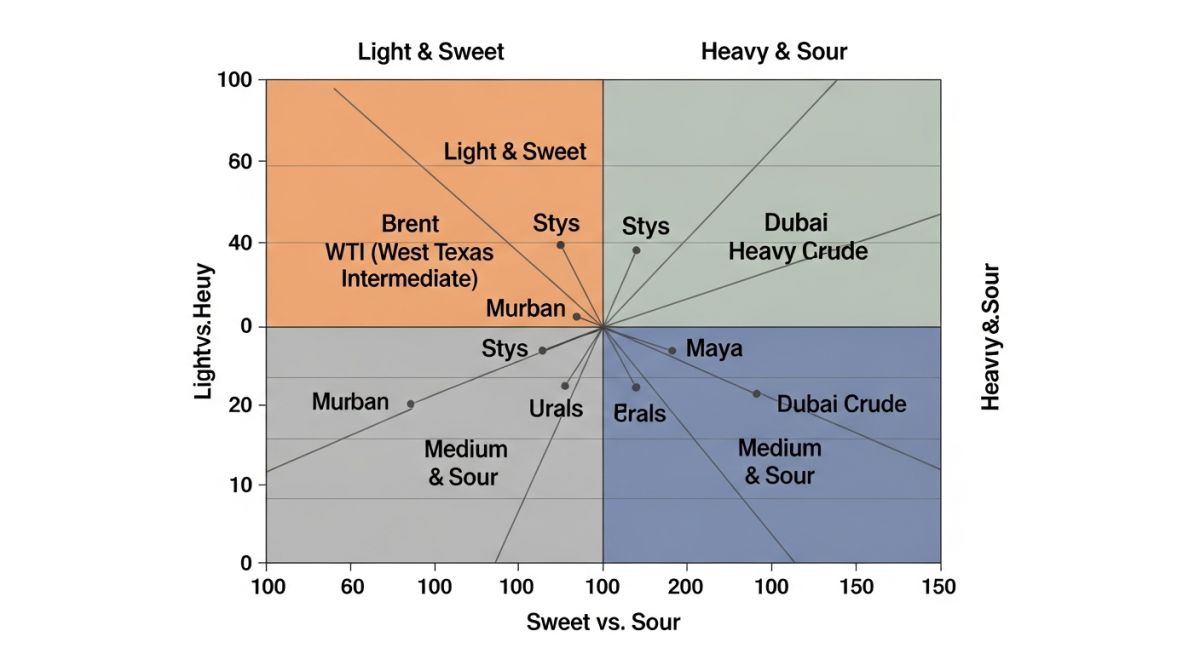
Sulfur is the most significant impurity among the characteristics of crude oil. It exists in various forms, including hydrogen sulfide (H2S), mercaptans, and thiophenes. The industry divides crude into two primary categories: Sweet Crude (Sulfur < 0.5%) and Sour Crude (Sulfur > 0.5%). High sulfur content requires extensive hydrotreating processes to meet environmental regulations, such as the Tier 3 gasoline standards and IMO 2020 marine fuel limits. Beyond emissions, sulfur compounds are highly corrosive to refinery metallurgy, particularly in high-temperature sections like the crude heater and fractionation towers.
True Boiling Point (TBP) and ASTM Distillation Curves
The characteristics of crude oil are best visualized through distillation curves. The True Boiling Point (TBP) curve is generated using a high-efficiency fractionation column (typically 15 to 100 theoretical stages) to provide a precise relationship between the cumulative volume percentage distilled and the boiling temperature. Unlike the simpler ASTM D86 distillation used for product specification, the TBP curve is essential for rigorous process simulation in software like HYSYS or Aspen Plus. These curves allow engineers to determine the “cut points” for naphtha, kerosene, and gas oil.
Evaluating the Viscosity of Crude Oil
Viscosity is a critical transport property that dictates the energy required for pumping and the heat transfer coefficients in exchangers. For petroleum engineering, we focus on Kinematic Viscosity, measured in Centistokes (cSt), and Dynamic Viscosity, measured in Centipoise (cP). As per ISO 3104 standards, viscosity is highly temperature-dependent; thus, crude assays must provide measurements at multiple reference temperatures (typically 40°C and 100°C) to allow for accurate hydraulic modeling.
Defining Flash Point and Fire Point in Safety Characteristics
Safety characteristics of crude oil are governed by the Flash Point—the lowest temperature at which vapors above the liquid will ignite when exposed to a flame. The Fire Point is slightly higher, indicating the temperature at which the oil will sustain combustion for at least 5 seconds. Engineers refer to ASTM D93 (Pensky-Martens Closed Cup) to classify crude for hazardous area zoning and storage tank venting requirements.
| Property | Light Crude (e.g., WTI) | Heavy Crude (e.g., Maya) |
|---|---|---|
| API Gravity | 37 – 42 °API | 21 – 22 °API |
| Sulfur Content | Low (< 0.45%) | High (> 3.3%) |
| Viscosity @ 40°C | ~3 – 5 cSt | > 300 cSt |
| Relevant Standard | ASTM D287 | API MPMS Ch. 9 |
Pour Point and Flow Characteristics of Crude Oil
The Pour Point is the lowest temperature at which crude oil remains fluid. This property is vital for subsea pipeline design and terminal operations in cold climates. High-paraffin crudes often exhibit high pour points due to wax crystallization. To mitigate this, engineers may employ Pour Point Depressants (PPD) or heat-traced piping systems to ensure continuous flow and prevent “gelation” in the line.
Octane Number and Fuel Performance Metrics
While the Octane Number is primarily a property of finished motor spirit (gasoline), it is a key characteristic of the naphtha fraction found in crude oil. It measures the resistance to “knocking” or auto-ignition in internal combustion engines. A higher octane rating indicates a greater proportion of branched-chain alkanes and aromatics, which can withstand higher compression ratios without pre-detonation.
EPCLand YouTube Channel
2,500+ Videos • Daily Updates
Crude Oil API Gravity & Specific Gravity Converter
Quickly calculate characteristics of crude oil density using the standard API formula (141.5/S.G. – 131.5). Input either value to determine the other.
Engineering Case Study: Feedstock Optimization

Challenge: Mitigating Rapid Corrosion in Overhead Condensers
A major Gulf Coast refinery experienced a 40% increase in corrosion rates within their Atmospheric Distillation Unit (ADU) overhead system. Initial investigations suggested that the shift in the characteristics of crude oil being processed—moving from a domestic light sweet blend to a heavier import—was the primary driver. The engineering team needed to identify the specific chemical triggers causing the metallurgy failure.
Technical Analysis
Detailed assay analysis revealed that while the API gravity remained within design limits (32 °API), the Sulfur content had spiked from 0.4% to 1.8%. More critically, the salt content (measured as PTB – pounds per thousand barrels) exceeded the desalter’s efficiency rating, leading to hydrochloric acid formation in the overheads.
The Solution
The refinery implemented a real-time blending strategy, using the Watson K-factor and Kinematic Viscosity data to balance the heavier sour feed with lighter synthetic crudes. They also upgraded the metallurgy of the condenser bundles to duplex stainless steel and optimized the desalter wash water injection rates based on the new crude characteristics.
Result: By closely monitoring the characteristics of crude oil and adjusting process parameters accordingly, the refinery extended the turnaround interval from 3 years to 5 years, saving an estimated $12 million in unplanned maintenance and lost production.
Expert Insights: Lessons from 20 years in the field
-
●
Assay Accuracy: Never rely on “average” assay data for refinery design. The characteristics of crude oil can fluctuate significantly between batches from the same field; always request a fresh ASTM D2892 distillation report for new feedstock contracts.
-
●
Viscosity Gradients: In pipeline hydraulics, remember that the relationship between temperature and viscosity is non-linear. Always model your “worst-case” restart scenario using the pour point plus a 10°C safety margin to avoid plugged lines.
-
●
Metallurgy Selection: Sulfur is not the only culprit. Check the Naphthenic Acid Content (Total Acid Number – TAN). High TAN crudes require 317L or higher molybdenum stainless steels in high-velocity areas, regardless of the API gravity.
-
●
Blending Physics: When blending crudes to achieve a target API, remember that volumes are not always perfectly additive due to molecular packing (excess volume of mixing). Use the API Manual of Petroleum Measurement Standards (MPMS) for precise custody transfer calculations.
