What is a Demister Pad? Working Principle, Types, and 2026 Engineering Guide
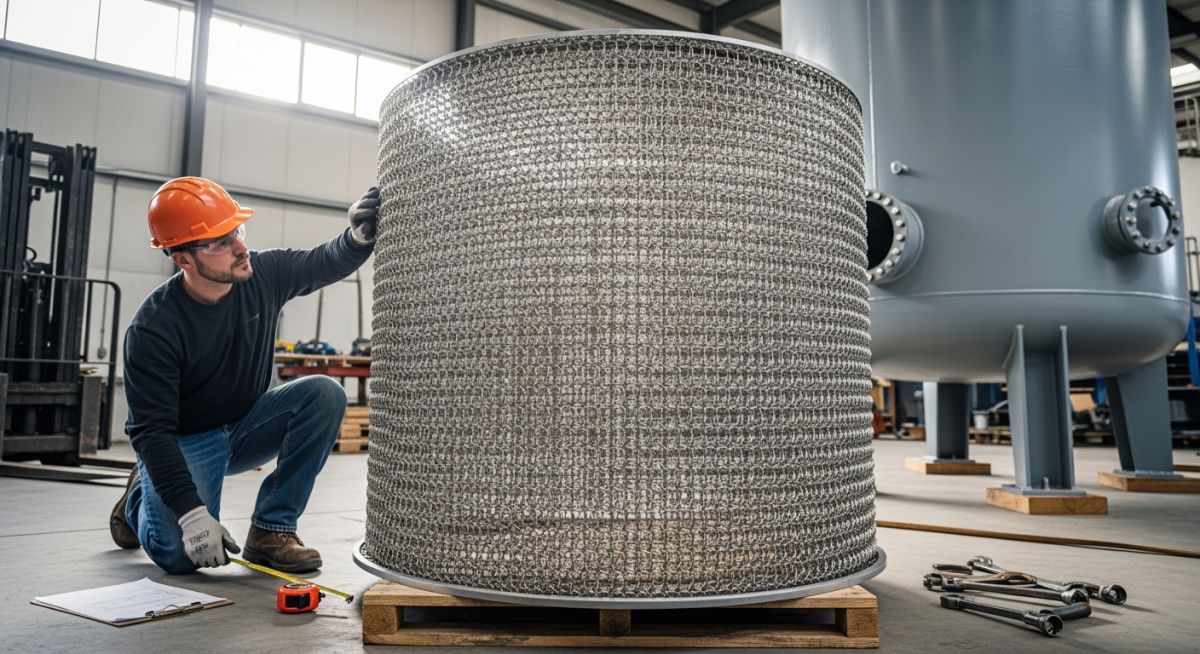
A Demister Pad is an essential internal component designed to remove liquid entrainment from gas streams in process equipment such as scrubbers, evaporators, and distillation columns. By utilizing the principle of impingement separation, a Demister Pad ensures that high-velocity vapor streams are stripped of moisture droplets, protecting downstream equipment like compressors from erosion and preventing product loss in chemical manufacturing.
What is a Demister Pad?
A Demister Pad is a porous interface, typically made of knitted wire mesh, used to separate liquid droplets from a gas stream. As vapor passes through the mesh, inertia causes droplets to strike the wire surfaces, coalesce, and drain away due to gravity, achieving up to 99.9% separation efficiency.
“In modern process design, selecting the correct mesh density for your Demister Pad is the difference between a high-purity output and catastrophic compressor failure.”
— Atul Singla, Founder of Epcland
Knowledge Check: Demister Pad Fundamentals
Quiz Complete!
Quick Navigation
- 1. Fundamental Working of a Demister Pad
- 2. Essential Types of Demister Pad Mist Eliminators
- 3. High-Performance Materials for Construction
- 4. Characteristic Features of Performance
- 5. Internal Construction and Support Grids
- 6. Step-by-Step Installation in Process Vessels
- 7. Technical Specifications and Design
Complete Course on
Piping Engineering
Check Now
Key Features
- 125+ Hours Content
- 500+ Recorded Lectures
- 20+ Years Exp.
- Lifetime Access
Coverage
- Codes & Standards
- Layouts & Design
- Material Eng.
- Stress Analysis
Fundamental Working of a Demister Pad (Impingement Theory)
The operation of a Demister Pad relies on the physical principle of Inertial Impingement. In a typical chemical process, gas or vapor travels upward through a vessel, often carrying tiny liquid droplets known as entrainment. Because these droplets have greater mass and momentum than the surrounding gas molecules, they cannot negotiate the tortuous path created by the knitted wire mesh of the Demister Pad.
Physics of Entrainment Separation in Vapor Streams
As the vapor stream enters the Demister Pad, it is forced to change direction rapidly as it weaves through the dense wire layers. The liquid droplets, unable to follow these sharp turns due to inertia, strike the wire surfaces and adhere to them. Over time, these micro-droplets accumulate and coalesce into larger globule forms. Once the gravitational force acting on these larger drops exceeds the upward velocity of the gas and the surface tension of the wire, the liquid drains back down to the bottom of the vessel.
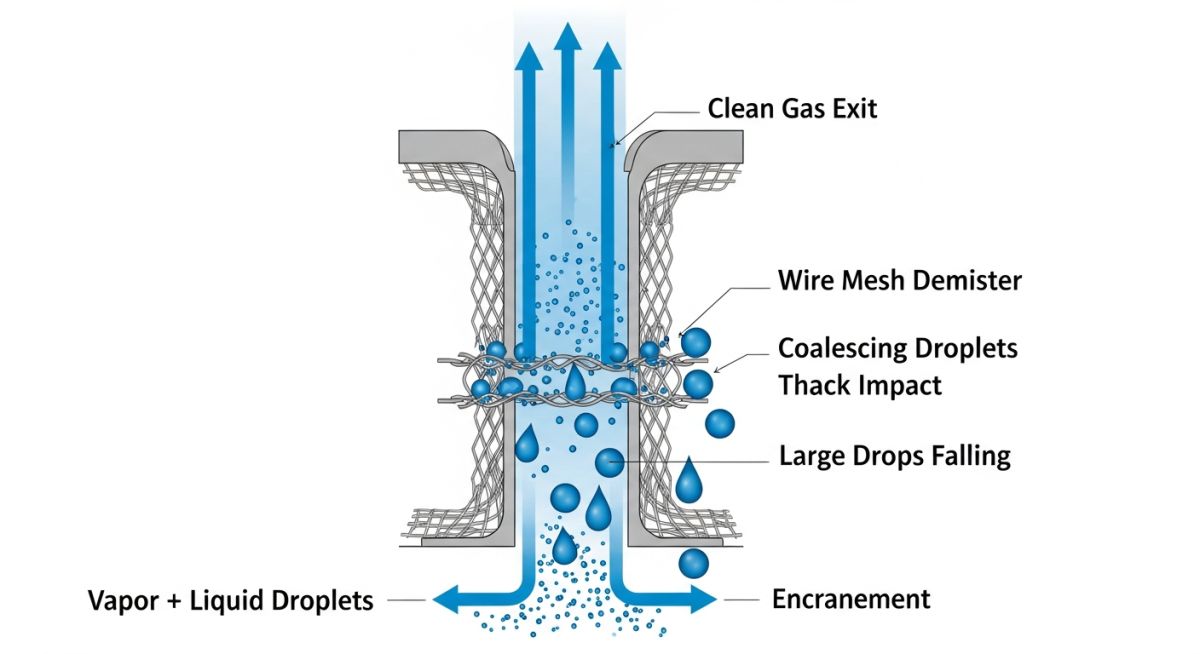
This separation mechanism is highly velocity-dependent. If the velocity is too low, the droplets may simply drift through the mesh without hitting the wires. Conversely, if the velocity is too high, the separated liquid can be “torn” off the wires and re-entrained into the exit gas stream, a phenomenon known as flooding. Engineering a Demister Pad for 2026 standards requires a precise balance of mesh density and vessel diameter to maintain the optimal “K-Value.”
Essential Types of Demister Pad Mist Eliminators
Not all separation challenges are identical; therefore, the Demister Pad is manufactured in various configurations to handle specific liquid loads and particle sizes. The choice of Mist Eliminator type significantly impacts the overall pressure drop and maintenance cycle of the system.
Knitted Wire Mesh vs. Vane Type Separators
The most common Demister Pad is the Knitted Wire Mesh type. This version uses layers of interlocking wires to create a high surface area-to-volume ratio, making it exceptionally efficient at capturing droplets down to 3-5 microns. It is the gold standard for high-purity requirements in steam drums and distillation columns.
In contrast, Vane Type Separators (sometimes called Chevron baffles) consist of parallel zig-zag plates. While they offer lower efficiency for very fine mists compared to a mesh Demister Pad, they are much more robust in “dirty” services where solid particles might clog a standard wire mesh. In 2026, hybrid designs that combine a primary vane stage with a secondary mesh Demister Pad are becoming increasingly popular for heavy-duty gas processing.
High-Performance Materials for Demister Pad Construction
Material selection for a Demister Pad is dictated by the chemical composition, temperature, and pressure of the process stream. Using the wrong alloy can lead to rapid corrosion, resulting in wire fragments migrating downstream and damaging rotating equipment.
Corrosion Resistance: SS316L, Monel, and PP Mesh
For general petrochemical applications, Stainless Steel 316L is the preferred material for a Demister Pad due to its excellent balance of cost and corrosion resistance. However, in more aggressive environments, specialty alloys are required:
- Monel 400: Ideal for Demister Pad applications involving hydrofluoric acid or sea water.
- Hastelloy C276: Used in extremely corrosive flue gas desulfurization (FGD) units.
- Polypropylene (PP): A cost-effective, non-metallic Demister Pad option for low-temperature aqueous solutions where metallic contamination must be avoided.
- PTFE (Teflon): The ultimate choice for high-temperature, highly acidic environments where even high-grade alloys fail.
Characteristic Features of Demister Pad Performance
The effectiveness of a Demister Pad is not merely based on its presence but on its specific design characteristics. In 2026, process engineers prioritize three primary metrics: separation efficiency, surface area availability, and the allowable pressure drop. A high-performance Demister Pad must provide maximum droplet capture while minimizing the energy required to push gas through the mesh.
Efficiency, Surface Area, and Pressure Drop Factors
Separation efficiency in a Demister Pad is typically rated for droplets larger than 5 microns. By increasing the wire surface area through multi-strand knitting, a Mist Eliminator can achieve 99.9% removal. However, this increases the resistance to flow. The Pressure Drop Analysis is critical; a standard clean Demister Pad should operate within a range of 25 to 250 Pascal (Pa). Exceeding this often indicates fouling or liquid “hold-up” within the mesh.
Internal Construction of Demister Pads and Support Grids
A Demister Pad is rarely a loose piece of mesh. It is a precision-engineered assembly. The knitted mesh is layered to a specific thickness (usually 100mm to 150mm) and then sandwiched between top and bottom support grids. These grids, often made of flat bars and round rods, ensure the Demister Pad does not collapse or bypass gas under high-pressure surges.
| Feature Type | Standard Mesh | High-Efficiency Mesh | High-Throughput Vane |
|---|---|---|---|
| Free Volume | 97% – 98% | 96% – 97% | > 99% |
| Surface Area | 280 m2/m3 | 450+ m2/m3 | ~150 m2/m3 |
| Droplet Size | > 5 microns | > 2 microns | > 15 microns |
Step-by-Step Demister Pad Installation in Process Vessels
Proper installation is as vital as the design itself. A Demister Pad must be snugly fitted against the vessel walls to prevent “vapor bypass,” where gas takes the path of least resistance around the mesh rather than through it.
- Support Ring Inspection: Ensure the internal vessel ring is level and free of debris.
- Sectional Loading: Most Demister Pad units are shipped in “manway-sized” blocks. These are passed through the manhole and laid out like a puzzle.
- Tight Fitment: The final “key” section must be forced in to ensure the entire Vapor-Liquid Separator assembly is compressed tightly.
- Tie-Down: Use 12-gauge SS wire to secure the Demister Pad to the support grid to prevent displacement during process upsets.
Technical Demister Pad Specifications and Design Calculations
In 2026, engineering teams adhere strictly to ASME Section VIII for vessel internals and API 12J guidelines for oil-gas separation. The sizing of a Demister Pad is governed by the Souders-Brown equation, which determines the maximum allowable vapor velocity.
The Souders-Brown Design Basis
Vmax = K * [ (ρL – ρV) / ρV ]0.5
Where:
Vmax = Maximum Design Velocity (m/s)
K = Capacity Factor (Typically 0.107 for standard Demister Pad)
ρL = Liquid Density (kg/m3)
ρV = Vapor Density (kg/m3)
Industrial Advantages of Demister Pad Integration
Integrating a high-quality Demister Pad offers significant ROI. Beyond simple Entrainment Separation, these units reduce maintenance costs by preventing salt deposits on turbine blades and downstream catalyst poisoning. Furthermore, in 2026 sustainability initiatives, a Demister Pad helps plants meet stringent emission standards by capturing hazardous liquid mists before they are vented to the atmosphere.
Demister Pad Velocity Calculator
Use this 2026 engineering tool to calculate the Maximum Allowable Vapor Velocity (Vmax) based on the Souders-Brown equation for your Demister Pad sizing.
EPCLand YouTube Channel
2,500+ Videos • Daily Updates
Demister Pad Failure Case Study: Troubleshooting Liquid Carryover
Project Data: Gas Scrubber Unit
- Industry: Natural Gas Processing
- Component: 316L SS Knitted Wire Mesh Demister Pad
- Problem: Sudden 15% increase in liquid carryover to the downstream compressor.
- Operating Year: 2026
Failure Analysis
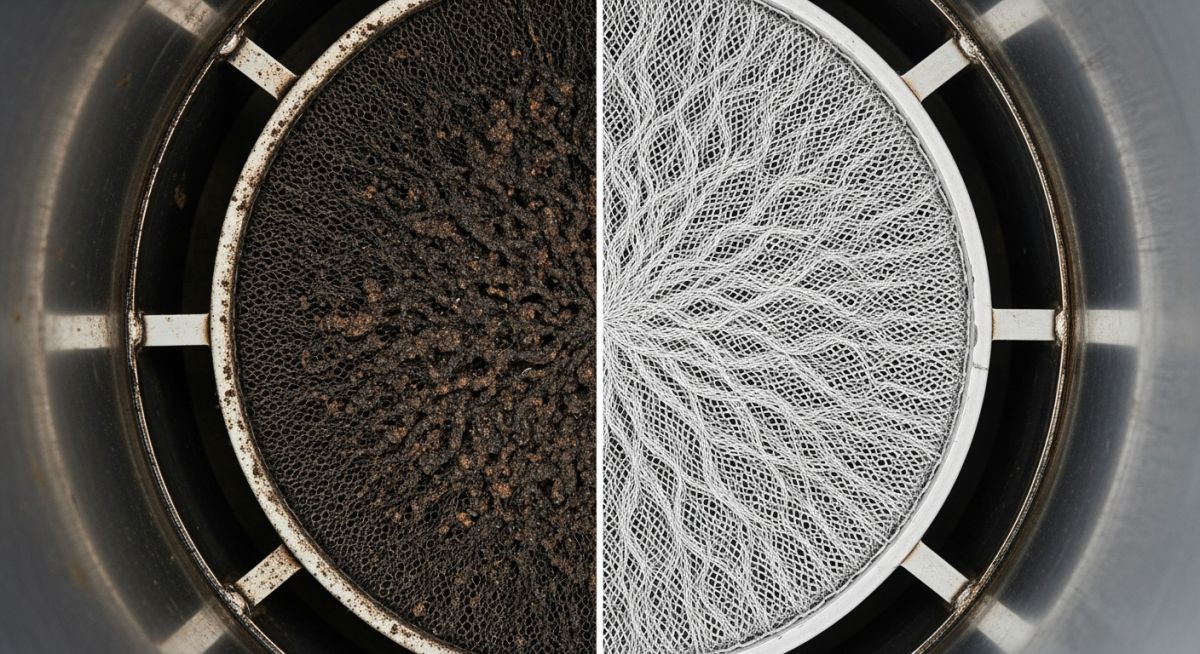
Upon internal inspection, the engineering team identified two critical issues. First, the Demister Pad was partially fouled with glycol deposits, increasing the local vapor velocity. Second, the support tie-wires had snapped due to vibration, causing a 2-inch gap at the vessel wall. This “bypass” allowed untreated vapor to skip the Entrainment Separation process entirely.
Engineering Fix & Lessons Learned
The Solution:
The damaged mesh was replaced with a multi-density Demister Pad designed for higher liquid loads. New heavy-duty SS317L support grids were installed using double-bolt clamps instead of simple tie-wires to resist process pulsations.
Lessons Learned:
- Annual Pressure Drop Analysis is mandatory to detect early fouling.
- Peripheral sealing (J-hooks) is superior to central tie-wires in high-flow vessels.
- Regular cleaning intervals prevent irreversible mesh clogging.
Frequently Asked Questions about Demister Pad Technology
What is the typical lifespan of a 316L SS Demister Pad? ▾
In non-corrosive environments with proper maintenance, a Demister Pad can last 5 to 10 years. However, in high-acid services or applications with high solid entrainment, lifespan may be reduced to 2-3 years due to erosion or fouling.
Can a Mist Eliminator be cleaned and reused? ▾
Yes, many Mist Eliminator units can be cleaned using high-pressure steam, water jets, or chemical solvents, provided the wire mesh structure has not suffered mechanical deformation or significant thinning from corrosion.
How does Pressure Drop Analysis indicate a failing Demister Pad? ▾
A sudden spike in pressure drop across the Demister Pad usually indicates solid buildup or “flooding,” while a sudden drop in pressure might signify that the mesh has collapsed or been blown out of its support grid.
What is the minimum droplet size a Vapor-Liquid Separator can capture? ▾
A standard knitted wire Demister Pad is highly effective for droplets 5 microns and larger. For sub-micron mists, specialized fiber-bed coalescers or high-density Vapor-Liquid Separator designs are required.
Engineering Summary for 2026 Process Optimization
As we progress through 2026, the Demister Pad remains a cornerstone of efficient process engineering. Whether it is ensuring the purity of steam in power generation or protecting expensive catalysts in petrochemical refining, the role of effective Entrainment Separation cannot be overstated. By understanding the relationship between gas velocity, mesh density, and material compatibility, engineers can design systems that maximize uptime and minimize environmental impact.
Optimize Your Separation Efficiency Today
Download our 2026 Comprehensive Design Guide for Demister Pad sizing and material selection to ensure your vessels operate at peak performance.
Access Engineering Whitepaper📚 Recommended Resources: Piping engineering
Read these Guides
🎓 Advanced Training