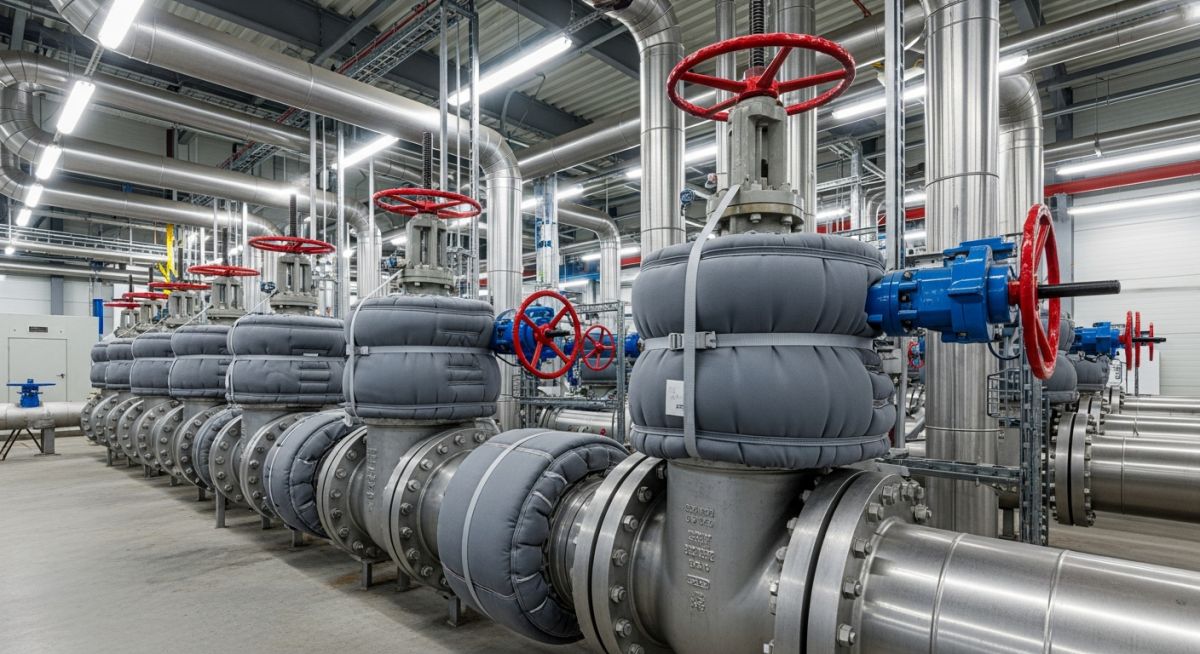
What are Industrial Steam Valves? Types, Applications, and 2026 Specifications
Industrial Steam Valves are the critical flow control components designed to manage the high temperatures and pressures associated with steam distribution in modern power plants and manufacturing facilities. Selecting the correct valve geometry and material is essential to prevent common failures like wire-drawing, thermal binding, and seat leakage in saturated or superheated systems.
At a Glance: What is an Industrial Steam Valve?
An Industrial Steam Valve is a specialized mechanical device used to start, stop, or regulate the flow of steam within a pressurized system. These valves must adhere to ASME B16.34 standards, utilizing heat-resistant materials like carbon steel or chrome-moly to withstand thermal expansion and high-velocity erosion common in 2026 steam applications.
Table of Contents
Steam Valve Engineering Challenge
Question 1 of 5
Complete Course on
Piping Engineering
Check Now
Key Features
- 125+ Hours Content
- 500+ Recorded Lectures
- 20+ Years Exp.
- Lifetime Access
Coverage
- Codes & Standards
- Layouts & Design
- Material Eng.
- Stress Analysis
Primary Functions of Industrial Steam Valves in Thermal Systems
In 2026, Industrial Steam Valves serve four foundational roles in energy management. Their primary purpose is to regulate the mass flow rate of steam to match process demand while maintaining safety thresholds. Beyond simple isolation, these valves manage pressure reduction (let-down stations), prevent vacuum formation during cooling cycles, and protect downstream equipment from over-pressurization. Understanding these functions requires a deep dive into fluid dynamics where steam velocity and phase changes (condensation) must be managed to avoid water hammer and localized erosion.

Categorizing the Main Types of Industrial Steam Valves
Selecting the correct Industrial Steam Valves depends on whether the application requires on/off service or continuous modulation. Each valve geometry handles the unique stresses of steam differently.
High-Performance Ball Valves for Industrial Steam Valves
Modern Industrial Steam Valves of the ball variety must utilize metal-to-metal seats or specialized reinforced PTFE for lower pressure ranges. For high-temperature service in 2026, vented balls are standard to prevent pressure buildup in the cavity caused by trapped condensate expanding into steam.
Globe Valves: The Standard for Industrial Steam Valves Throttling
Globe designs remain the workhorse for Industrial Steam Valves due to their precise throttling capabilities. They follow ASME B16.34 wall thickness requirements and often feature hardened “Stellite” trim to resist the abrasive nature of high-velocity saturated steam.
High-Temperature Butterfly Valves as Industrial Steam Valves
Triple-offset butterfly valves are now the preferred Industrial Steam Valves for large-diameter steam lines where space is limited. The geometric design ensures the seal only contacts the seat at the final moment of closure, significantly reducing wear in superheated steam environments.
Angle Valves for Heavy-Duty Industrial Steam Valves Service
Angle-style Industrial Steam Valves are frequently used in boiler blowdown applications. Their 90-degree body configuration allows for a “self-draining” flow path, which minimizes the risk of erosion compared to standard globe patterns.
Gate and Knife Valves in Industrial Steam Valves Isolation
For bulk isolation where minimal pressure drop is required, gate valves are the ideal Industrial Steam Valves. In 2026, flexible wedge designs are prioritized to mitigate the risk of thermal binding, a common failure where the valve becomes stuck due to the contraction of the body during cool-down.
Diaphragm Valves as Specialty Industrial Steam Valves
While less common in high-pressure headers, diaphragm Industrial Steam Valves are utilized in low-pressure, clean-steam environments such as pharmaceutical sterilization. These provide a hermetic seal, ensuring no steam leaks into the actuator mechanism.
Advanced Configurations for Industrial Steam Valves
Diverting Flow with 3-way Industrial Steam Valves
In 2026, Industrial Steam Valves with 3-way configurations are vital for heat exchanger bypass and temperature control loops. These valves allow for either mixing or diverting services, ensuring that the steam supply remains consistent even when a specific process branch is offline. Engineering designs must account for the differential thermal expansion between the three ports to maintain seat integrity.
Preventing Backflow with Non-return Industrial Steam Valves
Non-return Industrial Steam Valves, often referred to as stop-check valves, are critical on boiler outlets. They function as a globe valve to provide isolation but include a floating disk that acts as a check valve to prevent steam backflow into a shut-down boiler, protecting personnel and equipment during maintenance.
Safety Critical Pressure Release Industrial Steam Valves
Pressure Relief Valves (PRVs) are the final line of defense for Industrial Steam Valves. Per ASME Section I and VIII, these must be set to lift at a specific overpressure. In 2026, high-capacity nozzles and full-nozzle designs are standard to handle the rapid expansion of flashing steam.
Automated Control with Industrial Steam Solenoid Valves
For rapid cycling and remote automation, Industrial Steam Solenoid Valves utilize high-temperature coils (Class H or N) and stainless steel pistons. These are essential for steam injection pulses in tire manufacturing and sterilization chambers where sub-second response times are required.
Technical Engineering Specifications for Industrial Steam Valves
| Parameter | Saturated Steam | Superheated Steam | Standard Applied |
|---|---|---|---|
| Body Material | WCB Carbon Steel | WC6 / WC9 Chrome-Moly | ASTM A216 / A217 |
| Trim Hardfacing | Stellite 6 | Stellite 12 / 21 | API 600 Trim 5 |
| Max Velocity | 30 to 40 m/s | 50 to 75 m/s | Sizing Guidelines |
| Leakage Rate | Class IV | Class V / VI | ANSI/FCI 70-2 |
Sizing and Selection Criteria for Industrial Steam Valves
Proper sizing of Industrial Steam Valves avoids the “hunting” effect of oversized valves and the pressure drop of undersized units. The flow coefficient (Cv) calculation for steam must account for compressibility.
Basic Steam Flow Formula (Sub-Critical)
Cv = w / (2.1 * (P1 – P2) * (P1 + P2))1/2
- w = Steam flow rate (lb/hr)
- P1 = Inlet pressure (psia)
- P2 = Outlet pressure (psia)
Common Applications of Industrial Steam Valves in Modern Energy
As of 2026, Industrial Steam Valves are seeing increased deployment in Concentrated Solar Power (CSP) plants and high-efficiency Combined Cycle Gas Turbine (CCGT) facilities. These environments demand valves that can handle rapid thermal cycling and extreme temperatures exceeding 540 degrees Celsius (1000 degrees Fahrenheit).
Industrial Steam Valves Cv Calculator
Estimate the required Flow Coefficient (Cv) for saturated steam applications to ensure optimal valve sizing and prevent cavitation or erosion.
Note: For best control, Delta P should be 10% to 20% of inlet pressure.
Don’t miss this video related to Industrial Steam Valves

Summary: Master Piping Engineering with our complete 125+ hour Certification Course: ……
Case Study: Solving Wire-Drawing Erosion in High-Pressure Industrial Steam Valves
Project Data
- Facility: Combined Cycle Power Plant (2026 Retrofit)
- Service: Main Steam Bypass to Condenser
- Operating Pressure: 1250 psig
- Temperature: 950 degrees Fahrenheit (510 degrees Celsius)
Failure Analysis
The original Industrial Steam Valves experienced critical seat leakage within 4,000 hours of operation. Upon inspection, the valve trim exhibited deep longitudinal grooves—a classic symptom of wire-drawing. This was caused by the valve operating at a low lift position (under 10 percent) for extended periods, creating extremely high-velocity localized steam jets that eroded the standard stainless steel seats.
Engineering Fix
The engineering team replaced the standard globe valves with specialized Industrial Steam Valves featuring a multi-stage “Anti-Cavitation/Erosion” trim. This design breaks down the total pressure drop into several smaller stages, keeping the steam velocity below 50 m/s at the seating surface.
- Trim Material: Solid Stellite 6 with Diamond-Like Carbon (DLC) Coating.
- Sizing Adjustment: Reduced the port size to allow the valve to operate in a 40 percent to 60 percent lift range.

Lessons Learned for 2026
“Proper selection of Industrial Steam Valves requires more than just matching pipe size. In high-pressure let-down services, the velocity at the valve seat is the primary driver of MTBF (Mean Time Between Failure). Transitioning to multi-stage trims and hardened alloys is a non-negotiable requirement for modern high-efficiency plants.”
Frequently Asked Questions: Industrial Steam Valves
How do I prevent thermal binding in Industrial Steam Valves?
Thermal binding occurs when a wedge gate valve is closed at high temperatures and then cools, causing the body to contract around the wedge. To prevent this in Industrial Steam Valves, engineers specify flexible wedge designs or parallel slide gate valves which accommodate thermal contraction without seizing.
What is the difference between saturated and superheated Industrial Steam Valves?
Saturated steam valves must manage condensate and potential water hammer, often requiring stainless steel or bronze internals. Superheated Industrial Steam Valves operate at much higher temperatures (often above 800 degrees Fahrenheit), requiring chrome-moly (WC6 or WC9) body materials to prevent creep and high-temperature oxidation.
Why are pressure seal bonnets used in 2026 steam applications?
As system pressures increase, bolted bonnets require massive flanges and bolts. Pressure seal Industrial Steam Valves utilize the internal system pressure to crush a soft metal gasket against the body, creating a tighter seal as the pressure rises. This design is lighter and more reliable for high-pressure utility steam.
How often should Industrial Steam Valves be tested for leakage?
In accordance with 2026 predictive maintenance standards, critical isolation Industrial Steam Valves should undergo ultrasonic leak detection or thermal imaging every 6 to 12 months. Safety valves (PRVs) must follow strict jurisdictional intervals, typically involving annual lift tests or bench calibration.
Conclusion: The Future of Steam Flow Control
In 2026, the complexity of thermal systems continues to grow, placing higher demands on Industrial Steam Valves. Whether you are managing a district heating network or a high-pressure turbine bypass, the principles remains the same: select materials based on metallurgy (ASME B16.34), size for velocity rather than pipe diameter, and prioritize maintenance of the valve trim to prevent erosion.
By implementing the sizing logic and selection criteria outlined in this guide, engineering teams can ensure long-term reliability and energy efficiency across all Industrial Steam Valves installations.
📚 Recommended Resources: Industrial Steam Valves
Read these Guides
🎓 Advanced Training


