OISD 118 Layout Requirements: The 2026 Design Standard
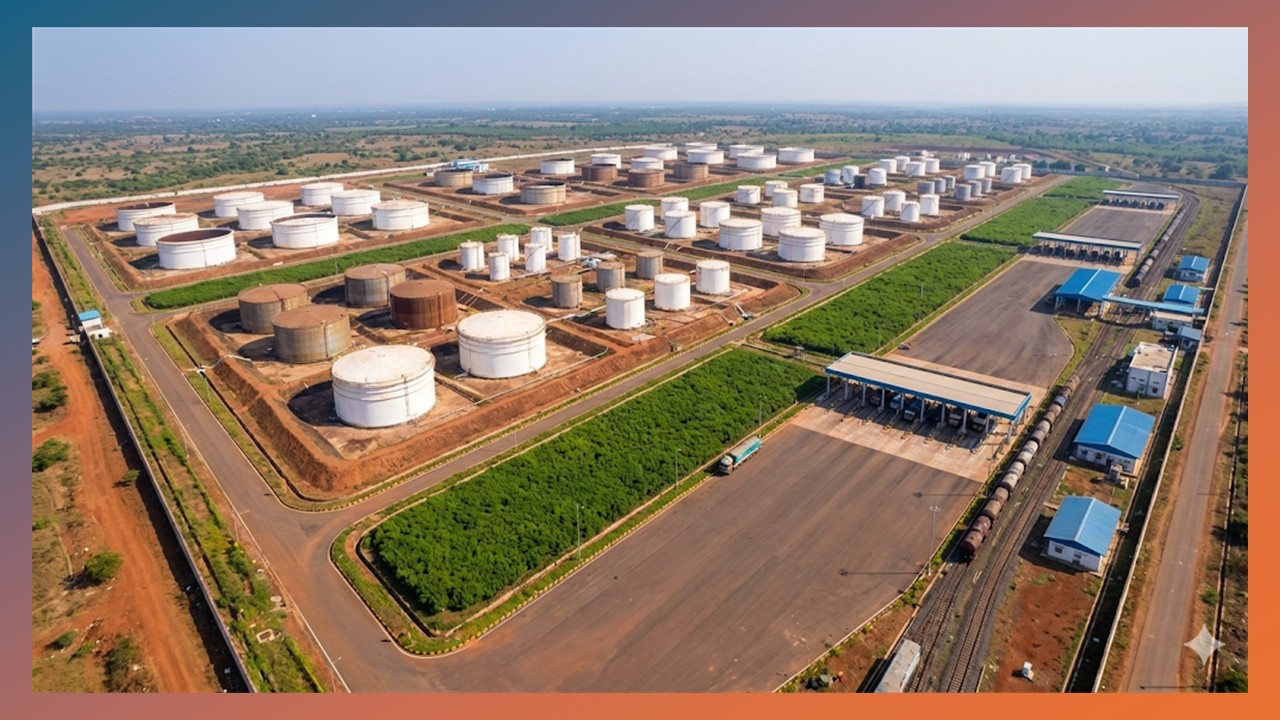
OISD 118 Layout Requirements form the statutory backbone of safety for the Oil & Gas industry in India, mandating precise spatial organization to prevent the “Domino Effect” during fire incidents. Whether designing a new refinery terminal or expanding an existing tank farm, adhering to the standard—”Layouts for Oil and Gas Installations”—is not optional; it is a legal prerequisite for PESO (Petroleum and Explosives Safety Organization) approval. In this guide, we decode the complex spacing matrices and containment rules to ensure your 2026 facility design is both efficient and compliant.
What is OISD-STD-118?
Published by the Oil Industry Safety Directorate (OISD), this standard defines the minimum distances between equipment, buildings, and boundary walls. Its core philosophy relies on Segregation and Containment.
⚡ OISD Safety Knowledge Check: 2026
Loading Quiz…
Complete Course on
Piping Engineering
Check Now
Key Features
- 125+ Hours Content
- 500+ Recorded Lectures
- 20+ Years Exp.
- Lifetime Access
Coverage
- Codes & Standards
- Layouts & Design
- Material Eng.
- Stress Analysis
The Foundation: Petroleum Class A B C Classification
Before applying any OISD 118 Layout Requirements, engineers must categorize the fluid being stored. The standard dictates that risk increases as the flash point decreases. The Petroleum Class A B C classification is the starting point for determining all subsequent safety distances.
Class A
Flash Point: < 23°C
Examples: LPG, Naphtha, Petrol (MS). Highest risk, largest spacing required.
Class B
Flash Point: 23°C to 65°C
Examples: Diesel (HSD), Kerosene (SKO), ATF. Moderate spacing norms.
Class C
Flash Point: > 65°C
Examples: LDO, FO, Lube Oils. Safer, allows tighter layouts.
Tank Farm Spacing Table & Distance Rules
The core of the OISD 118 Layout Requirements is the mandatory separation between equipment. This is known as “D” (Diameter). The rule prevents radiant heat from a fire in one tank from causing structural failure in adjacent tanks.
The table below simplifies the tank farm spacing table logic for floating roof and fixed roof tanks typically found in Class A/B service.
| Tank Scenario | Tank Type | Inter-Distance (Shell-to-Shell) |
|---|---|---|
| Class A / B Fluids | Floating Roof Tanks | 0.5 D (Min 10m) |
| Class A / B Fluids | Fixed Roof Tanks | 1.0 D (Min 10m) |
| Class C Fluids | Any Type | 0.3 D (Min 6m) |
| Boundary Wall | Any Tank | 20m to 30m (Based on Diameter) |
*Note: ‘D’ refers to the diameter of the larger tank. Always measure Shell-to-Shell. (Source: OISD-STD-118 Table 1).
Dyke Wall Volume Calculation Logic
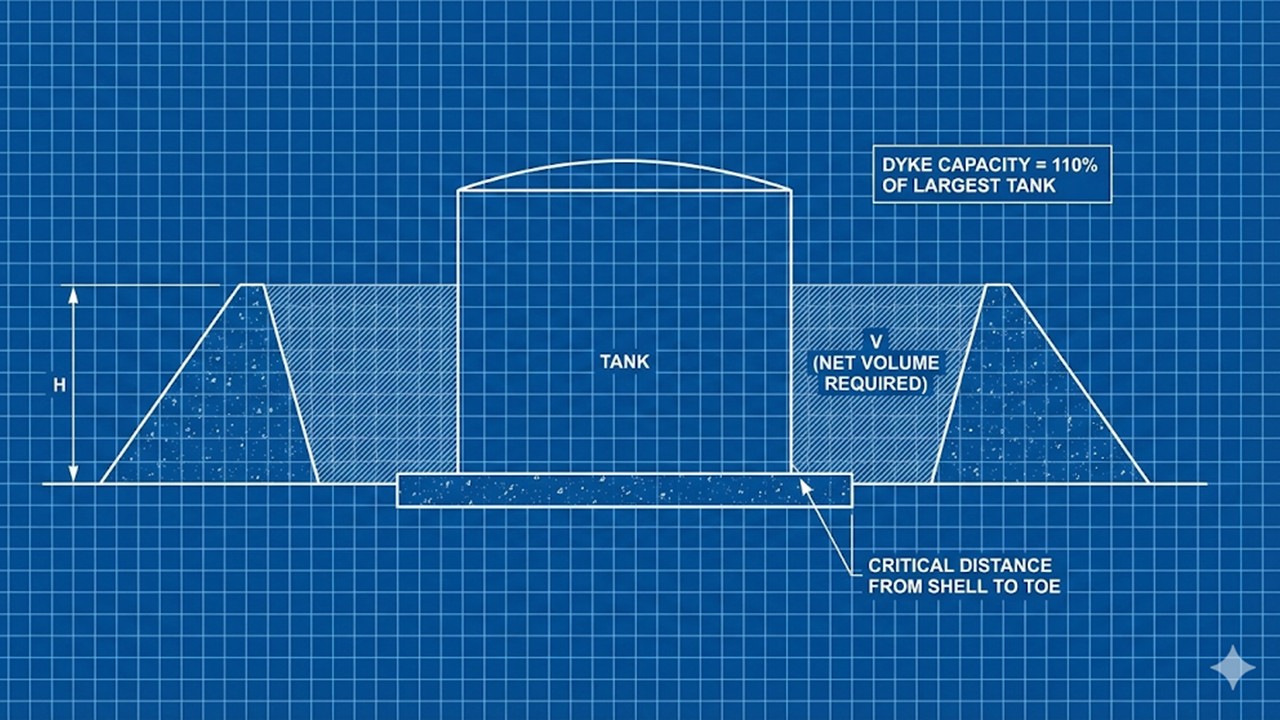
Containment is the second line of defense. Every tank farm must be enclosed by a dyke (bund) wall. The dyke wall volume calculation ensures that even if a tank ruptures catastrophically, the spill remains contained within the enclosure, protecting the rest of the facility.
The 110% Rule
OISD 118 stipulates that the net effective capacity of the dyke enclosure must be:
- Single Tank: 110% of Tank Volume.
- Multiple Tanks: 110% of the Largest Tank’s Volume – Volume displaced by other tanks up to dyke height.
Why 110%? The extra 10% allows for foam application and rainwater accumulation without overtopping during an emergency.
Block Layouts & Inter-Distance Safety Norms
Beyond individual tanks, OISD 118 Layout Requirements govern the macro layout of the facility. The standard mandates a “Block Layout” approach, where facilities are grouped by hazard level.
- Rule 1 Process Units: Should be located on high ground relative to tank farms to prevent vapor accumulation.
- Rule 2 Fire Stations: Must be located in a non-hazard zone, with direct access to the main road network, ensuring response time < 5 minutes.
- Rule 3 Road Widths: Main roads around process blocks must be at least 10 meters wide to accommodate heavy fire tenders.
Safety Compliance Report
Case Study: Brownfield POL Depot Expansion Audit
Facility Profile
- Location: Industrial Zone, Panipat (India)
- Asset: POL Storage Terminal (Class A & B)
- Expansion: Addition of 2x 10,000 KL Petrol (MS) Tanks
- Constraint: Limited plot area (Landlocked)
Compliance Check
- Standard: OISD-STD-118 (2025 Revision)
- Hazard Class: Class A (Flash Point < 23°C)
- Critical Gap: Boundary Wall Distance
The Challenge: Land Constraints vs. Safety Zones
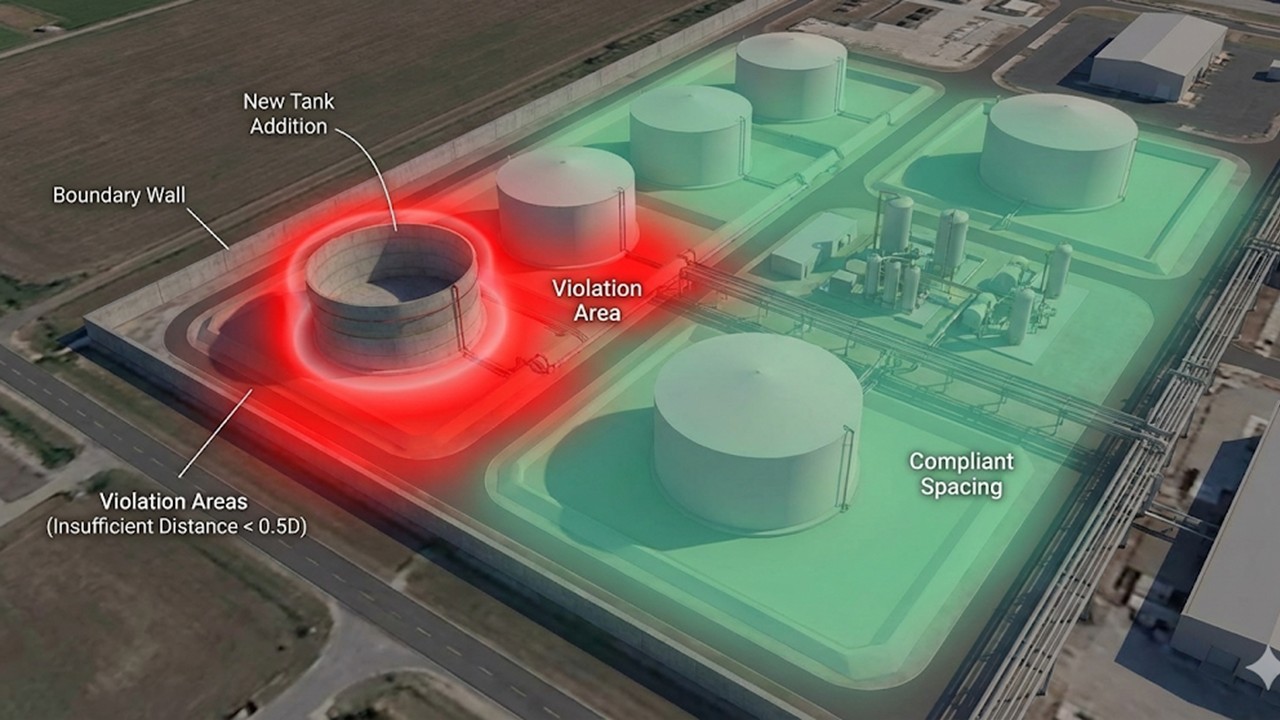
A major oil marketing company planned to expand storage capacity by adding two 20-meter diameter floating roof tanks for Motor Spirit (Petrol). The civil engineering team proposed a location in the North-East corner of the plot to utilize vacant land.
However, during the OISD 118 Layout Requirements audit, a critical violation was flagged. The proposed location was only 15 meters from the facility’s outer boundary wall. For Class A petroleum storage tanks with a diameter > 15m, OISD 118 Table-1 requires a minimum distance of 20 to 30 meters from the shell to the boundary, depending on the dyke configuration. Furthermore, the expansion encroached upon the mandatory ecological buffer.
Violation: Ecological Buffer
The standard mandates a specific green belt buffer zone width (typically 25m to 50m depending on total acreage) around the installation periphery. This zone acts as a windbreaker and vapor dispersion barrier. The proposed tank location would have reduced this green belt to less than 10 meters, violating environmental clearance (EC) and OISD norms.
The Engineering Solution
To achieve compliance without acquiring new land, the layout was radically redesigned:
- Tank Re-sizing: Instead of two wide 20m diameter tanks, the design was switched to three taller, narrower tanks (12m diameter). This reduced the required inter-distance (0.5D) and boundary distance.
- Dyke Optimization: A common dyke was utilized for the new tanks to minimize the footprint, ensuring the green belt buffer zone width remained intact at 25 meters.
- Fire Safety Upgrade: The addition of Class A inventory triggered a review of the firefighting system.
Impact on Fire Systems
OISD 118 layout changes invariably affect OISD 117 (Fire Protection) requirements. The new layout required the relocation of two remote-operated monitors. More importantly, the calculation showed the existing ponds were sufficient. The fire water storage capacity OISD requires (4 hours supply) was verified against the new “Single Largest Fire Contingency,” which remained the existing 20,000 KL Crude tank, not the new smaller MS tanks.
Result: The revised layout secured PESO approval. The project demonstrated that while OISD 118 Layout Requirements are rigid, changing equipment geometry (Height vs Diameter) often provides the engineering flexibility needed for brownfield projects.
EPCLand YouTube Channel
2,500+ Videos • Daily Updates
Frequently Asked Questions: OISD 118 Compliance
What is the basis for inter-distance safety norms in OISD 118?
The inter-distance safety norms are based on thermal radiation flux calculations. The goal is to ensure that if one tank catches fire, the radiant heat received by adjacent tanks does not exceed permissible limits (typically 4 kW/m² to prevent structural failure) before fire cooling systems can be activated. This is why distances are measured based on the Diameter (D) of the tank.
How does the Tank Farm Spacing Table change for Class C fluids?
Class C fluids (Flash point > 65°C, like LDO/Lube Oil) pose a lower fire risk. Consequently, the tank farm spacing table permits reduced separation. While Class A/B floating roof tanks require 0.5D, Class C tanks typically require only 0.3D (Minimum 6 meters) shell-to-shell distance. However, if Class A/B and Class C tanks share the same dyke, the stricter Class A/B norms apply to the entire group.
What is the requirement for Dyke Wall Height?
Per OISD 118, the dyke wall height should ideally be restricted to 2.0 meters to ensure effective firefighting access and visual monitoring. If plot constraints force a higher wall, special provisions for access (like additional staircases or ramps) must be provided. The minimum height is typically 1.0 meter to ensure adequate containment volume.
Is OISD 118 mandatory for all Indian installations?
Yes. OISD standards are integrated into the statutory framework enforced by PESO (Petroleum and Explosives Safety Organization) under the Petroleum Rules, 2002. Compliance with OISD 118 Layout Requirements is a prerequisite for obtaining the license to operate any petroleum storage or processing facility in India.
