
ASME B31.3 Process Piping Guide
Mastering the Code for Design, Safety, and Category M Service.
The ASME B31.3 code is the globally recognized standard for process piping design, governing the safety of piping systems in petroleum refineries, chemical plants, and pharmaceutical facilities. Engineers rely on this code to determine allowable stresses, wall thickness, and material requirements to prevent catastrophic failures in hazardous environments. Whether you are dealing with standard hydrocarbons or lethal fluids, strict adherence to B31.3 is mandatory for compliance.
What is ASME B31.3?
ASME B31.3 (Process Piping) is a section of the American Society of Mechanical Engineers (ASME) Code for Pressure Piping. It prescribes minimum requirements for the materials, design, fabrication, assembly, erection, examination, inspection, and testing of piping typically found in petroleum refineries, chemical, pharmaceutical, textile, paper, semiconductor, and cryogenic plants.
⚡ Test Your B31.3 Knowledge
Score: 0/5
Complete Course on
Piping Engineering
Check Now
Key Features
- 125+ Hours Content
- 500+ Recorded Lectures
- 20+ Years Exp.
- Lifetime Access
Coverage
- Codes & Standards
- Layouts & Design
- Material Eng.
- Stress Analysis
Core Scope and Responsibilities of ASME B31.3
Unlike other piping codes that focus on long-distance transmission (such as B31.4 for liquids or B31.8 for gas), ASME B31.3 is specifically tailored for the complex, high-consequence environment of processing plants. It covers the piping within property limits—connecting equipment like pumps, compressors, vessels, and exchangers.
One of the most critical aspects of ASME B31.3 is the clear division of responsibility. The “Owner” has the ultimate responsibility for designating the fluid service category, while the “Designer” is responsible for the engineering design to meet those requirements. This distinction is vital because incorrectly categorizing a fluid (e.g., treating a lethal fluid as normal) can lead to insufficient non-destructive examination (NDE) and catastrophic failure.
Fluid Service Categories in ASME B31.3
The code categorizes fluid services based on the potential hazard of the fluid and the severity of the operating conditions. Your design path—including material selection, fabrication, and testing—depends entirely on this selection.
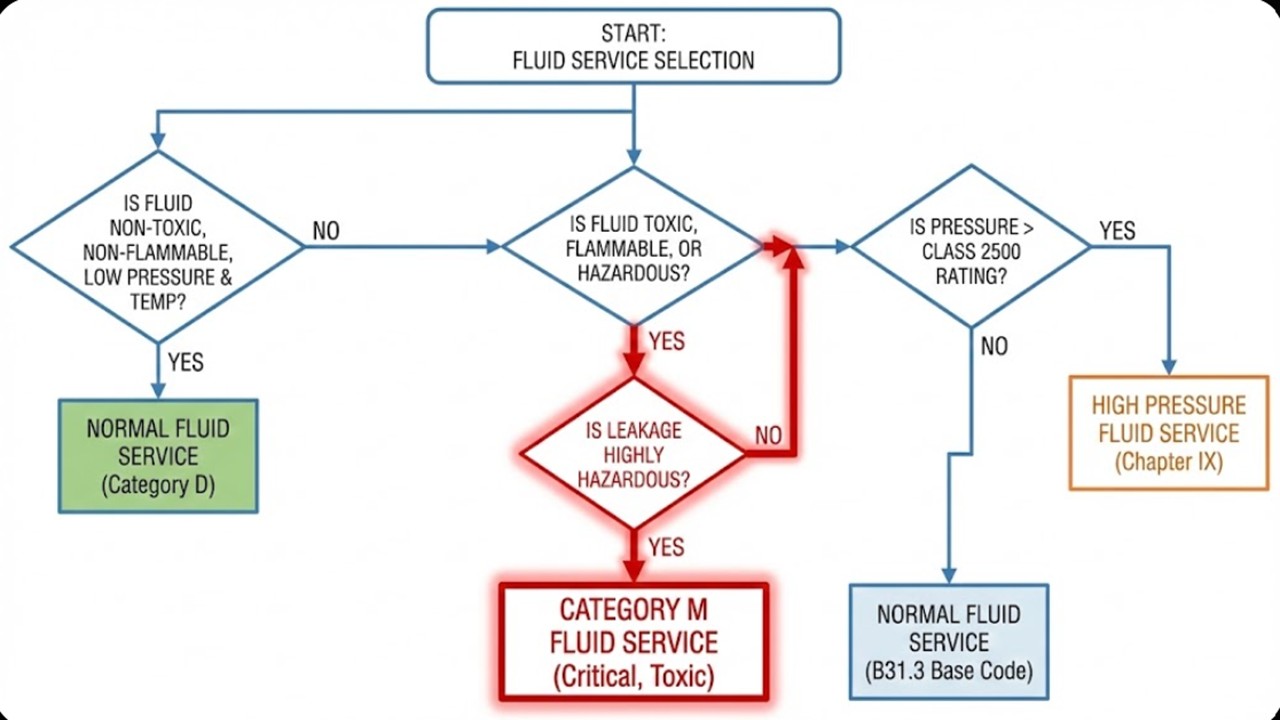
- D Category D: Non-flammable, non-toxic, and non-damaging to human tissue. The design pressure is less than 150 psig (1035 kPa) and temperature is between -29°C and 186°C.
- N Normal Fluid Service: The default category. It covers most general process piping that does not fall into D, M, or High Pressure.
- M Category M (Lethal): Fluids where a single exposure to a very small quantity caused by a leak can produce serious irreversible harm. ASME B31.3 mandates stricter safeguards here.
- K High Pressure Fluid Service (Chapter IX): For pressures exceeding that allowed by ASME B16.5 Class 2500 flanges.
Calculating Wall Thickness per ASME B31.3 Rules
The minimum required wall thickness ™ for straight pipe under internal pressure is calculated using the equation 304.1.2. Engineers must strictly adhere to this formula to ensure the pipe can withstand hoop stress without yielding.
Pressure Design Equation
Note on the ‘Y’ Coefficient: For ferritic steels operating below 482°C (900°F), Y is typically 0.4. However, as temperatures rise into the creep range, this value changes to account for the material’s plastic behavior. Failing to adjust ‘Y’ in high-temperature ASME B31.3 applications is a common design error.
Common Allowable Stress Values (Table A-1 Excerpt)
The following table highlights allowable stress (S) values for common piping materials at various temperatures. Always consult the latest 2024/2026 code edition for official values.
| Material Spec | Grade | Min Temp (°F) | Stress @ 100°F (ksi) | Stress @ 500°F (ksi) | Stress @ 700°F (ksi) |
|---|---|---|---|---|---|
| ASTM A106 | Gr. B (Carbon Steel) | -20 | 20.0 | 18.9 | 15.6 |
| ASTM A312 | TP304 (Stainless) | -425 | 20.0 | 17.5 | 15.6 |
| ASTM A335 | P11 (Chrome-Moly) | -20 | 15.0 | 15.0 | 15.0 |
| ASTM A333 | Gr. 6 (Low Temp CS) | -50 | 20.0 | 18.9 | 15.6 |
*ksi = kips per square inch (1000 psi). Values are for seamless pipe.
📊 ASME B31.3 Fluid Service Guide
Selecting the wrong fluid service is a critical design error. Use this matrix to classify your piping.
| Category | Criteria / Limits | Design Implication |
|---|---|---|
| Normal Fluid Service | Most process piping. Not D, M, or High Pressure. | Standard B31.3 rules apply. |
| Category D |
1. Non-flammable, Non-toxic. 2. Design Press < 150 psi (1035 kPa). 3. Temp between -29°C and 186°C. |
Less Stringent. Visual exam usually sufficient. |
| Category M | Toxic fluids where exposure to a small leak can cause irreversible harm (e.g., H2S, Chlorine). | Strict. 100% Radiography often required. No miter bends. |
| High Pressure (Chapter IX) | Pressure exceeds flange ratings (Class 2500) or Owner designated. | Special Analysis. Requires fatigue analysis and impact testing. |
| Severe Cyclic | High stress range (> 0.8 allowable) + high number of cycles (> 7000). | Requires 100% Volumetric NDE (RT/UT). |
⚔️ Code Wars: ASME B31.1 vs. B31.3
| Feature | ASME B31.1 (Power Piping) | ASME B31.3 (Process Piping) |
|---|---|---|
| Typical Application | Power Plants, Steam Generators, District Heating. | Refineries, Chemical Plants, Pharma, Cryogenics. |
| Safety Factor | Typically 3.5 to 4.0 (More Conservative). | Typically 3.0 (Allows thinner walls). |
| NDE Requirements | Prescriptive (Rules are fixed). | Based on Fluid Service (M, D, Normal). |
| Scope of Responsibility | Narrow definition. | Allows “Owner” to define service categories. |
EPCLand YouTube Channel
2,500+ Videos • Daily Updates
Case Study: ASME B31.3 Failure Analysis – Lethal Service Breach
Investigating a phosgene containment failure in a Gulf Coast petrochemical facility (2024 Audit).
📂 Project Data
- Location: Louisiana, USA
- Fluid Service: Phosgene (Lethal)
- Design Pressure: 150 PSIG
- Pipe Spec: Carbon Steel (A106 Gr B)
- Code Year: ASME B31.3 (2022 Edition)
The Failure Mode
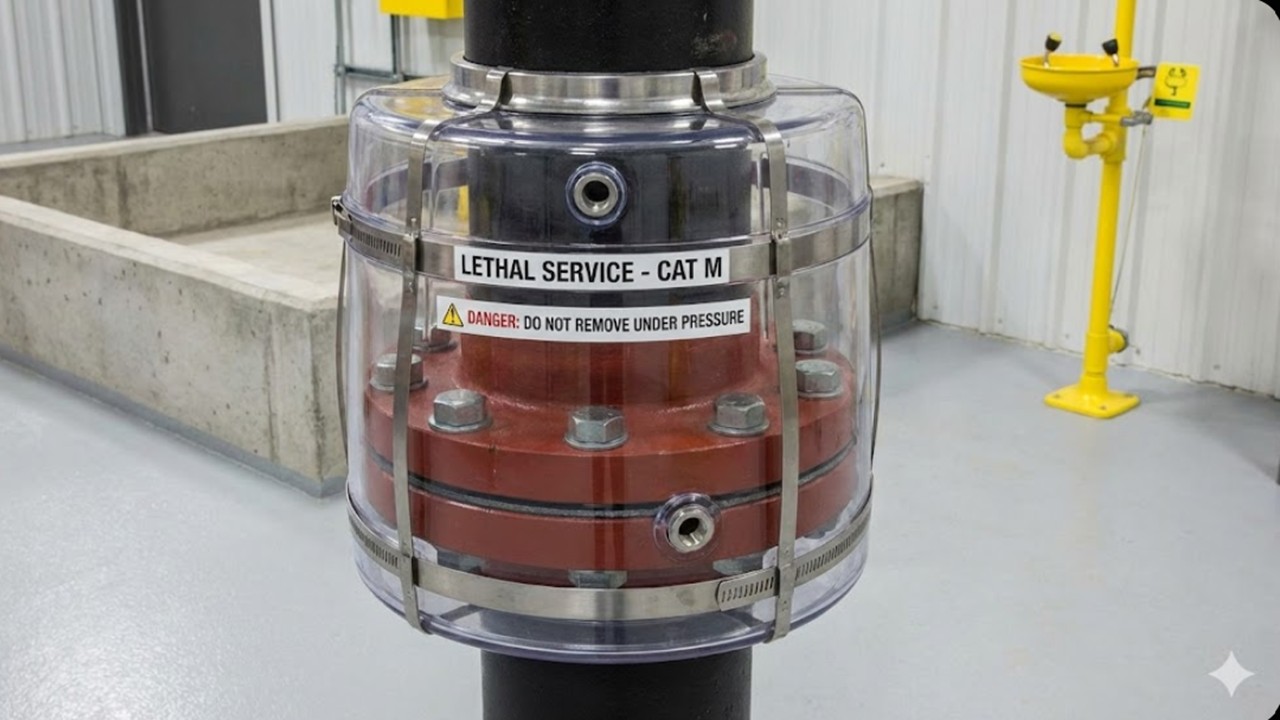
During a routine startup, a ppm-level leak was detected at a flanged joint connecting to a reactor injection nozzle. While the leak was contained by secondary scrubbing systems, it triggered an immediate plant shutdown.
Root Cause Analysis: The piping circuit was incorrectly classified as “Normal Fluid Service” during the FEED stage. Consequently, the standard hydrostatic test (1.5x design pressure) was performed, but the mandatory Sensitive Leak Test required for Lethal Service was omitted. The standard spiral-wound gasket micro-sealed during hydrotest but failed under the lower density gas load.
Engineering Solution
The engineering team initiated a “Category M” retrofit protocol strictly adhering to ASME B31.3 Chapter VIII.
- NDE Upgrade: 100% Radiography (RT) was performed on all butt welds (up from 5% random).
- Testing: A Sensitive Leak Test (Gas Bubble Test) was conducted per Para. 345.8, utilizing Helium trace gas.
- Safeguards: Installation of spray shields (flange guards) on all mechanical joints.
- Joint Reduction: Two flanged spools were replaced with fully welded loops to minimize leak paths.
📉 Result & ROI
Post-retrofit performance data (2025-2026).
0 Leaks
in 24 months of operation
100% Compliance
with ASME B31.3 Cat M
❓ Frequently Asked Questions (ASME B31.3)
What is the scope of ASME B31.3?
ASME B31.3 covers piping typically found in petroleum refineries, chemical, pharmaceutical, textile, paper, semiconductor, and cryogenic plants. It dictates requirements for materials, design, fabrication, assembly, erection, examination, and inspection.
What are the Fluid Service Categories?
The code defines several services: Normal Fluid Service (General), Category D (Non-toxic, <150 psi, -29°C to 186°C), Category M (Toxic/Lethal), High Pressure Fluid Service (Chapter IX), and Severe Cyclic Conditions.
What is the difference between ASME B31.1 and B31.3?
ASME B31.1 applies to ‘Power Piping’ (Steam power plants, electric generating stations) and is generally more conservative. ASME B31.3 applies to ‘Process Piping’ (Refineries, Chemical plants) and allows for a wider range of materials and thinner wall thicknesses in some applications.
Which edition is current in 2026?
As of early 2026, the ASME B31.3 2024 Edition is the most recent published version. Projects contracted after its effective date (typically 6 months after issuance) must comply with this edition.
