What is a Galvanized Steel Pipe? (Specs, Welding & Uses 2026)
Galvanized steel pipes are carbon steel pipes that have been coated with a protective layer of zinc to prevent corrosion and extend service life. Widely used in structural applications, outdoor handrails, and low-pressure plumbing, these pipes rely on the chemical principle of “Sacrificial Protection.” However, welding them poses specific health risks that every engineer and fabricator must understand in 2026.
Summary: Definition & Key Standard
A Galvanized Steel Pipe is typically a welded (ERW) or seamless steel pipe that meets ASTM A53 specifications. It undergoes a “Hot-Dip” process where it is submerged in molten zinc (approx. 450°C), creating a bonded alloy coating. This zinc layer acts as a sacrificial anode, corroding first to protect the underlying steel from rust.
Read on to learn about the “Zinc Flu” risks during welding.
Table of Contents
QUIZ Test Your Piping Knowledge
1. What is the primary material used to coat Galvanized Pipes?
Complete Course on
Piping Engineering
Check Now
Key Features
- 125+ Hours Content
- 500+ Recorded Lectures
- 20+ Years Exp.
- Lifetime Access
Coverage
- Codes & Standards
- Layouts & Design
- Material Eng.
- Stress Analysis
1. The Chemistry of Protection (Sacrificial Anode)
Galvanization isn't just paint; it's a metallurgical bond. The primary reason engineers specify galvanized steel is for its dual-layer protection mechanism: **Barrier Protection** and **Cathodic Protection**.

Figure 1: The Galvanic Series. Zinc (Anode) gives up electrons to protect Steel (Cathode) when an electrolyte (water) is present.
🛡️ Barrier Protection
The zinc coating acts as a physical shield, preventing moisture and oxygen from reaching the carbon steel substrate. As long as this barrier is intact, no rust forms.
⚡ Sacrificial Protection
If the pipe is scratched, the surrounding zinc will "sacrifice" itself. Zinc is more electrically active (anodic) than steel, so it corrodes preferentially, effectively "healing" the scratch electrochemically.
Hot-Dip Galvanizing (HDG) vs. Electro-Galvanizing
Not all galvanized pipes are equal. In industrial piping, **Hot Dipped Galvanized (HDG)** is the standard because it provides a thick, durable coating (50-85 microns) chemically bonded to the steel. Electro-galvanizing creates a shiny but very thin layer (<10 microns) suitable only for indoor aesthetics, not outdoor endurance.
2. Engineering Specifications (ASTM A53)
When ordering pipe for pressure applications (air, steam, water), you must refer to the correct standard. For galvanized pipe, the "Bible" is **ASTM A53**.
Key Requirements of ASTM A53
- Grade: Typically Grade A (lower strength, better bending) or Grade B (higher strength, standard pressure).
- Type: Type E (Electric Resistance Welded) or Type S (Seamless).
- Coating Weight: Must average at least 1.8 oz/ft² (550 g/m²). This thickness ensures a service life of 20-50 years depending on the environment.
- Marking: Pipes must be stenciled with "ASTM A53", the Grade, the Schedule, and the Manufacturer's Name.
3. Decoding "Schedule 40" Galvanized Steel Pipe
"Schedule 40" is often confused with a material grade, but it refers strictly to the Wall Thickness.
Pipe size is nominal (NPS). For example, a 2-inch pipe does not have a 2-inch outer diameter.
| NPS (Inch) | Outer Diameter (mm) | Wall Thickness (mm) - SCH 40 | Approx. Working Pressure (PSI) |
|---|---|---|---|
| 1/2" | 21.3 | 2.77 | 2300 |
| 1" | 33.4 | 3.38 | 2100 |
| 2" | 60.3 | 3.91 | 1500 |
| 4" | 114.3 | 6.02 | 1200 |
* Note: Working pressures are theoretical for Grade B seamless pipe at ambient temperature. Always check code requirements.
4. The Critical Guide to Welding Galvanized Pipes (Safety First)
Welding galvanized steel is chemically different from welding black steel. The zinc coating boils at a relatively low temperature (906°C), while steel melts at approx. 1500°C. This means the zinc vaporizes into a white oxide cloud long before the weld pool forms.
DANGER: Metal Fume Fever ("Zinc Flu")
Inhaling zinc oxide fumes causes acute toxicity known as "Zinc Shakes." Symptoms start 4-12 hours after exposure and include chills, fever, nausea, and muscle pain.
Mandatory Safety: Always use a P100 respirator or a fresh-air welding hood. Ensure high-volume local exhaust ventilation.
Step-by-Step Welding Procedure
To achieve an X-ray quality weld without porosity, you must remove the zinc first.
Grind to Bright Metal
Remove the zinc coating at least 1 to 2 inches from the weld joint on both the inside and outside surfaces. If you weld over zinc, the gas gets trapped in the weld pool, causing severe porosity and cracking.
Select the Electrode
For Stick (SMAW) welding, use E6010 or E6011 for the root pass to burn through residual zinc, followed by E7018. For MIG (GMAW), use standard ER70S-6 wire but expect more spatter.
Post-Weld Restoration (ASTM A780)
The welding heat destroys the zinc protection near the joint. You must restore it immediately using Cold Galvanizing Spray (Zinc-Rich Paint) or Zinc Solder Sticks to prevent the weld from rusting within days.
5. Applications & Limitations (Where NOT to use it)
While excellent for handrails and fence posts, galvanized pipe has specific prohibitions in industrial piping due to chemical reactions.
Approved Applications
- Compressed Air Lines: Prevents internal rust scaling which damages pneumatic tools.
- Outdoor Structures: Handrails, guardrails, and lighting poles (excellent UV and weather resistance).
- Fire Water Mains: Low-pressure dry systems where stagnant water would rust black steel.
- Cooling Towers: Structural supports exposed to humid environments.
Prohibited / Risky Uses
- Natural Gas Lines: The zinc coating can flake off internally, clogging small orifices in gas regulators and burners. (Black steel or PE is preferred).
- Potable Water (Drinking): Old galvanized pipes contained Lead and Cadmium. Modern codes generally prefer Copper or PEX.
- Diesel Fuel: Zinc reacts with diesel to form a gummy sludge that clogs fuel injectors.
- Hot Water > 60°C: Polarity reversal causes zinc to attack the steel (See Case Study).
⏱️ Galvanized Service Life Estimator
Estimate the time until First Maintenance (5% Rust) based on the zinc coating thickness and environmental exposure.
*Based on corrosion rate data from the American Galvanizers Association (AGA).
Corrosion Rate: ~0.5 - 1.0 µm/year
Standard ASTM A53 HDG is approx 55-85 µm.
Est. Time to First Maintenance
Applied Corrosion Rate
Zinc loss per year
Bonus: Fabricator's Toolkit (Threading & Terminology)
Fabricating galvanized pipe requires adjustments to standard black pipe procedures. Use this checklist to prevent torn threads and consult the glossary to communicate effectively with suppliers.
Zinc destroys cutting dies. The coating is soft but gummy. Always use a High-Sulphur Cutting Oil to flush chips away instantly. If you use standard oil, the zinc will plate onto the die teeth, ruining the thread profile.
1 Threading Inspection Checklist
2 Zinc Terminology Glossary
6. Case Study: Corrosion Failure in a Hot Water Recirculation Loop
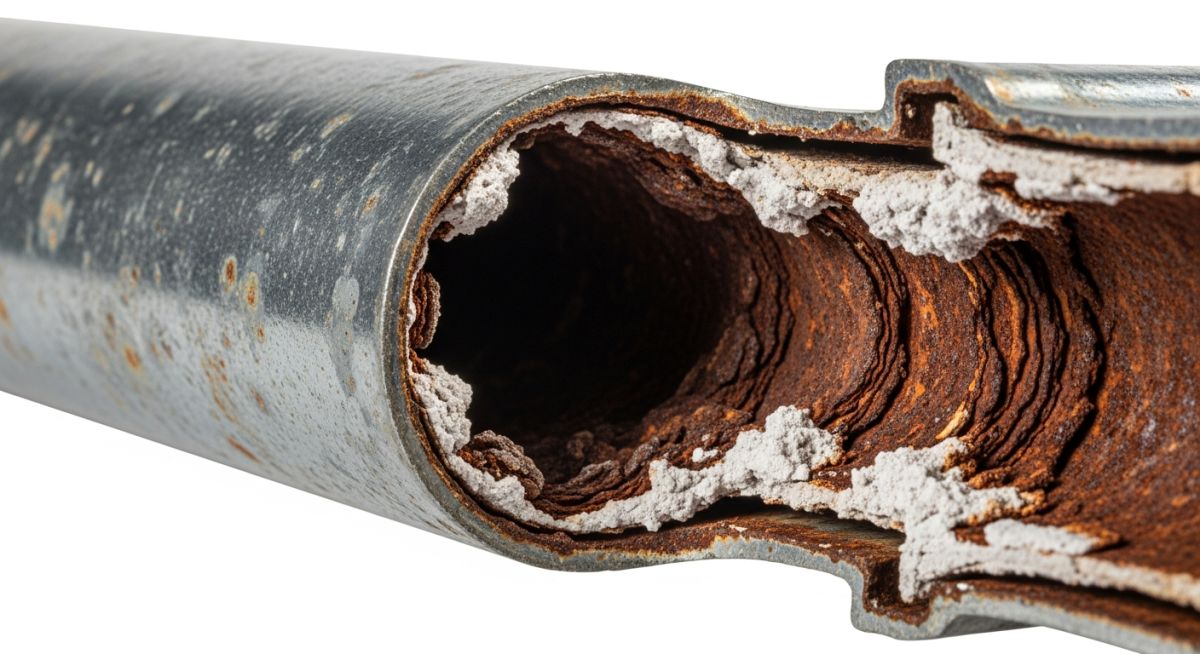
The Challenge: Premature Failure at 18 Months
Context: A luxury hotel reported low water pressure and "brown water" issues in their hot water system only 1.5 years after construction. The piping specification called for Schedule 40 Galvanized Steel for both Cold and Hot water lines to save costs over Copper.
The Investigation
Upon cutting open the hot water return line (maintained at 65°C / 149°F), engineers found the pipe lumen restricted by 80% due to massive rust tubercles. Surprisingly, the exterior of the pipe looked brand new.
The Engineering Science
Polarity Reversal: In water temperatures above 60°C (140°F), the electrochemical potential of Zinc changes. Instead of acting as a sacrificial anode, Zinc becomes cathodic to the underlying steel. The steel begins to corrode to protect the zinc—the exact opposite of the intended design.
The Fix: Material Swap
The entire hot water loop had to be replaced, incurring massive costs.
-
Old Spec
Galvanized Steel (ASTM A53) Suitable for Cold Water (< 60°C) only. Failed due to thermal polarity reversal.
-
New Spec
Type L Copper / CPVC Materials that are inert to hot water corrosion were installed.
Critical Lesson
Never specify Galvanized Steel for Hot Water Recirculation systems exceeding 140°F. The chemical bond that protects the pipe in cold water destroys it in hot water.
Don't miss this video related to Galvanized Steel Pipes
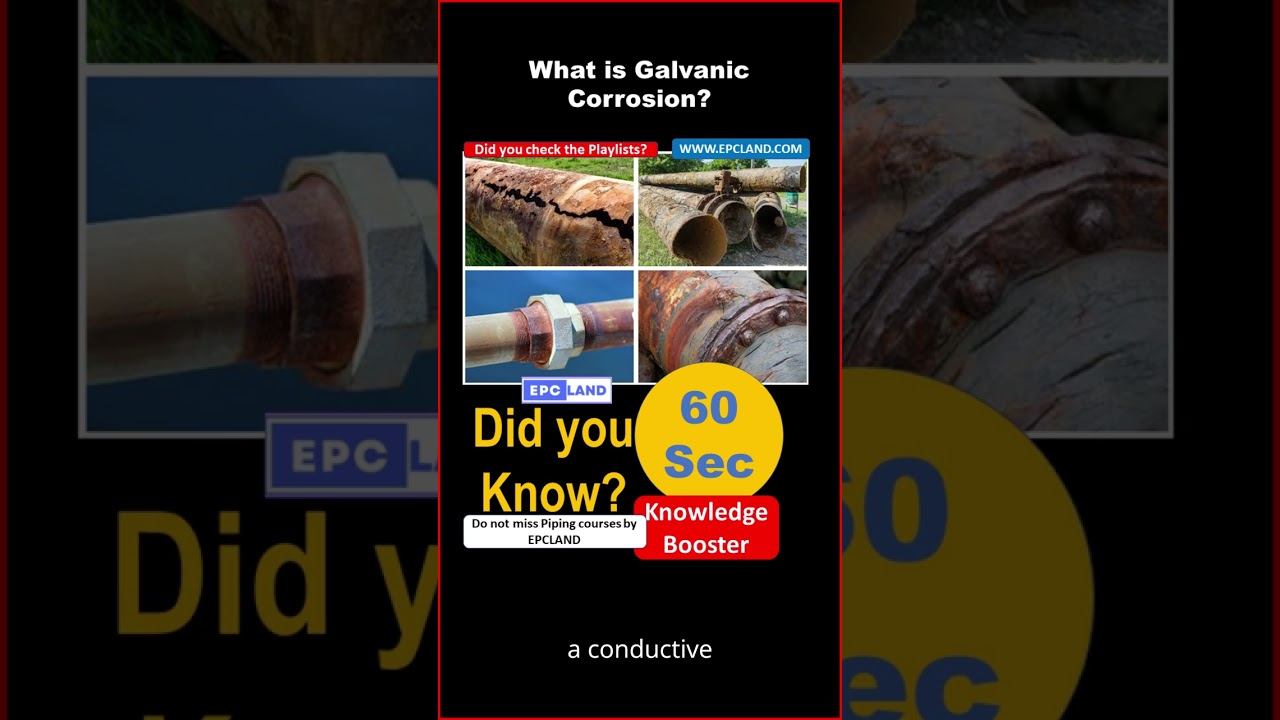
Summary: Understand the concept of galvanic corrosion and how to prevent it in piping design. #GalvanicCorrosion #Metallurgy #EPCLAND ......
📚 Recommended Resources: Galvanized Steel Pipes
Read these Guides



Frequently Asked Questions
What is the difference between Black Steel and Galvanized Steel Pipe?
Can you paint over Galvanized Steel?
Why does my galvanized pipe have white powdery spots?
Is Galvanized Pipe safe for drinking water?
Final Engineering Takeaway
Galvanized steel pipes are a structural powerhouse and a plumbing legacy. When used correctly (Cold Water, Outdoor Air, Structural), they offer decades of rust-free service. However, ignorance of welding safety or temperature limits can lead to catastrophic health risks and system failures.
© 2026 Epcland Engineering. All Rights Reserved.
Content Verified by Atul Singla (Senior Piping Engineer).

Related posts:
![High-grade industrial Wing Nut Types and Applications for mechanical assemblies.]()
Wing Nut Types and Applications: The 2026 Engineering Guide
![Industrial Monorail Crane Systems installed in a modern manufacturing plant 2026.]()
Monorail Crane Systems: Design, Types & 2026 Standards Guide
![Lead engineer performing a Factory Acceptance Test FAT on an industrial skid system 2026]()
Factory Acceptance Test FAT: The 2026 Engineering Guide to Zero-Defect Delivery
![Professional engineering workspace showing a Basis of Design document layout for a 2026 project.]()
Basis of Design: How to Write a BOD for Engineering Projects in 2026
![Industrial Flare Knockout Drum Sizing and installation in a refinery relief system.]()
Flare Knockout Drum Sizing: Design & API 521 Standards (2026 Guide)
![Advanced Reboiler Control Systems in a modern petrochemical refinery 2026.]()
Reboiler Control Systems: Engineering Guide to Precision Control 2026