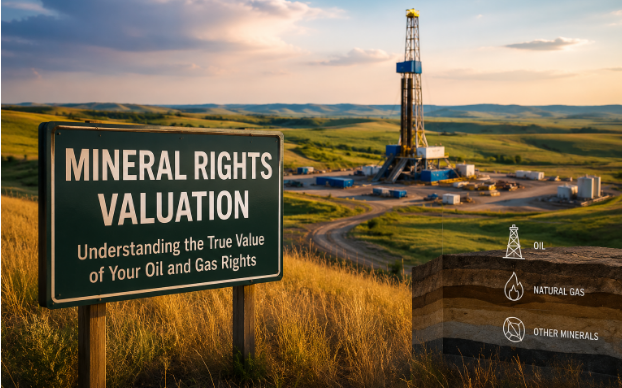
How Oil and Gas Landowners Can Better Understand the Value of Their Mineral Rights
Mineral rights grant legal ownership of underground resources such as oil, natural gas, and other minerals. For landowners, these rights can have significant financial value even when the surface land appears ordinary.
That value is not always easy to see. A lease offer, royalty check, or buyer proposal may seem attractive, but it does not automatically show fair market value. Mineral rights are priced through ownership, production, location, lease terms, title clarity, commodity prices, and future drilling potential.
To understand the real value of your mineral rights, you need to know what you own, how income is created, and what buyers or operators look for before making an offer.
What Are Mineral Rights in Oil and Gas Ownership?
Mineral rights are legal rights that allow an owner to lease, sell, transfer, or receive income from minerals beneath a tract of land. In oil and gas, these minerals usually include crude oil, natural gas, condensate, and related hydrocarbons.
Mineral rights can be separate from surface rights. Surface rights control land above ground, including buildings, roads, crops, and fences. Mineral rights control the resources below ground. In many producing states, one person may own the surface while another owns the minerals.
This matters because owning land does not always mean owning the oil and gas beneath it. Before reviewing any lease or sale offer, landowners should confirm ownership through deeds, leases, probate records, or mineral deeds.
Accurate mineral rights documentation helps prove ownership, support valuation, and reduce delays during negotiations.
Why Is Mineral Rights Value Difficult to Estimate?
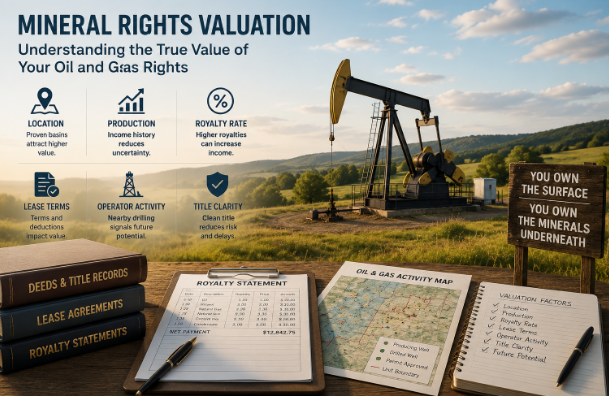
Mineral rights value is difficult to estimate because it depends on both current income and future development. Producing minerals have a royalty history that can be reviewed. Non-producing minerals depend more on geology, nearby drilling, lease activity, and buyer demand.
Two nearby properties can have very different values. One tract may already be included in a producing unit. Another may sit outside active drilling plans, even if it appears similar on a map.
A single royalty check does not show the full picture. Production can decline, oil and gas prices can change, and new wells can increase future income.
The Main Value Drivers Include:
- ✔Production status: Minerals in production are easier to price because they have an income history.
- ✔Location: Acreage in proven basins usually attracts stronger offers.
- ✔Royalty rate: Higher royalty percentages can improve income.
- ✔Lease terms: Deductions, pooling, and term length can change net value.
- ✔Title clarity: Clean records reduce buyer risk.
- ✔Nearby activity: Permits and new wells can signal future development.
What Factors Affect Mineral Rights Value the Most?
Valuation factors are measurable conditions that influence what a buyer, operator, or appraiser may pay for mineral rights. The most important factors are usually location, production, royalty rate, lease quality, operator activity, and ownership clarity.
Location is often the first filter. Mineral rights in active oil and gas basins usually receive more attention than acreage in areas with little drilling history. Buyers look at the county, nearby wells, formation, spacing rules, and operator activity.
Production is another major factor. If a property already generates royalty income, buyers can study monthly revenue, production decline, deductions, and product mix. Producing minerals usually carry less uncertainty than non-producing minerals.
Lease terms also matter. A higher royalty rate can increase value, but only if the lease does not allow excessive post-production deductions. Net income matters more than the headline royalty percentage.
How Do Net Mineral Acres and Net Royalty Acres Affect Value?
Net mineral acres are the actual mineral acres a person owns after ownership fractions are applied. If a tract contains 100 gross acres and you own 50 percent of the minerals, you own 50 net mineral acres.
Net royalty acres measure ownership after accounting for royalty percentage. This helps buyers compare properties with different lease terms. For example, 50 net mineral acres leased at 25 percent royalty can produce more income than 50 net mineral acres leased at 12.5 percent royalty, assuming similar production.
This is why the average price per acre can be misleading. Acreage in one basin, county, or lease structure may not compare directly with acreage somewhere else. Before comparing offers, landowners should know their net mineral acres, royalty rate, lease burden, unit size, and ownership decimal.
How Can Landowners Estimate Producing Mineral Rights Value?
Landowners can estimate the value of producing mineral rights by reviewing income history, production trends, lease terms, operator activity, and comparable offers. Producing minerals is easier to evaluate because they already generate measurable income.
Start with royalty statements. These records show product type, sales volume, price, taxes, deductions, and net payment. Reviewing for at least 12 months provides a clearer view than a single check.
Next, study decline. Many oil and gas wells produce more in the early months and decline over time. If income is falling quickly, buyers will price that risk into the offer. If more wells are planned nearby, future upside may increase value.
A Practical Review Should Include:
- ▪Gather recent royalty statements.
- ▪Average monthly income.
- ▪Check production decline.
- ▪Review operator activity.
- ▪Compare multiple offers.
- ▪Get expert input when ownership or income is complex.
How Can Landowners Estimate Non-Producing Mineral Rights Value?
Landowners can estimate the value of non-producing mineral rights by focusing on future development potential rather than current income. These minerals may still be valuable, but they carry more uncertainty because no active royalty stream exists.
The key question is whether the acreage is likely to be developed. Buyers look at nearby wells, drilling permits, lease offers, operator interest, and basin performance. If the surrounding acreage is active and productive, non-producing minerals may attract stronger offers.
Useful Steps Include:
- ➔Confirm ownership through deeds and legal descriptions.
- ➔Identify the basin, county, and formation.
- ➔Research nearby wells and production.
- ➔Review lease offers and bonus payments.
- ➔Check drilling permits.
- ➔Compare buyer interest.
Mineral Rights Lease vs Sale: Which Option Creates More Value?
Leasing and selling create value in different ways. Leasing lets the landowner retain ownership while granting an operator the right to explore for and produce oil or gas. Selling transfers ownership to a buyer for immediate cash.
A lease can create value through a bonus payment and future royalties. This may suit landowners who believe the acreage has long-term upside. However, a lease does not guarantee drilling.
A sale creates liquidity. This can help with debt, estate planning, investment diversification, or family needs. The tradeoff is that future royalties usually belong to the buyer after closing.
| Factor | Leasing Mineral Rights | Selling Mineral Rights |
|---|---|---|
| Ownership | Landowner usually keeps ownership | Buyer receives ownership |
| Upfront money | Lease bonus | Sale payment |
| Future income | Possible royalties | Usually transferred |
| Risk | Landowner keeps future risk | Buyer assumes future risk |
| Best fit | Long-term upside | Immediate cash |
What Lease Terms Can Increase or Reduce Value?
Lease terms are contract conditions that control how minerals may be developed and how the landowner is paid. These terms affect royalty income, deductions, drilling rights, pooling, and long-term control.
Royalty rate is important, but it is not the only clause that matters. A high royalty can still produce weak checks if the lease allows broad post-production deductions. A lower royalty with cleaner cost language may sometimes create better net income.
Important Lease Terms Include:
- Royalty rate: The rate that determines the owner’s share of production revenue.
- Bonus payment: Provides upfront compensation.
- Primary term: Controls how long the lease remains active before production.
- Post-production deductions: Affects the final royalty check.
- Depth clause: Releases formations not being developed.
- Pugh clause: Releases acreage not included in production.
- Shut-in clause: Allows lease continuation when production is temporarily stopped.
What Mistakes Cause Landowners to Undervalue Their Mineral Rights?
Landowners often undervalue mineral rights by accepting the first offer, ignoring ownership fractions, or focusing only on recent royalty checks. Mineral rights are property interests affected by law, geology, engineering, production, and market demand.
An unsolicited offer may be fair, but it may also be low. Buyers often contact landowners when they see upside that the owner may not fully understand.
Common Mistakes Include:
- ✘Accepting the first offer too quickly.
- ✘Ignoring ownership fractions.
- ✘Overlooking deductions.
- ✘Forgetting future drilling potential.
- ✘Relying only on old checks.
- ✘Failing to confirm the title.
How to Increase Mineral Rights Value Before Negotiating or Selling
Landowners can increase the value of their mineral rights by organizing records, understanding ownership, reviewing income, and creating competition among buyers. The goal is to make the asset easier to evaluate.
Buyers usually pay more when records are complete and ownership is clear. Complete files reduce uncertainty and help buyers model future income.
Before Negotiating, Take These Steps:
- ✔Organize deeds, leases, probate records, and tax records.
- ✔Review royalty statements.
- ✔Verify net mineral acres.
- ✔Research nearby wells and permits.
- ✔Understand lease terms.
- ✔Request multiple offers.
- ✔Speak with a landman, attorney, appraiser, or broker when needed.
Conclusion
Mineral rights value comes from ownership, location, production, royalty terms, lease language, operator activity, title quality, commodity prices, and future drilling potential. No single royalty check or buyer letter can explain all of that.
An offer is not the same as fair market value. It is only one buyer’s view of the opportunity.
Before signing a lease or selling minerals, organize your records, confirm your net mineral acres, review royalty statements, compare multiple offers, and get professional guidance when the numbers are significant.
About the Author
Alisa | Pheasant Energy
Alisa represents Pheasant Energy, a premier Fort Worth, Texas-based upstream oil and gas company. Specializing in property development, mineral management, and asset acquisition, the Pheasant Energy team delivers trusted energy sector expertise to landowners navigating complex asset valuations.
Related posts:
![Industrial worker welding a large structural steel I-beam in a fabrication facility.]()
What is Structural Steel Fabrication and How Does It Work?
![A heavy-duty stainless steel turnbuckle tensioning a structural cable.]()
What is a Turnbuckle and How to Install It?
![Stack of newly manufactured galvanized steel pipes in an industrial warehouse]()
Understanding the Galvanized Pipe Meaning in Modern Piping Systems
![Industrial Alloy 625 piping components in a manufacturing plant]()
What is Alloy 625? Properties, Grades, and Applications of Alloy 625
![Close-up of a fractured steel shaft showing metal fatigue beach marks and failure zones.]()
What is Metal Fatigue and How Do Engineers Prevent It?
![Industrial machinery fitted with smart sensors displaying real-time condition-based maintenance data on a digital overlay.]()
What is Condition-Based Maintenance and How Does It Work?