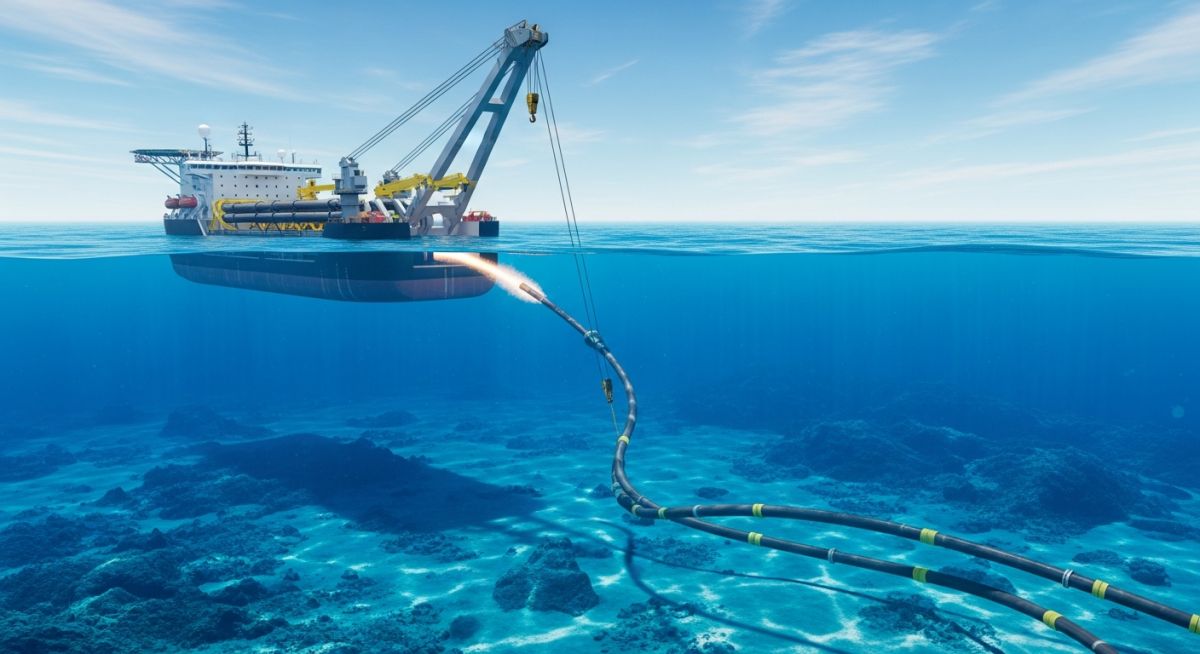
Verified Content 2026 Authored by Epcland Content & Dev Architect Comprehensive Engineering Guide to Subsea Pipeline Design Subsea Pipeline Design represents one of the most challenging disciplines in offshore engineering, requiring a precise balance between hydraulic efficiency, structural integrity, and environmental resistance. In 2026, the integration of advanced materials and automated installation analysis has further refined how engineers approach the transport of hydrocarbons and fluids across the ocean floor. What is Subsea Pipeline Design? Subsea Pipeline Design is the multi-disciplinary engineering process of determining the optimal route, material, wall thickness, and stability requirements for offshore pipelines. It ensures the system withstands internal fluid pressures, external hydrostatic loads, and seabed geo-hazards while complying with international standards like DNV-ST-F101 and ASME B31.8. Table of Contents 1. What is a Subsea Pipeline in Offshore Engineering? 2. Advantages and Disadvantages of Subsea Pipeline Design 3. Core Engineering Requirements for Subsea Pipeline Design 4. Technical Calculations in Subsea Pipeline Design 5. Route Selection and Geo-Hazards in Subsea Pipeline Design 6. Advanced Structural Analysis for Subsea Pipeline Design 7. Construction and Installation of Subsea Pipeline Design Systems 8. Case Study: Implementing Subsea Pipeline Design in Deepwater Technical Knowledge Check: Subsea Pipeline Design Question 1 of 5 Next Question Restart Quiz What is a Subsea Pipeline in Offshore Engineering? In the realm of offshore energy, a subsea pipeline is a sophisticated conduit system engineered to transport fluids—such as crude oil, natural gas, or water—across the ocean floor. Subsea Pipeline Design involves creating a pressure-retaining vessel that must remain functional for 25 to 50 years while submerged in a corrosive, high-pressure, and often geologically unstable environment. Advantages and Disadvantages of Subsea Pipeline Design Every engineering decision involves trade-offs. When implementing a Subsea Pipeline Design, engineers must evaluate the economic and technical benefits against the inherent risks of deepwater operations. Feature Advantages Disadvantages Efficiency Continuous transport with lower operational costs than tankers. High initial capital expenditure (CAPEX). Safety Minimized risk of surface collisions and weather disruptions. Difficult and expensive to repair if a leak occurs. Environment Lowest carbon footprint per barrel of fluid transported. Potential impact on local marine benthic ecosystems. Core Engineering Requirements for Subsea Pipeline Design The design process is governed by strict safety factors. To ensure the Subsea Pipeline Design meets international safety benchmarks, engineers must adhere to various limit states: serviceability, ultimate, fatigue, and accidental limit states. Identifying Product Transport and Throughput Requirements The primary objective of Subsea Pipeline Design is throughput. Engineers use flow assurance software to simulate fluid behavior, ensuring that the internal diameter is sufficient to meet production targets while preventing the formation of hydrates or wax, which can bridge and block the pipeline. Industry Codes and Standards (DNV-ST-F101, ASME B31.8, API 5L) Standardization is critical. Most modern projects utilize DNV-ST-F101 (Submarine Pipeline Systems), which provides a risk-based approach to design. Other vital standards include ASME B31.4 for liquid hydrocarbons and ASME B31.8 for gas transmission, while API 5L specifies the requirements for the manufacture of the line pipe itself. As illustrated in the diagram above, the Subsea Pipeline Design must account for the interaction between the pipe, the soil, and the surrounding seawater. The external hydrostatic pressure increases by approximately 1 bar for every 10 meters of depth, necessitating robust wall thickness to prevent collapse. Technical Calculations in Subsea Pipeline Design Precision in mathematical modeling is the cornerstone of 2026 Subsea Pipeline Design. Engineers must solve for both internal pressure containment and external collapse resistance to ensure the pipeline survives its intended design life. Internal Diameter and Hydraulic Design The internal diameter (ID) is determined by the required flow rate and the allowable pressure drop. Using the Darcy-Weisbach equation, engineers calculate the friction loss to ensure the delivery pressure at the receiving terminal meets operational requirements. Material Selection for Corrosive Subsea Environments In Subsea Pipeline Design, material choice is dictated by fluid chemistry (H2S and CO2 content). Common materials include Carbon Steel with Corrosion Resistant Alloy (CRA) cladding or 13Cr Stainless Steel for highly corrosive service. Pipeline Wall Thickness Calculation and Pressure Containment Wall thickness (t) is calculated based on the Hoop Stress formula. According to ASME B31.8, the minimum wall thickness for a Subsea Pipeline Design is determined by: t = (P × D) / (2 × S × F × E × T) Where: P = Design Internal Pressure; D = Outside Diameter; S = Specified Minimum Yield Strength (SMYS); F = Design Factor; E = Longitudinal Joint Factor; T = Temperature Derating Factor. Route Selection and Geo-Hazards in Subsea Pipeline Design Selecting the optimal path is a spatial optimization problem. Engineers must navigate around shipwrecks, coral reefs, and unstable slopes to minimize risk and cost. Optimized Route Selection and Bathymetry Analysis Modern Subsea Pipeline Design utilizes Autonomous Underwater Vehicles (AUVs) to map bathymetry with centimeter-level precision. This data helps avoid "Free Spans"—sections where the pipe hangs unsupported across two high points, leading to fatigue failure. On-Bottom Stability and Hydrodynamic Loading To prevent lateral shifting, the pipeline's submerged weight must exceed the hydrodynamic lift and drag forces exerted by 100-year storm waves. Stability Factor Analysis Method Standard Limit Vertical Stability Weight vs. Buoyancy (Bu) S.G. > 1.1 Lateral Stability Friction vs. Hydrodynamic Drag F.O.S > 1.1 (DNV-RP-F109) Seabed Liquefaction Pore Pressure Analysis Site Specific Advanced Structural Analysis for Subsea Pipeline Design Finite Element Stress Analysis and Global Buckling Thermal expansion in 2026 Subsea Pipeline Design is managed through Finite Element Analysis (FEA). If the pipeline is axially restrained by soil friction, the resulting compressive stress can trigger global buckling. Engineers may intentionally design "buckle initiators" (S-curves) to relieve this stress in a controlled manner. Installation Analysis: S-Lay, J-Lay, and Reel-Lay Dynamics Installation analysis determines the maximum tension and minimum radius a pipeline can endure during deployment. In S-Lay, the pipeline forms an 'S' shape, requiring a stinger for support. In J-Lay, used for deepwater, the pipeline enters vertically, significantly reducing the bending stress at the touchdown point. Subsea Pipeline Design Wall Thickness Calculator Design Pressure (P) [psi] Outside Diameter (D) [inch] Specified Minimum Yield Strength (SMYS) [psi] Design Factor (F) [Default 0.72] Calculate Thickness Reset Required Nominal Wall Thickness (t) 0.000 Note: Calculation based on Barlow's formula as per ASME B31.8 standards for 2026 subsea pipeline design benchmarks. Don't miss this video related to Subsea Pipeline Design Summary: Master Piping Engineering with our complete 125+ hour Certification Course: ...... ✅ 2500+ VIDEOS View Playlists → JOIN EXCLUSIVE EDUCATION SUBSCRIBE Hydrogen-Ready Subsea Pipeline Design: 2026 Specifications As the global energy mix shifts, Subsea Pipeline Design is evolving to accommodate pure hydrogen (H2) and hydrogen-blended natural gas. Unlike hydrocarbons, hydrogen molecules are extremely small and can permeate high-strength steel, leading to a phenomenon known as hydrogen embrittlement. Technical Challenges for H2 Transport Hydrogen-Induced Cracking (HIC): Atomic hydrogen diffusion into the steel lattice reduces ductility and fracture toughness. Elastomer Degradation: Standard seals and gaskets used in Subsea Pipeline Design may experience rapid decompression failure when exposed to high-pressure hydrogen. Welding Requirements: Enhanced weld procedures and post-weld heat treatment (PWHT) are required to minimize hardness in the Heat Affected Zone (HAZ). ASME B31.12 Compliance and Material Selection Current Subsea Pipeline Design for hydrogen follows ASME B31.12. To mitigate risks, engineers are trending toward lower-strength steels (e.g., API 5L Grade X42 or X52) because higher-strength steels (X70 and above) are more susceptible to embrittlement. Furthermore, internal coating technologies are being developed to create a chemical barrier between the hydrogen gas and the steel surface. Case Study: Implementing Subsea Pipeline Design in Deepwater Projects Project Data Location: Santos Basin, Brazil Water Depth: 2,100 meters Fluid: Pre-salt Crude Oil (High CO2) Pipeline Type: 10-inch Rigid SLWR (Steel Lazy Wave Riser) The Engineering Challenge The extreme depth and jagged seabed bathymetry created significant free spans exceeding 30 meters. Standard Subsea Pipeline Design parameters failed to meet fatigue life requirements due to Vortex-Induced Vibrations (VIV) caused by strong deep-ocean currents. Failure Analysis & Mitigation Analysis showed that the original route would lead to structural failure within 3 years. The Subsea Pipeline Design was modified to include VIV Strakes on 40 percent of the span sections and the installation of 15 grout bag supports to reduce the effective span length to under 12 meters. Engineering Fix Implementation of DNV-RP-F105 for free span fatigue assessment and the use of high-strength X65 grade steel with a 3mm corrosion allowance to handle the acidic fluid composition. Lessons Learned Early-stage AUV bathymetry is non-negotiable. Integrating 2026 real-time monitoring sensors allowed the operator to track axial walking and adjust thermal loads dynamically. Frequently Asked Questions: Subsea Pipeline Design What are the primary factors affecting Subsea Pipeline Design wall thickness? The wall thickness is primarily dictated by internal design pressure, water depth (external hydrostatic pressure), and the Specified Minimum Yield Strength (SMYS) of the steel. In 2026, engineers also factor in corrosion allowances and mill tolerances to ensure compliance with DNV-ST-F101 standards. How does Offshore Pipeline Engineering address Vortex Induced Vibration (VIV)? VIV occurs when ocean currents create alternating vortices around the pipe, causing rhythmic oscillations. In Subsea Pipeline Design, this is mitigated by installing helical strakes or fairings, which disrupt the flow and prevent the synchronization of vortex shedding. What is the significance of DNV-ST-F101 in 2026 pipeline projects? DNV-ST-F101 is the global standard for submarine pipeline systems. It uses a Load and Resistance Factor Design (LRFD) approach, providing more optimized and safer designs compared to traditional working stress methods by accounting for specific uncertainties in loads and material resistance. Why is On-bottom Stability Analysis critical for Subsea Pipeline Design? On-bottom stability ensures the pipeline remains in its surveyed position despite hydrodynamic loads from waves and currents. Engineers calculate the required concrete weight coating or rock dumping thickness to prevent lateral sliding or vertical lifting off the seabed. Conclusion: The Future of Subsea Pipeline Design Achieving excellence in Subsea Pipeline Design requires a holistic understanding of fluid mechanics, structural integrity, and marine geology. As we navigate the energy requirements of 2026, the focus has shifted toward digital twin integration and carbon-neutral installation practices. By adhering to rigorous standards like ASME and DNV, offshore engineers continue to build the resilient infrastructure necessary for global energy security. 📚 Recommended Resources: Subsea Pipeline Design Read these Guides 📄 Pipeline Pigging: Systems, Inspection & Types (2026 Guide) 📄 Top EPC Companies in UAE for Jobs (2026): Career Guide & Rankings 📄 Commissioning in Oil and Gas: Process, Stages & Best Practices (2026) 📄 Post Weld Heat Treatment: Complete ASME Guide & Process (2026) 🎥 Watch Tutorials Which Pipe Type Is Best for Offshore Pipelines? Steps to Become a Pipeline Engineer: Education, Experience, Certification, and More ASTM A106 vs. ASTM A53 vs. API 5L: Decoding the Differences in Steel Pipes |