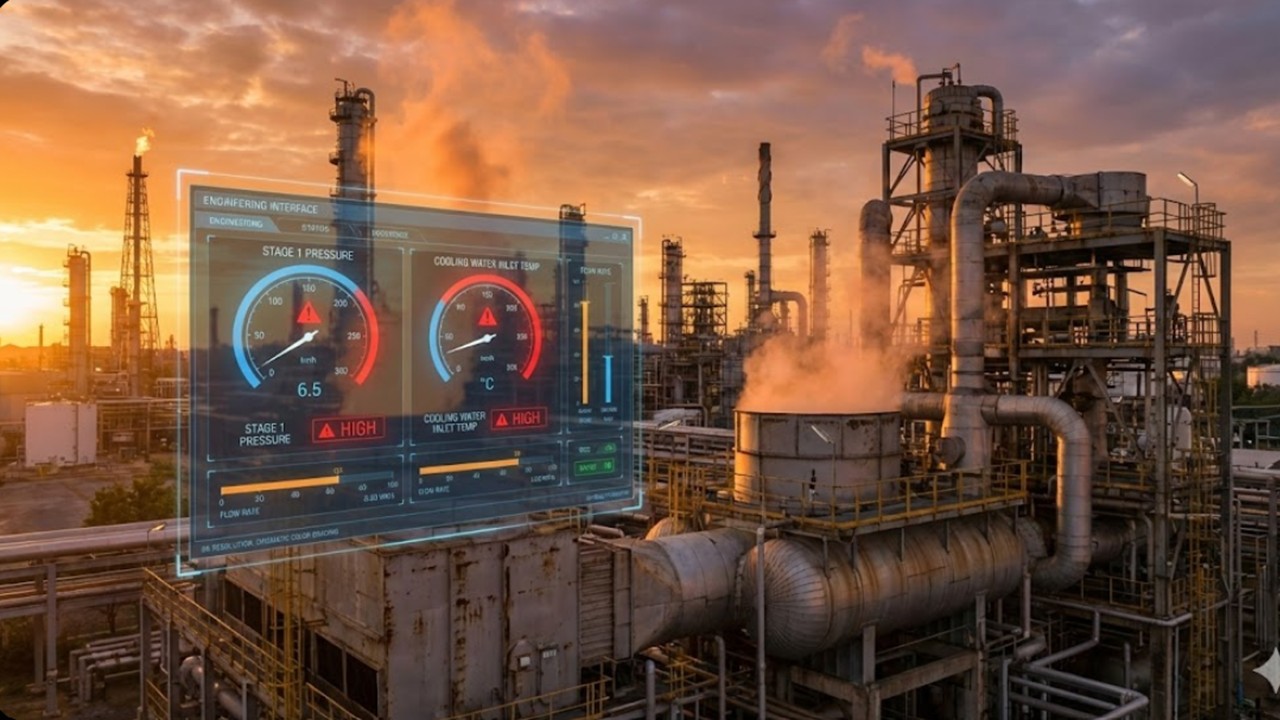
⚠️ Verified Field Guide (2026 Edition) Steam Ejector Troubleshooting: 5 Common Symptoms & Fixes Effective Steam Ejector Troubleshooting is the systematic process of diagnosing vacuum instability by isolating variables such as motive steam quality, cooling water temperature, and air leakage. Unlike mechanical pumps, ejector failures are rarely "broken parts" but rather violations of the thermodynamic design envelope. 🔧 Diagnostic Aptitude: Can You Spot the Root Cause? Score 4/5 to prove your field readiness. Question 1 of 5 Next Question → The Physics of Instability: "Break" vs. "Pickup" Before we dive into the symptoms, we must understand the single most important concept in **Steam Ejector Troubleshooting**: the Performance Curve. Unlike a centrifugal pump that simply moves less fluid as head increases, an ejector has a binary operating mode. It is either "Stable" (Supersonic) or "Unstable" (Subsonic). When an ejector fails, it doesn't just lose efficiency—it "breaks." This occurs when the discharge pressure rises high enough to push the supersonic shock wave back into the diffuser throat. Once this happens, the motive steam can no longer entrain the suction gas, and vacuum collapses instantly. Visualizing the Failure Mode Figure 1: The hysteresis loop. Note that the pressure required to recover vacuum (Pickup) is always lower than the pressure where it fails (Break). The "Break" Pressure The Maximum Discharge Pressure (MDP) the ejector can tolerate before failing. If your backpressure (from a fouled condenser or hot cooling water) exceeds this limit, the system surges. The "Pickup" Pressure Once vacuum is broken, you cannot simply return to the Break Pressure to fix it. You must lower the discharge pressure significantly (often by 15-20%) to re-establish the supersonic shock wave. This is called hysteresis. "90% of ejector problems are not in the ejector itself. They are in the utilities: wet steam, hot water, or air leaks." — Senior Process Consultant, 2026 Reliability Forum The Master Troubleshooting Matrix (HEI Standard) Use this matrix to correlate observed field symptoms with potential root causes. Symptom Probable Cause Field Verification / Fix Surging / "Huffing" High Backpressure (Exceeds MDP) Check downstream pressure. Often caused by Hot Cooling Water (> Design Temp) or fouled condensers raising the pressure of the next stage. Gradual Vacuum Loss Nozzle Erosion / Wear Inspect nozzle throat diameter. If >5% larger than design, steam bypasses the throat, destroying the pressure profile. Replace nozzle. Sudden "Break" Low Motive Steam Pressure Check steam header. Ejectors are designed for a specific pressure (e.g., 150 PSIG). If pressure drops below the design point, velocity drops below Mach 1. Erratic Spikes Flooded Condenser Leg Check the condensate drain leg (barometric leg). If the trap fails or the leg is clogged, water backs up, submerging the ejector discharge. Poor Base Vacuum Air Leakage Perform a "Drop Test". Isolate the system and time the pressure rise. Leaks overload the ejector mass balance. Essential Calculation: Air Leakage Load When troubleshooting vacuum loss, you must quantify the air leak. Use this formula during a Drop Test to see if the leak exceeds the ejector's design capacity. Leakage Rate (W_air) Calculates the mass of air entering the system based on the rate of pressure rise in a known volume. W_air = (V * ΔP * 0.6) / t W_air: Air Leakage (lb/hr) V: System Volume (cubic feet) ΔP: Pressure Rise (mmHg) t: Time (minutes) 0.6: Constant (varies slightly with temp, approx for 70°F) 🧮 Vacuum Drop Test Calculator Estimate air leakage rate based on system pressure decay (Volume Drop Test). System Volume (V) [m³] Total volume of piping + vessel. Pressure Rise (ΔP) [mbar] Difference over test duration. Test Duration (t) [min] Calculate Leakage Rate Estimated Air Leakage: 0.0 kg/hr *Based on air at 20°C. Standard approx. 🩺 Ejector Diagnostic Matrix Symptom Probable Cause Immediate Field Check Surging / unstable Vacuum 1. Low Motive Steam Pressure. 2. High Discharge (Back) Pressure. Check PI (Pressure Indicator) at steam inlet. Check for blockage in discharge line/silencer. Whistling Noise Superheated Steam passing through nozzle (rare) or air leak at gasket. Check steam temperature vs saturation curve. Spray soapy water on flanges. Gradual Performance Loss 1. Nozzle erosion (Throat enlarged). 2. Diffuser scaling/fouling. Shut down and inspect nozzle internal diameter. Clean diffuser internal surface. "Chugging" Sound Flooded suction or Inter-condenser flooded. Check hotwell level gauge. Ensure condensate legs are draining properly (barometric leg seal). 📉 The "Break" vs. "Pickup" Rule Why your ejector won't restart after a pressure spike. ❌ Break Pressure (MDP) The maximum back-pressure the ejector can handle before the supersonic shock wave collapses. Result: Vacuum totally breaks. ✅ Pickup Pressure The pressure you must drop BELOW to restart the supersonic flow. Note: Pickup is always lower than Break pressure! Field Tip: If you lose vacuum due to back-pressure, simply lowering pressure to the "Break point" isn't enough. You must lower it further to the "Pickup point" to re-establish the motive shock wave. Field Diagnostics Log Case Study: The "Summer Surge" Phenomenon SEASONAL FAILURE Site Location Texas Petrochem Complex System Type 3-Stage Steam Ejector Design CW Temp 32°C (90°F) Actual CW Temp 35°C (95°F) The Problem: Afternoon Instability The vacuum system operated flawlessly during the night shift (25 mmHgA). However, every day between 2:00 PM and 5:00 PM, the vacuum would degrade rapidly to 60+ mmHgA, accompanied by a loud "huffing" sound (surging) from the discharge piping. Operators initially suspected a steam pressure drop, but logs confirmed the header was stable at 150 PSIG. The correlation was eventually linked to the cooling water supply temperature, which peaked in the mid-afternoon. Exhibit A: The system was operating dangerously close to the "Break Pressure" line. Engineering Analysis: Crossing the MDP Threshold We analyzed the **Maximum Discharge Pressure (MDP)** of the 2nd Stage Ejector (Z-Stage). The Chain Reaction: 1. High Cooling Water Temp (35°C) reduced the condensation efficiency in the Inter-condenser. 2. This caused the pressure inside the Inter-condenser to rise (higher saturation pressure). 3. The Inter-condenser pressure *is* the discharge pressure (backpressure) for the 2nd Stage Ejector. 4. Once this backpressure exceeded the 2nd Stage MDP (approx 120 mmHgA), the shock wave collapsed. Thermodynamic Check: Design Condenser Pressure: 90 mmHgA (at 32°C water) Actual Condenser Pressure: 125 mmHgA (at 35°C water) Status: Backpressure > MDP (120 mmHgA). RESULT = SURGE. The Fix: Extending the Curve ✔ Short Term (Operations): We increased the Motive Steam Pressure to the 2nd Stage from 150 PSIG to 165 PSIG (safety valve permitting). Why? Higher motive pressure slightly increases the MDP capability, pushing the "Break" point higher, allowing it to tolerate the hotter condenser. ✔ Maintenance Action: During the next outage, the inter-condenser bundle was pulled. It was 40% fouled with calcium scale. Cleaning the tubes restored the heat transfer coefficient (U-value). ✔ Result: After cleaning, even with 35°C water, the condenser pressure remained at 105 mmHgA—safely below the MDP of the ejector. Vacuum stability was restored 24/7. Lesson: Troubleshooting the ejector often means fixing the condenser. Frequently Asked Questions What causes a steam ejector to surge? Surging (often heard as "huffing") is typically caused by the discharge pressure exceeding the ejector's Maximum Discharge Pressure (MDP). This violation of the compression ratio usually results from fouled condensers, hot cooling water, or downstream blockages in the vent lines. How do I identify a motive steam pressure problem? If motive pressure is below design (e.g., < 95% of rating), the nozzle cannot establish the required supersonic velocity, causing a sharp loss in vacuum ("breaking"). If it is too high, it may choke the diffuser throat, reducing suction capacity (load) but not necessarily breaking vacuum immediately. What is the 'Break Pressure' in ejector troubleshooting? Break Pressure is the discharge pressure threshold at which the ejector flow becomes unstable and vacuum collapses. Troubleshooting often involves ensuring the system operates safely below this point. Remember, the pressure required to recover vacuum (Pickup) is always lower than the Break pressure. How do air leaks affect vacuum performance? Air leaks act as a "phantom load." They overload the ejector with non-condensable gas that the system wasn't sized for. This shifts the operation to the far right of the performance curve, resulting in poor suction pressure (higher absolute pressure) or even crossing the break point. Conclusion: Stop Blaming the Ejector Successful Steam Ejector Troubleshooting requires a shift in mindset. Because ejectors have no moving parts, they rarely "break" in the mechanical sense. Instead, they are victims of their environment. As we saw in the "Summer Surge" Case Study, the root cause of vacuum failure is often found in the utilities—wet steam, hot cooling water, or air leakage—rather than the ejector body itself. For 2026, adopt a holistic diagnostic approach. Check your steam traps, monitor your cooling water delta-T, and perform regular drop tests. If the utilities are within design parameters, then (and only then) should you break out the wrenches to inspect the nozzle.