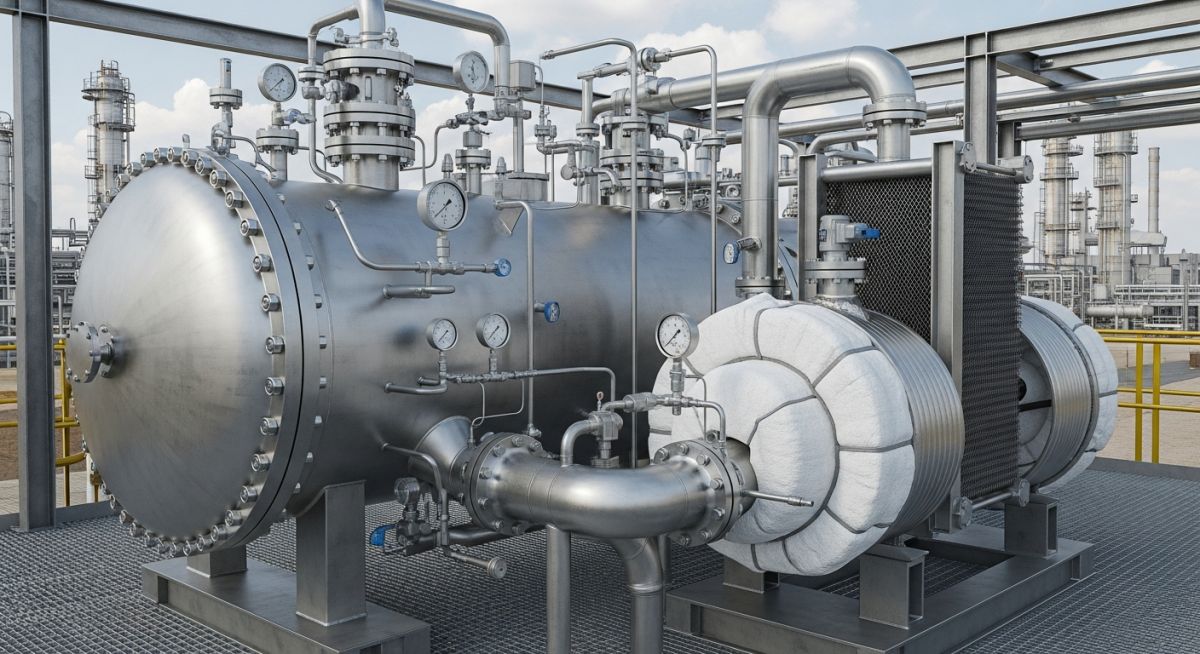
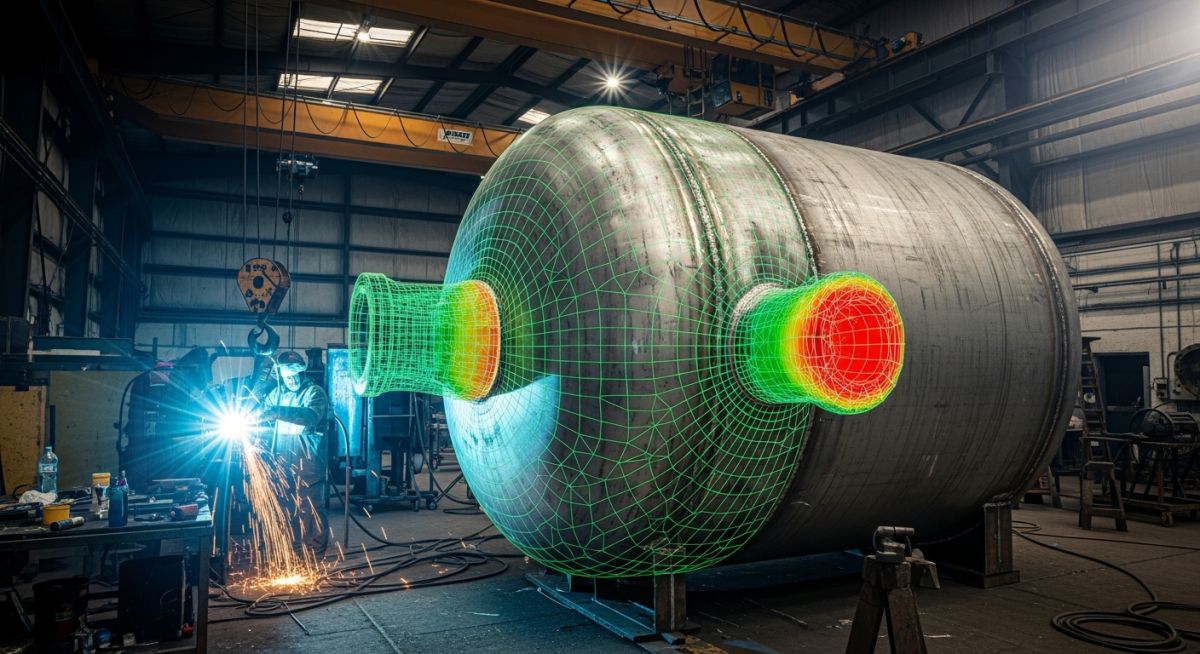
Verified Engineering Content Updated: 2026 Complete Guide to Managing Local Primary Membrane Stresses in 2026 Imagine you are reviewing an FEA report for a critical high-pressure nozzle. The software flags a red zone at the junction where stresses climb significantly above the allowable limit (S). Your first instinct might be to thicken the entire shell, but is that necessary? Often, what you are seeing is not a global failure point, but Local Primary Membrane Stresses. Failing to distinguish between general membrane stress and its localized counterpart can lead to massive material waste or, worse, a catastrophic plastic collapse that standard safety factors won't catch. In this guide, we break down the ASME Section VIII Division 2 requirements to help you classify, linearize, and validate these stresses with surgical precision. Key Takeaways Classification Accuracy: Understand why PL is limited to 1.5S instead of the standard 1.0S allowable stress. Linearization Mastery: Learn the exact method to extract membrane components from complex 3D FEA meshes. Code Compliance: Navigate the specific distance requirements (sqrt of Rt) defined by ASME for localized regions. What are Local Primary Membrane Stresses? Local Primary Membrane Stresses (PL) are average across-the-thickness stresses produced by internal pressure or mechanical loads that occur in a localized region. Unlike general membrane stress, PL is allowed to reach 1.5 times the allowable stress (S) because the surrounding lower-stressed material provides structural reinforcement, preventing immediate failure. "Many junior engineers confuse local membrane stress with secondary stress. Remember: primary stress is 'load-controlled.' If the load doesn't go away when the metal deforms, it's primary. Don't let a secondary classification mask a potential plastic collapse." — Atul Singla, Founder of Epcland Table of Contents 1. What are Local Primary Membrane Stresses (PL)? 2. Distinguishing General vs. Local Primary Membrane Stresses 3. ASME Section VIII Div 2 Limits for Local Primary Membrane Stresses 4. How to Linearize and Extract Local Primary Membrane Stresses from FEA 5. Why Local Primary Membrane Stresses Exceed Limits: Troubleshooting 6. Advanced Protection Against Plastic Collapse and Local Primary Membrane Stresses 7. Local Primary Membrane Stresses Failure Case Study Knowledge Check: Stress Classification Question 1 of 5 According to ASME Section VIII Div 2, what is the allowable limit for Local Primary Membrane Stresses (PL)? A) 1.0S B) 1.5S C) 3.0S Which of the following is a "load-controlled" stress that does not self-limit by deformation? A) Local Primary Membrane Stress B) Thermal Expansion Stress C) Peak Stress (F) To be classified as "local," the stress intensity exceeding 1.1S must not extend more than what distance in the meridional direction? A) 1.0 √(Rt) B) 1.0 √(Rt) C) 2.5 √(Rt) Which FEA tool is used to separate Local Primary Membrane Stresses from bending stresses? A) Mesh Refinement B) Stress Linearization C) Topology Optimization If Local Primary Membrane Stresses exceed limits, what is the most direct engineering solution? A) Decrease Operating Temperature B) Increase Local Component Thickness C) Increase Fillet Radius Next Question → What are Local Primary Membrane Stresses (PL)? To understand Local Primary Membrane Stresses, we must first look at the nature of primary stress itself. Primary stress is load-controlled, meaning it is developed by the imposition of external loads, such as internal pressure or gravity. Unlike secondary stresses, which are self-limiting through minor plastic deformation, Local Primary Membrane Stresses do not diminish as the material yields. If the load persists and the stress exceeds the material's capacity, the result is ultimate failure or plastic collapse. The "Local" designation is a critical distinction in ASME Section VIII Division 2. A membrane stress is considered local if it occurs in a region where the stress intensity exceeds 1.1 times the allowable stress (S), provided the region is confined. Specifically, the stress must decay to the general membrane limit within a specific distance—traditionally 1.0 √(Rt) in the meridional direction. Because this stress is confined and supported by surrounding lower-stressed material, the code allows a higher limit (1.5S) than it does for general membrane stress (1.0S). Distinguishing General vs. Local Primary Membrane Stresses The distinction between General Primary Membrane Stress (Pm) and Local Primary Membrane Stresses (PL) is often the difference between a passing design and an expensive redesign. General membrane stress (Pm) is the average stress across the entire cross-section of a vessel, such as the hoop stress in a cylindrical shell far from any discontinuities. If Pm exceeds the allowable limit, the entire vessel is at risk of bursting. In contrast, Local Primary Membrane Stresses (PL) typically occur at structural discontinuities. Common locations include: Nozzle-to-Shell Junctions: Where the opening creates a redistribution of pressure loads. Cone-to-Cylinder Transitions: Where the change in geometry causes a localized increase in membrane force. Support Skirt Attachments: Where the weight of the vessel and thermal gradients introduce localized loads. Head-to-Shell Junctions: Especially in flatter heads where the transition zone is abrupt. The critical engineering takeaway is that while PL is higher than Pm, it is still a "primary" stress. This means it must be balanced by external forces and moments. If you classify a stress as PL, you are effectively stating that the surrounding material is strong enough to redistribute the load, preventing the localized yielding from turning into a total structural collapse. ASME Section VIII Div 2 Limits for Local Primary Membrane Stresses The ASME code provides a strict hierarchy for stress limits. For Local Primary Membrane Stresses, the limit is defined as PL ≤ 1.5S (or 1.5SE if a joint efficiency is applicable). This 50% "bonus" over general membrane stress is granted because the localized nature of the stress prevents a large-scale plastic hinge from forming across the entire vessel diameter. However, this limit only applies if the stress is truly local. If the high-stress region extends beyond the 1.0 √(Rt) limit, it must be reclassified as Pm and restricted to 1.0S. How to Linearize and Extract Local Primary Membrane Stresses from FEA Modern Finite Element Analysis (FEA) provides a total stress tensor at every node, but ASME Section VIII Division 2 requires us to decompose this into membrane and bending components for validation. This is achieved through Stress Linearization. To extract Local Primary Membrane Stresses, an engineer defines a Stress Classification Line (SCL)—a straight line perpendicular to the surfaces of the component through the thickness. The Local Primary Membrane Stresses component is the average value of the stress across this line. Mathematically, it is the integral of the stress distribution divided by the thickness (t). When performing this in software like ANSYS or Abaqus, ensure your SCL is located away from sharp "singularity" corners but close enough to the discontinuity to capture the true structural response. Why Local Primary Membrane Stresses Exceed Limits: Troubleshooting If your FEA results show that Local Primary Membrane Stresses exceed the 1.5S limit, the design is non-compliant and risks plastic collapse. Before changing the entire vessel thickness, check these common engineering bottlenecks: Issue Impact on PL Recommended Action Insufficient Reinforcement High PL at nozzle neck-to-shell junction. Add a reinforcing pad or use a heavy-wall "integrally reinforced" nozzle. Small Transition Radius Stress concentration elevates membrane average. Increase the knuckle radius or transition taper (1:3 ratio). External Pipe Loads Moments add to pressure-induced PL. Evaluate pipe support locations to reduce nozzle moments. Misaligned SCL Artificial inflation of linearized results. Ensure SCL is perfectly normal to the mid-surface. Advanced Protection Against Plastic Collapse The ultimate goal of limiting Local Primary Membrane Stresses is Protection Against Plastic Collapse. ASME Section VIII Division 2, Part 5 provides three paths for this: Elastic Stress Analysis Method: The simplest but most conservative. You must ensure PL ≤ 1.5S. Limit-Load Analysis Method: Uses a numerical model with perfectly plastic material behavior to find the "collapse load." Elastic-Plastic Stress Analysis Method: The most accurate. It accounts for strain hardening and provides the highest allowable loads by simulating real material behavior. For most standardized vessels, the [ASME Boiler and Pressure Vessel Code (BPVC)](https://www.asme.org) Elastic Method is the industry gold standard due to its balance of safety and computational efficiency. ASME Div 2 PL Limit Calculator Quickly calculate the Local Primary Membrane Stresses (PL) allowable limit (SPL) for 2026 compliance. As per ASME Section VIII Div 2, the limit is typically 1.5S or SY, depending on material properties and temperature conditions. Allowable Stress (S) at Design Temp (MPa) Yield Strength (SY) at Design Temp (MPa) Ultimate Tensile Strength (SU) (MPa) Governed by Time-Dependent (Creep) Properties? Calculate SPL Limit Calculated SPL Limit 0 MPa Basis: 1.5 × S Enter material values to see the compliance limit. Local Primary Membrane Stresses Failure Case Study The Scenario A hydrogen reactor operating at 15.5 MPa was flagged during a 2026 fitness-for-service audit. The original Design by Formula (DBF) calculations passed, but a modern FEA revealed high stress at a 24-inch manway nozzle. The total stress intensity was within limits, but the linearized Local Primary Membrane Stresses (PL) exceeded the 1.5S threshold. The Technical Root Cause The failure was attributed to an Insufficient Reinforcement Zone. While the total area of reinforcement met the code, the spatial distribution was poor. The membrane stress didn't decay within the required 1.0 √(Rt) distance, meaning the "Local" stress was effectively behaving as a "General" stress (Pm). Corrective Action & Engineering Solution Design Modification: The manway neck thickness was increased from 50mm to 75mm to absorb the localized pressure thrust. Linearization Audit: New SCL lines were drawn through the hub-to-shell transition to ensure PL stayed below 1.5S (177 MPa for the SA-516 70 material used). Validation: An Elastic-Plastic analysis was performed to confirm a Safety Factor of 2.4 against plastic collapse, satisfying [ASME Section VIII Division 2 Part 5](https://www.asme.org). Expert Insights: Lessons from 20 years in the field ● Don't over-mesh singularities: If you are extracting Local Primary Membrane Stresses at a sharp corner without a fillet, the stress will "blow up." Always use the linearization integration method rather than picking the peak nodal value to avoid mathematical artifacts. ● The 1.1S Rule: If your membrane stress is between 1.0S and 1.1S, ASME Section VIII Division 2 allows you to classify it as general primary membrane stress (Pm) without the "Local" distance checks, provided it doesn't stay that high for long. ● Distance Matters: If the high-stress region (above 1.1S) extends further than 1.0 √(Rt), you are no longer in a "local" regime. You must treat the entire region as Pm, or the vessel risks global buckling or bursting. Frequently Asked Questions Can I use 1.5S for any high stress found in FEA? ▼ No. You can only use the 1.5S limit for Local Primary Membrane Stresses. If the stress includes bending (linear through the thickness), the limit is higher (SPL + Pb). If it is a surface notch effect, it is Peak Stress (F) and is only used for fatigue evaluations. What happens if PL exceeds 1.5S but passes Limit Load analysis? ▼ As per the [ASME BPVC Section VIII Division 2](https://www.asme.org), if the Elastic-Plastic or Limit Load analysis passes, the design is compliant. The elastic PL limit is a conservative "screening" tool; nonlinear analysis is the ultimate authority for protection against plastic collapse. Is PL always caused by internal pressure? ▼ No. External loads such as piping moments, vessel weight, and even wind or seismic loads can contribute to Local Primary Membrane Stresses. If the load is sustained and not self-limiting, it must be classified as primary. How do I determine the 'R' and 't' for the 1.0 √(Rt) check? ▼ 'R' is the mean radius of the shell at the point of interest, and 't' is the thickness of the shell. For nozzle junctions, use the shell parameters to define the "local" decay region according to ASME Section VIII Div 2 Part 5. Is PL classification required for Section VIII Division 1? ▼ Division 1 is typically Design by Formula. However, if you perform FEA via Mandatory Appendix 46, you are required to use the classification and allowable stress rules of Division 2, including the 1.5S limit for Local Primary Membrane Stresses. Does Stress Linearization work for 2D Axisymmetric models? ▼ Yes, linearization is highly effective in 2D models. It simplifies the extraction of Local Primary Membrane Stresses by integrating along the SCL. Just ensure the pressure thrust is correctly accounted for in the boundary conditions. References & Standards ASME BPVC Section VIII - Division 2: Alternative Rules API 579-1/ASME FFS-1 Fitness-for-Service ISO 16528: Boilers and Pressure Vessels - Safety Requirements Epcland Engineering Knowledge Base & Design Resources