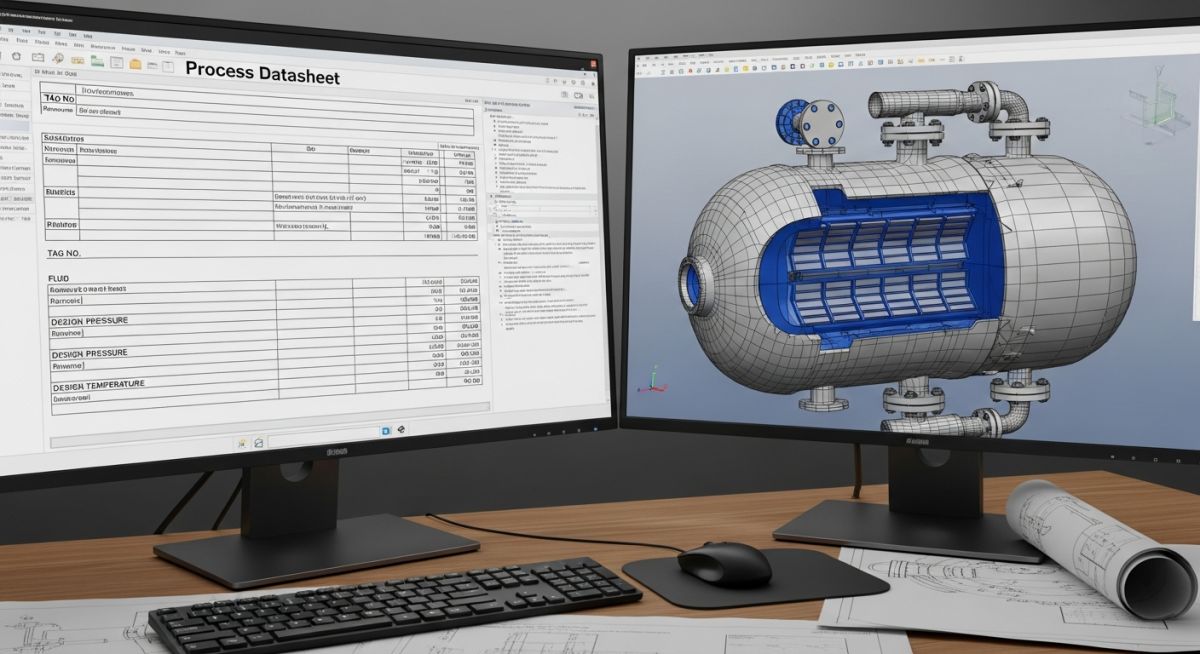
Verified Technical Content 2026 Reviewed by Epcland Content & Dev Architect What is a Process Datasheet? A Comprehensive Engineering Guide A Process Datasheet serves as the fundamental bridge between process design and mechanical engineering, capturing the essential operating conditions and performance requirements needed for equipment fabrication and procurement. In the complex world of industrial design, this document ensures that every piece of equipment is built to handle specific chemical and physical stressors safely. Definition: Process Datasheet A Process Datasheet is a formal engineering document that specifies the functional requirements of process equipment. It defines operating temperatures, pressures, fluid properties, and performance targets. Unlike mechanical datasheets, it focuses on "what" the equipment must do within the process rather than "how" it is physically constructed. Guide Navigation Fundamental Definition: What Is a Process Datasheet? Understanding Process Datasheet Structure and Components Engineering Significance of the Process Datasheet Industrial Applications of the Process Datasheet Workflow for Generating a Precise Process Datasheet Final Thoughts on Process Datasheet Management in 2026 Process Datasheet Proficiency Quiz Question 1 of 5 Restart Quiz Fundamental Definition: What Is a Process Datasheet? At its core, a Process Datasheet is the primary document used to communicate the functional requirements of a piece of equipment from the process engineering team to the rest of the project organization. While a Process Flow Diagram (PFD) integration provides the macro view of the plant, the datasheet provides the micro-level engineering design data necessary for specific equipment selection. In 2026, the Process Datasheet remains the "source of truth." If a pump is required to move 500 cubic meters per hour of sulfuric acid at 60 degrees Celsius, those specific process design parameters are codified in this document. It does not dictate the thickness of the steel or the type of welding used—that is the role of the mechanical datasheet—but it dictates the environment the steel must survive. Understanding Process Datasheet Structure and Components A well-structured Process Datasheet follows a logical hierarchy. It begins with high-level identification and moves into granular technical specifications. Modern process equipment specifications are often digitalized, allowing for seamless data transfer between simulation software and procurement databases. General Information and Administrative Metadata for Process Equipment Specifications This section identifies the "Who, What, and Where" of the equipment. It includes the project name, the specific equipment tag number (e.g., P-101 for a pump or HE-202 for a heat exchanger), and the revision history. Accurate metadata is vital for process design parameters tracking, ensuring that vendors are always working from the most current version of the Process Datasheet. Vital Process Parameters and Design Data This is the engine room of the document. Here, engineers list the fluid properties and operating envelopes. Key engineering design data found in this section includes: Operating Temperature and Pressure: The normal and maximum conditions expected during steady-state operation. Fluid Composition: Specific gravity, molecular weight, and viscosity of the process medium. Flow Rates: Minimum, normal, and rated capacities, often derived from Process Flow Diagram (PFD) integration. Vapor Pressure: Essential for preventing cavitation in liquid-handling equipment. Material of Construction and Equipment Data Sheet Standards While the mechanical team finalizes the structural details, the process engineer suggests the required materials based on chemical compatibility. For example, an Equipment Data Sheet for a corrosive brine service might specify Titanium or Hastelloy. This section also references critical codes such as ASME Section VIII for pressure vessels or API 610 for centrifugal pumps to ensure the Process Datasheet aligns with global safety benchmarks. Performance Metrics and Efficiency Requirements A Process Datasheet must also define how well the equipment must perform. This includes heat transfer coefficients for exchangers, required efficiency percentages for compressors, and turndown ratios for control valves. These process equipment specifications ensure the plant can operate effectively not just at 100 percent load, but during startup and low-capacity periods as well. Engineering Significance of the Process Datasheet The Process Datasheet serves as the legal and technical contract between the process engineering group and the procurement department. Without a finalized and approved datasheet, the chain of engineering production halts. It ensures that the technical intent of the process design is preserved through the lifecycle of the project. Standardized Communication for Process Equipment Specifications By utilizing standardized process equipment specifications, multi-disciplinary teams can speak the same technical language. This standardization reduces the risk of misinterpretation during the hand-off to mechanical, piping, and instrumentation teams. In 2026, many firms utilize ISO-certified templates to maintain consistency across global project sites. Feature Process Datasheet Mechanical Datasheet Primary Focus Operating conditions and fluid properties Physical construction and materials Key Data Flow rate, Pressure, Temperature, Viscosity Wall thickness, Flange rating, Weld details Originating Group Process Engineering Mechanical/Rotating Engineering Purpose Functional equipment sizing Detailed fabrication and procurement Streamlining Procurement via Process Datasheet Accuracy When a Process Datasheet is accurate, the procurement cycle is significantly shortened. Vendors can provide precise quotes because the performance boundaries are clearly defined. Inaccurate data often leads to "Technical Queries" (TQs) which can delay long-lead items by several weeks, impacting the overall project schedule and increasing costs by thousands of USD. Safety, Compliance, and Instrument Data Sheet Integration Process safety is heavily dependent on the instrument data sheet, which derives its alarm and trip settings directly from the Process Datasheet. If the maximum allowable operating pressure (MAOP) is not communicated correctly between these documents, the Safety Instrumented System (SIS) may fail to trigger during an overpressure event. Industrial Applications of the Process Datasheet Every sector of the EPC (Engineering, Procurement, and Construction) industry relies on this document. While the headers may change, the core engineering design data requirements remain remarkably consistent across varied industrial sectors. High-Pressure Engineering Design Data in Oil and Gas In upstream oil and gas, the Process Datasheet for a high-pressure separator must account for slugging regimes and variable gas-to-oil ratios. Engineers must provide process design parameters that accommodate these fluctuations to prevent liquid carryover into the gas flare headers. Technical Calculations in the Process Datasheet The data populated in these documents is the result of rigorous thermodynamics. For example, when calculating the heat duty (Q) for a heat exchanger datasheet, the following relationship is utilized: Q = m · cp · ΔT Where: Q = Heat Duty, m = mass flow rate, cp = specific heat capacity, and ΔT = temperature difference. Additionally, the Process Datasheet for pumps must clearly define the Net Positive Suction Head Available (NPSHa) using the formula: NPSHa = hp + hs - hvpa - hf Ensuring NPSHa > NPSHr (Required) is a mandatory safety check in any process equipment specification. Workflow for Generating a Precise Process Datasheet Creating a Process Datasheet is an iterative task. It usually starts with a simulation run in software like HYSYS or Aspen Plus. The output data is then filtered and manually reviewed by a Senior Process Engineer before being formally issued for design. Step 1: Define the process case (Normal, Minimum, Maximum, Turndown). Step 2: Extract stream data from the Process Flow Diagram (PFD) integration. Step 3: Calculate physical properties at operating conditions. Step 4: Populate the Process Datasheet template with administrative and technical data. Step 5: Inter-disciplinary review (IDR) with Mechanical and Electrical teams. Process Datasheet: Pump NPSHa Calculator Use this tool to calculate the Net Positive Suction Head Available (NPSHa) for your Process Datasheet entries. Ensure all units are in meters (m) for accuracy. Suction Surface Pressure (hp) [m] Absolute pressure on the liquid surface in the suction tank. Static Liquid Head (hs) [m] Positive if liquid is above pump, negative if below. Vapor Pressure Head (hvpa) [m] Absolute vapor pressure at operating temperature. Suction Friction Loss (hf) [m] Total pressure drop in suction piping and fittings. Calculate NPSHa Reset Fields Calculation Summary 0.00 m Case Study: Avoiding Pump Failure via Accurate Process Datasheet Specifications In early 2026, a major petrochemical facility in Southeast Asia experienced recurring mechanical seal failures and impeller pitting on a critical boiler feed water pump (P-402). The investigation highlighted the vital importance of the Process Datasheet in preventing operational downtime. Project Data & Problem Equipment Tag: P-402 (Centrifugal Pump) Service: High-Temperature Boiler Feed Water Issue: Excessive vibration and noise (85+ dB) Impact: USD 45,000 per day in lost production Failure Analysis The root cause was identified as cavitation. A review of the original Process Datasheet revealed that the suction friction loss (hf) had been underestimated during the design phase. This led to a calculated NPSHa that was significantly lower than the actual field conditions. The Engineering Fix The engineering team revised the Process Datasheet to reflect the actual piping geometry and the highest possible operating temperature. By correctly specifying the process design parameters, the team was able to: Increase the suction line diameter to reduce friction loss (hf). Relocate the deaerator vessel to increase the static liquid head (hs). Re-issue a new instrument data sheet for the low-suction pressure trip. Lessons Learned "The Process Datasheet is not just a form to fill out; it is a safety-critical design document. In this case, a 0.5-meter error in suction head calculation resulted in USD 250,000 in repair costs and lost revenue. Always verify fluid properties at the 'worst-case' operating temperature before finalizing process equipment specifications." — Senior Process Lead, EPC Project 2026 Frequently Asked Questions How often should process equipment specifications be updated during the FEED phase? During the Front-End Engineering Design (FEED) phase in 2026, process equipment specifications should be updated whenever there is a significant change in the Heat and Material Balance (HMB). Typically, this involves at least three iterations: Preliminary, Issue for Design (IFD), and Issue for Purchase (IFP). What is the relationship between engineering design data and the mechanical team? The process engineer provides the engineering design data (functional requirements) which the mechanical team then uses to create the mechanical datasheet (construction details). This ensures that the physical equipment can handle the chemical and thermal stresses defined by the process design. Does process flow diagram integration improve datasheet accuracy? Yes, process flow diagram integration via automated engineering tools ensures that the mass and energy balances flow directly into the datasheet. This eliminates manual data entry errors and ensures that the equipment is sized for the exact stream conditions shown on the PFD. Why are process design parameters critical for long-lead equipment procurement? Long-lead items like large compressors or reactors require early ordering to meet project schedules. Fixed process design parameters allow procurement to lock in technical bids early, preventing costly change orders later in the construction phase that can exceed thousands of USD in variations. Conclusion The evolution of engineering in 2026 has made digital accuracy more important than ever. By meticulously defining every fluid property, thermal gradient, and pressure limit, engineers protect the integrity of the entire plant. Whether you are designing a simple storage tank or a complex multi-stage distillation column, the foundation of a successful build is always a high-quality Process Datasheet. Mastering the technical nuances of the Process Datasheet ensures safety, reduces project costs, and guarantees that industrial equipment performs as intended throughout its operational life. 📚 Recommended Resources: Process Datasheet Read these Guides 📄 Project Life Cycle: Process Industry: Piping Quiz 📄 Secrets of Piping Engineering by EPCLand 📄 All About Design Checking: Piping Quiz 📄 Pipe Couplings, Types & Applications: Piping Quiz 🎓 Advanced Training 🏆 Valve Material Specifications (VMS): Comprehensive Guide 🎥 Watch Tutorials Process Datasheet II Tank Data Sheet II Pump Data Sheet II Process Engineering Complete Guide on Valve Material Specification (VMS):Course for Piping Engineers #Valve #Piping #VMS Day-25 of 30: English: ASME B31.3 Calculations Made Easy