Desalination: Comprehensive Guide to the Reverse Osmosis Process (2026)
The Reverse Osmosis Process has become the global benchmark for seawater desalination, offering unparalleled efficiency in converting high-salinity intake into high-purity potable water. As we move through 2026, advancements in membrane flux and energy recovery devices have redefined the economic viability of SWRO plants.
What is the Reverse Osmosis Process?
The Reverse Osmosis Process is a water purification technology that uses a semi-permeable membrane to remove ions, molecules, and larger particles from seawater. By applying hydraulic pressure exceeding the natural osmotic pressure, water is forced through the membrane, leaving concentrated brine behind and producing fresh permeate.
“In 2026, the focus has shifted from mere salt rejection to maximizing energy efficiency through isobaric pressure exchangers. The Reverse Osmosis Process is now as much about power management as it is about chemistry.”
— Atul Singla, Founder of Epcland
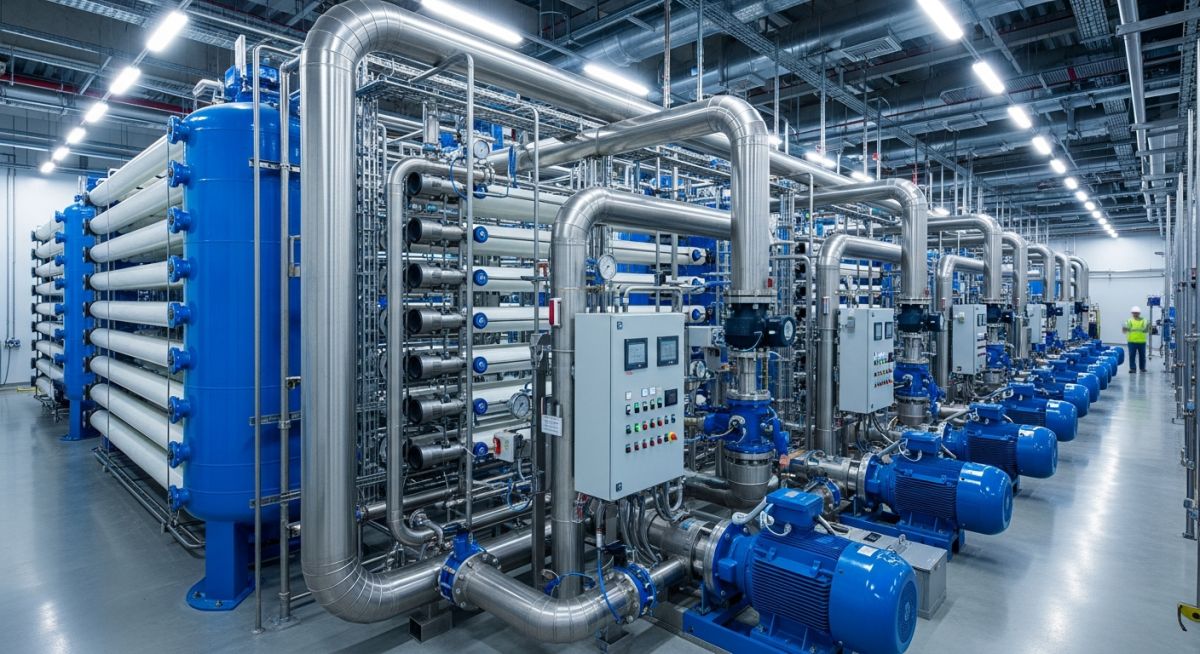
Table of Contents
- Technical Overview of the Reverse Osmosis Process
- Phase 1: Seawater Pumping for Reverse Osmosis Process Intake
- Phase 2: Critical Pre-treatment in Desalination Membrane Technology
- Phase 3: High-Pressure Desalination and Energy Recovery
- Fundamental Reverse Osmosis Process Principles
- Phase 4: Permeate Post-treatment and Stabilization
- Final Phase: Water Storage and Brine Management Protocols
- Advanced Reverse Osmosis Process Case Study
Knowledge Check: Reverse Osmosis Mastery
Loading question…
Complete Course on
Piping Engineering
Check Now
Key Features
- 125+ Hours Content
- 500+ Recorded Lectures
- 20+ Years Exp.
- Lifetime Access
Coverage
- Codes & Standards
- Layouts & Design
- Material Eng.
- Stress Analysis
Technical Overview of the Reverse Osmosis Process
The Reverse Osmosis Process represents the pinnacle of membrane-based separation science in 2026. Unlike thermal distillation, which relies on phase changes, the Reverse Osmosis Process utilizes high-pressure pumps to force seawater through semi-permeable membranes. These membranes are engineered at the molecular level to allow water molecules to pass while rejecting more than 99.8% of dissolved salts, boron, and other contaminants. The efficiency of a modern SWRO (Seawater Reverse Osmosis) facility is measured by its specific energy consumption (SEC) and its recovery ratio, which typically ranges between 40% and 45% for seawater applications.
Phase 1: Seawater Pumping for Reverse Osmosis Process Intake
The lifecycle of the Reverse Osmosis Process begins at the intake structure. Engineering standards for 2026 emphasize the use of “Low-Velocity” open intakes or “Beach Wells” to minimize the impingement and entrainment of marine life. Once the raw seawater enters the plant, high-volume centrifugal pumps transport the water to the treatment stream. Material selection is critical at this stage; pump impellers and casings are typically constructed from Super Duplex Stainless Steel (e.g., 25Cr Duplex) to resist the highly corrosive nature of chloride-rich seawater and prevent premature erosion-corrosion.

Phase 2: Critical Pre-treatment in Desalination Membrane Technology
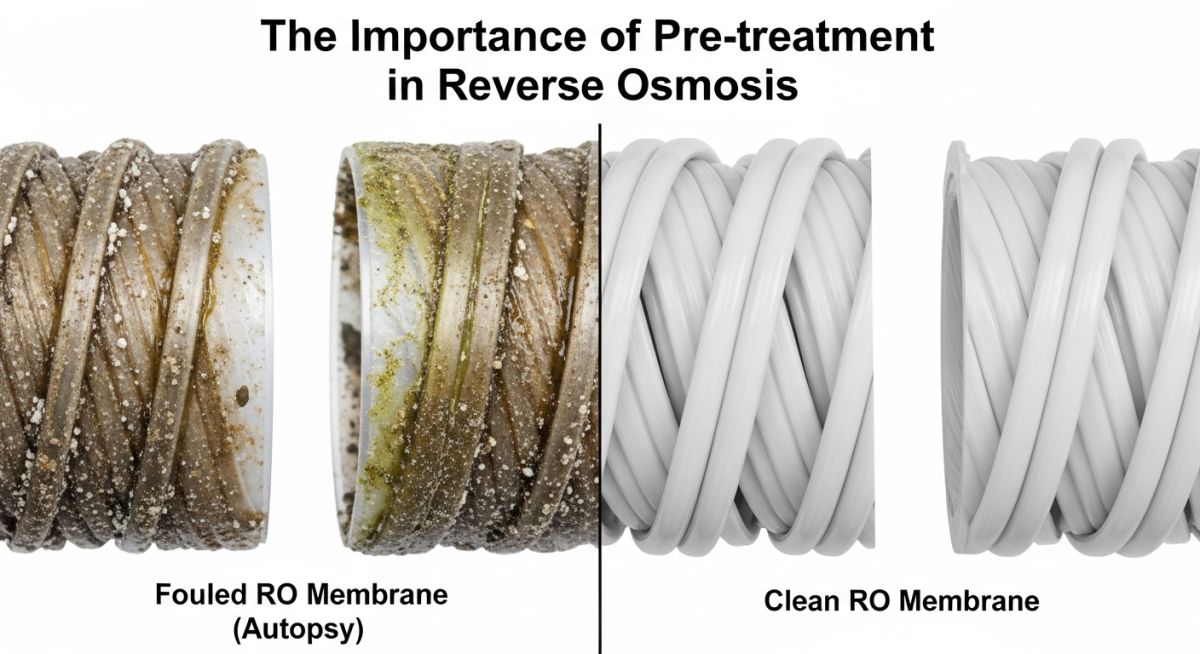
Pre-treatment is the most vital defensive layer for protecting the sensitive Reverse Osmosis Process membranes. Without robust Desalination Membrane Technology in the pre-treatment phase, the main RO membranes would suffer from rapid fouling, scaling, and bio-growth. In 2026, engineers prioritize the removal of Suspended Solids (SS) and the reduction of the Silt Density Index (SDI) to a value below 3.0 to ensure membrane longevity.
Multi-Media Pressure Filter System Engineering
Traditional pressure filter systems utilize stratified layers of anthracite, sand, and garnet. These media layers act as a depth filter, trapping macro-particles and organic matter. Modern configurations often incorporate dual-stage filtration, where the first stage removes large debris and the second stage polishes the water to meet the strict requirements of the Reverse Osmosis Process. Chemical dosing with coagulants (like Ferric Chloride) is often used upstream to enhance particle aggregation.
Advanced Submerged Membrane Systems (UF/MF)
As part of the evolving Desalination Membrane Technology landscape, submerged Ultrafiltration (UF) or Microfiltration (MF) systems have replaced sand filters in many high-capacity plants. These systems use hollow-fiber membranes that provide an absolute barrier to bacteria and viruses. By integrating submerged membranes, the Reverse Osmosis Process benefits from a more consistent feed water quality, regardless of seasonal variations in seawater turbidity or harmful algal blooms (HABs).
Phase 3: High-Pressure Desalination and Energy Recovery
The core of the Reverse Osmosis Process occurs within the high-pressure membrane bank. To overcome the osmotic pressure of seawater (typically 25-30 bar), high-pressure pumps must boost the feed water to operational pressures between 55 and 70 bar. Engineering standards such as API 610 govern the selection of these high-pressure pumps, ensuring they can withstand continuous duty in saline environments. Modern 2026 designs utilize thin-film composite (TFC) membranes that maximize salt rejection while minimizing the required net driving pressure.
Energy Recovery Devices (ERD) Integration
In the Reverse Osmosis Process, only about 40% of the water passes through the membrane as fresh permeate. The remaining 60% exits as high-pressure brine. Without Energy Recovery Devices (ERD), this hydraulic energy would be wasted. By integrating ERDs, plants can reduce their total energy consumption by up to 60%, making large-scale desalination economically feasible in 2026.
Pelton Turbine Applications in SWRO
Pelton turbines are a traditional form of Energy Recovery Devices (ERD). The high-pressure brine stream is directed through a nozzle onto a runner, which is coupled to the main pump shaft or a generator. This converts the kinetic energy of the brine into mechanical power, assisting the primary motor and reducing the electrical load required for the Reverse Osmosis Process.
High-Efficiency Pressure Exchange Technology
Isobaric Pressure Exchangers (PX) represent the state-of-the-art in 2026. These devices work by transferring pressure directly from the high-pressure concentrate stream to a portion of the low-pressure seawater feed. With efficiencies exceeding 97%, these devices are now the industry standard for optimizing the Reverse Osmosis Process.
| Parameter | Standard Range (2026) | Engineering Target |
|---|---|---|
| Operating Pressure | 55 – 80 bar | Optimize for SEC |
| Recovery Ratio | 35% – 45% | 42% (Standard SWRO) |
| Salt Rejection | 99.5% – 99.85% | > 99.7% |
| Specific Energy | 2.5 – 3.5 kWh/m3 | < 2.8 kWh/m3 |
Fundamental Reverse Osmosis Process Principles
The thermodynamics of the Reverse Osmosis Process are governed by the relationship between osmotic pressure (π) and applied hydraulic pressure (P). For the process to occur, the applied pressure must be greater than the osmotic pressure.
Key Equation: Flux and Pressure
The Water Flux (Jw) is calculated as:
Jw = A × (ΔP – Δπ)
- A = Water permeability coefficient of the membrane.
- ΔP = Hydraulic pressure difference across the membrane.
- Δπ = Osmotic pressure difference across the membrane.
Phase 4: Permeate Post-treatment and Stabilization
Water produced by the Reverse Osmosis Process is often too pure for direct consumption or distribution in metal pipes. It is acidic and lacks the necessary minerals for human health. Therefore, Permeate Post-treatment is essential to ensure the water is non-corrosive and palatable.
Remineralization by addition of CaCl2 and NaHCO3
One common method involves the direct injection of Calcium Chloride and Sodium Bicarbonate. This method allows for precise control over the Calcium (Ca2+) and alkalinity (HCO3–) levels, ensuring the water meets local potable standards for 2026.
Remineralization by passage through a Calcite Bed
A more passive and sustainable approach is passing the RO permeate through a bed of limestone (Calcite). As the water flows through, it naturally dissolves the calcium carbonate, increasing the pH and hardness.
Remineralization of Infiltrated Water by Ca(OH)2
In large-scale municipal applications, Lime (Calcium Hydroxide) injection followed by CO2 dosing is used to stabilize the permeate from the Reverse Osmosis Process. This creates a stable Langelier Saturation Index (LSI) to protect downstream infrastructure.
Reverse Osmosis Process Efficiency Calculator
Estimate the Recovery Rate and Specific Energy Consumption (SEC) for your SWRO design in 2026.
*Calculations based on 2026 standard isobaric recovery efficiencies.
EPCLand YouTube Channel
2,500+ Videos • Daily Updates
Advanced Reverse Osmosis Process Failure Case Study
Project Data (2026 Audit)
- Location: 150 MLD Red Sea SWRO Plant
- Issue: Rapid decline in permeate flux and 15% increase in SEC.
- Observation: Feed pressure increased from 62 bar to 74 bar within 48 hours.
Failure Analysis
Upon membrane autopsy, engineers identified Irreversible Bio-fouling caused by an unexpected Algal Bloom. The existing Desalination Membrane Technology in the pre-treatment stage (dual-media filters) was overwhelmed, allowing extracellular polymeric substances (EPS) to reach the Reverse Osmosis Process membranes.
Engineering Fix
The facility implemented a two-fold engineering response to stabilize the Reverse Osmosis Process:
- Interim: Conversion of pre-treatment dosing to include Chlorine Dioxide (ClO2) for targeted oxidation.
- Long-term: Integration of a Submerged Membrane System (UF) upstream of the RO racks to provide an absolute barrier against organics.
Lessons Learned
“For the Reverse Osmosis Process to remain resilient in 2026, intake monitoring for Chlorophyll-a must be automated. Relying on traditional media filters alone is a high-risk design for regions prone to blooms.”
Final Phase: Water Storage and Brine Management Protocols
The final steps of the Reverse Osmosis Process involve safe storage of the treated permeate and environmentally compliant disposal of the concentrated brine. Storage tanks must be lined according to ASME RTP-1 standards to prevent corrosion from the treated, yet still reactive, water.
Brine Management Protocols are critical environmental engineering challenges in 2026. Brine salinity is typically twice that of natural seawater. The most common method of disposal is diffusion into the open ocean via multi-port diffusers to ensure rapid dilution and minimal impact on benthic ecosystems. Onshore options include deep-well injection or solar evaporation ponds, depending on geological surveys and local environmental regulations.
Further Studies and Online Video Courses
To deepen your expertise in the Reverse Osmosis Process, we recommend reviewing standards from API, ASME, and ISO related to pumps, pressure vessels, and material selection. Epcland provides extensive video courses covering detailed SWRO plant design principles for 2026.
FAQ: Engineering the Reverse Osmosis Process
What is the typical specific energy consumption (SEC) for the Reverse Osmosis Process in 2026?
In 2026, thanks to high-efficiency Energy Recovery Devices (ERD) like isobaric pressure exchangers, the typical SEC for a large-scale SWRO Reverse Osmosis Process ranges from 2.5 to 3.5 kWh/m3 of fresh water produced.
How do pre-treatment technologies impact the lifespan of desalination membranes?
Robust Seawater Pre-treatment Systems, particularly those using advanced ultrafiltration Desalination Membrane Technology, protect the main RO membranes from fouling agents. This ensures the Silt Density Index (SDI) is consistently low, extending the membrane life from 3-5 years to 7-10 years, dramatically reducing operational costs.
What is the primary concern regarding brine waste disposal in modern SWRO plant design?
The primary concern in SWRO Plant Design for brine disposal is the localized environmental impact of increased salinity and temperature. Modern Brine Management Protocols focus on rapid dilution through engineered outfall structures to prevent harm to sensitive marine ecosystems.
Why is post-treatment necessary after the Reverse Osmosis Process?
Permeate Post-treatment is necessary because the ultra-pure water produced by the Reverse Osmosis Process is corrosive and lacks essential minerals. Remineralization stabilizes the water (adjusting pH and LSI) for safe distribution through municipal piping networks and makes it suitable for human consumption.
Conclusion: Mastering the 2026 Reverse Osmosis Process
The engineering behind the modern Reverse Osmosis Process is a testament to sophisticated integration of fluid dynamics, material science, and chemical engineering. By optimizing pre-treatment systems, leveraging high-efficiency Energy Recovery Devices (ERD), and adhering to strict Brine Management Protocols, engineers in 2026 can design sustainable, cost-effective desalination solutions that ensure global water security. Mastering every phase of this process is essential for any EPC professional.
Leave a Reply Cancel reply
Recent Posts
About Me
📚 Recommended Resources: Piping
Read these Guides
🎓 Advanced Training



Related posts:
![High-grade industrial Wing Nut Types and Applications for mechanical assemblies.]()
Wing Nut Types and Applications: The 2026 Engineering Guide
![Industrial Monorail Crane Systems installed in a modern manufacturing plant 2026.]()
Monorail Crane Systems: Design, Types & 2026 Standards Guide
![Lead engineer performing a Factory Acceptance Test FAT on an industrial skid system 2026]()
Factory Acceptance Test FAT: The 2026 Engineering Guide to Zero-Defect Delivery
![Professional engineering workspace showing a Basis of Design document layout for a 2026 project.]()
Basis of Design: How to Write a BOD for Engineering Projects in 2026
![Industrial Flare Knockout Drum Sizing and installation in a refinery relief system.]()
Flare Knockout Drum Sizing: Design & API 521 Standards (2026 Guide)
![Advanced Reboiler Control Systems in a modern petrochemical refinery 2026.]()
Reboiler Control Systems: Engineering Guide to Precision Control 2026