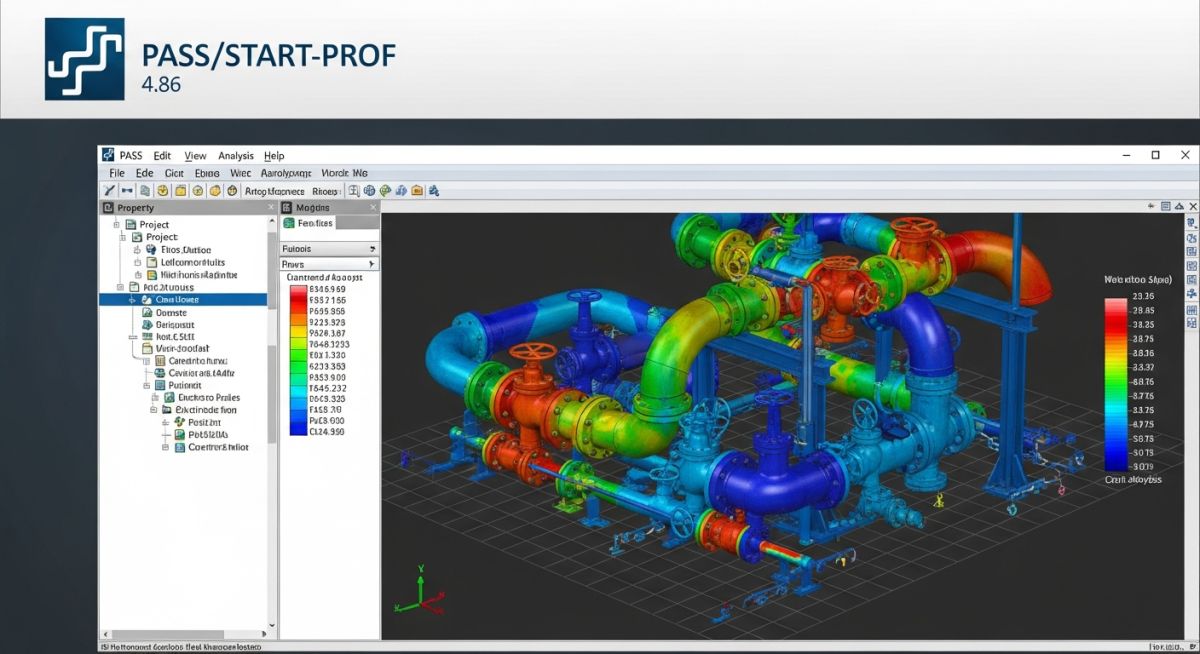
PASS/START-PROF 4.86 Released: Discover the New Pipe Stress Analysis Capabilities
Over my 20 years in piping engineering, I have seen software tools evolve from basic command-line calculators to highly integrated design suites. When it comes to analyzing complex piping networks, buried pipelines, and fiberglass systems, the software you choose directly impacts both safety and project margins. The release of PASS/START-PROF 4.86 marks a significant leap forward. In my experience, many stress analysis tools require tedious manual workarounds for non-linear soil interactions or fiberglass anisotropic properties. This new version addresses those exact pain points, streamlining our workflows and reducing the risk of human error during code compliance checks.
On my recent projects, the pressure to deliver accurate stress reports under tight schedules has only increased. We can no longer afford to spend days setting up complex boundary conditions or manually iterating spring hanger selections. PASS/START-PROF 4.86 introduces smart automation that handles these tasks in minutes. Whether you are designing high-temperature steam lines under ASME B31.3 or buried oil transit lines, this update provides the fidelity and speed required for modern engineering workflows.
Key Engineering Takeaways from Version 4.86:
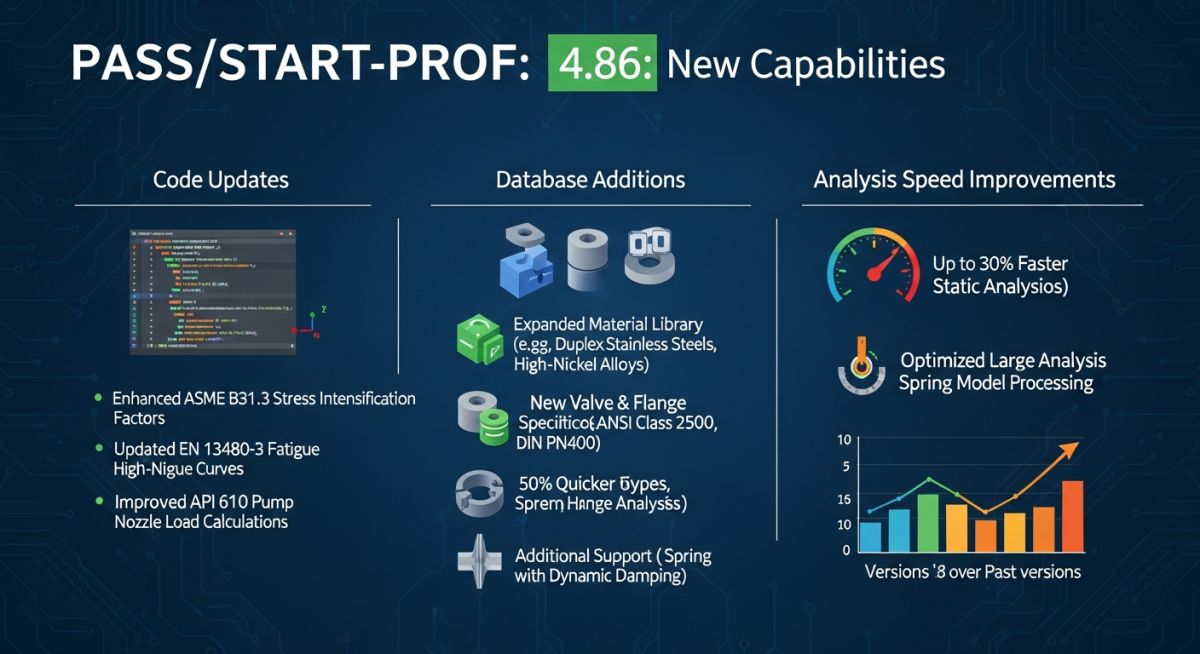
- Seamless integration of the latest international piping codes, reducing manual compliance verification time.
- Enhanced non-linear solver capabilities for modeling complex support gaps, friction, and soil-pipe interactions.
- Advanced fiberglass (FRP/GRP) modeling tools that accurately account for anisotropic material properties.
- Automated spring hanger selection algorithms that optimize support designs based on actual operating load cases.
- Improved user interface responsiveness and 3D graphics rendering for massive, plant-wide piping models.
Why Is PASS/START-PROF 4.86 Revolutionizing Stress Analysis?
To truly appreciate what PASS/START-PROF 4.86 brings to the table, we must look at the underlying physics and mathematical models it employs. In traditional pipe stress analysis, modeling buried pipelines requires the engineer to manually calculate equivalent soil spring stiffnesses. This is often done using simplified formulas that do not capture the true non-linear behavior of soil under varying thermal expansion cycles.
In this new version, the software utilizes an advanced non-linear soil-pipe interaction model. The soil is represented as a continuous field of tri-axial non-linear springs. The spring stiffness in the horizontal (Kh), vertical upward (Kv_up), vertical downward (Kv_down), and axial (Ka) directions are calculated automatically based on soil properties such as internal friction angle, cohesion, and soil density.
Ka = f(Cohesion, Friction Angle, Pipe Diameter, Depth of Cover)
Kh = f(Soil Density, Depth of Cover, Passive Earth Pressure Coefficient)
This level of automation eliminates the need for external spreadsheets and reduces the likelihood of input errors. Furthermore, the software’s solver has been optimized to handle these non-linearities with remarkable stability, preventing the convergence failures that often plague engineers when running large buried piping models.
Anisotropic Modeling for FRP/GRP Piping
Another area where PASS/START-PROF 4.86 shines is in the analysis of Fiberglass Reinforced Plastic (FRP/GRP) piping. Unlike steel, fiberglass is anisotropic; its mechanical properties vary significantly between the axial and hoop directions. Analyzing these systems using isotropic steel assumptions can lead to catastrophic failures or wildly over-designed support structures.
The software implements the stress analysis requirements of ISO 14692. It allows engineers to input distinct elastic moduli for the axial (Ea) and hoop (Eh) directions, as well as shear moduli (G) and Poisson’s ratios. The software then automatically calculates the stress components and compares them against the envelope of allowable stresses defined by the manufacturer or the standard.
Automated Spring Hanger Selection
Selecting the right variable or constant spring hangers is one of the most time-consuming tasks in piping design. I have spent countless hours in my career manually adjusting spring rates and pre-loads to ensure that nozzle loads on sensitive equipment remain within allowable limits.
PASS/START-PROF 4.86 automates this entire process. The software analyzes the piping system in both the cold (installed) and hot (operating) conditions. It then queries its extensive built-in manufacturer databases (including LISEGA, Carpenter & Paterson, and others) to select the optimum hanger size, spring rate, and preset load. This ensures that the load variation on adjacent equipment nozzles is minimized, keeping your design fully compliant with API 610 and API 617 standards.
The table below outlines the primary piping codes supported in PASS/START-PROF 4.86, along with their specific application scopes and the key stress criteria evaluated by the software’s calculation engine.
| Piping Code | Application Scope | Key Stress Criteria | Version 4.86 Enhancements |
|---|---|---|---|
| ASME B31.3 | Process Piping (Refineries, Chemical Plants) | Sustained, Expansion, Occasional Stresses | Updated to latest edition; improved stress intensification factors (SIFs) for tees. |
| ASME B31.1 | Power Piping (Steam Generation Stations) | Thermal Expansion, Creep, Dynamic Loads | Enhanced creep-rupture life evaluation for high-temperature alloys. |
| EN 13480 | European Industrial Metallic Piping | Flexibility Analysis, Wind & Seismic Loads | Fully integrated European material database updates. |
| ISO 14692 | GRP/FRP Piping Systems | Anisotropic Stress Envelope, Joint Shear | Automated generation of the 3D stress envelope for fiberglass joints. |
This matrix maps the core technical entities, structural acronyms, and physical parameters utilized within PASS/START-PROF 4.86 to ensure precise modeling and code compliance.
| Entity / Acronym | Technical Definition | Physical Parameter | Reference Standard |
|---|---|---|---|
| SIF | Stress Intensification Factor | Dimensionless multiplier for local stress | ASME B31J / ASME B31.3 |
| FRP / GRP | Fiberglass / Glass Reinforced Plastic | Anisotropic elastic moduli (Ea, Eh) | ISO 14692 |
| WRC 537/107 | Welding Research Council Local Stress | Radial, circumferential, and shear stresses | WRC Bulletin 537 / 107 |
| PUF | Polyurethane Foam Insulation | Shear strength and thermal conductivity | EN 253 (District Heating) |
How to Verify Your PASS/START-PROF 4.86 Model?
Before running your final stress analysis and generating reports for client submission, it is vital to perform a rigorous model verification. In my experience, even the most advanced software cannot protect against incorrect input data. Use this checklist to verify your model integrity.
Pre-Analysis Verification Steps:
-
Material Properties: Verify that the selected material database matches the project piping specification exactly, paying close attention to the design temperature and corresponding allowable stress values.
-
Boundary Conditions: Ensure that equipment nozzles are modeled with appropriate stiffnesses (using WRC 297/537 or FEA) rather than assuming rigid anchors, which can artificially inflate stress values.
-
Soil Parameters (Buried Lines): Confirm that the soil density, friction angle, and depth of cover match the geotechnical report. Check that the non-linear soil spring generation is active.
-
Support Gaps and Friction: Double-check that guide and limit stop gaps are modeled accurately. Ensure that realistic friction coefficients (e.g., 0.3 for steel-on-steel, 0.1 for PTFE) are applied.
-
Load Case Definition: Verify that all operating, shutdown, hydrotest, and occasional (wind/seismic) load cases are defined in accordance with ASME B31.3.
Field Case Study: Real-World Application
The Problem: High Nozzle Loads on a Sensitive Steam Turbine
During the design phase of a combined-cycle power plant, my team was tasked with analyzing a 24-inch high-pressure steam line connecting the steam generator to a sensitive steam turbine. The initial stress analysis, performed using legacy software, indicated that the turbine nozzle loads exceeded the allowable limits defined by NEMA SM 23 by over 150%.
The legacy software struggled to model the non-linear behavior of the variable spring hangers and the complex soil-pipe interaction of the underground bypass line. To compensate, the previous design team suggested adding two massive expansion loops, which would have required an additional 45 tons of structural steel and significantly increased the pressure drop across the system.
The Solution: Advanced Modeling in PASS/START-PROF 4.86
I decided to remodel the entire system using PASS/START-PROF 4.86. By leveraging the software’s advanced non-linear solver, we were able to model the exact support gaps and realistic friction coefficients at the pipe guides. More importantly, we utilized the automated spring hanger selection engine, which optimized the spring rates and pre-loads across all operating and shutdown cases.
The software’s integrated soil-pipe interaction module allowed us to model the buried portion of the bypass line with high fidelity, capturing the natural flexibility provided by the soil rather than treating the ground entry point as a rigid anchor.
The Outcome
The results were outstanding. The optimized model in PASS/START-PROF 4.86 demonstrated that the turbine nozzle loads were actually well within the NEMA SM 23 allowables without the need for any additional expansion loops. This saved the project over 120,000 in structural steel and piping materials, reduced the system pressure drop by 0.4 bar, and shaved three weeks off the engineering schedule.
Frequently Asked Engineering Questions
What Makes PASS/START-PROF 4.86 Different From Competitors?
How does PASS/START-PROF 4.86 handle buried piping analysis compared to other software?
Can I import models from CAESAR II into PASS/START-PROF 4.86?
What codes are supported for fiberglass (FRP/GRP) piping in this version?
How does the software calculate non-linear support gaps and friction?
Is PASS/START-PROF 4.86 compliant with the latest ASME B31.3 editions?
What are the hardware requirements for running large-scale models in version 4.86?
===
Complete Course on
Piping Engineering
Check Now
Key Features
- 125+ Hours Content
- 500+ Recorded Lectures
- 20+ Years Exp.
- Lifetime Access
Coverage
- Codes & Standards
- Layouts & Design
- Material Eng.
- Stress Analysis
