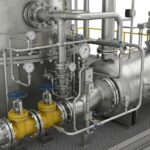
What is a Multiport Selector Valve or MSV? Importance of MSV Skids

A Multiport Selector Valve (MSV) is a specialized engineering solution designed to streamline well testing and production manifold operations in the upstream oil and gas sector. By replacing complex, high-maintenance traditional manifolds with a single, automated selector unit, operators can divert flow from multiple wells into a shared production header while simultaneously isolating one specific well for testing purposes without interrupting the overall field output.
What is a Multiport Selector Valve (MSV)?
A Multiport Selector Valve (MSV) is a multi-port flow diverter that allows multiple inlet streams (wells) to be grouped into a common outlet while diverting a single selected stream to a secondary test outlet. It eliminates the need for complex isolation valves, reducing manifold weight, footprint, and leakage risks.
Article Contents
- Engineering Overview: What is a Multiport Selector Valve (MSV)?
- Core Multiport Selector Valve Functions and Flow Logic
- Crucial Applications of MSV Technology in the Oil and Gas Industry
- Mechanical Working Principle of a Multiport Selector Valve
- Integrated Systems: What is an MSV Skid?
- Technical Advantages of Deploying MSV Skids in Production
- Engineering Challenges and Disadvantages of Multiport Selector Valves
- Market Landscape: Global MSV Skid Manufacturers
- Selection Criteria for a Multiport Selector Valve Skid System
- Case Study: Automated Well Testing via Multiport Selector Valve Skids
MSV Technical Knowledge Check
Question 1 of 5Quiz Completed!
Complete Course on
Piping Engineering
Check Now
Key Features
- 125+ Hours Content
- 500+ Recorded Lectures
- 20+ Years Exp.
- Lifetime Access
Coverage
- Codes & Standards
- Layouts & Design
- Material Eng.
- Stress Analysis
Engineering Overview: What is a Multiport Selector Valve (MSV)?
In traditional upstream operations, a production manifold consists of a complex network of piping and isolation valves designed to route individual wells to either a production header or a test header. A Multiport Selector Valve (MSV) revolutionizes this layout by consolidating the functions of multiple isolation valves into a single, highly integrated mechanical unit.
The primary engineering objective of a Multiport Selector Valve is to provide a reliable, space-efficient, and automated means of well selection. By utilizing a rotating internal selector, the MSV can isolate any single inlet from a group of wells and divert its flow to a dedicated test line—such as a Three-Phase Separator or a Multi-phase Flow Meter (MPFM)—while the remaining wells continue their combined flow into the main production line.
Core Multiport Selector Valve Functions and Flow Logic
The flow logic of a Multiport Selector Valve is often referred to as a "Many-to-Two" diversion. This reflects the valve's ability to take multiple high-pressure inlet streams and categorize them into two distinct output streams.
- Group Production Function: In normal operation, all inlets are routed to the group production outlet. This ensures continuous field production and pressure maintenance.
- Individual Well Testing: Upon command from the control system, the internal diverter of the Multiport Selector Valve rotates to a specific port. This "picks" the selected well for isolation and routes it to the test outlet.
- Purge and Maintenance: Many MSV designs include a "Home" or "Blank" port. This allows the selector to be positioned where no specific well is isolated, or it can be used for manifold purging during maintenance shutdowns.

Crucial Applications of MSV Technology in the Oil and Gas Industry
The adoption of Multiport Selector Valve technology is most prevalent in environments where space, weight, and automation are critical operational priorities.
| Application Area | Role of Multiport Selector Valve | Key Benefit |
|---|---|---|
| Offshore Platforms | Replaces large, heavy manifolds. | Reduces topside weight and deck footprint. |
| Unconventional Shale | Centralizes 10+ well pad testing. | Enables remote, unmanned well-test sequences. |
| Enhanced Oil Recovery | Manages viscous EOR fluids. | Fewer leak points in high-temp/high-pressure lines. |
Mechanical Working Principle of a Multiport Selector Valve
The mechanical heart of a Multiport Selector Valve is a precisely machined internal rotor or diverter plug. This plug is housed within a pressure-containing body that complies with API 6A or API 6D standards, depending on the service pressure and fluid chemistry.
The Selection and Diversion Mechanism
Most Multiport Selector Valve designs feature a set of radial inlet ports and two axial or radial outlet ports. An electric or pneumatic actuator drives the internal selector shaft. As the shaft rotates, the diverter plug aligns its internal channel with a specific well inlet. This creates a secure, isolated conduit to the test outlet.
Advanced Multiport Selector Valve systems utilize high-performance elastomeric or metal-to-metal seals to prevent "cross-talk" between the test well and the group production header. This sealing integrity is vital for accurate data acquisition; if the production stream leaks into the test stream, the calculated well-cut and flow rates will be inaccurate, leading to poor reservoir management decisions.
Integrated Systems: What is a Multiport Selector Valve (MSV) Skid?
An MSV Skid is a modular, pre-engineered assembly that integrates a Multiport Selector Valve with the necessary piping, instrumentation, and control systems required for autonomous well testing. Instead of installing individual components on-site, the skid is fabricated in a controlled facility, pressure-tested according to ASME B31.3, and shipped as a complete package to the wellsite.
A typical Multiport Selector Valve skid includes the selector valve itself, an automated actuator (often electric or electro-hydraulic), a Multi-phase Flow Meter (MPFM), and a local control panel (PLC). This integration allows for well testing automation where the selector moves from well to well based on a pre-programmed schedule, transmitting real-time data to a centralized SCADA system.
Technical Advantages of Deploying Multiport Selector Valve Skids
The shift from traditional manifolds to Multiport Selector Valve skids offers significant benefits in terms of both Capital Expenditure (CAPEX) and Operational Expenditure (OPEX).
| Feature | Traditional Manifold | Multiport Selector Valve Skid |
|---|---|---|
| Footprint | Large (Multiple headers/valves) | Compact (60-75% smaller) |
| Weight | High (Extensive structural steel) | Reduced (Minimal piping) |
| Leak Paths | Numerous flange/threaded joints | Minimal (Integrated design) |
| Automation | Manual or complex actuator racks | Simplified (Single actuator) |
Engineering Challenges and Disadvantages of the Multiport Selector Valve
While highly efficient, the Multiport Selector Valve is a complex mechanical device that presents certain trade-offs compared to simpler bulk valve systems.
- Sealing Wear: The internal selector plug rotates under high differential pressure, which can lead to seal degradation over time, especially in "sandy" or high-solids production.
- Single Point of Failure: If the primary Multiport Selector Valve actuator or selector plug fails, the ability to test any well in that cluster is compromised until repairs are made.
- Initial CAPEX: The cost of a single precision-engineered Multiport Selector Valve can be higher than the combined cost of the standard gate or ball valves it replaces.
- Maintenance Specialty: Internal repairs to an MSV require specialized technicians and proprietary seal kits, unlike standard valves that can be serviced by general maintenance teams.
Market Landscape: Leading Multiport Selector Valve Skid Manufacturers
The market for Multiport Selector Valve technology is dominated by a few global engineering firms with extensive experience in upstream oil and gas manifolds. These manufacturers provide systems rated for high-pressure service (up to 15,000 psi) and sour gas (H2S) environments.
Emerson (Daniel/Fisher)
Renowned for high-precision selector technology and seamless integration with DeltaV control systems.
Cameron (Schlumberger)
Specializes in heavy-duty API 6A selector valves for high-pressure offshore and subsea applications.
Baker Hughes
Provides comprehensive skid solutions that incorporate advanced Multi-phase Flow Metering technology.
TechnipFMC
A leader in subsea manifold systems utilizing compact Multiport Selector Valve designs.
Engineering Selection Criteria for a Multiport Selector Valve Skid
When specifying a Multiport Selector Valve for a new production facility, engineers must evaluate several critical parameters to ensure long-term reliability.
Inlet Port Configuration
Most standard Multiport Selector Valve units are designed with an 8-way configuration (7 inlets for wells, 1 for maintenance). However, 10-way and 12-way units are available for larger well pads. The selection depends on the total number of wells expected on a single manifold.
Pressure and Temperature Rating
The valve body and seals must be rated for the maximum wellhead shut-in pressure. This often requires compliance with ANSI Class 600, 900, or 1500 ratings. For high-temperature reservoirs or EOR applications, metallic seals or high-performance perfluoroelastomers are required to maintain a bubble-tight seal.
Multiport Selector Valve Footprint Calculator
Estimate the potential space and weight savings of an MSV Skid compared to a traditional dual-header manifold based on the number of well inlets.
Estimated Weight Savings
Replacing a traditional manifold with an Multiport Selector Valve skid will reduce the total structural weight by approximately 0 kg.
Estimation Methodology:
- Traditional Length calculation includes dual-header spacing (Production/Test) and 2 isolation valves per well.
- MSV Skid Length is based on a consolidated modular frame and a single selector unit.
- Weight savings account for the elimination of redundant piping, fittings, and up to 14 large-bore isolation valves.
EPCLand YouTube Channel
2,500+ Videos • Daily Updates
Case Study: Reducing Topside Weight with a Multiport Selector Valve Skid

📊 Project Data
- Project Type: Brownfield Offshore Platform Retrofit
- Existing System: 12-Well Manual Production Manifold
- New Technology: 8-Port Multiport Selector Valve Skid
- Service: Sour Crude Oil with Sand Production
⚠️ Failure Analysis
The aging platform faced a critical weight restriction that prevented the installation of new well headers. The traditional manifold was suffering from chronic "passing" issues in the isolation valves due to sand erosion. This cross-leakage between the test and production lines rendered well-testing data inaccurate, leading to poor reservoir depletion estimates and high maintenance costs.
The Engineering Fix
The engineering team decommissioned the manual manifold and installed a modular Multiport Selector Valve skid. By utilizing a single selector with metal-to-metal seals and a tungsten carbide coating, the system achieved superior erosion resistance. The entire manifold logic was centralized into a single actuator, which was integrated into the platform's existing safety instrumented system (SIS) for remote, automated well-test cycling.
💡 Lessons Learned
Conclusion: Implementing the Multiport Selector Valve not only solved the physical weight crisis but also enabled more frequent and precise well tests, allowing the operator to optimize production by 5 percent across the field.
Frequently Asked Questions about Multiport Selector Valve Technology
How does a Multiport Selector Valve improve well testing automation in remote fields?
A Multiport Selector Valve enables well testing automation by centralizing the flow diversion of multiple wells into a single actuated unit. Instead of manual operators traveling to remote sites to open and close numerous valves, a centralized PLC can command the MSV to rotate to specific ports at scheduled intervals. This allows for continuous, unmanned data collection and transmits real-time flow data back to a SCADA system, significantly reducing field labor costs.
What are the typical pressure and temperature ratings for an MSV Skid in upstream oil and gas?
In the upstream oil and gas sector, a standard MSV Skid is typically designed to meet ANSI Class 600, 900, or 1500 requirements, allowing it to handle pressures ranging from 1,480 psi to 3,705 psi. For high-pressure reservoirs, specialized units are rated up to 10,000 or 15,000 psi. Temperature ratings generally range from -29°C to 121°C (-20°F to 250°F), though specialty seals can extend this range for high-temperature EOR applications.
Can a Multiport Selector Valve handle multi-phase flow metering directly?
While the Multiport Selector Valve itself is a diversion device, it is almost always paired with a multi-phase flow metering (MPFM) unit on a single skid. The MSV isolates the specific well stream and directs it into the MPFM, which then measures the individual rates of oil, water, and gas without the need for large, bulky test separators. This combination is what makes the modern MSV skid so compact and efficient.
What is the standard maintenance cycle for a selector valve in a production manifold?
The maintenance cycle for a Multiport Selector Valve depends on the "cleanliness" of the production stream. In clean service, internal inspections are typically performed every 3 to 5 years. However, in high-sand or corrosive environments, seals may need to be checked annually. The production manifold design usually includes a bypass or a blank port on the MSV to allow for internal component replacement without shutting down the entire well pad.
Final Verdict on MSV Technology
The Multiport Selector Valve has fundamentally changed the landscape of well-site design and manifold engineering. By consolidating numerous valves into a single, high-performance unit, operators can achieve massive structural weight savings and a significantly smaller equipment footprint—benefits that are critical for both offshore platforms and complex onshore well pads.
As the industry moves toward unmanned operations and real-time reservoir management, the role of the Multiport Selector Valve and its associated skids will only grow. Its ability to provide precise flow diversion and enable automated testing makes it a cornerstone technology for the next generation of digital oilfield infrastructure.
📚 Recommended Resources: Valve
Read these Guides
🎓 Advanced Training



Related posts:
![High-grade industrial Wing Nut Types and Applications for mechanical assemblies.]()
Wing Nut Types and Applications: The 2026 Engineering Guide
![Industrial Monorail Crane Systems installed in a modern manufacturing plant 2026.]()
Monorail Crane Systems: Design, Types & 2026 Standards Guide
![Lead engineer performing a Factory Acceptance Test FAT on an industrial skid system 2026]()
Factory Acceptance Test FAT: The 2026 Engineering Guide to Zero-Defect Delivery
![Professional engineering workspace showing a Basis of Design document layout for a 2026 project.]()
Basis of Design: How to Write a BOD for Engineering Projects in 2026
![Industrial Flare Knockout Drum Sizing and installation in a refinery relief system.]()
Flare Knockout Drum Sizing: Design & API 521 Standards (2026 Guide)
![Advanced Reboiler Control Systems in a modern petrochemical refinery 2026.]()
Reboiler Control Systems: Engineering Guide to Precision Control 2026