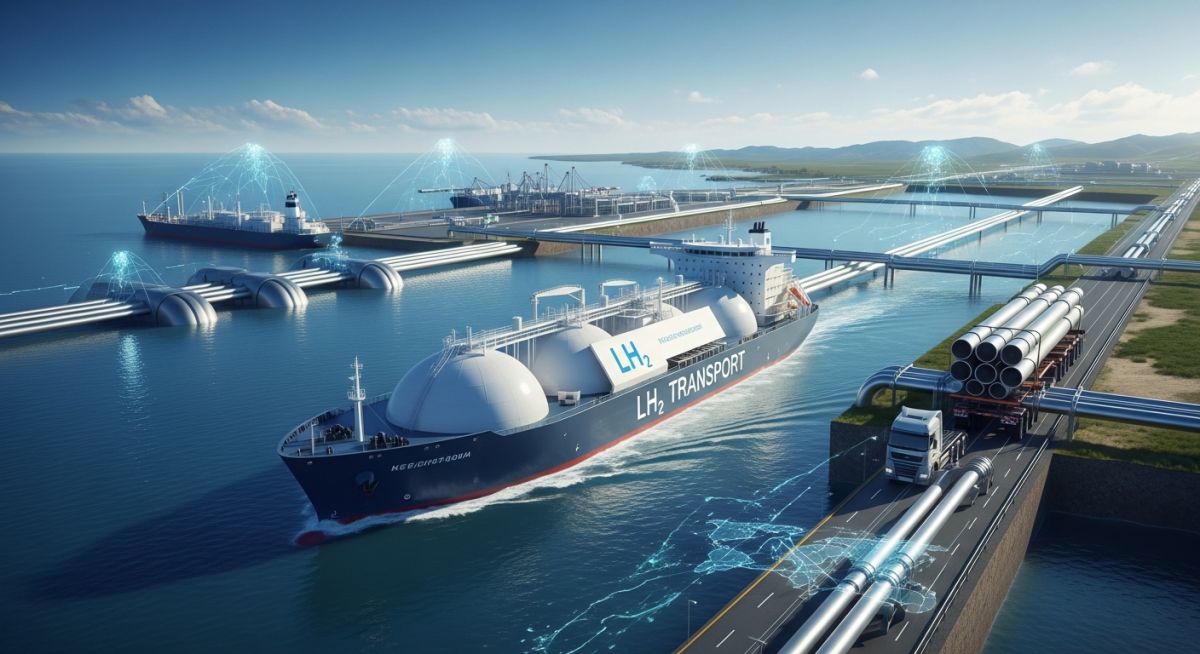
How to Select and Design Hydrogen Transportation Methods Safely
In my 20 years of piping engineering, I have watched hydrogen transition from a niche refinery feedstock to the frontier of clean energy. But here is the cold, hard truth: hydrogen is a notoriously difficult molecule to transport. Its low volumetric density and high propensity for metal embrittlement make pipeline and vessel design an unforgiving discipline. In this guide, I will break down the physics, the codes, and the real-world trade-offs of each transport pathway.
Key Engineering Takeaways
- Understand why high-strength carbon steels fail rapidly in high-pressure hydrogen service.
- Learn the thermodynamic penalties of liquid hydrogen liquefaction and ortho-to-para conversion.
- Compare the efficiency of chemical carriers like ammonia and Liquid Organic Hydrogen Carriers (LOHC).
Why Hydrogen Transportation Methods Require Strict Engineering
When designing systems for hydrogen, we cannot treat it like natural gas. Hydrogen has the smallest molecular size of any element, allowing it to readily diffuse into the interstitial spaces of metal crystal lattices. This phenomenon, known as hydrogen-induced cracking (HIC) or hydrogen embrittlement, drastically reduces the ductility and fracture toughness of standard piping materials.
1. Gaseous Hydrogen Pipelines
Pipelines are the most cost-effective method for high-volume, long-distance transport. However, we must design them under the strict guidelines of ASME B31.12.
For material selection, high-strength steels (such as API 5L X70 or X80) are highly susceptible to embrittlement. In my practice, I restrict pipeline materials to low-strength carbon steels like API 5L Grade X52 or lower, operating at lower design stress factors (typically 0.5 or lower instead of the standard 0.72 used for natural gas).
2. High-Pressure Tube Trailers
For localized distribution where pipelines do not exist, we rely on tube trailers. These systems operate at extreme pressures, typically between 250 bar and 500 bar.
Modern designs utilize Type IV composite cylinders, which feature a non-metallic polymer liner wrapped in carbon fiber. This design eliminates the risk of metal embrittlement while significantly reducing the dead weight of the trailer, allowing for higher payloads.
3. Liquid Hydrogen Transportation (LH2)
To transport hydrogen as a liquid, we must cool it to cryogenic temperatures below -253 degrees Celsius at atmospheric pressure. This process is highly energy-intensive, consuming up to 30 percent of the hydrogen’s lower heating value (LHV) during liquefaction.
A critical thermodynamic challenge in liquid transport is the ortho-to-para hydrogen spin state conversion. At room temperature, hydrogen consists of 75 percent ortho-hydrogen (parallel nuclear spins) and 25 percent para-hydrogen (antiparallel spins). As it cools, the equilibrium shifts toward 100 percent para-hydrogen. This conversion is exothermic. If we do not use catalysts to force this conversion during liquefaction, the slow, natural conversion inside the transport vessel will release enough heat to boil off the entire payload within days.
Engineering Calculation: Real Gas Density of Hydrogen
To size compressors and storage vessels, we must calculate the real gas density of hydrogen at high pressures. Because hydrogen exhibits significant non-ideal behavior, we use the compressibility factor (Z).
rho = (P * MW) / (Z * R * T)
Where:
– rho = Density of hydrogen (kg/m3)
– P = Absolute pressure (Pascals)
– MW = Molecular weight of hydrogen (0.002016 kg/mol)
– Z = Compressibility factor (dimensionless)
– R = Universal gas constant (8.314 J/mol-K)
– T = Absolute temperature (Kelvin)
At 100 bar (10,000,000 Pa) and 15 degrees Celsius (288.15 K), the compressibility factor Z of hydrogen is approximately 1.06. This is unique because most gases have a Z factor less than 1.0 at moderate pressures. Hydrogen’s Z factor greater than 1.0 means it is less compressible than an ideal gas, requiring more volume and higher compression energy than simplified ideal gas calculations would suggest.
Evaluating Different Hydrogen Transportation Methods Safely
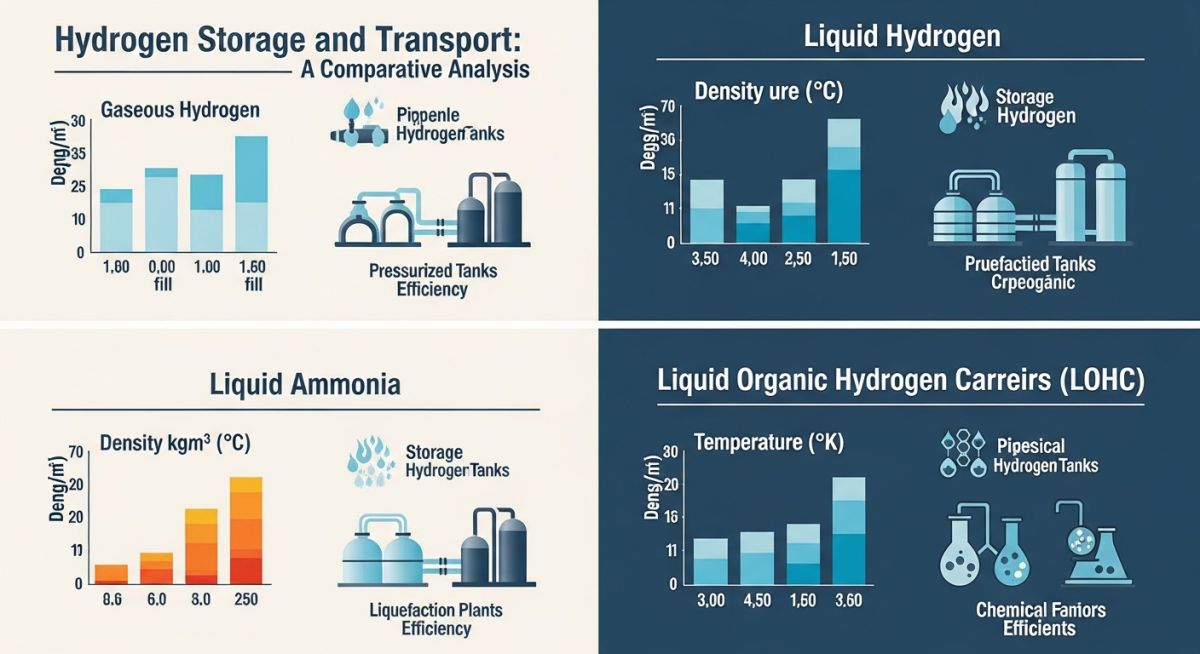
Selecting the correct transport pathway requires balancing physical properties against capital expenditure. The table below outlines the key engineering parameters for the primary hydrogen carriers used in modern industrial projects.
| Transport Method | Physical State | Operating Temp (°C) | Operating Pressure (bar) | Volumetric Density (kg-H2/m3) | Primary Design Code |
|---|---|---|---|---|---|
| Gaseous Pipeline | Gas | Ambient | 30 to 100 | 2.5 to 8.0 | ASME B31.12 |
| Tube Trailer (Type IV) | Gas | Ambient | 250 to 500 | 18.0 to 33.0 | ISO 11119-3 / DOT |
| Liquid Tanker (LH2) | Liquid | -253 | 1 to 5 | 70.8 | ASME Sec VIII Div 1 |
| Liquid Ammonia (NH3) | Chemical Liquid | -33 (or 8.5 bar) | 1 to 10 | 121.0 | ASME B31.3 / CFR 195 |
| LOHC (Toluene/MCH) | Chemical Liquid | Ambient | 1 | 47.0 | ASME B31.3 |
This matrix maps the critical engineering acronyms, physical parameters, and standard references required for regulatory compliance during the design phase.
| Acronym | Parameter Name | Engineering Limit | Standard Reference |
|---|---|---|---|
| HIC | Hydrogen-Induced Cracking | Hardness limit below 22 HRC | NACE MR0175 / ISO 15156 |
| BOR | Boil-Off Rate | Less than 0.3 percent per day | API RP 520 |
| MAOP | Maximum Allowable Operating Pressure | Derated based on material class | ASME B31.12 / CFR 192 |
| HE | Hydrogen Embrittlement | Avoid high-strength carbon steels | ASTM F1459 |
How to Commission Hydrogen Piping Systems
Before introducing hydrogen into any pipeline or storage system, a rigorous commissioning protocol must be executed. Hydrogen has an extremely wide flammability limit (4 percent to 75 percent in air) and a very low ignition energy, meaning any oxygen contamination can lead to immediate combustion.
Pre-Commissioning Field Checklist
-
Nitrogen Purging (Triple Evacuation Method): Purge the system with high-purity nitrogen until the oxygen concentration is verified to be below 1.0 percent by volume at all low-point drains and high-point vents.
-
Helium Leak Testing: Perform a sensitive leak test using a 10 percent helium / 90 percent nitrogen mix at maximum allowable operating pressure (MAOP). Use mass spectrometer detectors at all flanged joints.
-
Electrical Grounding and Bonding: Verify that all piping segments, flanges, and vessels are electrically bonded and grounded to earth. Resistance to ground must be less than 10 Ohms to prevent static discharge.
-
Material Traceability Verification: Cross-reference all Material Test Reports (MTRs) to confirm that no carbon steel components exceed a hardness of 22 HRC or a tensile strength of 80 ksi.
Field Case Study: Real-World Application
The Problem: Hydrogen Blending Failure
A refinery in Europe attempted to blend 15 percent hydrogen into an existing API 5L X70 natural gas pipeline without modifying the operating pressure or monitoring embrittlement. Within 9 months of operation, micro-cracking was detected at high-stress weld joints during a routine smart pigging run. The high-strength steel was highly susceptible to hydrogen-assisted fatigue under cyclic pressure loading.
The Outcome: Engineering Remediation
I was called in to perform a fitness-for-service assessment per API 579. We immediately reduced the operating pressure to lower the hydrogen partial pressure, implemented continuous acoustic emission monitoring, and replaced the high-stress segments with lower-strength API 5L X52 steel spools. This successfully stabilized the system and prevented crack propagation.
Direct Recommendation: Never assume an existing natural gas pipeline can accept hydrogen without a comprehensive metallurgical and fracture mechanics assessment under ASME B31.12.
Frequently Asked Engineering Questions
Why is hydrogen embrittlement so dangerous in pipelines?
What is the difference between Option A and Option B in ASME B31.12?
Why does liquid hydrogen require ortho-to-para conversion?
How do LOHCs compare to liquid hydrogen for transport?
What is the maximum allowable hardness for steel in hydrogen service?
Can we use existing natural gas pipelines for pure hydrogen?
Complete Course on
Piping Engineering
Check Now
Key Features
- 125+ Hours Content
- 500+ Recorded Lectures
- 20+ Years Exp.
- Lifetime Access
Coverage
- Codes & Standards
- Layouts & Design
- Material Eng.
- Stress Analysis

📚 Recommended Resources: hydrogen transportation methods
Read these Guides
- 📄 How to Mitigate Hydrogen Storage and Transportation Challenges
- 📄 Hydrogen Energy Storage System using O2-free Advanced Electrolyzer System (AES)
- 📄 Hydrogen Pipeline vs Natural Gas Pipeline vs HVAC Powerline vs HVDC Powerline: Which is the Lowest-Cost Energy Transport Form?
- 📄 A Comprehensive Guide to Hydrogen Refueling Stations: Operations, Components, and Technologies