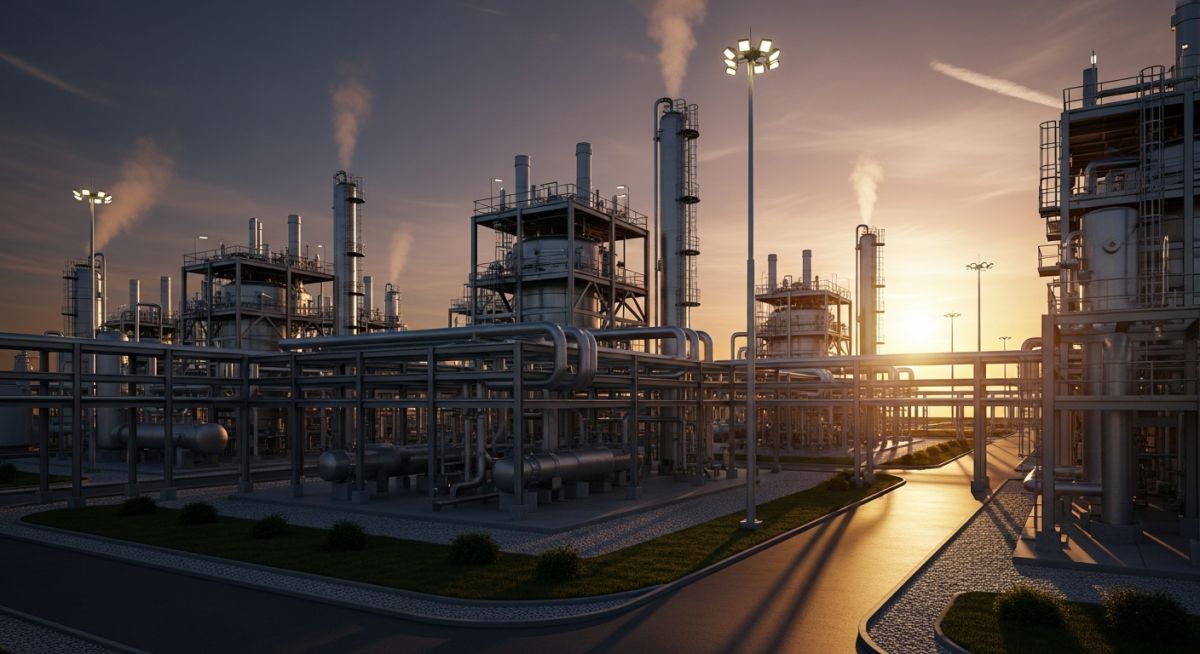
Overview of the Ammonia Production: Haber-Bosch Process
The Haber-Bosch Process serves as the backbone of global food security, enabling the industrial-scale Ammonia Production required for modern fertilizers. As we look toward 2026, the integration of green hydrogen and high-efficiency synthesis loops is redefining how this century-old chemical feat operates in a decarbonizing world.
What is the Haber-Bosch Process?
The Haber-Bosch Process is the primary industrial method for Ammonia Production, synthesizing ammonia (NH3) from nitrogen and hydrogen. It utilizes an iron-based catalyst under high pressures (150 to 250 bar) and temperatures (400 to 500 degrees Celsius) to break the strong triple bond of atmospheric nitrogen.
Table of Contents
Technical Knowledge Check
Question 1 of 5
Complete Course on
Piping Engineering
Check Now
Key Features
- 125+ Hours Content
- 500+ Recorded Lectures
- 20+ Years Exp.
- Lifetime Access
Coverage
- Codes & Standards
- Layouts & Design
- Material Eng.
- Stress Analysis
Applications of Ammonia in Modern Industry 2026
The output of the Haber-Bosch Process is primarily utilized in the production of nitrogenous fertilizers, which sustain approximately 50 percent of the global population. Beyond agriculture, ammonia serves as a critical precursor for explosives (ammonium nitrate), specialized cleaning agents, and as a zero-carbon marine fuel in 2026 energy transition roadmaps.
Ammonia Production Processes and Technological Evolution
While various methods exist for Ammonia Production, including coal gasification and water electrolysis, the catalytic synthesis via the Haber-Bosch route remains the most economically viable at scale. Engineering standards such as API 560 for fired heaters and ASME Section VIII for pressure vessels govern the design and safety of these high-intensity chemical loops.
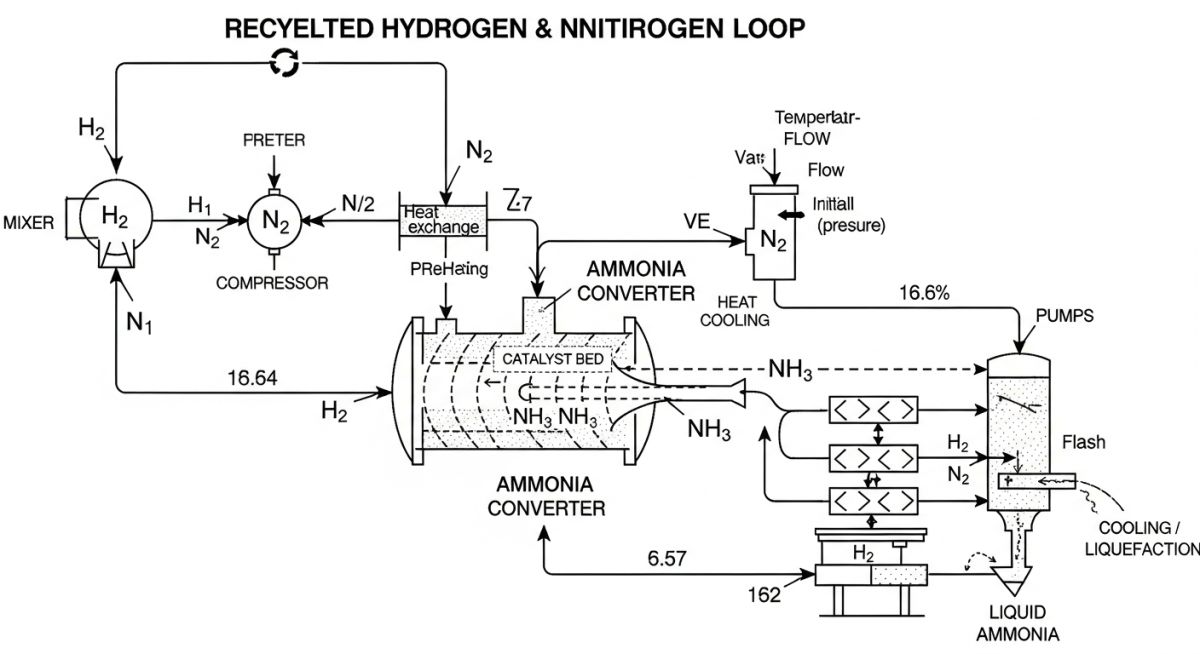
Haber-Bosch Process of Ammonia Production: Technical Breakdown
The Haber-Bosch Process is a masterpiece of thermodynamics and kinetics. It operates on the principle of shifting chemical equilibrium to favor the exothermic production of NH3 through high pressure and controlled temperature gradients.
1. Feedstock preparation for the Haber-Bosch Process:
The Ammonia Production sequence begins with the generation of synthesis gas (syngas). Nitrogen is sourced from cryogenic air separation or pressure swing adsorption, while hydrogen is typically extracted from natural gas via Steam Methane Reforming (SMR). Sulfur removal is critical at this stage to prevent the irreversible poisoning of downstream catalysts.
2. Mixing natural gas and air for Ammonia Production:
In the primary and secondary reformers, natural gas (methane) reacts with steam and introduced air. This step not only provides the necessary hydrogen but also introduces the nitrogen required for the Haber-Bosch Process. The air-to-gas ratio is meticulously controlled to achieve the precise 3:1 hydrogen-to-nitrogen stoichiometric requirement.
3. Heating and pressurization in the Haber-Bosch Process:
Before entering the synthesis reactor, the gas mixture is compressed to pressures ranging from 150 to 250 bar using multi-stage centrifugal compressors. This high-pressure environment is fundamental to Ammonia Production, as it compresses the gas volume, effectively forcing the molecular collisions required for nitrogen fixation over the iron-based catalyst.
4. Chemical reaction during Ammonia Production: Catalyst Dynamics
Inside the synthesis converter, the Haber-Bosch Process occurs over a promoted iron catalyst. The reaction N2 + 3H2 ↔ 2NH3 is exothermic, releasing approximately 92.4 kJ/mol of energy. To maximize the yield in 2026 industrial setups, the gas passes through multiple catalyst beds with inter-stage cooling to maintain the temperature between 400 and 500 degrees Celsius, balancing reaction rate and equilibrium shift.
5. Ammonia separation and purification in the Haber-Bosch Process:
Since the single-pass conversion rate of the Haber-Bosch Process is typically only 15 percent to 20 percent, the effluent gas must be cooled. Ammonia is condensed into a liquid state and separated in a high-pressure separator. The unreacted nitrogen and hydrogen are then recycled back to the compressor suction, ensuring a total process efficiency exceeding 98 percent.
6. Ammonia storage and transport for global distribution:
Post-production, ammonia is stored in large, refrigerated atmospheric tanks at -33 degrees Celsius or in pressurized spherical tanks (Hortonspheres). Engineering compliance with CGA G-2.1 standards is mandatory for the safe handling of anhydrous ammonia during transport via pipelines or maritime vessels in 2026.
Measures to Reduce Environmental Impact during Ammonia Production
Modern Ammonia Production is shifting toward “Green Ammonia” by replacing steam methane reforming with water electrolysis powered by renewable energy. Carbon Capture and Storage (CCS) technologies are also being integrated into the Haber-Bosch Process to mitigate CO2 emissions, targeting a 30 percent reduction in carbon intensity by 2030.
| Parameter | Traditional Haber-Bosch | Advanced Low-Pressure Loop |
|---|---|---|
| Operating Pressure | 150 to 250 bar | 80 to 120 bar |
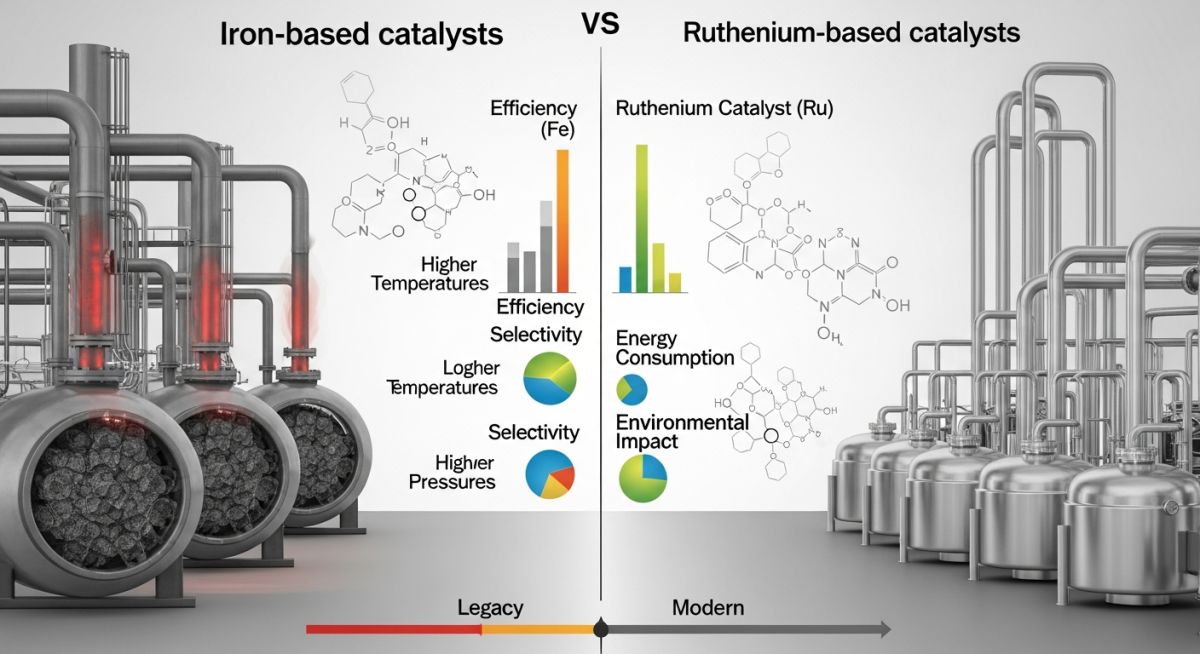
| Catalyst Type | Magnetite (Iron) | Ruthenium on Carbon |
| Energy Consumption | 30 to 35 GJ per ton | 27 to 29 GJ per ton |
Thermodynamic Equilibrium Constants
The equilibrium constant (Kp) for the Haber-Bosch synthesis is expressed as:
Increasing the total system pressure (P) shifts the equilibrium toward the product side, as the reaction results in a reduction of total gas moles from 4 to 2.
Haber-Bosch Process Yield Calculator
Estimate the theoretical Ammonia Production output based on Nitrogen feed and conversion efficiency. This tool assumes a stoichiometric 1:3 ratio for Hydrogen.
NH3 Output (Single Pass)
0.00 kg/hr
H2 Required (Total)
0.00 kg/hr
Note: Calculations are based on molar masses of N: 14.01 and H: 1.008. Real-world Haber-Bosch Process results may vary due to catalyst aging and temperature fluctuations.
Case Study: Optimizing the Haber-Bosch Process in a 2000 MTPD Facility
Project Data
- Facility Type: Brownfield Ammonia Synthesis Plant
- Daily Capacity: 2000 Metric Tons Per Day (MTPD)
- Target: Reduction of specific energy consumption from 34 GJ/ton to 31 GJ/ton
- Year: 2026 Retrofit
Failure Analysis
The facility experienced high pressure drops across the primary synthesis converter. Investigation revealed catalyst sintering and significant inert gas accumulation (Argon and Methane) in the recycle loop, which decreased the partial pressure of reactants and forced the compressors to work harder, increasing energy costs by 12 percent.
Engineering Fix
The engineering team implemented a two-pronged solution:
- Replacement of the legacy radial-flow baskets with high-activity promoted iron catalysts to improve conversion per pass.
- Installation of a Cryogenic Purge Gas Recovery Unit (PGRU) to extract high-purity hydrogen from the purge stream and return it to the loop.
Lessons Learned
Effective Ammonia Production relies heavily on purge management. By recovering hydrogen and reducing the concentration of inerts, the loop pressure was safely lowered by 15 bar while maintaining the same production volume, confirming that thermodynamic efficiency in the Haber-Bosch Process is directly tied to gas purity and catalyst surface area.
Frequently Asked Questions about Ammonia Production
How does the Haber-Bosch Process relate to green hydrogen initiatives in 2026?
The fundamental chemistry of the Haber-Bosch Process remains the same. The “green” initiative for 2026 involves replacing the high-carbon Steam Methane Reforming (SMR) with water electrolysis powered by renewable energy. This decarbonizes the hydrogen feedstock, making the resulting ammonia a sustainable energy carrier.
What safety standards (API/ASME) govern modern Ammonia Production facilities?
Key standards include ASME Boiler and Pressure Vessel Code Section VIII for reactor vessels, API 570 for piping inspection codes, and specific environmental guidelines under the EPA’s RMP (Risk Management Plan) in North America. These ensure integrity for high-pressure Haber-Bosch Process components.
Can the Haber-Bosch Process operate efficiently at lower temperatures or pressures?
Operating at lower pressures drastically reduces the yield according to Le Chatelier’s principle. However, recent advances using novel ruthenium-based catalysts allow operation at significantly lower pressures (around 90 bar) than traditional iron catalysts while maintaining profitable Ammonia Production rates.
What is the single-pass conversion rate of the industrial Haber-Bosch reactor?
Typically, an industrial Haber-Bosch Process achieves a single-pass conversion efficiency of 15 percent to 20 percent. The high overall efficiency of the plant (over 98 percent) is achieved through recycling the unreacted synthesis gas back into the process loop after separating the liquid ammonia product.
Engineering Conclusions
The Haber-Bosch Process remains one of the most significant engineering achievements of the last century, fundamentally altering the trajectory of human civilization. In 2026, the focus for Ammonia Production is shifting from pure efficiency gains to sustainable feedstock integration and carbon neutrality, ensuring the process remains vital for both food production and future energy logistics. Engineers worldwide continue to optimize catalyst technology and loop dynamics to balance kinetics, thermodynamics, and environmental responsibility.
One thought on “Overview of the Ammonia Production: Haber-Bosch Process”
Leave a Reply Cancel reply
Recent Posts
About Me
📚 Recommended Resources: ammonia
Read these Guides
🎓 Advanced Training



Don’t miss this video related to Ammonia
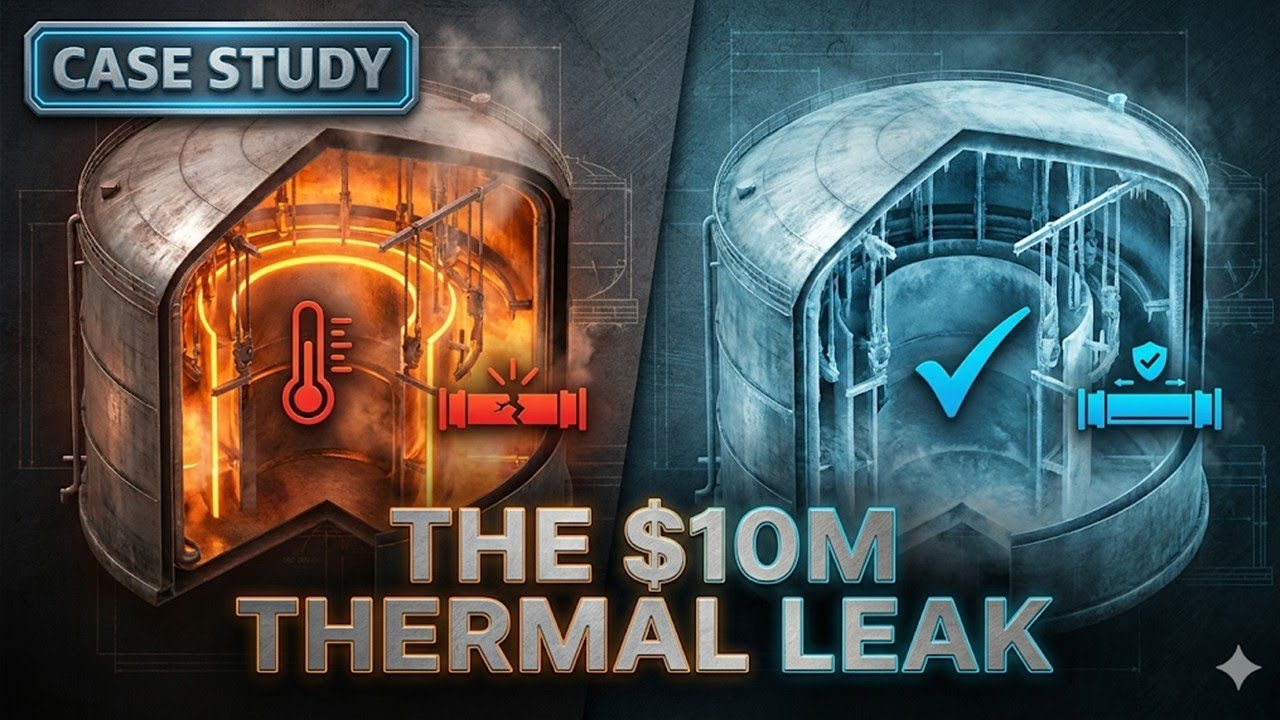
Summary: On March 20, 1989, a catastrophic foundation failure caused 7000 tons of liquid ammonia to explode from its containment….