What is a Cryogenic Tank? Design, Construction, and Applications of Cryogenic Storage Tanks
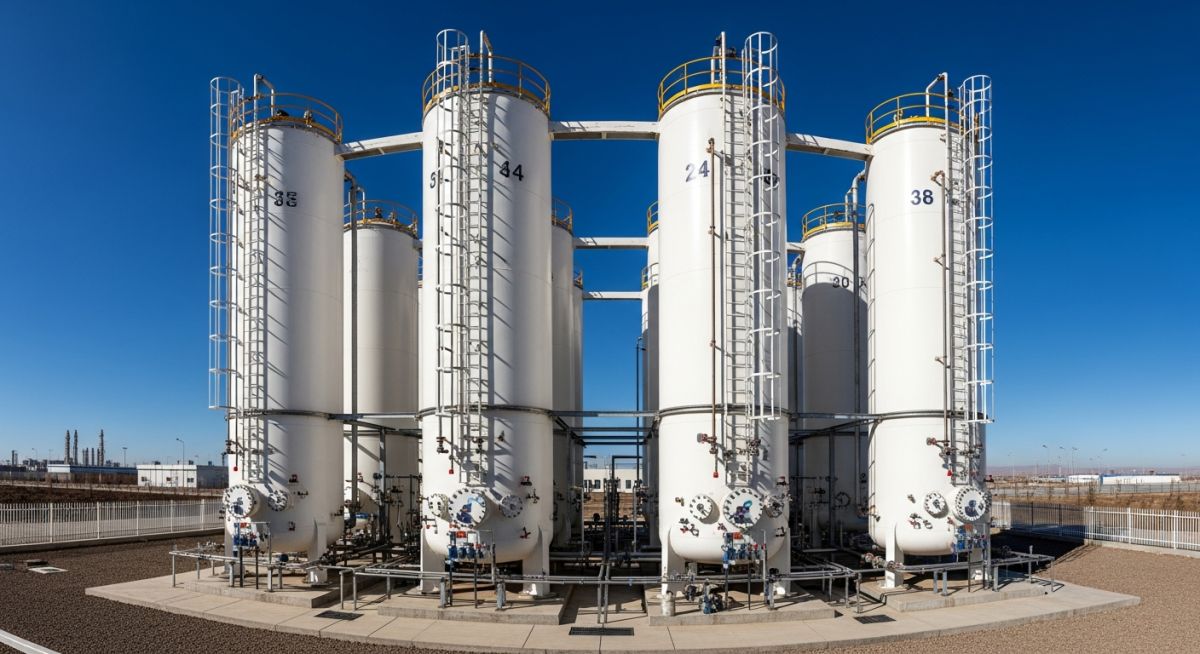
Cryogenic Storage Tanks are specialized pressure vessels engineered to store liquefied gases at extremely low temperatures, typically below -150°C (-238°F). These sophisticated systems play a critical role in modern infrastructure, enabling the high-density transport and preservation of essential fluids like liquefied natural gas (LNG), liquid oxygen, and liquid nitrogen for industrial, medical, and aerospace sectors.
What are Cryogenic Storage Tanks?
Cryogenic Storage Tanks are highly insulated containers designed to maintain liquefied gases in their liquid state. They utilize a “tank-within-a-tank” design, featuring an inner stainless steel vessel and an outer carbon steel jacket. The vacuum-sealed annular space between these layers, often filled with perlite, minimizes heat transfer to prevent evaporation.
Table of Contents
Cryogenic Engineering Quiz
Question 1 of 5
Complete Course on
Piping Engineering
Check Now
Key Features
- 125+ Hours Content
- 500+ Recorded Lectures
- 20+ Years Exp.
- Lifetime Access
Coverage
- Codes & Standards
- Layouts & Design
- Material Eng.
- Stress Analysis
Understanding Cryogenic Storage Tanks and Liquefied Gases
The fundamental purpose of Cryogenic Storage Tanks is to store industrial gases in their liquid phase, which significantly increases the energy density per unit of volume. For example, liquid nitrogen occupies nearly 700 times less space than its gaseous form at standard temperature and pressure. To maintain these gases—such as Oxygen, Nitrogen, Argon, and Helium—at temperatures as low as -269°C, the tanks must function as massive high-performance “thermos flasks.”
Modern Cryogenic Storage Tanks are categorized by their orientation (vertical or horizontal) and their capacity. They are critical in supply chains where constant, high-purity gas delivery is required without the logistical footprint of high-pressure cylinder manifolds.
Engineering Design and Construction of Cryogenic Storage Tanks
The design of Cryogenic Storage Tanks is dictated by stringent engineering codes, primarily ASME Section VIII, Division 1 or 2, and API 620 (specifically Appendix R and Q for refrigerated storage). These standards ensure the structural integrity of the vessel under extreme thermal stress and internal pressure.
Double-Wall Vacuum Insulation Fundamentals
The core of the construction involves a dual-vessel system. The inner vessel is typically fabricated from high-grade austenitic stainless steel (e.g., Type 304 or 304L) to prevent brittle fracture at sub-zero temperatures. The outer jacket is usually made of carbon steel, as it only needs to withstand atmospheric pressure and provide structural support.
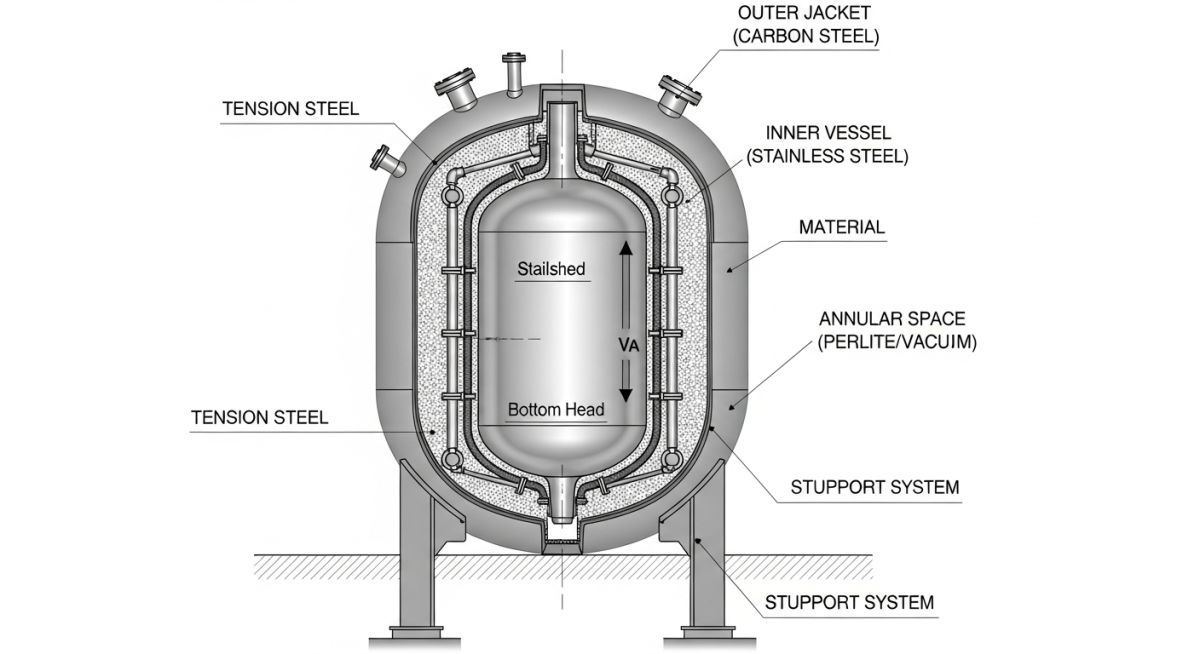
The annular space between these two vessels is the most critical design element. It is filled with a granular insulation material, such as expanded perlite, and then evacuated to a high vacuum level (typically below 10 microns). This double-wall vacuum insulation nearly eliminates heat transfer via conduction and convection, ensuring a low heat leak rate and minimal product loss.
Material Selection for Cryogenic Fluids
When dealing with cryogenic fluids, engineers must account for the coefficient of thermal expansion. Specialized supports made of non-conductive materials are used to suspend the inner tank within the outer jacket, preventing “thermal bridges” that would otherwise allow heat to bypass the vacuum insulation.
Global Applications of Cryogenic Storage Tanks
The deployment of Cryogenic Storage Tanks spans across multiple high-stakes industries, each requiring specific pressure ratings and material certifications.
Industrial Gases and Cryogenic Fluids
In manufacturing and metal fabrication, Cryogenic Storage Tanks provide a steady supply of liquid argon for shielding gases in welding and liquid nitrogen for laser cutting. These tanks are often integrated with ambient vaporizers that convert the liquid back into gas as it is drawn from the tank.
Energy and Power: Liquefied Natural Gas (LNG)
The energy sector relies heavily on Cryogenic Storage Tanks for the storage of Liquefied Natural Gas (LNG). By cooling natural gas to -162°C, it can be stored and transported across oceans in specialized carriers or kept in peak-shaving plants to meet winter heating demands.
Aerospace and Defense Fuel Systems
In the aerospace sector, Cryogenic Storage Tanks are used to manage liquid rocket propellants. High-pressure liquid oxygen (LOX) and liquid hydrogen (LH2) require extreme thermal management. Engineering these tanks involves rigorous vibration analysis to ensure the double-wall vacuum insulation remains intact during the high-G loads of a launch sequence.
Medical Applications for Liquid Oxygen
Healthcare facilities utilize Cryogenic Storage Tanks to store bulk medical-grade oxygen. These systems are designed for high reliability, ensuring that the evaporation rate does not exceed the hospital’s base demand, thus providing a continuous life-support supply even during power outages.
Critical Benefits of Cryogenic Storage Tanks
The adoption of Cryogenic Storage Tanks provides significant operational advantages over traditional compressed gas storage.
| Feature | Compressed Gas Cylinders | Cryogenic Storage Tanks |
|---|---|---|
| Storage Density | Low (High Pressure) | High (600:1 to 800:1 Ratio) |
| Operating Pressure | 2,000 – 6,000 psi | 50 – 250 psi (Typical) |
| Safety Risk | High (Kinetic Energy) | Moderate (Thermal/Pressure) |
| Maintenance | Frequent Changeovers | Automated/Bulk Refill |
ASME Standard Safety and Reliability
Compliance with ASME Section VIII ensures that the vessel can withstand cyclic loading and thermal expansion. Because Cryogenic Storage Tanks operate at lower pressures than standard gas cylinders, the risk of explosive decompression is mitigated, provided the pressure relief valves are maintained according to 2026 safety standards.
Physics of Heat Leak and Boil-Off
The efficiency of Cryogenic Storage Tanks is measured by the Net Evaporation Rate (NER). The heat transfer (Q) into the tank is calculated using:
Where:
U = Overall heat transfer coefficient (minimized by vacuum).
A = Surface area of the inner vessel.
T = Temperature differential across the insulation.
To minimize the heat leak rate, engineers optimize the surface-area-to-volume ratio, making vertical cylindrical tanks the preferred geometry for large-scale storage.
Cryogenic Storage Tanks Volume & Gas Yield Calculator
Estimate the equivalent gaseous volume and storage capacity for common cryogenic fluids based on liquid volume in 2026.
Estimated Gas Output:
*Calculation based on STP (Standard Temperature and Pressure) expansion coefficients for Cryogenic Storage Tanks.
Maintenance Checklist for Cryogenic Storage Tanks
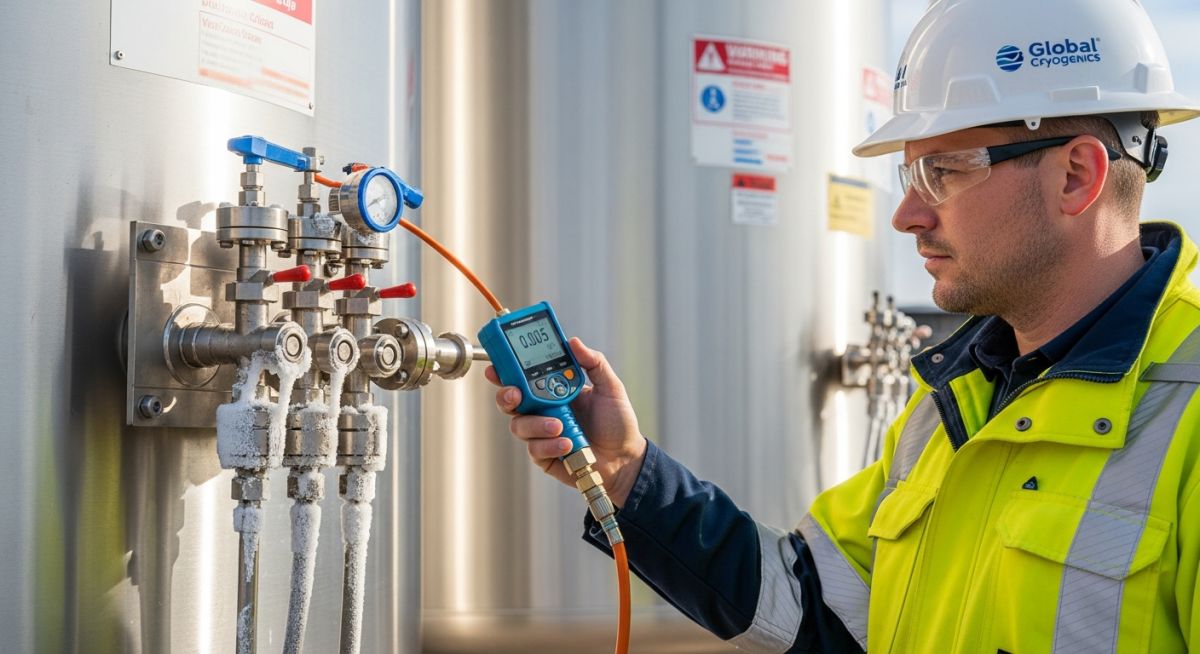
To ensure the longevity and safety of Cryogenic Storage Tanks, a rigorous preventative maintenance schedule is mandatory. In 2026, industry best practices involve a tiered inspection approach to monitor vacuum integrity, valve functionality, and structural health.
| Interval | Inspection Item | Engineering Objective |
|---|---|---|
| Monthly | Visual Frost Check & Pressure Log | Identify localized hot spots on the outer jacket; monitor for abnormal pressure build-up rates. |
| Quarterly | Relief Valve "Pop" Test & Icing Check | Ensure pressure relief valves actuate at set points and are free of ice blockages. |
| Bi-Annual | Vacuum Level Measurement | Confirm vacuum is within the 5-20 micron range using a calibrated thermocouple gauge. |
| Annual | ASME External Inspection & Paint Check | Full structural audit for corrosion, support fatigue, and compliance with 2026 safety signage. |
| 5-Year | Internal Inspection (If Required) | Comprehensive NDT (Non-Destructive Testing) of inner vessel welds and support struts. |
Warning: Always ensure the area is well-ventilated before performing maintenance on Cryogenic Storage Tanks. Atmospheric monitors must be worn to prevent asphyxiation from nitrogen/argon or fire hazards from oxygen enrichment.
Don't miss this video related to Cryogenic Storage Tanks
Summary: Master Piping Engineering with our complete 125+ hour Certification Course: ......
Cryogenic Storage Tanks Failure Case Study: Vacuum Loss Incident
Project Data
- Facility: Regional Peak-Shaving LNG Plant
- Equipment: 50,000 Gallon Vertical Cryogenic Storage Tanks
- Material: Inner (SS 304), Outer (ASTM A516 Gr. 70)
- Service: Liquefied Natural Gas (LNG) at -162°C
Failure Analysis
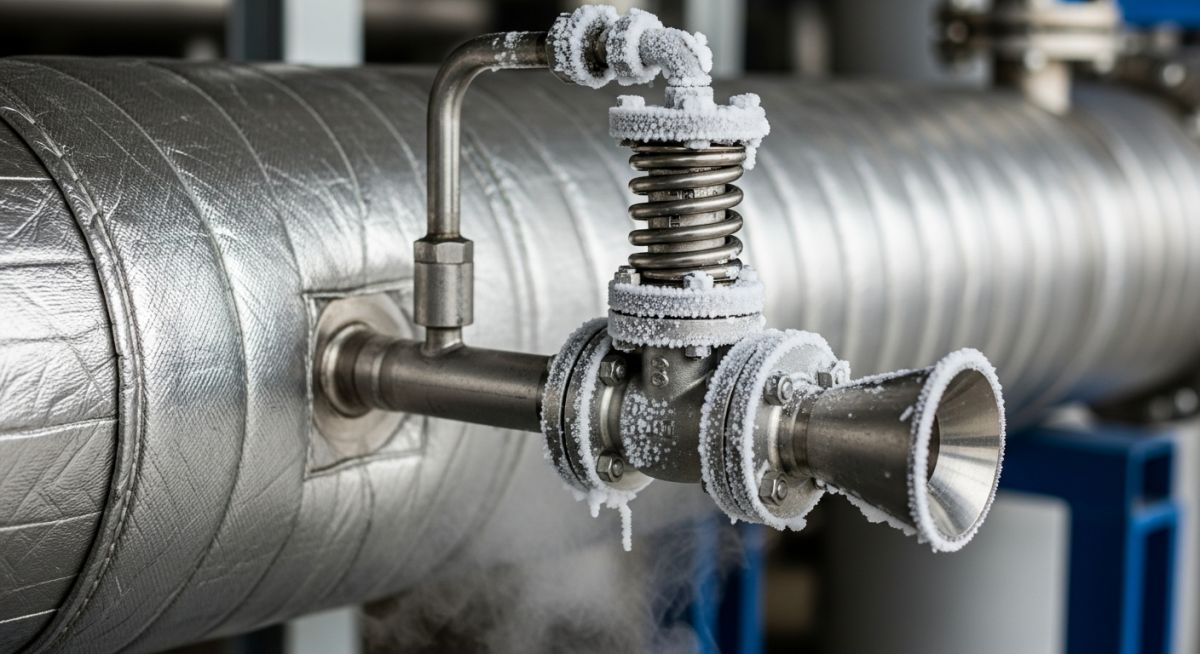
In early 2026, site operators noticed localized frost spots on the outer jacket and a rapid increase in the heat leak rate. Monitoring systems indicated that the internal pressure was rising 40% faster than the design baseline, forcing the primary pressure relief valves to cycle frequently.
Engineering Fix & Lessons Learned
Investigation: Ultrasonic leak detection revealed a micro-crack in the expansion bellows of the vacuum port. This allowed atmospheric air to enter the annular space, collapsing the vacuum and causing "thermal short-circuiting."
Fix: The tank was decommissioned and purged. The bellows were replaced with a heavy-duty reinforced assembly. The perlite insulation was re-dried using a heated nitrogen purge, and the annular space was re-evacuated to 5 microns.
Frequently Asked Questions: Cryogenic Storage Tanks
What are the primary safety components for high-pressure cryogenic fluids?
How often should the vacuum level be inspected in double-wall vacuum insulation?
Why is ASME Section VIII critical for cryogenic tank manufacturing?
What factors influence the boil-off gas (BOG) rate in LNG storage?
Conclusion: The Future of Cryogenic Storage Tanks
As the global demand for clean energy and high-purity industrial gases continues to rise in 2026, the engineering of Cryogenic Storage Tanks remains at the forefront of logistical innovation. By utilizing advanced double-wall vacuum insulation and adhering to rigorous ASME codes, these vessels ensure the safe and efficient handling of the world's most critical fluids.
Understanding the balance between thermal management, material science, and safety protocols is essential for any engineer or facility manager working with Cryogenic Storage Tanks. Proper maintenance and real-time monitoring of the vacuum jacket will extend the service life of these assets while minimizing product loss through boil-off.
Ready to optimize your cryogenic infrastructure?
Consult with certified engineers for the latest 2026 standards in tank design and safety audits.
Contact Specialist📚 Recommended Resources: Cryogenic Storage Tanks
Read these Guides


Related posts:
![Industrial machinery fitted with smart sensors displaying real-time condition-based maintenance data on a digital overlay.]()
Understanding the Essential Types of Forklifts for Construction Sites
![High-pressure steam venting from industrial piping during a steam blowing procedure.]()
What is Steam Blowing and the Steam Blowing Procedure?
![Diagram illustrating the transition from Front End Engineering Design (FEED) to Detailed Engineering.]()
What is Front End Engineering Design or FEED Engineering?
![Engineer tightening bolts on a steel pipe flange using a torque wrench.]()
Mastering Flange Bolt Torque Calculation for Leak-Free Piping Systems
![Detailed piping isometric drawing on an engineer's desk showing various piping abbreviations and symbols.]()
Mastering Piping Abbreviations and Common Piping Terms in Engineering Design
![A heavy-duty motor operated valve with an electric actuator installed on an industrial pipeline.]()
Purpose: To illustrate the internal components and working mechanism of a Motor Operated Valve (MOV)...