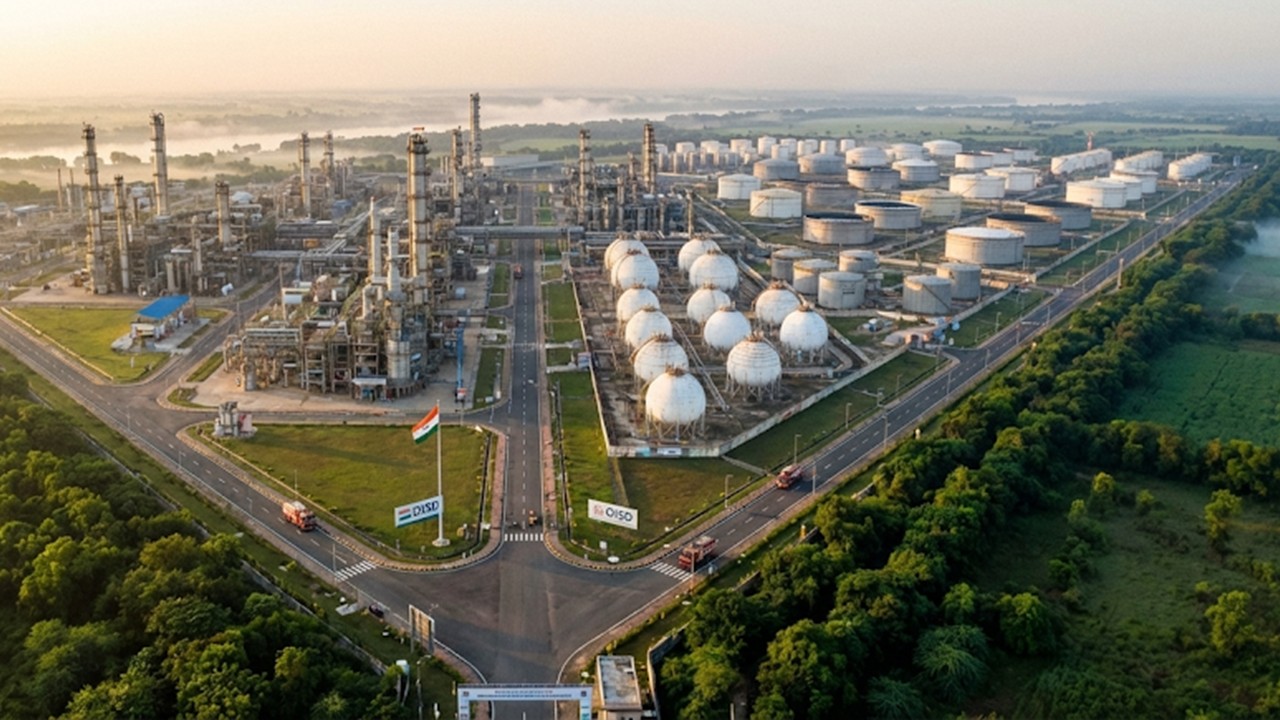
✅ Verified for 2026 by Epcland Engineering Team Fixed Roof Storage Tank Design: 2026 Engineering Guide Fixed Roof Storage Tank Design remains the fundamental blueprint for atmospheric and low-pressure storage in the oil, gas, and chemical industries. As we move through 2026, the demand for reliable, cost-effective storage solutions for non-volatile liquids—such as heavy crudes, fuel oils, and water—continues to rely on the robust structural integrity of fixed-roof architectures. Governed primarily by API standards, these tanks are engineered to protect contents from atmospheric contamination while maintaining structural stability under varying environmental and operational loads. What is a Fixed Roof Storage Tank? A fixed roof storage tank is a cylindrical vessel with a permanently attached roof, which can be flat, conical, or dome-shaped. Unlike floating roof tanks, the roof remains stationary during filling and emptying operations. This design is primarily used for liquids with low vapor pressure where evaporation losses are manageable or where the tank is retrofitted with an internal floating roof for emission control. Quick Navigation → API 650 Design Theory → Venting & PVRV Sizing → Case Study: Venting Failure → Frequently Asked Questions Fixed Roof Engineering Assessment Question 1 of 5 1. Which API standard is most commonly used for the design of atmospheric steel storage tanks? API 650 API 620 API 510 2. What is a primary disadvantage of a fixed roof tank compared to an external floating roof tank when storing volatile liquids? Higher initial cost Higher vapor emissions Poor protection from rain 3. A supported cone roof requires what structural component that a self-supporting dome roof does not? Internal columns or rafters Compression ring Thicker shell plates 4. What is the main purpose of a Pressure-Vacuum Relief Valve (PVRV) on a fixed roof tank? To pump out product To prevent overpressure and vacuum collapse To measure liquid levels 5. What does the term "Ullage" refer to in tank engineering? The volume of liquid in the tank The vapor space above the liquid The sediment at the bottom Next Question Figure 1: High-capacity fixed roof storage tank farm designed for atmospheric crude oil storage. Structural Foundation: API 650 Storage Tank Standards The engineering landscape for Fixed Roof Storage Tank Design in 2026 is dominated by the rigorous application of API 650 storage tank standards. This code provides the essential requirements for material selection, design, fabrication, and testing of welded vertical, cylindrical, above-ground, closed- and open-top steel storage tanks. For fixed roof applications, the standard ensures that the vessel can handle internal pressures up to 2.5 psig, though many operate at near-atmospheric conditions. One of the critical design aspects under API 650 is the "One-Foot Method" for determining shell thickness. This method calculates the required thickness at a point one foot above the bottom of each shell course, ensuring the tank can withstand the hydrostatic pressure of the stored liquid. The calculation typically follows this logic: td = (2.6 * D * (H - 1) * G) / (Sd) + CA td = Design Shell Thickness (inches) D = Nominal Tank Diameter (feet) H = Design Liquid Level (feet) G = Design Specific Gravity of the liquid Sd = Allowable Stress for the design condition (psi) CA = Corrosion Allowance (inches) Material Selection for 2026 Resilience Modern Fixed Roof Storage Tank Design prioritizes carbon steels with high fracture toughness. Common materials include ASTM A36 for smaller, less critical components and ASTM A516 Grade 70 for primary shell plates where higher tensile strength and better low-temperature performance are required. In coastal environments, specialized coatings or the addition of a significant corrosion allowance is standard practice to extend the service life to 40+ years. Roof Typologies: Cone Roof vs Dome Roof Tanks Figure 2: Architectural internal view of a supported cone roof with rafters and central column. The choice between Cone roof vs dome roof tanks depends heavily on the tank diameter and internal pressure requirements. Cone roofs are the industry workhorse, often categorized as either "Supported" or "Self-Supporting." Supported Cone Roofs: These utilize a system of rafters, girders, and internal columns (often a central pole). They are the most economical choice for large-diameter tanks (over 60 feet) where the weight of the roof plates requires structural reinforcement. Self-Supporting Cone/Dome Roofs: These roofs derive their strength from their shape and the compression ring at the shell-to-roof joint. These are preferred for smaller diameters or when internal obstructions (like columns) must be avoided for clean-out or coating reasons. Aluminum Geodesic Domes: A rising trend in 2026, these are often used as retrofits. They offer superior corrosion resistance and can be installed without hot work, making them ideal for existing tank upgrades. Venting & Safety: Atmospheric Storage Tank Venting Requirements Safety in Fixed Roof Storage Tank Design is intrinsically linked to how the tank "breathes." As liquid is pumped in or out, or as the temperature changes throughout the day, the pressure inside the tank fluctuates. Failure to manage these changes leads to catastrophic tank buckling (implosion) or overpressure rupture. Engineers must strictly adhere to atmospheric storage tank venting requirements as outlined in API 2000. This standard governs the sizing of emergency vents and normal breathing vents. A key component here is Pressure-vacuum relief valve (PVRV) sizing. These valves are calibrated to open at specific set-points to allow air in (vacuum relief) or vapor out (pressure relief), keeping the tank within its narrow structural design limits. Understanding Tank Breathing Losses Every time a fixed roof tank "exhales" due to thermal expansion, valuable product is lost as vapor. Tank breathing losses calculation is a critical part of the environmental impact assessment. These losses are categorized into: Loss Type Description Primary Cause 2026 Mitigation Standing Storage Loss Vapor expulsion due to daily temperature cycles. Solar Heating (Day/Night) Reflective Coatings / IFR Working Loss Vapor displacement during the filling process. Liquid Level Rise Vapor Recovery Units (VRU) Boiling Loss Losses when product temperature exceeds boiling point. Excessive Heat Ingress Tank Insulation / Cooling Wicking Loss Liquid traveling up internal surfaces via capillary action. Surface Tension Improved Seal Design The Internal Floating Roof Retrofit Trend To combat these losses, many operators are performing an internal floating roof retrofit. By installing a lightweight aluminum or stainless steel deck that floats on the liquid surface inside the fixed roof tank, emissions can be reduced by up to 98%. In 2026, this has become a mandatory environmental requirement in many jurisdictions for tanks storing liquids with a vapor pressure higher than 0.5 psi. Checklist for High-Performance Tank Design Frangible Roof-to-Shell Joint: Ensures that in an overpressure event, the roof fails before the bottom, preventing a full liquid release. Proper Earthing/Grounding: Essential for lightning protection and static electricity dissipation. Manway Access: Minimum of two manways (shell and roof) for safe entry and ventilation during maintenance. Drainage: For dome roofs, ensuring proper water runoff to prevent "ponding" and structural overload. In conclusion, Fixed Roof Storage Tank Design is a balance of structural rigidity and flexible venting. Whether utilizing a traditional supported cone roof or an advanced aluminum dome, the integration of API 650 storage tank standards and modern emission control technologies ensures that these vessels remain the safest and most efficient choice for bulk liquid storage in 2026. Case Study: Fixed Roof Storage Tank Design Failure Analysis Figure 3: Schematic of vacuum-induced buckling risk due to inadequate venting capacity. Project Location Port of Houston Logistics Terminal Equipment Type 50,000 bbl Supported Cone Roof Tank Operational Event High-Speed Emergency Pump-Out Design Standard API 650 / API 2000 7th Edition Problem Statement: Vacuum-Induced Shell Buckling In early 2025, a critical failure occurred at a fuel terminal during an emergency transfer of heavy fuel oil. A fixed roof storage tank experienced a partial structural collapse of the top shell course and roof. The incident occurred as operators activated high-capacity portable pumps to drain the tank in response to a downstream line leak. Within 15 minutes of reaching maximum discharge flow, the tank emitted a loud "thud," and the top-third of the shell began to pull inward, a phenomenon known as vacuum-induced buckling. Initial inspections revealed that while the Fixed Roof Storage Tank Design was structurally sound for static loads, it failed to maintain atmospheric pressure during the dynamic event. This specific tank was designed for a standard pump-out rate of 1,200 gallons per minute (GPM), but the emergency configuration exceeded 3,500 GPM. Root Cause Analysis & Venting Failure The failure was attributed to a massive oversight in Pressure-vacuum relief valve (PVRV) sizing. The existing PVRV was sized based on the original design flow rates from the late 1990s and did not account for "emergency out-breathing" or "emergency in-breathing" requirements mandated by the updated API 2000 standards. Analysis showed that the internal vacuum pressure reached -8.5 ounces per square inch, exceeding the buckling resistance of the 0.25-inch thick upper shell plates. Furthermore, the bird screens on the primary vents were partially clogged with debris and dried product, reducing the effective air-intake area by approximately 40%. This combination of undersized venting and poor maintenance created a "perfect storm" for atmospheric storage tank failure. Solution & Engineered Result The remediation plan involved a full structural restoration of the buckled shell plates and a complete redesign of the venting system. The engineering team implemented a multi-stage safety approach to ensure the facility meets 2026 safety benchmarks: Technical Upgrades Implemented PVRV Redundancy: Replaced the single PVRV with a dual-valve system, each capable of handling 150% of the maximum possible pump-out rate. Vacuum Breaker: Installed an independent emergency vacuum breaker set to open slightly before the main PVRV set-point as a secondary safety layer. Smart Monitoring: Integrated differential pressure transmitters that send real-time alerts to the control room if the tank pressure deviates from atmospheric by more than 2 inches of water column. Wind Girder Reinforcement: Added an intermediate wind girder to the top shell course to increase the vessel's resistance to external pressure and vacuum loads. The total cost of repair and upgrades was approximately 450,000 USD. However, a "Full Containment" failure or a shell rupture during the event would have resulted in losses exceeding 12 million USD in product and environmental cleanup. This case highlights that Fixed Roof Storage Tank Design is only as reliable as its venting system. The terminal has now updated its standard operating procedures (SOPs) to include mandatory recalculation of venting capacity whenever pumping hardware is upgraded. Engineering Lesson: Always design for the maximum physical capacity of the connected piping, not just the nominal operating flow, to protect against vacuum collapse. Frequently Asked Questions What are the primary API 650 storage tank standards for fixed roof design? The API 650 storage tank standards provide the industry-recognized framework for material selection, shell thickness calculations, and fabrication tolerances. For fixed roof designs, it specifically outlines requirements for roof-to-shell frangibility, rafter spacing, and allowable internal pressures (up to 2.5 psig). Following these standards ensures structural safety against hydrostatic and environmental loads like wind and snow. How do engineers decide between cone roof vs dome roof tanks? In the comparison of cone roof vs dome roof tanks, the decision is usually driven by cost and diameter. Supported cone roofs are the most economical for small to mid-sized tanks. Aluminum geodesic domes are preferred for large diameters where self-supporting structures are needed to avoid internal columns, or in corrosive environments where the superior durability of aluminum reduces long-term maintenance costs. When is an internal floating roof retrofit necessary? An internal floating roof retrofit is typically required in 2026 for any fixed roof tank storing volatile organic compounds (VOCs) with a true vapor pressure greater than 0.5 psi (3.4 kPa). This upgrade is driven by environmental regulations (such as EPA or local air quality mandates) to drastically reduce evaporation losses and improve the site's carbon footprint. Why is the tank breathing losses calculation critical for compliance? Tank breathing losses calculation determines the volume of vapor expelled from the tank due to daily thermal expansion and contraction. Regulatory bodies require these calculations to issue operating permits and ensure the facility remains within emission limits. In 2026, accurate modeling using API MPMS Chapter 19 software is the standard method for reporting these environmental impacts. Conclusion: The Future of Fixed Roof Tank Engineering Fixed Roof Storage Tank Design remains an indispensable asset in global bulk liquid infrastructure. While the fundamental physics of atmospheric storage haven't changed, the integration of 2026 technologies—such as laser-scanned shell inspections, automated venting diagnostics, and high-efficiency emission controls—has elevated the safety and longevity of these vessels. By prioritizing API 650 storage tank standards and implementing robust atmospheric storage tank venting requirements, engineers can mitigate the risks of structural failure and product loss. As industry standards continue to evolve, the balance between economic construction and environmental responsibility will remain the primary driver for high-performance storage solutions. EPC Authority Structural Verified 2026 Compliant