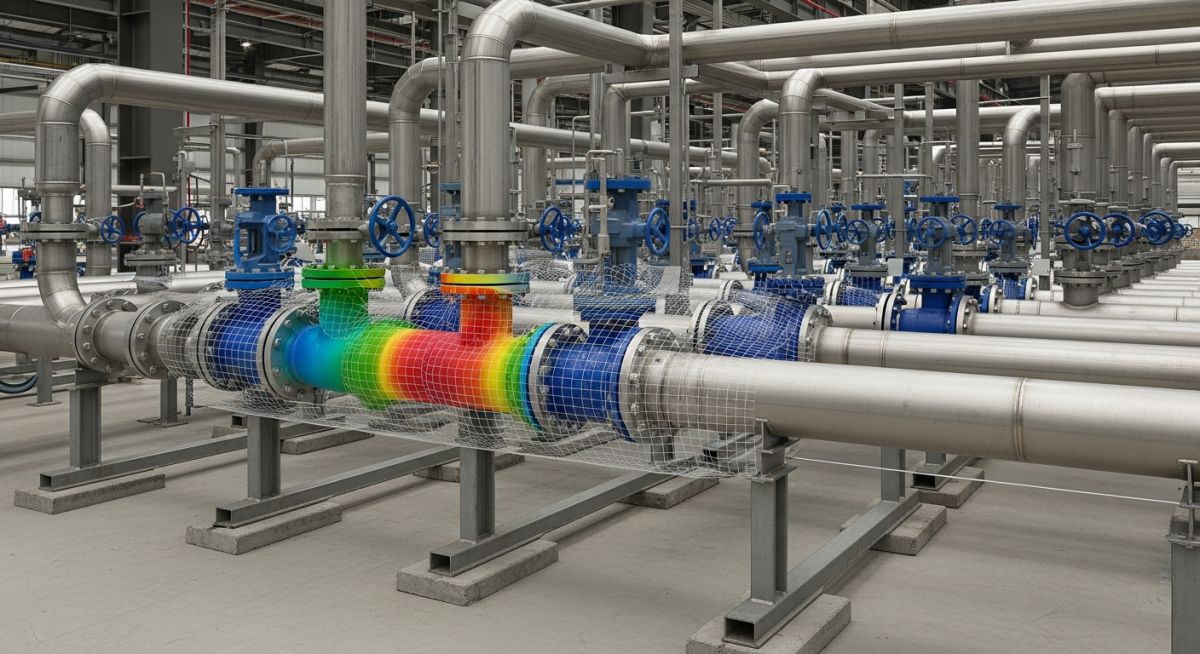
Focus Keyword Friction Forces in Cold State of Piping SEO Title Understanding Friction Forces in Cold State of Piping Analysis Guide Slug friction-forces-cold-state-piping Meta Learn why friction forces in cold state of piping exist after thermal cycles and how to model residual piping loads accurately in START-PROF software. Tags Piping Stress Analysis, START-PROF, Friction Modeling, ASME B31.3, Thermal Hysteresis Verified Engineering Content | 2026 Edition Does Friction Forces in Cold State of Piping Exist? Friction Forces in Cold State of Piping are often a source of confusion for junior stress engineers who expect loads to return to zero once a system cools down. In reality, the interaction between thermal expansion and support resistance creates a complex state of residual stress that remains long after the heat is gone. Quick Answer: The Reality of Cold Friction Yes, Friction Forces in Cold State of Piping absolutely exist. When a pipe expands and then contracts, friction at the supports prevents it from returning to its original zero-stress position. This results in residual loads and displacements, a phenomenon known as thermal hysteresis, which must be accounted for in piping stress analysis. In This Technical Guide Physics of Friction Forces in Cold State of Piping Why Loads and Displacements are Not Zero The Hysteresis Loop: Tracking Thermal Cycles Modeling in PASS START-PROF Software Managing Multiple Warming and Cooling Cycles Case Study: High-Pressure Steam Lines Common Engineering Questions (FAQ) Engineering Knowledge Check: Friction Mechanics Next Question Restart Quiz Understanding the Physics of Friction Forces in Cold State of Piping To understand why Friction Forces in Cold State of Piping exist, we must look at the fundamental mechanics of support interaction. In a theoretical world without friction, a pipe would expand when heated and return exactly to its original coordinates when cooled. However, real-world piping systems rest on supports with a specific Support Friction Coefficient (typically 0.3 for steel-on-steel or 0.1 for PTFE). According to ASME B31.3, the analysis must consider the displacement of the system. When the pipe is first installed (the "As-Built" state), there are no thermal stresses. As the temperature rises, the pipe expands, overcoming the static friction force. The moment the pipe moves, the friction force acts in the opposite direction of the expansion. This force is calculated as the product of the normal load (weight) and the friction coefficient. Why Loads and Displacements are Not Zero: The Role of Residual Piping Loads The reason why Residual Piping Loads remain in the system during the cold state is due to the "locking" effect of friction. When the system cools down from its operating temperature back to ambient, it attempts to contract. However, the friction force at the supports now acts in the opposite direction to resist this contraction. "Engineers often mistake the cold state for a zero-load state. In reality, the first cold state after a thermal cycle is often the most critical for checking nozzle loads on pumps and compressors because the friction forces have reversed, creating a different stress profile than the installation state." Because the friction force magnitude (mu multiplied by Normal Force) is often significant, it prevents the pipe from sliding all the way back to its original zero-position. The system gets "stuck" a few millimeters away from its starting point. This remaining displacement generates a constant force on anchors and equipment, which we define as the Friction Forces in Cold State of Piping. The Hysteresis Loop: Visualizing Thermal Expansion Hysteresis The most effective way to visualize this phenomenon is through Thermal Expansion Hysteresis. In stress analysis, if we plot the Force (F) against the Displacement (D), we do not see a straight line. Instead, we see a loop. The Three Stages of the Hysteresis Cycle Stage 1: Installation (Zero State): The pipe is installed. Displacement is 0, and Friction Forces in Cold State of Piping are non-existent because no movement has occurred. Stage 2: Operation (Hot State): The pipe expands. Friction acts against the expansion. The anchors feel the force of the pipe's thermal growth plus the friction resistance. Stage 3: Shutdown (Cold State after Cycle): The pipe cools. It tries to return to Stage 1. Friction now flips 180 degrees to resist the contraction. The pipe stops moving before it reaches the original zero-point. The "gap" between the zero-point and the stopping point is the residual displacement. This cycle demonstrates that the "Cold State" of a pipe depends entirely on its history. This is why advanced PASS START-PROF Software algorithms are necessary to track the sequence of load cases accurately, ensuring that Friction Forces in Cold State of Piping are not ignored during the design of sensitive equipment connections. How to Model Friction Forces in Cold State of Piping in START-PROF Modeling Friction Forces in Cold State of Piping requires software that can perform non-linear analysis and track load history. PASS START-PROF Software excels in this area by automatically creating a sequence of load cases that mimic the actual life cycle of the plant. Unlike basic linear solvers, START-PROF recognizes that the friction state is "path-dependent." When setting up your Piping Stress Analysis, you must define the Support Friction Coefficient for each support type. START-PROF then calculates the following sequence to determine the residual loads: Load Case Type Friction Behavior Resulting Displacement Installation (L1) Zero friction force initially. 0 mm (Reference Point) Operating (L2) Friction opposes thermal expansion. Maximum expansion (minus friction lag) Cold State (L3) Friction reverses to oppose contraction. Residual non-zero displacement Multiple Cycles (L4+) Friction stabilizes in a cyclic loop. Steady-state hysteresis loop Impact of Multiple Warming and Cooling Cycles on Friction A common question in Piping Stress Analysis is: "What happens after 10 or 100 cycles?" The Friction Forces in Cold State of Piping do not increase indefinitely. Instead, the system reaches a state of "Shakedown." After the first few thermal cycles, the residual forces and displacements usually settle into a predictable, repeating pattern. Thermal Cycling Fatigue and Friction Stability While the magnitude of Friction Forces in Cold State of Piping stabilizes, the repeated reversal of these forces contributes to Thermal Cycling Fatigue. Each time the friction force flips direction, it creates a local stress range at the supports and anchors. Engineering Formula: Friction Resistance The friction force magnitude (Ff) at any given support is calculated as: Ff = μ × Nload Where: μ = Support Friction Coefficient (Dimensionless) Nload = Normal force or vertical load on the support (measured in Newtons or Pounds) In complex systems with several warming and cooling cycles, Residual Piping Loads can shift the neutral position of the pipe. This shift is critical for high-temperature steam lines where the total displacement range determines the life of the expansion joints and the integrity of the equipment nozzles. Failure to account for these cycles can lead to unexpected anchor failure or support "walking" (where supports slowly shift their position over time). Friction Forces in Cold State of Piping Calculator Estimate the residual friction force and the theoretical residual displacement (spring-back lag) in your piping system. Normal Load on Support (N) The vertical force acting on the sliding support. Friction Coefficient (μ) 0.3 for Steel/Steel, 0.1 for PTFE. Axial Pipe Stiffness (N/mm) Stiffness of the piping segment resisting movement. Thermal Expansion (mm) Calculated free thermal growth of the segment. Calculate Residual Forces Reset Analysis Results Friction Force Magnitude 0 N Residual Displacement 0 mm Note: This displacement represents the "dead zone" where the pipe remains stationary even after cooling, causing Friction Forces in Cold State of Piping to persist. ASME Code Compliance: How B31.3 and B31.1 Address Friction Forces in Cold State of Piping The international standards for piping design, specifically ASME B31.3 (Process Piping) and ASME B31.1 (Power Piping), do not explicitly mandate a single method for friction calculation. However, they do require that the designer accounts for all loads acting on the system. When analyzing Friction Forces in Cold State of Piping, the codes emphasize the importance of displacement stress ranges and the reactions on supports and equipment. ASME B31.3 Paragraph 319.2.3: Displacement Stress Range ASME B31.3 focuses on the displacement stress range (SE). The code assumes that the piping system will "shake down" to an elastic state after several cycles. However, the Friction Forces in Cold State of Piping are what define the starting and ending points of that range. If the friction is high, the "cold" position of the pipe shifts, effectively changing the mean stress of the cycle. Code Reference Requirement for Friction Impact on Cold State Analysis ASME B31.3 (Process) Must consider "Restraint of Movements" (Para. 301.8). Requires analysis of the most severe displacement condition, including residual cold loads. ASME B31.1 (Power) Must consider "Friction Resistance" in support design. Focuses on anchor integrity and preventing overstress during thermal contraction cycles. API 610 / 617 Strict Nozzle Load Limits. Friction in the cold state often causes nozzle loads to exceed allowable limits post-operation. The Importance of Non-Linear Analysis Modern interpretations of the ASME codes suggest that for critical systems (High Pressure/High Temperature), a simple linear analysis is insufficient. To truly comply with the requirement to protect sensitive equipment, engineers must use the PASS START-PROF Software approach: Sustained Loads: Weight and pressure in the cold state, influenced by residual friction. Expansion Loads: The full range from the cold-cycle state to the hot-operating state. Occasional Loads: Seismic or wind loads acting on a system already stressed by Friction Forces in Cold State of Piping. By following these code-aligned practices, you ensure that your Piping Stress Analysis is not just a mathematical exercise, but a robust safety verification that accounts for the physical reality of friction-induced hysteresis. Case Study: Managing Friction Forces in Cold State of Piping for High-Pressure Steam Lines In a recent power plant expansion project, a 12-inch high-pressure steam line (operating at 350 degrees C) exhibited unexpected flange leakage at the turbine inlet during a scheduled maintenance shutdown. While the system performed perfectly during operation, the Friction Forces in Cold State of Piping created significant misalignment once the system cooled down. Project Data Pipe Material: A335 Grade P11 Alloy Steel Design Temp: 350 degrees C Design Pressure: 40 Bar Initial Design Assumption: Zero friction loads in cold state. Failure Analysis The initial stress report only considered the "Installation" state (L1) and "Operating" state (L2). During the first cooling cycle, the friction at the heavy-duty sliding supports reversed direction. This created a residual axial force of 15,000 N that pushed against the turbine nozzle in the "Cold State" (L3). The Engineering Fix The engineering team re-modeled the system using PASS START-PROF Software, specifically activating the cyclic load history feature. The following changes were implemented: Support Upgrade: Replaced steel-on-steel sliding plates (μ = 0.3) with low-friction PTFE slide plates (μ = 0.1). Anchor Optimization: The main anchor was reinforced to handle the Friction Forces in Cold State of Piping identified in the L3 load case. Cold Spring: Introduced a calculated cold spring to offset 50 percent of the thermal expansion, reducing the overall movement range. Lessons Learned Always validate equipment nozzle loads in the cold state after the first thermal cycle. Relying on the installation (as-built) state is dangerous for high-temperature systems because Friction Forces in Cold State of Piping can be significantly higher and act in a different direction than the initial loads. Frequently Asked Questions about Friction Forces in Cold State of Piping Does the Support Friction Coefficient change between the hot and cold states? While the Support Friction Coefficient is typically modeled as a constant value (such as 0.3 for steel), the actual force magnitude changes because it always opposes the direction of movement. In the cold state after a cycle, the magnitude of Friction Forces in Cold State of Piping remains high, but the vector is flipped compared to the operating state. How do Residual Piping Loads affect pump nozzle alignment? Residual Piping Loads can push or pull on a pump nozzle even when the fluid is at ambient temperature. This is a common cause of flange leaks and bearing wear. If the Friction Forces in Cold State of Piping are not accounted for, the pump may be aligned in a "stressed" state, leading to premature mechanical seal failure once the system starts. Can Thermal Expansion Hysteresis be completely eliminated? Eliminating Thermal Expansion Hysteresis entirely is nearly impossible in systems with sliding supports. However, it can be minimized by using low-friction materials like PTFE or by using hanging supports (variable springs) that allow movement without horizontal friction resistance. Why does PASS START-PROF Software produce different results than linear solvers? Many linear solvers ignore the history of the system and assume friction resets to zero. PASS START-PROF Software uses a non-linear iterative process that tracks the friction state through every phase—from installation to operation and back to the cold state. This ensures that Friction Forces in Cold State of Piping are captured accurately, reflecting real-world physical behavior. Summary Understanding Friction Forces in Cold State of Piping is a hallmark of a senior stress engineer. By recognizing that piping systems do not return to a zero-stress state after heating and cooling, we can design more robust anchors, safer equipment connections, and more reliable industrial facilities. Always ensure your piping stress analysis includes the full thermal cycle to capture these critical residual loads. Published by Epcland Content & Dev Architect | Year 2026 📚 Recommended Resources: Friction Forces in Cold State of Piping Read these Guides 📄 Test Your Knowledge: The Ultimate Piping Thermal Expansion Quiz for Engineers 📄 Pipe Support Engineering: 2026 Design & Selection Guide