What is a Heavy Hex Nut? Dimensions, Standards, and Engineering Guide
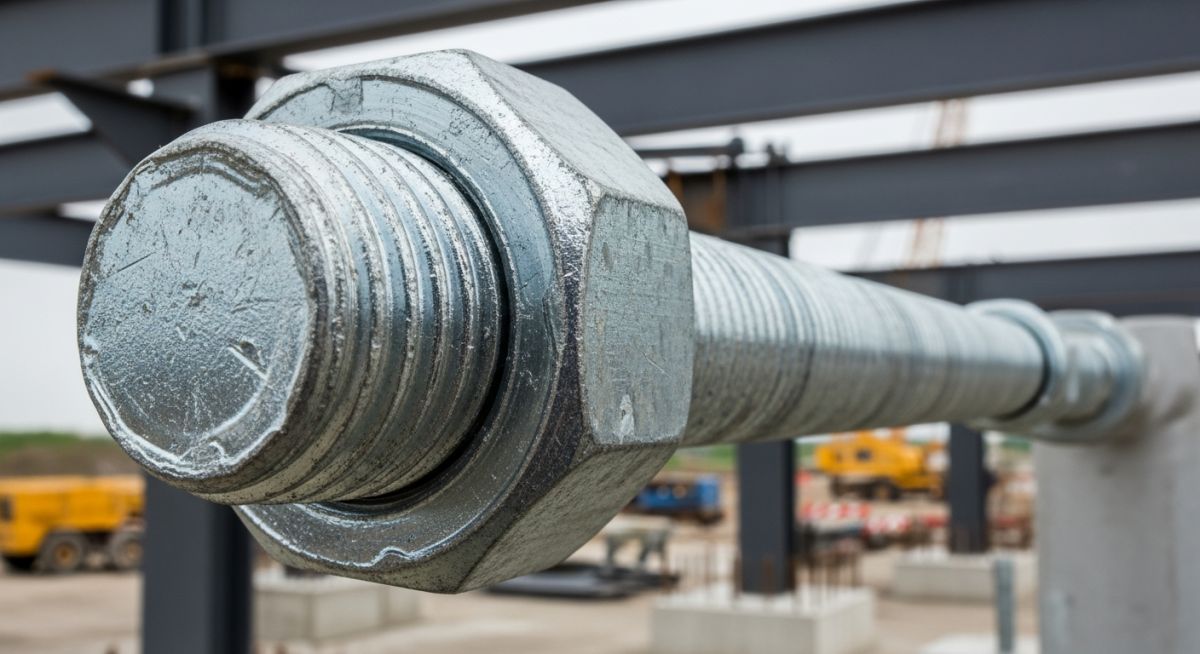
You are standing on a job site, and a crate of fasteners arrives for a high-pressure flange assembly. At first glance, the nuts look identical to the ones in your local hardware store—but they are slightly wider, noticeably thicker, and significantly heavier. If you mistakenly use a standard nut here, you aren’t just making a minor error; you are inviting a catastrophic failure under load.
The Heavy Hex Nut is the unsung hero of industrial engineering. Designed to handle higher proof loads than standard “finished” hex nuts, these fasteners are the global standard for structural steel, pressure vessels, and high-temperature piping. In this 2026 guide, we break down the dimensions, standards, and critical selection criteria every engineer must know.
Key Takeaways
- The “Heavy” Factor: Understanding that the width across flats (AF) and thickness are greater than standard nuts for the same thread size.
- Standard Compliance: Why ASME B18.2.2 and ASTM A194 2H are the non-negotiable benchmarks for these fasteners.
- Safety Margin: How increased thread engagement prevents “stripping” in high-vibration and high-pressure environments.
Quick Answer
A Heavy Hex Nut is a specialized fastener that is wider and thicker than a standard (finished) hex nut of the same diameter. Governed primarily by ASME B18.2.2, they provide a larger bearing surface and greater thread engagement, making them essential for high-strength bolting applications in structural steel and high-pressure piping (often paired with ASTM A193 grade bolts).
“During my years managing EPC piping projects, I have seen many young engineers confuse ‘Standard’ with ‘Heavy.’ In a high-pressure flange, the Heavy Hex Nut is required because its larger width across flats distributes the load better against the flange face. Never settle for ‘close enough’ when it comes to bolting.”
— Atul Singla, Founder of Epcland
Heavy Hex Nut Mastery Quiz
Test your knowledge on fastener standards, dimensions, and structural applications.
1. Which ASME standard primarily governs the dimensional requirements for Heavy Hex Nuts?
Definition: What are Heavy Hex Nuts and Why Are They Used?
In the world of industrial fasteners, the Heavy Hex Nut represents the premium tier of internal threading components. Unlike a standard “Finished Hex Nut” found in general consumer hardware, a heavy hex nut is specifically designed with a larger profile. This increased “bulk” is not for aesthetic reasons; it provides two critical mechanical advantages: a larger bearing surface and greater thread engagement.
The primary reason engineers specify Heavy Hex Nuts is to handle high-tensile loads and extreme pressures. In 2026, as industrial plants push for higher operating temperatures and pressures, the standard hex nut often lacks the surface area required to distribute clamping force without deforming the mating material (such as a pipe flange or structural beam). By using a heavy hex series nut, the load is spread across a wider area, effectively reducing the compressive stress on the joint face and preventing the nut from “embedding” into the steel.
Heavy Hex Nut Standards and Specifications (ASME B18.2.2 & ASTM)
The engineering of a Heavy Hex Nut is strictly governed by international standards to ensure interchangeability and safety in high-risk environments. The most important dimensional standard is ASME B18.2.2 (Square and Hex Nuts – Inch Series). This document defines the exact tolerances for the width across flats, the thickness of the nut, and the perpendicularity of the bearing surface.
Beyond dimensions, the material properties are defined by ASTM standards. For most EPC (Engineering, Procurement, and Construction) projects, you will encounter ASTM A194 (for high-pressure and high-temperature service) and ASTM A563 (for general structural and mechanical use). Within these, Grade 2H is perhaps the most ubiquitous specification for heavy hex nuts, known for its high-strength heat-treated carbon steel properties that pair perfectly with ASTM A193 B7 stud bolts.
Comprehensive Heavy Hex Nut Dimensions and Size Chart
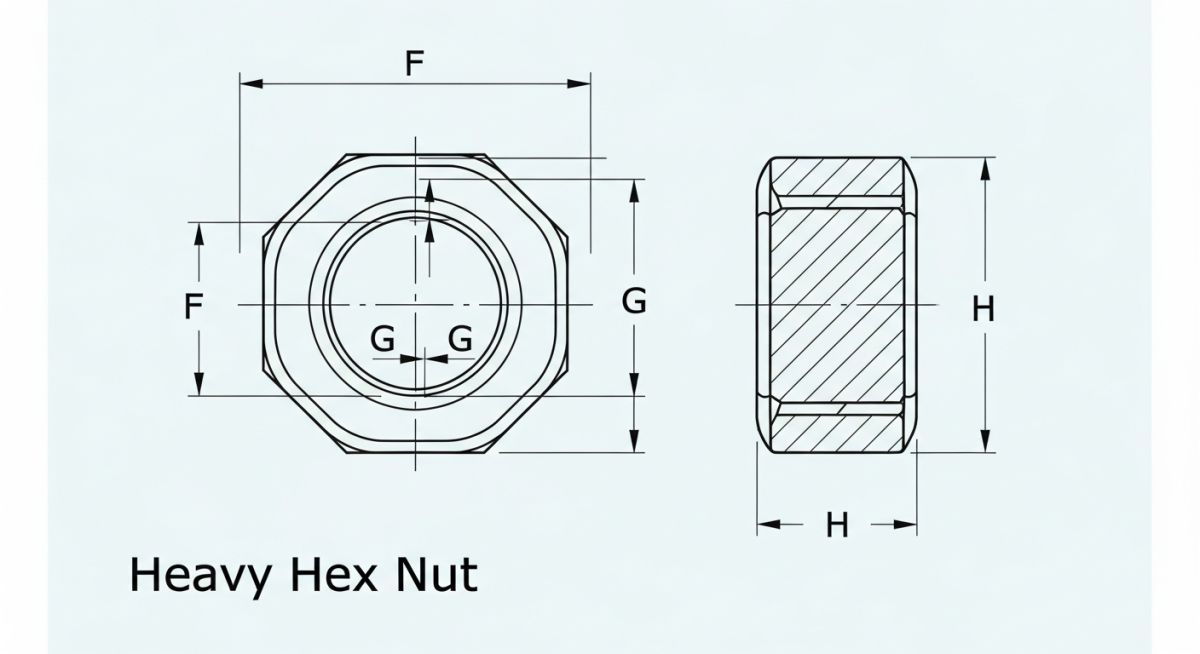
Understanding Heavy Hex Nut dimensions is vital for ensuring that your tools (wrenches and sockets) and your clearance zones are correctly planned. The “Width Across Flats” (AF) of a heavy hex nut is typically 1/8 of an inch larger than a standard hex nut of the same diameter. This means a 1-inch bolt requires a 1-1/2 inch wrench for a standard nut, but a 1-5/8 inch wrench for a heavy hex nut.
In the technical table below, we have outlined the standard dimensions for the most common heavy hex nut sizes used in industrial piping and structural steel as of 2026. Note that “H” represents the nominal thickness, and “F” represents the width across the flats.
| Nominal Size (Inches) | Width Across Flats (F) | Thickness/Height (H) |
|---|---|---|
| 1/2″ | 7/8″ | 31/64″ |
| 5/8″ | 1-1/16″ | 39/64″ |
| 3/4″ | 1-1/4″ | 47/64″ |
| 7/8″ | 1-7/16″ | 55/64″ |
| 1″ | 1-5/8″ | 63/64″ |
Structural Comparison: Standard Hex Nuts vs. Heavy Hex Nuts
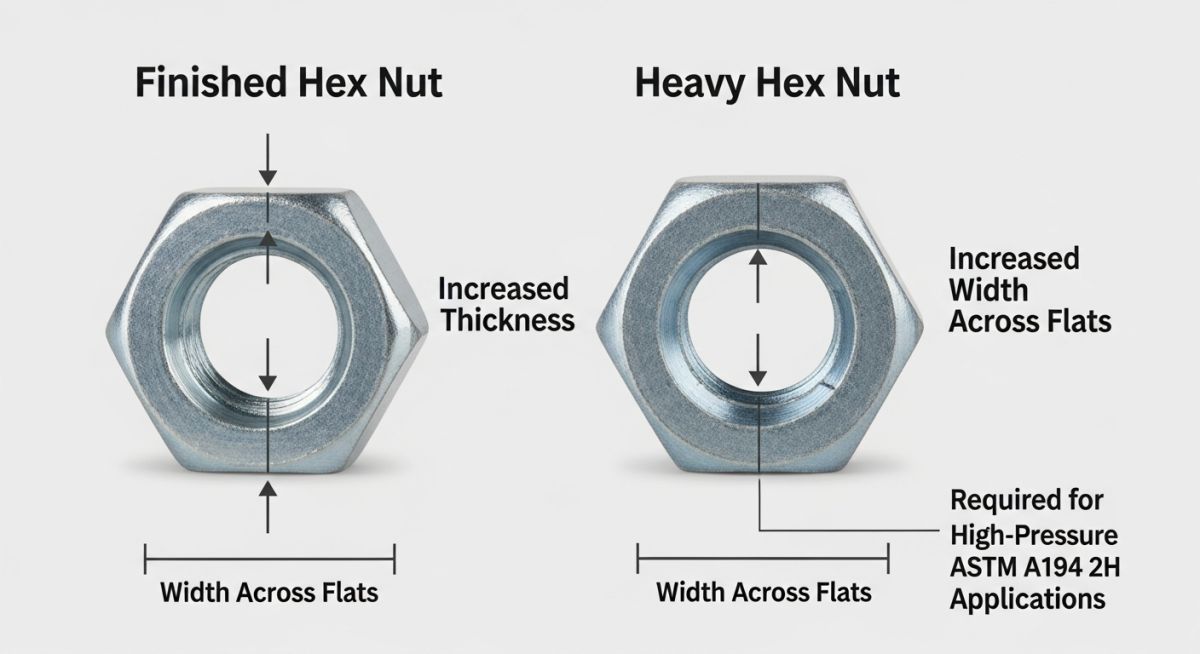
The difference between a “Finished” (Standard) hex nut and a Heavy Hex Nut is primarily dimensional, but the mechanical implications are profound. A standard hex nut is designed for general-purpose applications where clamping force is moderate. However, in heavy industrial settings, the standard nut’s smaller bearing surface can lead to “dilation”—where the nut actually expands under high tension, causing the threads to lose their grip and eventually strip.
The Heavy Hex Nut addresses this by increasing the “Width Across Flats” (the distance between the parallel sides) and the thickness. This extra material provides a higher “Proof Load” (the amount of tension the nut can withstand without permanent deformation). For instance, a 1-inch Heavy Hex Nut provides approximately 15% more bearing surface area than its standard counterpart. This extra area is vital when bolting into softer materials or when using high-strength Grade 8 or B7 bolts that generate massive clamping forces.
| Feature | Standard (Finished) Hex Nut | Heavy Hex Nut |
|---|---|---|
| Width Across Flats | Smaller (e.g., 1-1/2″ for 1″ bolt) | Larger (e.g., 1-5/8″ for 1″ bolt) |
| Thickness (Height) | Nominal (7/8″ for 1″ bolt) | Increased (63/64″ for 1″ bolt) |
| Primary Application | Automotive, General Mechanical | Oil & Gas, Structural Steel, Power Plants |
| Bolting Partner | Grade 2, Grade 5 Bolts | ASTM A193 B7, A325, A490 Bolts |
Common Material Grades for Heavy Hex Nuts (A194 2H vs. A563)
Selecting the correct Heavy Hex Nut requires looking beyond dimensions and into the metallurgical “Grade” of the steel. In 2026, the two most dominant specifications are ASTM A194 and ASTM A563.
ASTM A194 Grade 2H: The Piping Powerhouse
This is a high-strength, quenched and tempered carbon steel nut. It is specifically intended for high-pressure and high-temperature service. If you see a “2H” stamped on the face of a Heavy Hex Nut, you are dealing with a component capable of withstanding the rigors of a steam line or a high-pressure reactor. It is almost always paired with ASTM A193 B7 stud bolts.
ASTM A563 Grade DH: The Structural Standard
While A194 is for piping, ASTM A563 Grade DH is the go-to for structural steel construction. These nuts are designed to meet the mechanical requirements of ASTM F3125 (which covers A325 and A490 structural bolts). They provide high proof load strengths but are generally more suited for ambient temperature atmospheric conditions rather than high-heat industrial processes.
Professional Guidelines for Specifying Heavy Hex Nuts in EPC Projects
For Piping Engineers and Structural Leads, specifying the right Heavy Hex Nut is a matter of safety and compliance. When developing a Bolting Material Specification (BMS), you must ensure that the nut’s strength equals or exceeds the strength of the bolt it is paired with. A common engineering rule is that the nut should always be the “stronger” component—it is far safer for a bolt to snap under extreme tension than for a nut to strip its threads, as stripping leads to a gradual, often invisible loss of clamping force.
Engineering Checklist for 2026 Projects:
- Thread Series: Ensure UNC (Unified Coarse) threads for sizes up to 1 inch, and 8UN (8-Thread Series) for sizes above 1 inch, per ASME B1.1.
- Marking Verification: Every Heavy Hex Nut must have a manufacturer’s mark and the grade symbol (e.g., 2H, 2HM, DH) clearly visible.
- Coatings: If using Hot-Dip Galvanizing (HDG) per ASTM A153, ensure the nuts are “over-tapped” to account for the coating thickness while maintaining structural integrity.
- Wrench Clearance: Because Heavy Hex Nut dimensions are larger, always check that there is enough physical space (radial clearance) on the flange or baseplate for the hydraulic torque wrench to fit.
Heavy Hex Nut Dimensional Lookup Tool
Instantly find ASME B18.2.2 dimensions and recommended wrench sizes for heavy-duty fasteners.
Pro Tip: Heavy Hex Nuts are 1/8″ wider across the flats than standard hex nuts. Always ensure your tool kit includes the larger socket sizes required for these industrial fasteners.
ASME B18.2.2 Specifications
Recommended Wrench/Socket
1-5/8″
Heavy Hex Nut Failure Case Study: The High-Pressure Flange Leak
The Incident: Critical Steam Escape
In a chemical processing plant in early 2026, a 10-inch Class 600 steam flange began leaking profusely during a restart after maintenance. The leak was so severe that it triggered an automatic safety shutdown of the entire unit. Upon investigation, the maintenance team found that while the ASTM A193 B7 stud bolts were correct, the nuts used were standard Finished Hex Nuts instead of the specified Heavy Hex Nuts.
The Engineering Analysis
The lead mechanical engineer conducted a forensic audit of the failed joint. The analysis revealed two major technical failures caused by the wrong nut selection:
- Nut Dilation: Under the 45,000 psi bolt tension required for the Class 600 flange, the thinner walls of the standard hex nuts “dilated” (widened). This caused the internal threads to lose contact with the bolt, leading to a loss of 30% of the initial clamping force.
- Bearing Surface Crushing: The standard nuts had a smaller Width Across Flats, concentrating the load on a smaller area of the flange face. This created micro-indentations on the flange, preventing a uniform seal against the gasket.
The Rectification Strategy
The facility management mandated an immediate swap of all 1,200 fasteners on the steam header. The replacement fasteners were ASTM A194 Grade 2H Heavy Hex Nuts. Because of the larger Heavy Hex Nut dimensions, the maintenance crew had to source larger sockets (e.g., moving from a 1-1/2″ socket to a 1-5/8″ socket for the 1″ studs). The increased thickness of the 2H nuts ensured that the full thread engagement was maintained even under thermal expansion.
The Outcome
After switching to the correct Heavy Hex Nuts, the joint passed a hydrostatic test at 1.5 times the operating pressure with zero leakage. The total cost of the rework, including lost production time, exceeded 450,000 USD—a staggering price for a failure caused by a “simple” nut substitution. This case highlights why strictly adhering to ASME B18.2.2 is a non-negotiable safety requirement.
Expert Insights: Lessons from 20 Years in Fastener Engineering
The 2HM Grade Rule: In 2026, for any plant dealing with sour service (H2S), we never use standard 2H nuts. We specify ASTM A194 Grade 2HM, which are 100% hardness tested to ensure they won’t crack under stress corrosion.
Galvanized Over-tapping: If you are using galvanized Heavy Hex Nuts, ensure they are over-tapped after galvanizing according to ASTM A563. Without this, the coating will strip during installation, leading to immediate corrosion.
Thread Protrusion: Always ensure at least one full thread is visible beyond the nut after tightening. If the bolt is flush or recessed, you have not achieved full thread engagement, significantly lowering the joint’s safety factor.
Washer Face Orientation: Almost all Heavy Hex Nuts have a specified bearing surface (washer face). Installing them upside down against the material reduces the contact area and can lead to uneven load distribution.
Frequently Asked Questions
What is the specific difference between a standard nut and a Heavy Hex Nut?
What wrench size do I need for a 1-inch Heavy Hex Nut?
Can I use a Finished Hex Nut in place of a Heavy Hex Nut if I’m in a hurry?
What does the “2H” mark on a Heavy Hex Nut signify?
Why are Heavy Hex Nuts required for ASTM A325 and A490 bolts?
How do you verify a Heavy Hex Nut is genuine in 2026?
Related posts:
![High-grade industrial Wing Nut Types and Applications for mechanical assemblies.]()
Wing Nut Types and Applications: The 2026 Engineering Guide
![Industrial Monorail Crane Systems installed in a modern manufacturing plant 2026.]()
Monorail Crane Systems: Design, Types & 2026 Standards Guide
![Lead engineer performing a Factory Acceptance Test FAT on an industrial skid system 2026]()
Factory Acceptance Test FAT: The 2026 Engineering Guide to Zero-Defect Delivery
![Professional engineering workspace showing a Basis of Design document layout for a 2026 project.]()
Basis of Design: How to Write a BOD for Engineering Projects in 2026
![Industrial Flare Knockout Drum Sizing and installation in a refinery relief system.]()
Flare Knockout Drum Sizing: Design & API 521 Standards (2026 Guide)
![Advanced Reboiler Control Systems in a modern petrochemical refinery 2026.]()
Reboiler Control Systems: Engineering Guide to Precision Control 2026