What is Corrosion Allowance? Guide to Steel Piping CA and ASME Standards
Corrosion Allowance is a vital engineering safety margin added to the minimum required wall thickness of a pipe or pressure vessel to ensure structural integrity over its intended design life. In the demanding environments of 2026 energy infrastructure, calculating this allowance accurately is the difference between a 30-year service life and catastrophic premature failure.
Quick Definition: Corrosion Allowance
Corrosion Allowance (CA) is the additional thickness of material added to the pressure-design wall thickness of a component to compensate for metal loss due to corrosion, erosion, or mechanical wear. It ensures the equipment remains safe for operation until its next scheduled inspection or decommissioning.
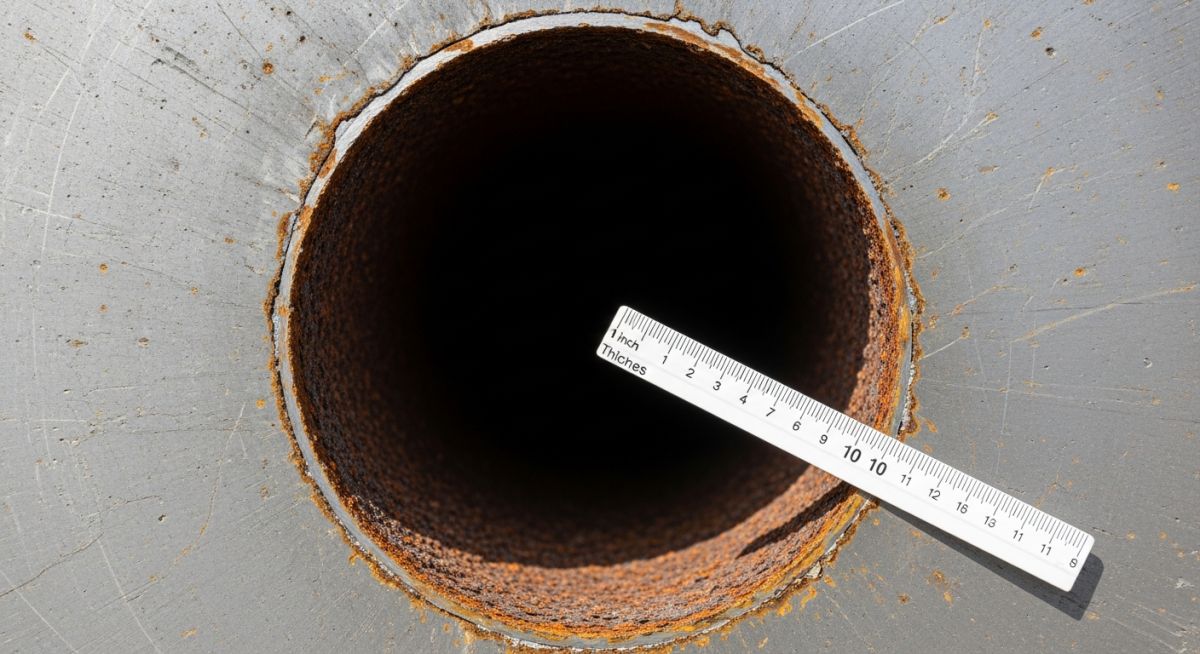
Table of Contents
Engineering Knowledge Check
Quiz Complete!
Complete Course on
Piping Engineering
Check Now
Key Features
- 125+ Hours Content
- 500+ Recorded Lectures
- 20+ Years Exp.
- Lifetime Access
Coverage
- Codes & Standards
- Layouts & Design
- Material Eng.
- Stress Analysis
Understanding the Fundamentals of Corrosion Allowance
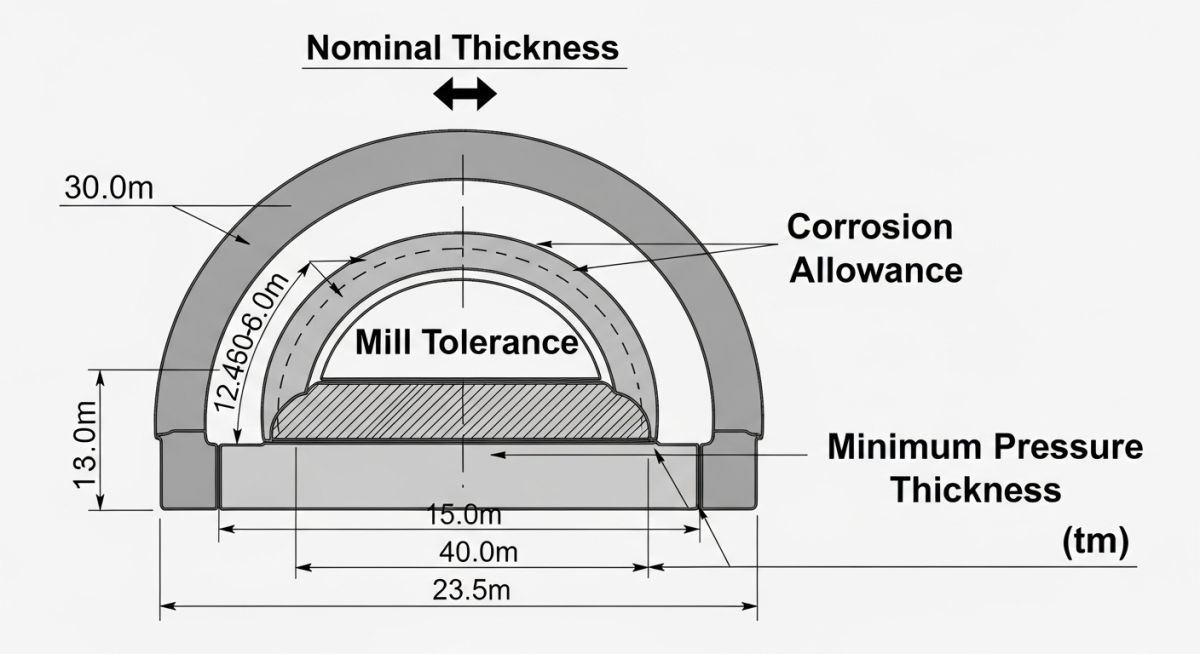
In the lifecycle of a piping system, Corrosion Allowance acts as a sacrificial layer of metal. Unlike the structural wall thickness required to contain internal pressure, the CA is designed to be consumed over time. Engineering codes such as ASME B31.3 and ASME Section VIII mandate that this allowance be accounted for to ensure that the pipe never thins below its minimum safe pressure-holding thickness during its 2026 design life.
Regulatory Framework for Corrosion Allowance: ASME and API
Standardization is critical for safety. The primary codes governing Corrosion Allowance include:
- ASME B31.3 (Process Piping): Defines the total wall thickness as the sum of pressure design thickness, Corrosion Allowance, and erosion margins.
- API 570: Provides guidelines for the inspection and remaining life calculation of piping systems based on measured Corrosion Allowance depletion.
- NACE MR0175/ISO 15156: Specific to oil and gas environments where H2S is present, influencing the required Corrosion Allowance for Steel alloys.
Critical Factors Affecting Corrosion Allowance in Industrial Piping
Selecting the correct Corrosion Allowance is not a "one size fits all" decision. Engineers must analyze several Factors Affecting Corrosion Allowance to avoid either over-engineering (which increases cost and weight) or under-engineering (which risks failure).
Chemical Environment
The presence of CO2, H2S, chlorides, or oxygen dramatically increases the rate of metal loss. Fluids with high acidity (low pH) require a significantly larger Corrosion Allowance.
Operating Temperature
Higher temperatures generally accelerate chemical reactions. In many carbon steel applications, the Corrosion Allowance for Steel must be increased if operating above 200 degrees Celsius.
Fluid Velocity and Erosion
High-velocity fluids or slurry transport can cause erosion-corrosion. In these cases, the Corrosion Allowance must also account for mechanical wear of the pipe wall.
Design Life Requirements
A plant designed for a 10-year lifespan will require a different Corrosion Allowance than a 40-year utility header, directly impacting the material wall thickness selection.
Determining the Standard Corrosion Allowance for Steel
When specifying Corrosion Allowance for Steel, engineers typically look to industry benchmarks. Carbon steel, while cost-effective, is highly susceptible to uniform corrosion, whereas stainless steel relies on passivity.
| Material Type | Typical Service | Standard CA (mm) |
|---|---|---|
| Carbon Steel | General Water / Steam | 1.5 mm to 3.0 mm |
| Carbon Steel | Sour Crude / Chemicals | 3.0 mm to 6.0 mm |
| Stainless Steel | Corrosive Chemicals | 0.0 mm (Usually) |
| Galvanized Steel | Instrument Air | 0.0 mm to 1.0 mm |
The Critical Effect of Corrosion Allowance in Pipe Stress Analysis
In the realm of 2026 piping design, the Effect of Corrosion Allowance in Pipe Stress Analysis cannot be overstated. When a stress engineer models a system in software like Caesar II, they must account for the pipe in its "Corroded Condition." This significantly alters the system's structural behavior.
Mechanical Impacts on Stress Results
- Section Modulus Reduction: As the Corrosion Allowance is "removed" in the software model, the section modulus decreases. This leads to higher longitudinal stresses under the same bending moments.
- Weight Considerations: Stress analysis for sustained loads typically uses the "Uncorroded" (New) weight for weight calculations but the "Corroded" cross-section for stress capability.
- Flexibility Increase: A thinner wall (nominal minus Corrosion Allowance) is more flexible. While this might reduce thermal expansion loads on nozzles, it can lead to excessive sagging and vibration issues in long spans.
ASME and API Compliance for Corrosion Allowance Implementation
Adhering to ASME B31.3 standards requires a precise application of the Corrosion Allowance. The code stipulates that the pipe must sustain its internal design pressure at its end-of-life thickness.
Advanced Engineering Calculations for Corrosion Allowance
To determine the final nominal wall thickness (tn) of a steel pipe, engineers use a multi-step calculation. This formula ensures the Corrosion Allowance for Steel is integrated with manufacturing tolerances.
Piping Wall Thickness Formula (ASME B31.3)
The minimum required thickness (tm) is calculated as:
P: Internal Design Pressure (PSIG)
D: Outside Diameter of Pipe (inches)
S: Allowable Stress Value (PSI)
c: Corrosion Allowance + Erosion Margin (inches)
E: Longitudinal Weld Joint Quality Factor
Y: Coefficient (based on material and temp)
Note: Once tm is found, you must account for Mill Tolerance (usually 12.5 percent).
Final Nominal Thickness (tn) = tm / 0.875
Comparative Impact of CA on Piping Lifespan
| Service Type | Rate (mm/yr) | Recommended CA | Estimated Life |
|---|---|---|---|
| Inert Gas (N2) | 0.01 | 0.0 mm | 50+ Years |
| Standard Steam | 0.05 | 1.5 mm | 30 Years |
| Brine/Salt Water | 0.20 | 3.0 mm | 15 Years |
| Acid Injection | 0.50+ | 6.0 mm+ | Material Change Advised |
Corrosion Allowance and Wall Thickness Calculator
Calculate the Minimum Required Thickness (tm) and Suggested Nominal Thickness (tn) based on ASME B31.3 logic, including a standard 12.5 percent mill tolerance.
Min. Required Thickness (tm)
0.00 mm
Formula: t + c
Nominal Thickness (tn)
0.00 mm
Includes 12.5 percent Mill Tolerance
Don't miss this video related to Corrosion Allowance
Summary: Welcome to our comprehensive 30-day course on ASME B31.3 - the code that governs process piping! 🛢️ In this single video, ......
Internal Coatings vs. Corrosion Allowance: A Cost-Benefit Analysis
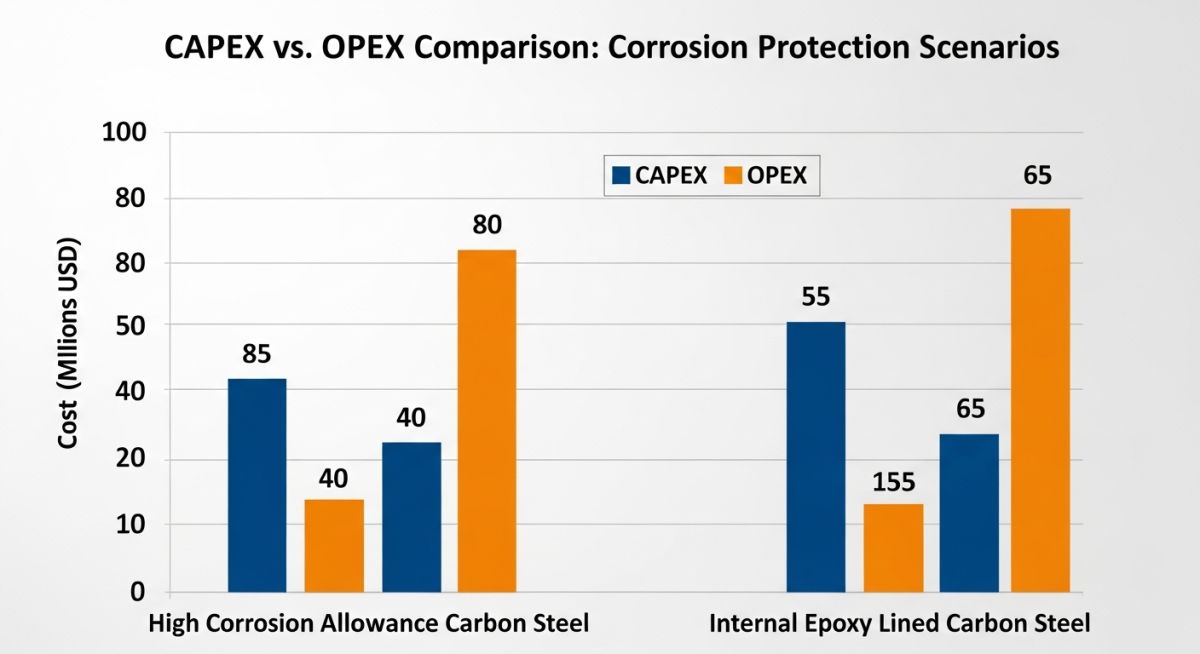
When faced with highly corrosive fluids, engineers in 2026 often face a dilemma: Should we increase the Corrosion Allowance for Steel to extreme levels (e.g., 6.0 mm or 9.0 mm), or should we invest in internal coatings? While adding CA is a passive solution, it significantly increases the total weight and cost of the piping system.
High CA Approach (Sacrificial)
- Weight Impact: Heavier pipe requires more robust pipe supports and structures.
- Welding Costs: Thicker walls require more weld passes and longer Preheat/PWHT times.
- Procurement: Extremely thick walls may move the pipe into "Special Schedule" or forged categories, increasing lead times.
- Reliability: Predictable, but allows the pipe to physically degrade over its 2026 service life.
Internal Coating Approach (Preventative)
- Weight Impact: Allows for standard wall thicknesses, reducing structural steel requirements.
- Maintenance: Requires holiday testing and specialized field-joint coating during installation.
- Performance: Prevents the Effect of Corrosion Allowance in Pipe Stress Analysis from ever becoming a factor, as wall thickness remains constant.
- Risk: If the coating fails (pinholes), localized "pitting" corrosion can occur faster than general thinning.
Engineering Recommendation for 2026
For general utility services (water, steam, air), a standard 1.5 mm to 3.0 mm Corrosion Allowance is the most economical choice. However, for aggressive produced water or chemical injection lines where the required CA exceeds 6.0 mm, switching to an internal FBE (Fusion Bonded Epoxy) or Glass Flake Lining is recommended to maintain system flexibility and reduce CAPEX.
Case Study: Premature Failure Due to Underestimated Corrosion Allowance
Project Data
Offshore Produced Water Line
Material: ASTM A106 Grade B
Design Life: 20 Years
Original CA: 1.5 mm
Failure Analysis
After only 7 years of operation in 2026, ultrasonic testing revealed a wall loss of 2.2 mm. The pipe had exceeded its Corrosion Allowance, resulting in a localized pinhole leak at a high-turbulence elbow.
The Engineering Fix
The investigation found that the fluid corrosivity was higher than initially projected due to increased CO2 injection for enhanced oil recovery. The engineering team implemented a two-part solution:
- Immediate Remediation: Replaced the affected section with a higher Corrosion Allowance for Steel of 4.5 mm to match the remaining 13-year field life.
- Systemic Change: Integrated internal epoxy lining for high-velocity segments to reduce the effective corrosion rate from 0.31 mm/year to near zero.
Lessons Learned
- ● Dynamic Monitoring: CA should be re-validated if process conditions (temperature or chemistry) change from the original 2026 design basis.
- ● Stress Validation: The Effect of Corrosion Allowance in Pipe Stress Analysis was critical during the fix; the heavier wall pipe required new flexibility loops to prevent nozzle overloads.
Frequently Asked Questions About Corrosion Allowance
Does the Corrosion Allowance affect the weight of the pipe in stress software?
What is the relationship between Design Life and CA?
Can I use 0.0 mm Corrosion Allowance for Steel?
How does Material Wall Thickness mill tolerance impact CA?
Final Engineering Verdict on Corrosion Allowance
Correctly identifying the required Corrosion Allowance is a fundamental responsibility of the piping engineer. From meeting ASME B31.3 compliance to ensuring the Effect of Corrosion Allowance in Pipe Stress Analysis is accurately modeled, CA dictates the safety and longevity of industrial assets.
In 2026, as infrastructure demands become more extreme, relying on standard "1.5 mm" defaults is no longer sufficient. Detailed fluid analysis and metallurgical assessment are required to determine the optimal Corrosion Allowance for Steel in any high-pressure or high-temperature application.