Types of Plumbing Pipes: The Definitive Engineering Guide

Selecting the correct Types of Plumbing Pipes is a critical engineering decision that impacts a building’s hydraulic efficiency, water potability, and long-term maintenance costs. From traditional metallic systems like copper and galvanized iron to modern high-performance thermoplastics like PEX and CPVC, each material carries specific ASTM and ISO designations that dictate its pressure rating, temperature tolerance, and chemical compatibility.
What are the different types of plumbing pipes?
The primary types of plumbing pipes include metallic options like copper (Types K, L, M) and galvanized steel, alongside advanced thermoplastics such as PEX, PVC, CPVC, and ABS. Material selection depends on the application, such as potable water supply, drainage (DWV), or gas distribution, based on temperature and pressure requirements.
Plumbing Material Knowledge Check
Question 1 of 5
Complete Course on
Piping Engineering
Check Now
Key Features
- 125+ Hours Content
- 500+ Recorded Lectures
- 20+ Years Exp.
- Lifetime Access
Coverage
- Codes & Standards
- Layouts & Design
- Material Eng.
- Stress Analysis
Copper Pipes (ASTM B88): The Gold Standard of Durability
Copper has been the cornerstone of plumbing engineering for decades due to its exceptional longevity and natural bacteriostatic properties. Governed by ASTM B88, copper piping is classified into three primary types based on wall thickness, which determines its pressure rating and suitable environment.
Engineering Comparison: Pipe Wall Thickness & Standards

Advantages of Copper Pipes
- Corrosion Resistance: Copper forms a protective “patina” layer that resists internal corrosion in most potable water conditions.
- Bacteriostatic Properties: It naturally inhibits the growth of bacteria and viruses on the inner pipe walls, ensuring higher water quality.
- Thermal Stability: Unlike some plastics, copper does not lose structural integrity at high temperatures, making it ideal for boiler lines.
Applications of Copper Pipes
Selection depends on the “Type” designation:
- Type K (Green Stripe): Thickest wall. Used for underground service lines and high-pressure industrial applications.
- Type L (Blue Stripe): Standard wall. The most common choice for residential interior water supply.
- Type M (Red Stripe): Thinnest wall. Suitable for low-pressure domestic heating and branch lines where budget is a factor.
PEX Pipes: The Flexible Revolution
PEX (Cross-linked Polyethylene), regulated by ASTM F876 and F877, has revolutionized residential plumbing. Its flexibility allows for long continuous runs, significantly reducing the number of fittings—and potential leak points—in a system.
Benefits of PEX Pipes
- Freeze Resistance: PEX can expand slightly if water freezes inside, making it much less likely to burst than rigid metallic pipes.
- Ease of Installation: It uses “crimp” or “expansion” fittings rather than soldering, which eliminates the need for open flames on the job site.
- Manifold Systems: PEX is ideally suited for “home-run” systems where each fixture has a dedicated line from a central distribution manifold.
Engineering Note: PEX is highly sensitive to UV radiation. It must never be used in outdoor applications where it is exposed to direct sunlight, as the material will become brittle and fail.
PVC & UPVC Pipes: High-Efficiency Plastic Solutions
PVC (Polyvinyl Chloride) and its rigid counterpart UPVC (Unplasticized PVC) are the workhorses of drainage and irrigation systems. While often confused, they serve distinct engineering roles based on their chemical composition and Schedule rating.
Advantages of PVC Pipes
- Scale Resistance: The smooth interior surface prevents the buildup of sediment and scale, maintaining high flow rates over the pipe’s life.
- Chemical Inertness: PVC is resistant to a wide range of acids, bases, and salts, making it the standard for sewer lines.
- Cost Efficiency: Lightweight and inexpensive, it reduces both material and labor costs for large-scale DWV (Drain, Waste, Vent) systems.
UPVC vs. Standard PVC
UPVC (Unplasticized Polyvinyl Chloride) does not contain the phthalates used to make PVC flexible. This makes UPVC more rigid, durable, and suitable for window frames and specialized pressure-rated potable water lines in international markets.
CPVC Pipes: Engineered for High Temperature
CPVC (Chlorinated Polyvinyl Chloride) is essentially PVC that has undergone a chlorination reaction. This process increases the material’s glass transition temperature, allowing it to handle hot water up to 200°F (93°C), whereas standard PVC is limited to approximately 140°F.
Benefits and Applications of CPVC
- Potable Water Safety: Certified under NSF 61 for drinking water systems.
- Fire Resistance: CPVC has high flame-retardant properties and low smoke toxicity, making it a popular choice for residential fire sprinkler systems.
- Simple Joining: Uses a “one-step” solvent cement process that creates a chemical bond stronger than the pipe itself.
Galvanized Steel and Black Iron: Industrial Heritage
While modern residential projects favor plastics, Galvanized Steel and Black Iron pipes remain essential in industrial and gas distribution sectors. Governed by ASTM A53, these pipes are valued for their immense structural strength and resistance to mechanical damage.
Galvanized Iron (GI) Pipes
GI pipes are coated with a protective layer of zinc to prevent rusting. However, in potable water systems, this zinc eventually erodes, leading to internal oxidation.
- Advantage: Exceptional impact resistance and high pressure tolerance.
- Disadvantage: Prone to “tuberculation” (internal rust build-up) which restricts flow and discolors water.
Black Steel Pipes
Unlike galvanized pipes, black steel has no zinc coating. It is the industry standard for natural gas and propane lines because it is easily threaded and the lack of zinc prevents the flaking that can clog gas regulators and burners.
Polyethylene (PE) and HDPE: The Infrastructure Choice
High-Density Polyethylene (HDPE), regulated by ASTM D3350, is the primary material for municipal water mains and geothermal loops. Its “butt-fusion” welding technique creates a monolithic, leak-proof system.
Engineering Benefits of Polyethylene
- Fatigue Resistance: HDPE can handle the “water hammer” effect better than rigid pipes due to its lower modulus of elasticity.
- Biological Resistance: It does not support the growth of algae, fungi, or bacteria.
- SDR Ratings: Engineers select pipes based on the Standard Dimension Ratio (SDR), which is the ratio of the pipe diameter to its wall thickness.
Technical Engineering Comparison Matrix
The following table provides a data-rich comparison of the most common plumbing materials based on 2026 engineering standards.
| Pipe Material | ASTM Standard | Max Temp (°F) | Primary Application | Joint Method |
|---|---|---|---|---|
| Copper (Type L) | B88 | 400+ | Potable Water | Soldering / ProPress |
| PEX | F876 | 200 | Residential Supply | Crimp / Expansion |
| PVC (Sch 40) | D1785 | 140 | Drainage (DWV) | Solvent Cement |
| CPVC | D2846 | 200 | Hot Water Supply | Solvent Cement |
| ABS | D2661 | 140 | Sewer / Vent | Solvent Cement |
Plumbing Hydraulics: Flow Rate and Velocity
When sizing plumbing pipes, engineers must calculate the Flow Velocity (v) to prevent erosion (if too fast) or sediment buildup (if too slow). The relationship between flow rate and pipe size is governed by the Continuity Equation:
Q = A × v
Where:
- Q = Volumetric Flow Rate (ft3/s or m3/s)
- A = Cross-sectional Area of the pipe (ft2 or m2), calculated as π × r2
- v = Flow Velocity (ft/s or m/s)
Rule of Thumb: For residential potable water, velocity (v) should generally be maintained between 5 and 8 feet per second to minimize noise and pipe wear.
Specialty Pipes: CSST and ABS
CSST (Corrugated Stainless Steel Tubing)
CSST is a flexible stainless steel pipe used for gas distribution. Its primary advantage is its ability to be snaked through walls like electrical wire, significantly reducing labor. However, per NFPA 54, CSST must be properly bonded and grounded to prevent damage from lightning strikes or electrical surges.
ABS (Acrylonitrile Butadiene Styrene)
ABS is a rigid black plastic pipe used for Drain, Waste, and Vent (DWV) systems. It is slightly easier to install than PVC because it requires only a single step of solvent cement (no primer needed). However, it is more prone to warping when exposed to direct sunlight and is not permitted in certain jurisdictions due to local fire codes.
Plumbing Flow Velocity Calculator
Calculate the water velocity inside a pipe to ensure it meets engineering standards (typically 5-8 ft/s for potable water) to prevent erosion and noise.
Calculated Velocity
0.00
Feet Per Second (ft/s)
Engineering Status
Checking…
Assessment based on erosion limits.
Calculated using the continuity formula: v = (0.4085 × GPM) / d2. Standard limits: 5-8 ft/s.
Piping Expansion Loops: Managing Thermal Movement
Plastic piping materials like PEX, CPVC, and PVC have a significantly higher coefficient of thermal expansion than metallic pipes. For example, PEX can expand up to 1 inch for every 100 feet of pipe per 10°F temperature rise. Without a properly engineered expansion loop or offset, this linear growth can cause the pipe to buckle, stress fittings to the point of failure, or pull out of anchors.
Schematic: Engineering a U-Bend Expansion Loop

Piping Expansion Loop Calculator
Calculate the total linear expansion and the required leg length (L) for a U-bend expansion loop based on material properties and temperature differential.
Total Linear Expansion (ΔL)
0.00
Total change in length (Inches)
Required Leg Length (ℓ)
0.00
Minimum loop leg length (Inches)
Formula: ΔL = L × α × ΔT. Leg length calculated using the guided cantilever method for 2026 engineering standards.
Why Leg Length Matters
The Leg Length (ℓ) is the most critical dimension of an expansion loop. If the leg is too short, the pipe will be too rigid to absorb the movement, leading to a concentration of stress at the elbows. By ensuring the leg meets the calculated minimum, you allow the material to flex safely within its elastic limit, preventing long-term fatigue failure in hot water supply systems.
Engineering Case Study: Galvanized Replacement & PEX Modernization
Project: The Oak Ridge Heritage Apartments (Retrofit)
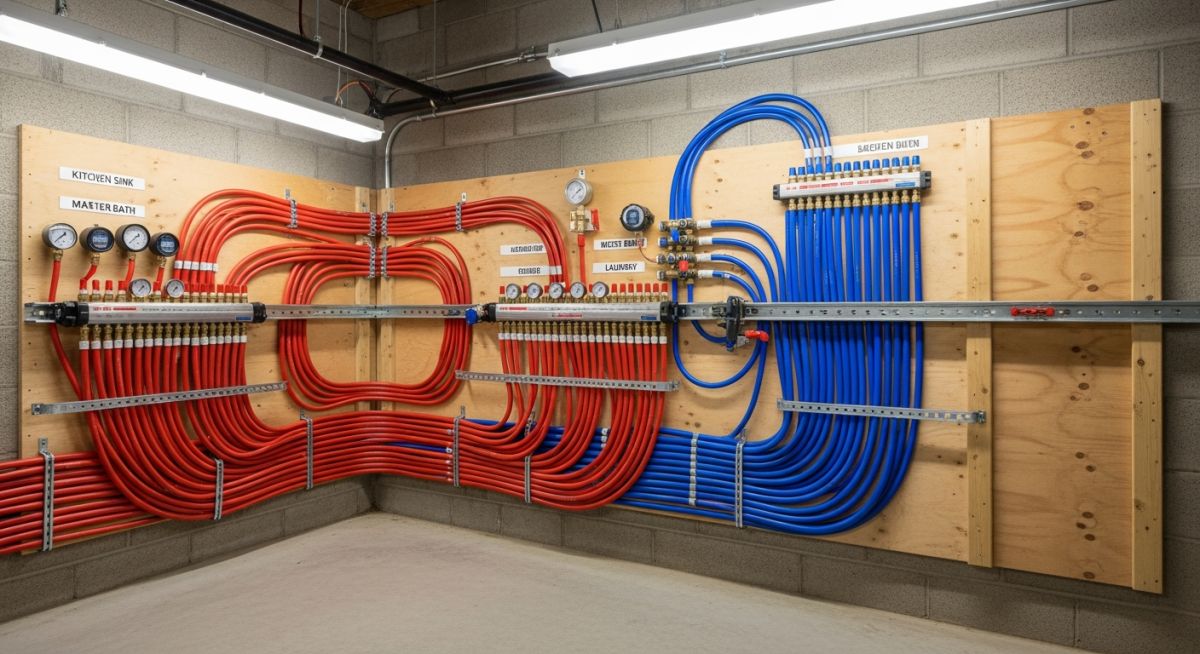
Project Data
- Building Type: 40-Unit Multi-Family Residential
- Original Material: 40-year-old Galvanized Steel
- Replacement Material: PEX-B with Multi-Port Manifolds
- Standard: ASTM F876/F877 Compliance
Failure Analysis
Occupants reported significant pressure drops and "rusty" water. Forensic analysis of the Galvanized Iron pipes revealed internal tuberculation—a build-up of rust that had reduced the effective inner diameter of the 3/4" supply lines to less than 1/4", causing severe hydraulic friction loss.
Engineering Fix: High-Efficiency Manifold Design
Rather than a traditional branch-and-tee layout, the engineering team implemented a Manifold (Home-Run) System using flexible PEX-B. This involved:
- Installing a central manifold in each unit's mechanical closet.
- Running continuous, joint-free PEX lines to every fixture (sinks, toilets, showers).
- Utilizing EPDM expansion joints at the main riser connections to accommodate thermal expansion.
Lessons Learned & ROI
- ● Hydraulic Performance: System pressure increased by 65% at the furthest fixtures due to the removal of restrictive rust and the reduction of 90-degree elbows.
- ● Cost Savings: Labor costs were reduced by 40% compared to a copper retrofit, as PEX allowed for faster routing through existing wall cavities without major demolition.
Frequently Asked Questions about Plumbing Pipe Types
Can I use standard PVC pipes for hot water supply lines?
What is the average lifespan of Copper vs. PEX piping?
Is PEX piping safe for drinking water (potable systems)?
Why is ABS pipe black while PVC pipe is usually white?
Conclusion
Understanding the various Types of Plumbing Pipes is fundamental to building a resilient and efficient water system. While copper remains a high-end choice for its longevity and antimicrobial properties, the versatility of PEX and CPVC has made them the modern standards for residential and commercial construction. By adhering to ASTM and NSF standards, engineers can ensure that the selected piping material matches the specific temperature, pressure, and chemical requirements of the project.
Technical Final Thought
"The evolution of plumbing from heavy cast iron and galvanized steel to flexible cross-linked polymers represents a triumph of material science—reducing installation labor by 40% while significantly lowering the risk of joint-related failures."
📚 Recommended Resources: Types of Plumbing Pipes
Read these Guides




Related posts:
![High-grade industrial Wing Nut Types and Applications for mechanical assemblies.]()
Wing Nut Types and Applications: The 2026 Engineering Guide
![Industrial Monorail Crane Systems installed in a modern manufacturing plant 2026.]()
Monorail Crane Systems: Design, Types & 2026 Standards Guide
![Lead engineer performing a Factory Acceptance Test FAT on an industrial skid system 2026]()
Factory Acceptance Test FAT: The 2026 Engineering Guide to Zero-Defect Delivery
![Professional engineering workspace showing a Basis of Design document layout for a 2026 project.]()
Basis of Design: How to Write a BOD for Engineering Projects in 2026
![Industrial Flare Knockout Drum Sizing and installation in a refinery relief system.]()
Flare Knockout Drum Sizing: Design & API 521 Standards (2026 Guide)
![Advanced Reboiler Control Systems in a modern petrochemical refinery 2026.]()
Reboiler Control Systems: Engineering Guide to Precision Control 2026