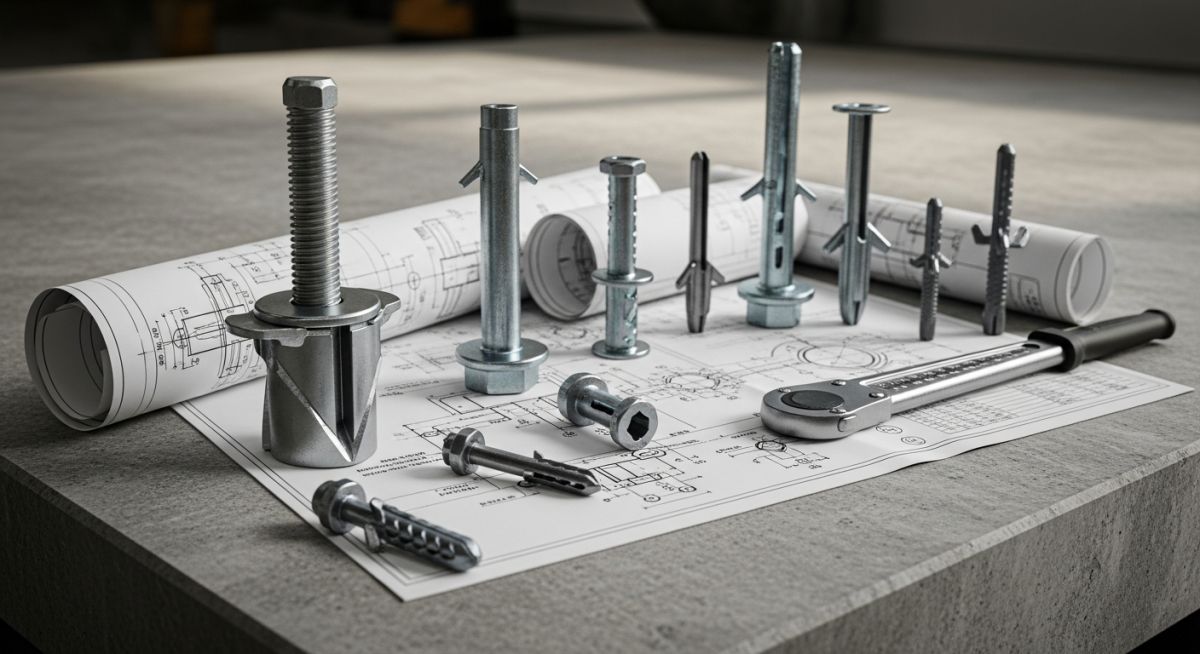
Engineering Verified 2026 Updated: January 2026 What are Concrete Anchors? Their Applications, Materials, and Types (2026 Guide) Concrete Anchors are specialized structural components designed to securely fasten elements to concrete base materials by transferring tensile and shear loads through mechanical friction, bearing, or chemical adhesion. In 2026, the selection of these fasteners is strictly governed by safety standards such as ACI 318-19 to ensure structural integrity in seismic and high-load environments. Defining Concrete Anchors Concrete Anchors are post-installed or cast-in-place fasteners used to attach structural or non-structural elements to concrete. They function through expansion (mechanical), bonding (chemical), or direct threading. High-performance types like wedge and sleeve anchors are critical for ensuring safety in industrial, commercial, and residential infrastructure projects requiring reliable load-bearing connections. Article Contents What are Concrete Anchors and How Do They Work? A Comparison of the Different Types of Concrete Anchors Engineering Materials for Concrete Anchors ACI 318 Standards: Importance of Proper Concrete Anchors Installation Industrial Applications of Concrete Anchors Adhesives vs. Mechanical: Performance Comparison of Concrete Anchors Maintenance and Inspection of Post-Installed Concrete Anchors Conclusion: Best Practices for Selecting Concrete Anchors Technical Proficiency Quiz: Concrete Anchors Question 1/5 Which ACI standard governs the design and selection of post-installed anchors in concrete? Next Question Quiz Complete! Restart Quiz What are Concrete Anchors and How Do They Work? At their core, Concrete Anchors are structural elements designed to transfer loads from an attachment to a concrete base material. The mechanics of these fasteners rely on three primary principles: mechanical expansion, friction-based bearing, and chemical bonding. According to ACI 318-19 Chapter 17, the design strength of these anchors must account for the concrete's tensile capacity, edge distances, and the specific failure modes associated with the anchoring mechanism. When a mechanical anchor is tightened, it generates an expansion force against the walls of a pre-drilled hole. This creates a high-friction connection that resists "pull-out" forces. For heavier structural requirements, "undercut" anchors or deep-set wedge anchors are utilized to leverage the internal bearing strength of the concrete matrix, ensuring the connection remains secure even under dynamic or seismic loading conditions prevalent in 2026 industrial designs. A Comparison of the Different Types of Concrete Anchors Mechanical Sleeve Anchors Sleeve anchors consist of a threaded bolt surrounded by an expansion sleeve. As the bolt is tightened, the sleeve expands along the entire length of the hole. These Concrete Anchors are highly versatile and are often preferred for applications in brick or block where the base material density might vary. They provide a high degree of "shear" resistance due to the full-length contact of the sleeve. Heavy-Duty Wedge Anchors Widely considered the industry standard for structural steel attachments, wedge anchors feature an expansion clip at the base. These Concrete Anchors are designed strictly for solid concrete and are not suitable for masonry. They are categorized by ASTM E488 for their superior tensile performance and are the primary choice for securing warehouse racking and heavy machinery. Acoustical Wedge Anchors for Overhead Loads Specifically engineered for suspension systems, acoustical wedge anchors are utilized for hanging ceiling grids and light fixtures. These specialized Concrete Anchors feature a tie-wire eyelet or threaded head, allowing for rapid installation in overhead concrete slabs while maintaining high pull-out safety factors. Drop-in Anchors for Flush Finishing Drop-in anchors are internally threaded fasteners that sit flush with the concrete surface. They require a specialized setting tool to drive an internal plug into the expansion zone. These Concrete Anchors are ideal for temporary attachments or applications where the bolt needs to be removed periodically without leaving a protrusion on the floor. Double Expansion Shield Anchors for Soft Masonry The double expansion shield is unique because it expands across its entire length from both ends. This makes these Concrete Anchors particularly effective in base materials of questionable integrity, such as aged concrete or soft limestone, where localized expansion might cause the material to crumble. Lag Shield Expansion Anchors Designed for use with lag screws, these shields are made of a malleable zinc alloy. These Concrete Anchors are frequently used in masonry or mortar joints. As the lag screw is driven in, the shield deforms and bites into the substrate, providing a vibration-resistant grip suitable for gate hinges and exterior fixtures. Hammer Drive Pin Anchors For light-duty attachments like electrical conduit or drywall tracks, hammer drive pins offer the fastest installation. These Concrete Anchors do not require a wrench; rather, a central pin is hammered into the body, forcing the base to expand instantly. Note that these are permanent and difficult to remove once set. Split Drive Anchor Systems Split drive anchors feature a pre-expanded split shank. When driven into a hole of the exact diameter, the spring-steel tension provides an immediate mechanical lock. These Concrete Anchors are highly effective for tamper-proof security applications since they lack a removable bolt head. Threaded Rod Anchor Applications In 2026, threaded rod systems are increasingly paired with adhesive resins. These Concrete Anchors allow for custom lengths to be cut on-site to accommodate thick baseplates. They are essential in HVAC and piping support where long vertical drops from the ceiling are required. Specialty Concrete Anchors and Direct Threading Systems Strike Anchor Mechanisms for High-Speed Installation Strike anchors are heavy-duty, impact-driven Concrete Anchors. They feature a pre-assembled nut and washer with a hardened steel pin. Once placed in the hole, the pin is struck with a hammer, expanding the anchor body. These are ideal for permanent installations in solid concrete where speed is a priority and torque-based expansion is not required. Plastic Toggle Anchor for Hollow Walls and Lightweight Masonry For non-structural attachments in hollow block or drywall, plastic toggle Concrete Anchors provide a broad bearing surface. The plastic wings fold to pass through a pre-drilled hole and then spring open on the reverse side. In 2026, reinforced polymer variants provide improved creep resistance for light shelving and electrical boxes. Tapcon Concrete Anchor and Masonry Screws for Direct Threading Commonly known as Tapcons, these Concrete Anchors use a high-low thread design to cut directly into the concrete or masonry. This eliminates the need for an expansion shield. They are coated with Climaseal for corrosion resistance and are excellent for attaching wood plates, shutters, and window frames to concrete substrates. Kaptoggle and Toggle Wing Hollow Wall Anchors These are heavy-duty versions of the toggle bolt. The Kaptoggle Concrete Anchors feature a solid metal channel that provides superior pull-out strength in hollow base materials compared to plastic alternatives. They are often used for wall-mounted TV brackets and heavy mirrors on hollow masonry. Sammys Screws for Structural Attachments Sammys Screws are specialized Concrete Anchors designed specifically for the fire protection and HVAC industries. They allow for the direct attachment of threaded rods to concrete or steel without the need for secondary brackets, significantly reducing labor time for pipe hanging. Engineering Materials for Concrete Anchors The longevity of Concrete Anchors is largely determined by their metallurgical composition. In 2026, engineers prioritize environmental exposure levels when selecting materials: Zinc Plated Carbon Steel: Suitable for dry, indoor environments with minimal moisture exposure. Hot-Dip Galvanized: Provides a thicker protective layer for outdoor use in moderately humid climates. Type 304 Stainless Steel: Excellent for general outdoor and chemical exposure. Type 316 Stainless Steel: The gold standard for marine or highly corrosive industrial environments due to high molybdenum content. Technical Comparison of Concrete Anchors Anchor Type Base Material Load Capacity Removability Wedge Anchor Solid Concrete Very High Permanent Sleeve Anchor Concrete/Brick/Block Medium to High Removable Bolt Drop-In Anchor Solid Concrete High Flush-Mounted Masonry Screw Concrete/Block Light to Medium Fully Removable ACI 318 Structural Calculations for Concrete Anchors Calculation for Design Tensile Strength (Phi Nn) based on Concrete Breakout Capacity: Nbg = (ANc / ANco) . psiec,N . psied,N . psic,N . psicp,N . Nb Where: ANc = Actual concrete breakout cone area ANco = Area of a single anchor breakout cone psi = Modification factors for eccentricity, edge distance, and cracking Nb = Basic concrete breakout strength in tension For 2026 compliance, engineers must ensure that the applied factored load Nua is less than or equal to the design strength Phi Nn. Failure to account for edge distance modification factors is a leading cause of premature substrate failure. Concrete Anchors Calculator Estimate the theoretical concrete breakout strength in tension for a single post-installed anchor based on ACI 318 simplified variables. Concrete Compressive Strength (f'c) in PSI Effective Embedment Depth (hef) in Inches Concrete Condition Uncracked Concrete (kc = 24) Cracked Concrete (kc = 17) Calculate Capacity Reset Estimated Breakout Strength (Nb) 0 Pounds Force (Lbf) Disclaimer: This calculator provides a theoretical estimate for Concrete Anchors based on the basic breakout equation. Actual site conditions, edge distances, and 2026 safety factors (Phi) must be applied by a professional engineer. Engineering Case Study: Structural Performance of Concrete Anchors in Seismic Zones 01. Project Data Location: Logistics Hub, California (2026 Retrofit) Application: Mezzanine Support Column Base Plates Substrate: 6-inch Reinforced Concrete Slab (f'c = 4500 PSI) Design Standard: ASCE 7-22 Seismic Design Category D 02. Failure Analysis Initial inspection revealed that the existing sleeve-style Concrete Anchors had begun to slip under moderate vibratory loads from automated sorting equipment. Technical analysis indicated that the anchors were installed with insufficient embedment depth, failing to reach the "uncracked" tension zone of the slab. Micro-cracking around the anchor head led to a 30% reduction in shear capacity, posing a significant risk for the 2026 seismic safety audit. 03. Engineering Fix The remediation team replaced the undersized sleeve fasteners with high-performance, large-diameter wedge-type Concrete Anchors. Key upgrades included: Switching to ACI 318-19 compliant anchors rated for cracked concrete seismic applications. Increasing the effective embedment depth (hef) from 3 inches to 4.5 inches. Using a calibrated digital torque wrench to ensure 80 foot-pounds of installation torque for consistent expansion. Lessons Learned "For industrial facilities in seismic zones, the selection of Concrete Anchors must prioritize cracked concrete ratings. Even if the slab appears uncracked initially, dynamic loading and seismic events will eventually induce tensile cracks that render standard anchors ineffective. Verification of torque is not optional; it is the final link in structural safety." Frequently Asked Questions about Concrete Anchors How do I determine the correct embedment depth for post-installed anchors? The effective embedment depth (hef) for Concrete Anchors is calculated based on the required design tensile strength and the concrete breakout area. In 2026, engineers follow ACI 318-19 Chapter 17 guidelines, which dictate that deeper embedment significantly increases the breakout cone volume, thereby increasing the total load capacity. Are adhesive bonding agents better than mechanical expansion for wedge anchor installation? Adhesive anchors are often superior for close-to-edge installations because they do not exert expansion stresses on the concrete. However, mechanical Concrete Anchors like wedge anchors provide immediate load-bearing capabilities and are generally more cost-effective for standard structural attachments where edge distances are not a limiting factor. What is the impact of base material thickness on tensile capacity? The substrate thickness must be at least 1.5 to 2 times the embedment depth to prevent "blow-out" or splitting of the concrete. When Concrete Anchors are used in thin slabs, the reduction in the concrete breakout cone reduces the overall tensile capacity, requiring a derating of the anchor's advertised load values. Can I use standard carbon steel anchors in coastal marine facilities? No. Carbon steel Concrete Anchors, even if zinc-plated, will rapidly corrode in chloride-rich environments. For 2026 maritime projects, Type 316 Stainless Steel is mandatory to ensure long-term structural reliability and to prevent oxide expansion, which can lead to concrete spalling. Conclusion: Best Practices for Selecting Concrete Anchors In 2026, the complexity of structural fastening requires a deep understanding of load dynamics, substrate integrity, and environmental exposure. Whether you are specifying heavy-duty wedge anchors for seismic retrofitting or masonry screws for light-duty fixtures, adhering to the latest ACI 318 standards is the only way to guarantee safety. Always verify your installation torque and prioritize high-grade materials like Type 316 Stainless Steel for corrosive environments. By selecting the right Concrete Anchors for the specific application, you ensure the longevity and resilience of the built environment. Back to Top Retake Engineering Quiz 📚 Recommended Resources: Concrete Anchors Read these Guides 📄 Water Pumping Station Piping Stress Analysis: Flexible Sleeve Guide 📄 Thrust and Anchor Blocks in Pipelines: Design & Calculation Guide (2026) 📄 Thrust Block Design: Sizing & Calculation Guide (2026) 📄 Thermal Expansion Pipe Buckling: Real-World Lessons from a Steam Pipeline Failure 🎥 Watch Tutorials Part-48 : Question & Answers Series II Piping Engineering Topics Exclusive Content Access