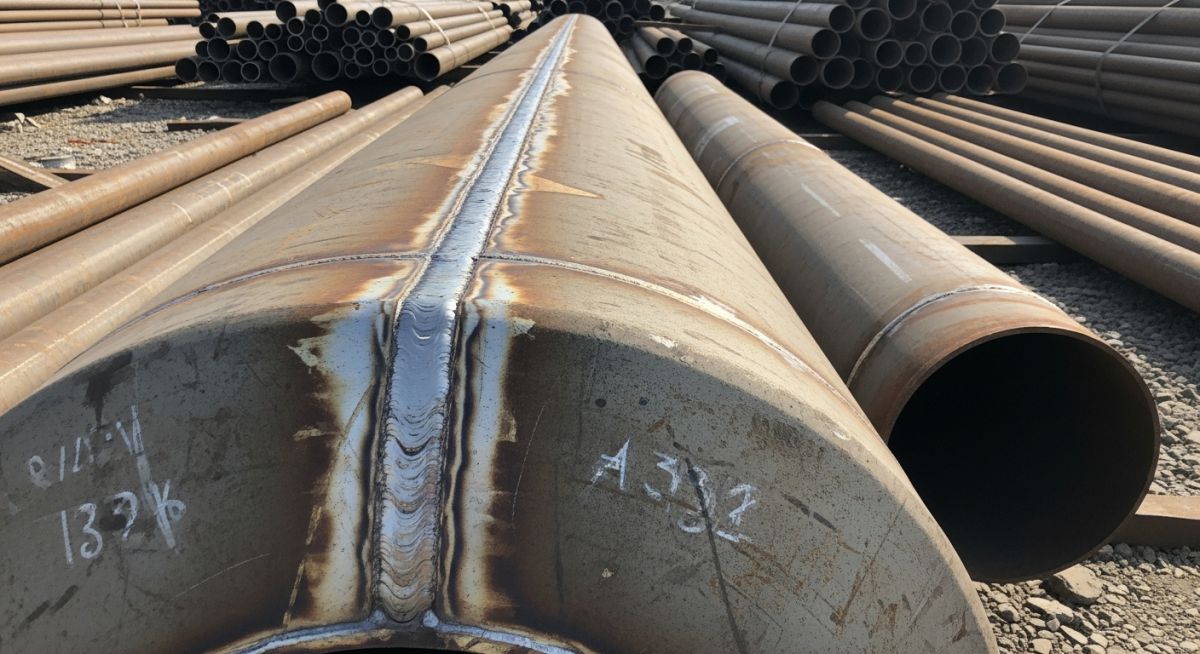
Verified Engineering Content 2026 Published by Epcland Editorial Team Differences Between ASTM A312 and ASTM A358: ASTM A312 vs ASTM A358 You are finalizing the procurement list for a high-pressure corrosive service line, and the requisition calls for 24-inch stainless steel piping. Your supplier offers ASTM A312, but your Lead Piping Engineer insists on ASTM A358. Choosing the wrong specification isn't just a technical error—it is a million-dollar risk involving weld joint efficiency, radiographic requirements, and potential catastrophic failure under ASME B31.3 cyclic loading. In this guide, we break down the critical metallurgical and manufacturing distinctions in the ASTM A312 vs ASTM A358 debate to ensure your piping system remains compliant and cost-effective in 2026. Key Takeaways Manufacturing Range: ASTM A312 is the standard for small to medium-bore seamless and automatic welded pipes, while ASTM A358 is specifically for large-diameter Electric Fusion Welded (EFW) pipes. Filler Metal: A358 requires the addition of filler metal during welding, whereas A312 welded pipes are typically autogenous (no filler added). Inspection Rigor: ASTM A358 offers five distinct classes of pipe based on the intensity of radiographic testing (RT) and weld passes. What is the main difference between ASTM A312 vs ASTM A358? The primary difference lies in the manufacturing process and diameter. ASTM A312 is used for seamless and autogenous welded stainless steel pipes (typically up to 24 inches), while ASTM A358 covers large-diameter Electric Fusion Welded (EFW) pipes that use filler metal and are categorized into five classes based on radiographic inspection and weld passes. "In my 20 years of piping design, I've seen many juniors confuse these two. Remember: if your pipe requires a joint efficiency factor (Ej) of 1.00 via 100% radiography for a large bore, you are almost always looking at ASTM A358 Class 1. Don't let a vendor substitute A312 Welded for A358 without checking the filler metal requirements." — Atul Singla, Founder of Epcland Table of Contents What is ASTM A312? (Seamless and Welded) What is ASTM A358? (Electric Fusion Welded) ASTM A312 vs ASTM A358: Key Differences in Manufacturing Critical Applications: Choosing ASTM A312 vs ASTM A358 Engineering Standards: ASME B31.3 Compliance for ASTM A312 vs ASTM A358 Cost and Availability Impact: ASTM A312 vs ASTM A358 Technical Challenge: ASTM A312 vs ASTM A358 Test your knowledge on 2026 piping standards Question 1 of 5 Which manufacturing process is unique to ASTM A358 compared to A312? A) Electric Fusion Welding with Filler Metal B) Cold Drawing without Filler C) Extrusion Question 2 of 5 In ASTM A358, which class requires 100% radiography (RT) of all welds? A) Class 1 B) Class 3 C) Class 5 Question 3 of 5 What is the typical diameter limit where A312 becomes less common than A358? A) Above 8 to 12 inches B) Under 2 inches C) Only 48 inches+ Question 4 of 5 Under ASME B31.3, what is the weld joint efficiency (Ej) of A358 Class 1? A) 1.00 B) 0.85 C) 0.80 Question 5 of 5 True or False: ASTM A312 welded pipe usually contains added filler metal. A) True B) False Next Question What is ASTM A312? (Seamless and Welded) ASTM A312 is the primary material specification for seamless, straight-seam welded, and heavily cold-worked austenitic stainless steel pipe. Designed for 2026 high-temperature and general corrosive service, it is the "workhorse" of the piping industry. Most process plants utilize A312 for small-bore piping (typically 1/8 inch to 24 inches). The welded variant in A312 is produced using an automatic welding process that requires no addition of filler metal (autogenous welding). This ensures the chemical composition of the weld remains identical to the parent base metal, providing uniform corrosion resistance across the pipe's circumference. For critical applications, A312 pipe must undergo heat treatment (solution annealing) to restore the metallurgical properties of the stainless steel after the fabrication process. What is ASTM A358? (Electric Fusion Welded) ASTM A358 covers Electric Fusion Welded (EFW) austenitic stainless steel pipe intended for high-temperature and high-pressure service. Unlike A312, A358 is specifically engineered for large-diameter pipes (often 8 inches up to 72 inches or more) where seamless manufacturing is either impossible or prohibitively expensive in 2026. The defining characteristic of A358 is the addition of filler metal during the welding process. This allows for thicker wall sections to be joined securely. A358 is unique because it is divided into five distinct classes (Class 1 through Class 5), which dictate the level of radiographic examination and whether the weld is made from one side or both sides. This classification system gives engineers the flexibility to balance cost against joint integrity based on the fluid service's severity. Manufacturing Process Comparison ASTM A312 vs ASTM A358: Key Differences in Manufacturing The fundamental divergence between ASTM A312 vs ASTM A358 lies in the welding methodology and the resulting weld joint. In A312 welded pipe, the edges of the plate are fused directly. In A358, an electrode provides filler material, creating a weld bead that must be carefully managed to avoid defects like slag inclusion or lack of fusion. Furthermore, A358 pipes are fabricated from ASTM A240 plate. The quality of the final pipe is heavily dependent on the quality of the plate and the expertise of the welder or welding machine. Because A358 pipes are often large, they frequently undergo 100% X-ray inspection (Radiographic Testing) to ensure the filler-metal joint is free of internal voids, whereas A312 pipes often rely on eddy current or hydrostatic testing for quality assurance. Critical Applications: Choosing ASTM A312 vs ASTM A358 In 2026 industrial projects, the selection between ASTM A312 vs ASTM A358 is driven primarily by the required pipe diameter and the severity of the fluid service. ASTM A312 is the default choice for process piping in chemical plants, food processing, and cryogenic services for diameters below 12 inches. Its seamless variant is preferred for high-vibration environments where a longitudinal weld might act as a stress riser. Conversely, ASTM A358 is mandated for large-scale infrastructure such as water desalination intake lines, heavy-wall refinery reactors, and large-bore steam headers. Because A358 allows for filler metal, it can accommodate the heavy wall thicknesses (Schedule 80 and above) required for high-pressure headers that A312 cannot realistically achieve through autogenous welding. Engineering Standards: ASME B31.3 Compliance for ASTM A312 vs ASTM A358 Compliance with ASME B31.3 (Process Piping) is the most critical hurdle for any engineer. When comparing ASTM A312 vs ASTM A358, you must evaluate the Weld Joint Quality Factor (Ej). For A312 welded pipe, the Ej is typically 0.85. However, A358 provides a path to a 1.00 factor, allowing for thinner walls (and lower costs) if the correct Class is specified. Property ASTM A312 ASTM A358 Weld Type Seamless or Autogenous (No filler) Electric Fusion Welded (With filler metal) Standard Sizes 1/8" to 24" NPS 8" to 72"+ NPS Radiography (RT) Not standard (unless specified) Mandatory for Class 1, 2, and 5 Filler Metal Prohibited in welding process Required (matches base metal grade) ASME B31.3 Ej 0.85 (Welded) / 1.00 (Seamless) Up to 1.00 (Class 1) Cost and Availability Impact: ASTM A312 vs ASTM A358 In 2026, market volatility makes procurement strategy as important as technical design. ASTM A312 is a commodity item; it is readily available from stockists worldwide in common grades like 304L and 316L. ASTM A358, however, is often a "made-to-order" product, especially for higher classes or exotic stainless grades like 317L or 347H. While A358 has a higher manufacturing cost per foot due to the filler metal and radiographic testing requirements, it is significantly cheaper than A312 Seamless for any size over 10 inches. Engineers should perform a lifecycle cost analysis, considering that an A358 Class 1 pipe with a 1.00 Ej may allow for a reduced wall thickness compared to an A312 Welded pipe (0.85 Ej), potentially saving tons of stainless steel on large projects. Piping Design Helper: Ej Selection (2026) Select your pipe specification and class to determine the Weld Joint Quality Factor (Ej) according to ASME B31.3 standards. Select Pipe Specification ASTM A312 (Seamless) ASTM A312 (Welded - Autogenous) ASTM A358 Class 1 (100% RT) ASTM A358 Class 2 (No RT) ASTM A358 Class 3 (Single Weld) ASTM A358 Class 4 (Single Weld + RT) ASTM A358 Class 5 (Spot RT) Weld Factor (Ej) 1.00 Note: Seamless pipes provide the highest reliability with a factor of 1.00. *Values are based on 2026 ASME B31.3 Table A-1B. Always verify with the latest code edition for critical design. Don't miss this video related to ASTM A312 and ASTM A358 Summary: Master Piping Engineering with our complete 125+ hour Certification Course: ...... ✅ 2500+ VIDEOS View Playlists → JOIN EXCLUSIVE EDUCATION SUBSCRIBE ASTM A312 vs ASTM A358 Failure Case Study Scenario: The "Equivalent" Substitution Disaster In a 2026 petrochemical expansion project in Southeast Asia, a procurement team substituted 500 meters of 16-inch ASTM A358 Class 1 pipe with ASTM A312 Welded pipe to save 15% on lead times. The engineering team assumed that since both were "welded stainless steel," the performance would be identical under the 25-bar operating pressure. The Technical Gap A312: Autogenous weld (no filler). Higher risk of weld thinning and "intergranular attack" in the Heat Affected Zone (HAZ). A358 Class 1: Uses filler metal and 100% RT, ensuring the weld crown and root are reinforced and defect-free. The Outcome During the hydrotest, three joints of the A312 pipe suffered longitudinal seam splits. The lack of filler metal resulted in a weld profile that could not handle the cyclic thermal expansion of the high-pressure steam. Engineering Lessons Learned Joint Efficiency Matters: The ASTM A312 vs ASTM A358 choice changed the Ej factor from 1.00 to 0.85, meaning the A312 pipe was technically under-designed for the required wall thickness. Filler Metal Importance: In large-bore piping (above 12 inches), filler metal (A358) provides a necessary safety margin for structural integrity that autogenous welds (A312) lack. Verification: Never accept A312 as a substitute for A358 Class 1 or 2 without a formal MOC (Management of Change) and re-calculation of the pipe wall thickness. Expert Insights: Lessons from 20 years in the field The 8-Inch Rule: While ASTM A312 is available in larger sizes, most global mills optimize their lines for 8 inches and below. For anything larger, ASTM A358 often provides better lead times and more reliable weld profiles due to the EFW process. Specify the Class: Simply writing "ASTM A358" on a purchase order is a recipe for disaster. You must specify the Class (1 through 5). A vendor will quote Class 3 (no RT) to win on price, but your service might demand Class 1 (100% RT). Wall Thickness Sensitivity: In 2026, with rising nickel prices, using ASTM A358 Class 1 (Ej 1.00) often allows you to drop one schedule size (e.g., from Sch 40S to Sch 10S) compared to A312 welded, leading to massive cost savings. Frequently Asked Questions Can ASTM A312 be used instead of ASTM A358? ▼ Only if the pipe diameter is within the A312 range (typically up to 24") and the design pressure calculations account for the difference in Weld Joint Efficiency (Ej). A312 is autogenous, while A358 uses filler metal; this change must be approved by the Lead Piping Engineer. What is the "Electric Fusion Weld" in A358? ▼ Electric Fusion Welding (EFW) refers to a process where the coalescence of metals is produced by the heat of an electric arc between electrodes. Unlike the high-frequency welding often used in A312, EFW in A358 uses filler metal to fill the joint, similar to plate-to-plate welding. Does ASTM A312 require X-ray? ▼ Standard ASTM A312 does not require 100% radiography. It typically uses non-destructive electrical tests or hydrostatic testing. If you require X-ray for A312, it must be specified as a supplementary requirement (S6). Why is my A358 pipe showing a longitudinal bead? ▼ This is normal. Because A358 uses filler metal, there is a visible weld reinforcement (bead) on the inside and outside of the pipe. A312 welded pipe is often processed to make the weld bead nearly invisible. Is A358 suitable for lethal service? ▼ Under ASME B31.3, pipes in lethal service (Category M) generally require 100% radiography. Therefore, ASTM A358 Class 1 is often acceptable, whereas standard A312 welded would require additional testing to meet the code. How do I verify the filler metal used in A358? ▼ Check the Material Test Report (MTR). A358 requires that the filler metal be compatible with the base metal (e.g., ER316L filler for 316L plate) and must be documented in the welding procedure specification (WPS). References & Standards ASTM A312/A312M Standard Specification for Seamless and Welded Stainless Steel Pipes ASTM A358/A358M Standard Specification for EFW Stainless Steel Pipe for High-Temp Service ASME B31.3 Process Piping Guide (2026 Edition) 📚 Recommended Resources: ASTM A312 and ASTM A358 Read these Guides 📄 What is a Glass Piping System? Engineering Design & Logic 2026 📄 Stainless Steel vs Alloy Steel: 2026 Material Engineering Guide 📄 How to Magnetize Stainless Steel? (Engineering Methods & Science 2026) 📄 Piping Material Engineering: Piping Course 🎓 Advanced Training 🏆 Piping Engineering Fundamentals Series- Part-3 🎥 Watch Tutorials ASTM A312 vs. ASTM A358: Demystifying Stainless Steel Pipe Standards | Which One to Choose? ASTM A312 vs. ASTM A358: Demystifying Stainless Steel Pipe Standards | Which One to Choose?