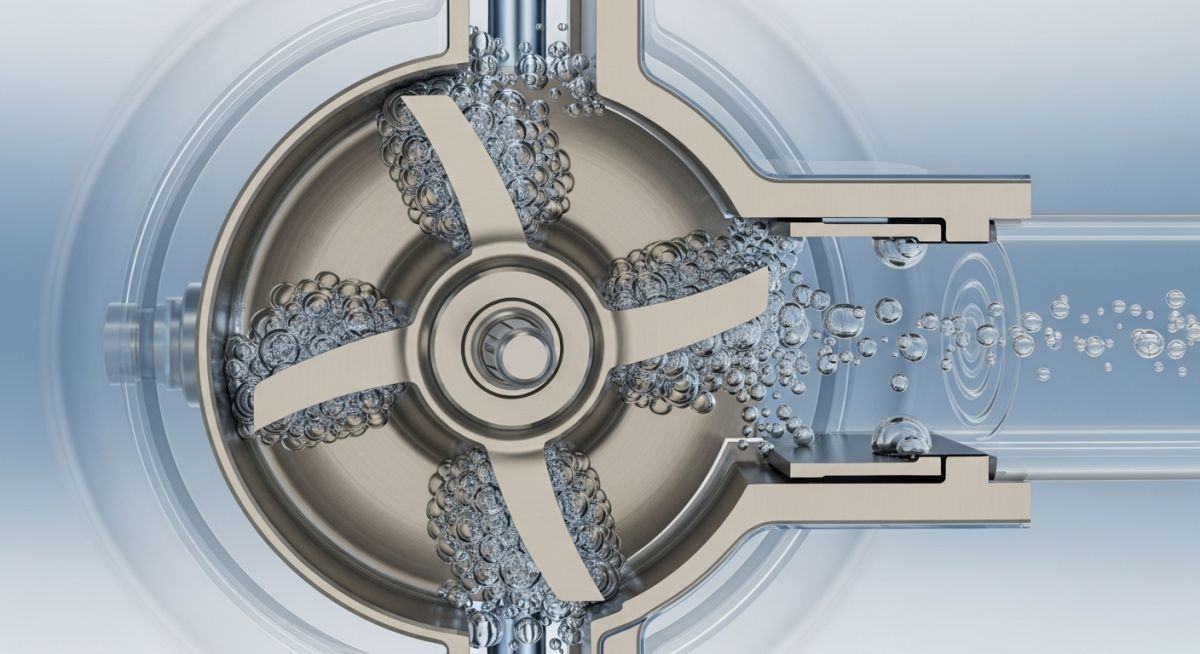
ASME & API Standards Compliant - 2026 Edition Eliminating Centrifugal Pump Cavitation: The Definitive Engineering Manual You hear it before you see it: a sound like gravel being churned inside your casing, followed by a sudden drop in discharge pressure and a spike in bearing vibration. In high-stakes industrial environments, Centrifugal Pump Cavitation isn't just a maintenance nuisance—it is a catastrophic failure in progress that can eat through a 316 stainless steel impeller in weeks. This guide moves beyond basic definitions to provide you with the exact hydraulic calculations, NPSH margin requirements, and forensic diagnostic steps needed to stabilize your system and extend MTBF (Mean Time Between Failure) across your entire pump fleet. Key Engineering Takeaways Hydraulic Stability: How to maintain a minimum 10% NPSH margin to prevent vapor bubble formation. Damage Identification: Differentiating between classical cavitation pitting and recirculation-induced erosion. System Optimization: 2026 industry best practices for suction piping design and velocity control. What is Centrifugal Pump Cavitation? Centrifugal pump cavitation occurs when the local suction pressure drops below the fluid's vapor pressure, causing vapor bubbles to form. As these bubbles move to higher-pressure zones near the impeller blades, they collapse violently, generating micro-jets and shockwaves that cause mechanical pitting, intense vibration, and significant loss of hydraulic efficiency. Founder's Insight: "In over two decades of commissioning API 610 pumps, I've found that 80% of cavitation issues are rooted in poor suction piping geometry, not the pump design itself. Always check your 'Straight Run' requirements before blaming the impeller." — Atul Singla Table of Contents 1. Understanding the Physics of Centrifugal Pump Cavitation 2. The Critical Role of NPSH in Preventing Centrifugal Pump Cavitation 3. Identifying Early Warning Signs of Centrifugal Pump Cavitation 4. Engineering Solutions to Eliminate Centrifugal Pump Cavitation 5. Maintenance Strategies for Impellers Damaged by Centrifugal Pump Cavitation Engineering Mastery: Cavitation Assessment Validate your technical knowledge for 2026 certification standards Question 1 of 5 Topic: Vapor Pressure What physical event triggers the start of Centrifugal Pump Cavitation? A. Excessive fluid velocity in the discharge volute B. Local static pressure falling below the fluid vapor pressure C. Air entering through a faulty mechanical seal Question 2 of 5 Topic: NPSH Margins According to 2026 industry standards, what is the minimum recommended NPSH margin for critical hydrocarbon services? A. NPSHa = NPSHr (1.0 ratio) B. NPSHa > 1.1 times NPSHr C. NPSHa > 5.0 times NPSHr Question 3 of 5 Topic: Forensic Analysis Classic Centrifugal Pump Cavitation damage usually appears on which part of the impeller? A. The back shroud and wear rings B. The suction side of the vane near the leading edge C. The center of the impeller hub Question 4 of 5 Topic: System Design Which modification will increase NPSHa to stop Centrifugal Pump Cavitation? A. Increasing the static height of the suction vessel B. Using a smaller diameter suction pipe C. Increasing the fluid temperature Question 5 of 5 Topic: Diagnostics What is the "3% Head Drop" rule in Centrifugal Pump Cavitation testing? A. When efficiency drops by 3% due to air leaks B. The standard point where NPSHr is measured C. The minimum allowable motor speed reduction Next Question → Technical Audit Complete! You are ready to proceed to the core engineering fundamentals. 1. Understanding the Physics of Centrifugal Pump Cavitation At its core, Centrifugal Pump Cavitation is a two-stage phase-change phenomenon governed by the relationship between local static pressure and the fluid's thermodynamic vapor pressure. When liquid enters the impeller eye, it must accelerate to match the vane velocity. According to Bernoulli’s principle, this increase in kinetic energy causes a simultaneous drop in pressure. If the pressure at any point—typically the suction side of the blade leading edge—falls below the vapor pressure (Pv) at the operating temperature, the liquid "boils" at room temperature, forming millions of microscopic vapor cavities. The secondary and most destructive phase occurs as these vapor bubbles are swept further into the impeller channels. As they move toward the higher-pressure discharge zones, the surrounding fluid pressure suddenly exceeds the internal bubble pressure, causing a violent, supersonic implosion. These implosions generate localized micro-jets with pressures reaching up to 100,000 PSI and temperatures exceeding 5,000°F. The cumulative impact of these shockwaves against the impeller surface causes "sponge-like" pitting and mechanical fatigue. Standard Reference: ANSI/HI 9.6.1 "NPSH Margin is required because the industry standard definition of NPSHr (NPSH3) represents a condition where the pump has already lost 3% of its total head due to established cavitation." View Hydraulic Institute Guidelines Engineering for Centrifugal Pump Cavitation prevention requires a deep understanding of suction energy. High-suction energy pumps, often defined by their Suction Specific Speed (Nss), are significantly more susceptible to damage even at low levels of cavitation. Modern 2026 diagnostic protocols emphasize that cavitation inception (NPSHi) can occur at pressures 2 to 10 times higher than the manufacturer's quoted NPSHr, meaning "meeting the curve" is rarely enough for high-reliability assets. 2. The Critical Role of NPSH in Preventing Centrifugal Pump Cavitation Net Positive Suction Head (NPSH) is the primary metric used to quantify the "safety buffer" between a liquid's current state and its boiling point at the pump suction. To eliminate Centrifugal Pump Cavitation, engineers must balance two distinct values: the system's "Available" head (NPSHa) and the pump's "Required" head (NPSHr). The former is a property of the system piping and tank elevation, while the latter is a mechanical constraint determined by the impeller's hydraulic design. In the 2026 industrial landscape, relying on a simple NPSHa > NPSHr check is considered an outdated practice. Reliability engineers now utilize the NPSH Margin Ratio. For standard water service, a ratio of 1.1 (10% margin) is typically sufficient. However, for critical chemical or hydrocarbon services, API 610 and HI standards recommend a margin of 1.3 or higher. This accounts for transient system changes, such as fluid temperature spikes or gradual strainer clogging, which can quickly erode a slim pressure margin. Calculating NPSHa requires precise field measurements. The formula NPSHa = Ha ± Hs - Hf - Hvp must account for: Ha: Absolute pressure on the liquid surface (Barometric pressure). Hs: Static head or lift from the liquid level to the pump centerline. Hf: Friction losses in the suction piping, including valves and strainers. Hvp: Vapor pressure of the liquid at the actual pumping temperature. 3. Identifying Early Warning Signs of Centrifugal Pump Cavitation Detecting Centrifugal Pump Cavitation before metal loss occurs is critical for 2026 predictive maintenance programs. The most distinct hallmark is "broadband" high-frequency vibration. Unlike mechanical unbalance, which manifests at the 1X running speed, cavitation-induced energy typically resides in the 2 kHz to 20 kHz range. This "floor" of noise is caused by the random, high-velocity implosions of vapor bubbles hitting the internal casing walls. Furthermore, engineers should monitor the Total Dynamic Head (TDH) vs. Power consumption ratio. In a cavitating state, the pump may maintain speed, but the discharge pressure will fluctuate wildly (surging), and the motor current (Amps) will drop. This occurs because the impeller is spinning in a mixture of liquid and vapor, which has a significantly lower density than the pure process fluid. 4. Engineering Solutions to Eliminate Centrifugal Pump Cavitation Correcting Centrifugal Pump Cavitation requires adhering to rigorous standards like ASME B73.1 for chemical pumps or API 610 for refinery services. If NPSHa is insufficient, the first line of defense is optimizing the suction piping. This includes replacing standard elbows with long-radius versions and ensuring a minimum of five pipe diameters of straight run before the suction flange to prevent "pre-swirl" and turbulence. In more severe cases, mechanical modifications are necessary. Installing an Inducer—a small axial-flow impeller upstream of the main impeller—can artificially boost the pressure at the suction eye. Alternatively, selecting a pump with a larger suction eye or lower Suction Specific Speed (Nss < 11,000) can broaden the stable operating window and significantly reduce the likelihood of vaporous cavitation. Solution Category Method Effect on Cavitation System Change Lower Pump Elevation Increases NPSHa by increasing Static Head Piping Fix Increase Suction Pipe Size Increases NPSHa by reducing Friction Losses Mechanical Fix Install Inducer Reduces the pump's required NPSHr Process Fix Install Suction Cooler Lowers Vapor Pressure (Pv) For detailed mechanical tolerances and allowable vibration limits during cavitation, consult the API 610 Standard for Centrifugal Pumps. NPSHa & Margin Calculator (2026 Standards) Calculate your system's Available NPSH and determine if you are at risk of Centrifugal Pump Cavitation. Surface Pressure (Ha) - Feet Abs Atmospheric is ~33.9 ft for water at sea level. Static Head/Lift (Hs) - Feet Positive for flooded suction, negative for lift. Friction Loss (Hf) - Feet Vapor Pressure (Hvp) - Feet Abs Pump Required NPSHr - Feet Run Hydraulic Analysis -- NPSH Available (Feet) Waiting for Input... Fill in the values to check for Centrifugal Pump Cavitation risk. 5. Case Study: Forensic Analysis of Centrifugal Pump Cavitation Field Report 2026-04 Industrial Water Treatment Facility The Case of the "Disappearing" Impeller Vanes A large-scale municipal water plant reported a 15% drop in discharge flow on a high-service pump within just 4,000 hours of operation. Initial vibration analysis showed a significant "noise floor" elevation between 5 kHz and 12 kHz, classic markers for Centrifugal Pump Cavitation. Despite the suction pressure gauge reading 12 PSI (well above the vapor pressure), the damage was catastrophic. The Root Cause Forensic inspection of the suction piping revealed an un-vane elbow located directly at the pump suction flange. This created a high-velocity "jet" on one side of the impeller eye, causing local pressure to drop below vapor pressure even though the average suction pressure seemed safe. The 2026 Solution The plant installed a suction flow straightener and increased the pipe diameter from 10" to 12". This modification raised the NPSHa by 4.5 feet and eliminated the turbulent pre-swirl, completely stopping the cavitation-induced vibration. Result: Following the repair and piping modification, the pump has operated for over 12,000 hours with zero loss in hydraulic efficiency and vibration levels remaining within ISO 10816-3 "Zone A" limits. Expert Insights: Lessons from 20 years in the field Avoid the Suction Specific Speed Trap: Many engineers select pumps with high Nss (>11,000) to achieve lower NPSHr. However, these pumps often have a very narrow operating window. In 2026, we prioritize mechanical robustness over a lower NPSHr to ensure long-term resistance to Centrifugal Pump Cavitation. Temperature Fluctuations: Vapor pressure is highly sensitive to temperature. A 10°F increase in process fluid temperature can double the vapor pressure, instantly turning a "safe" system into a zone for active Centrifugal Pump Cavitation. Always design for the "worst-case" summer ambient temperature. Forensic Distinction: If you see damage on the *pressure* side of the vane or near the discharge, you likely aren't dealing with classical cavitation. That is often "Discharge Recirculation," which occurs at low flow rates and mimics the sound of Centrifugal Pump Cavitation but requires a completely different hydraulic fix. References & Standards Hydraulic Institute (HI) Standards API 610: Centrifugal Pumps for Petroleum ASME B73.1: Chemical Process Pumps ISO 9906: Rotodynamic Pumps - Tests Centrifugal Pump Cavitation: Frequently Asked Questions What are the main causes of Centrifugal Pump Cavitation? The primary causes include insufficient NPSHa (available suction head), clogged suction strainers, high fluid temperatures (raising vapor pressure), excessive pump speed, and restricted suction piping diameters. Does Centrifugal Pump Cavitation always make noise? Not always. While "classic" cavitation sounds like pumping gravel, high-energy pumps can experience damaging cavitation that is masked by motor noise. In these cases, 2026-standard vibration analysis is the only reliable detection method. How do I calculate the NPSH margin for my pump? The NPSH margin is calculated as the ratio of NPSHa to NPSHr. For industrial reliability in 2026, we target a ratio of at least 1.1 to 1.3 depending on the fluid criticality. Can I stop Centrifugal Pump Cavitation by throttling the discharge valve? Yes, this is a common field "quick fix." By throttling the discharge, you reduce the flow rate (GPM), which reduces the pump's NPSHr and decreases suction piping friction losses, effectively increasing your safety margin. What is the difference between air entrainment and cavitation? Air entrainment is gas entering the pump from an external leak (like a seal), which causes a loss of prime. Cavitation is a phase change of the process fluid itself into vapor due to low pressure. Cavitation is far more destructive to metal surfaces. Why does Centrifugal Pump Cavitation cause pitting only in specific spots? Pitting occurs where the vapor bubbles collapse. This usually happens at the point where the local pressure rises back above the vapor pressure—typically slightly downstream of the suction eye on the impeller vane faces. 📚 Recommended Resources: Centrifugal Pump Cavitation Read these Guides 📄 What is a Fire Pump? Working, Sizing, and Types (2026 Guide) 📄 Slurry Pump Selection Guide: Engineering Types & Standards (2026) 📄 What is a Progressive Cavity Pump? Working, Design, and 2026 Standards 📄 The Ultimate Guide to Pump Performance Curve: Types & Interpretation (2026)