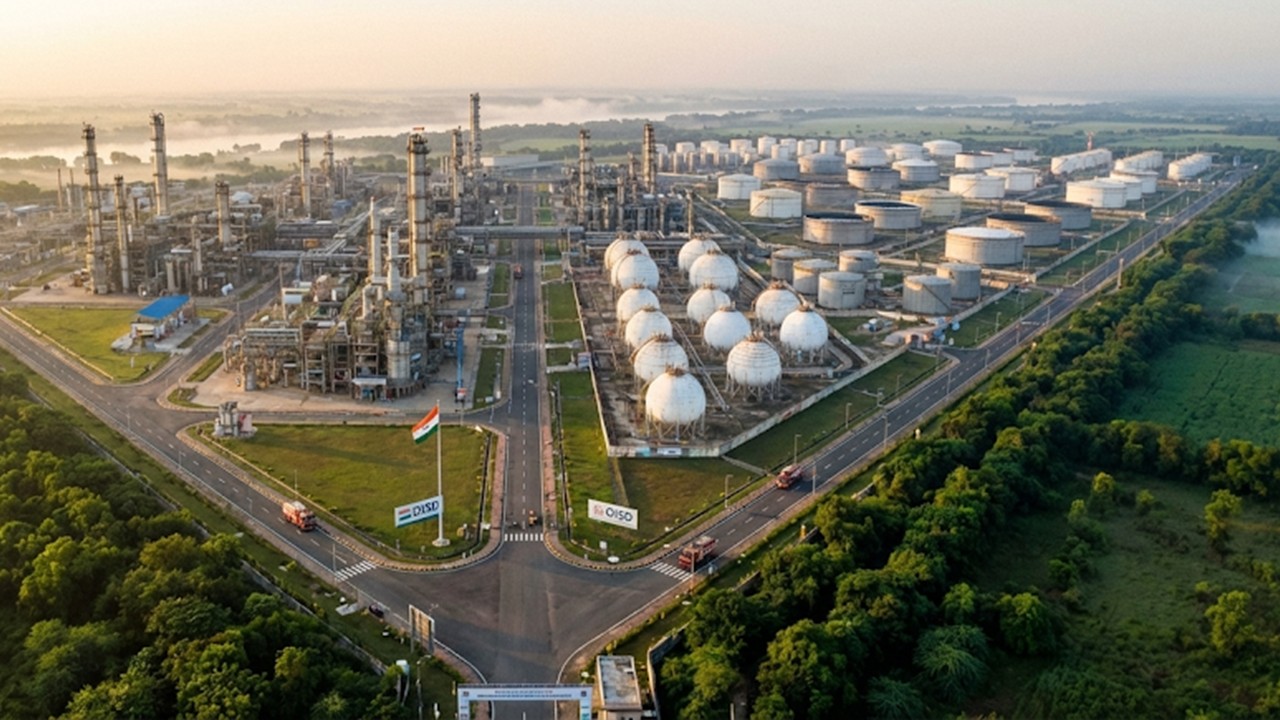
✅ Verified for 2026 by Epcland Process Safety Team Refinery Safety Distances OISD 118: The 2026 Design Standard Figure 1: A compliant refinery grid layout separating high-hazard process blocks from storage areas. Refinery Safety Distances OISD 118 constitute the non-negotiable geometric framework for designing India's downstream infrastructure. Unlike simple storage depots, a modern refinery is a dense agglomeration of high-pressure reactors, fired heaters, and volatile inventory. The Oil Industry Safety Directorate (OISD) mandates rigorous separation norms not merely to satisfy a checklist, but to physically interrupt the "Domino Effect"—ensuring that a fire in a Cracker Unit does not escalate into a catastrophic tank farm explosion. In this 2026 guide, we explore how to navigate these constraints, from basic block layouts to advanced LPG storage optimization. The Philosophy of Segregation OISD-STD-118 dictates that a refinery be divided into distinct "Blocks" based on risk potential. The primary goal of these Refinery Safety Distances OISD 118 is to create sterile fire corridors. ➤ Process Units: Must be grouped together but separated by 30-meter wide roads to allow 4-sided fire tender access. ➤ Storage: Must be located downwind of process units and separated by dykes and green belts. ➤ Optimization: Advanced technologies (like Mounded Bullets) can legally reduce these spacing requirements. ⚡ OISD Siting Knowledge Check: 2026 Loading Quiz... Retake Quiz Process Unit Inter-Distance Norms: The 30-Meter Rule At the heart of Refinery Safety Distances OISD 118 lies the concept of the "Process Block." A refinery is not a continuous machine; it is a collection of distinct units (Crude Distillation, Hydrocracking, Catalytic Reforming) that must be physically isolated to prevent total asset loss during a fire. The standard mandates specific process unit inter-distance norms based on the principle of thermal radiation. The "Battery Limit" (the edge of the unit's piping curb) defines the boundary. The minimum separation between the battery limits of two adjacent process blocks is set at **30 meters**. Fire Fighting Access: The gap ensures that large foam tenders can encircle a burning unit from all four sides without being subjected to heat flux > 4 kW/m². Maintenance Logistics: It provides sufficient swing radius for cranes during shutdowns, preventing accidental impact on live adjacent units. Vapor Dispersion: It prevents a gas cloud from Unit A from immediately overlapping with the ignition sources in Unit B. Figure 2: Safe Siting Schematic. Note the concentric safety zones radiating from the high-hazard process blocks. Blast Resistant Control Room Siting Criteria Historically, control rooms were placed centrally for ease of operation. However, modern Refinery Safety Distances OISD 118 prioritize operator survivability over convenience. A Vapor Cloud Explosion (VCE) can generate shockwaves capable of collapsing standard masonry miles away. This necessitates rigorous blast resistant control room siting protocols. The location is determined by a Quantitative Risk Assessment (QRA). Zone A: High Risk Areas where blast overpressure exceeds 1 psi. Control rooms here must be concrete-hardened, windowless (or blast-glass), and air-tight to prevent toxic ingress. Zone B: Safe Siting Locations outside the hazardous contour. OISD encourages moving non-essential buildings (Admin, Canteen) to this zone, often near the Green Belt. LPG Storage: Mounded Bullet vs Sphere Safety One of the most significant variables in calculating Refinery Safety Distances OISD 118 is the method of LPG storage. This decision dramatically impacts the facility's footprint. The Problem with Spheres Traditional Horton Spheres store large volumes of LPG above ground. They are susceptible to BLEVE (Boiling Liquid Expanding Vapor Explosion) if an external fire impinges on the shell. Consequently, OISD mandates massive separation distances (e.g., 60m to Process Units) to ensure thermal isolation. The Mounded Advantage Mounded bullet vs sphere safety analysis favors the former. Mounded bullets are horizontal vessels buried under a sand/earth mound. The earth cover eliminates direct flame impingement, removing the BLEVE risk. As a result, LPG mounded storage spacing is significantly reduced, often allowing vessels to be placed just 15 meters from other facilities, liberating acres of valuable land. Reference Table: OISD 118 Minimum Separations The table below summarizes the mandatory Refinery Safety Distances OISD 118. Note the drastic reduction in distance when switching from Spheres to Mounded Storage. From / To Process Unit LPG Sphere LPG Mounded Boundary Wall Process Unit 30 meters 60 meters 15 meters 60 meters Control Room 30m (Blast Safe) 60 meters 15 meters - Fire Station 60 meters 60 meters 60 meters - Inter-Vessel (Same Group) - 1.0 Diameter 3.5 meters - *Source: OISD-STD-118 Table 1 & 2. Mounded distances assume compliance with OISD-STD-150. Brownfield Engineering Report Case Study: Converting Spheres to Mounded Bullets Exhibit A: Comparative footprint. The transition to Mounded Storage (Right) eliminates the "BLEVE Risk Zone." Facility Constraints Asset: 9 MMTPA Urban Refinery (India) Legacy Storage: 4x 2000 MT Horton Spheres Expansion Goal: New Polypropylene Unit (PPU) Land Status: Landlocked (Zero expansion room) Compliance Metrics Standard: OISD-STD-118 / OISD-STD-150 Sphere Spacing: 60m to Process Unit Mounded Spacing: 15m to Process Unit The Challenge: The "Sterile Zone" Blockade The refinery management approved a high-margin Polypropylene Unit (PPU) project, but the Plot Plan Committee hit a wall. The only available internal space was adjacent to the existing LPG Tank Farm. Under Refinery Safety Distances OISD 118, above-ground spheres command massive separation zones due to the risk of BLEVE (Boiling Liquid Expanding Vapor Explosion). The existing spheres required a 60-meter safety buffer from any new process block. Additionally, OISD 118 mandates that the installation cannot expand outward into the periphery, as this would violate the refinery green belt requirements (a 50m wide ecological buffer mandated by the Ministry of Environment). The project was effectively stalled by safety geometry. The Solution: Technology Swap The engineering team proposed a radical brownfield intervention: Decommission the active spheres and construct a bank of Mounded Bullets in their place. Physics Shift: Mounded bullets are covered by a mound of earth, which acts as a thermal shield. This eliminates direct flame impingement, removing the BLEVE scenario entirely. Spacing Reduction: Per OISD-STD-150, LPG mounded storage spacing rules are far more lenient. The mandatory distance to the new PPU dropped from 60 meters to just 15 meters. Inter-Vessel Efficiency: The spacing between vessels dropped from 20m (1.0D for spheres) to just 3.5m (for maintenance access), shrinking the tank farm footprint by 60%. Secondary Benefit: Utility Load Beyond land reclamation, the switch drastically improved the facility's utility balance. The fire water demand calculation for spheres requires massive medium-velocity spray systems (10 lpm/m²) covering the entire shell surface. For mounded bullets, deluge protection is only required for the exposed manhole/dome area and the associated piping manifold. This reduced the fire water demand by approximately 80%, allowing the existing fire water pump house to support the new PPU without an expensive capacity upgrade. Result: The optimization liberated 12 acres of prime industrial land, allowing the PPU construction to proceed while actually increasing the safety factor of the refinery. Frequently Asked Questions: OISD 118 Siting What defines the 30-meter separation rule in refineries? The 30-meter rule is the cornerstone of process unit inter-distance norms. It mandates that the battery limits of adjacent process blocks (e.g., VDU and FCCU) must be separated by at least 30 meters. This distance allows for a four-lane road, ensuring that fire tenders can access a burning unit from any side while providing a thermal buffer to prevent the fire from spreading to the neighboring block. How does mounded storage affect safety distances? The mounded bullet vs sphere safety comparison is decisive for layout planning. Because mounded vessels are covered with earth, they are immune to BLEVE. OISD 118 allows the safety distance from LPG storage to a process unit to be reduced from 60 meters (for spheres) to just 15 meters (for mounded bullets), significantly optimizing land use. Can the green belt be used for expansion? No. Refinery green belt requirements are statutory environmental norms monitored by the Ministry of Environment, Forest and Climate Change (MoEFCC). The buffer zone (typically 25-50 meters wide depending on refinery size) must be maintained to absorb noise and fugitive emissions. Encroaching on this zone for equipment siting leads to immediate regulatory non-conformance. What determines blast resistant control room siting? Siting is based on Quantitative Risk Assessment (QRA). The design must evaluate the potential "Vapor Cloud Explosion" (VCE) radius. If the control room falls within a zone where blast overpressure could exceed ~1 psi, it must be constructed as a blast-resistant concrete structure. Ideally, OISD recommends siting it outside this hazard zone entirely. Designing for Resilience in 2026 Refinery Safety Distances OISD 118 are more than just red lines on a plot plan; they are the geometric guarantee of operational continuity. As demonstrated by the transition from spheres to mounded bullets, modern engineering allows us to meet these rigid safety standards while maximizing asset value. Whether you are siting a new Hydrocracker or retrofitting a tank farm, the distance you leave today is the safety margin you rely on tomorrow. Need Support with OISD Siting Calculations? Always reference the latest OISD-STD-118 and OISD-STD-150 revisions for statutory approval.