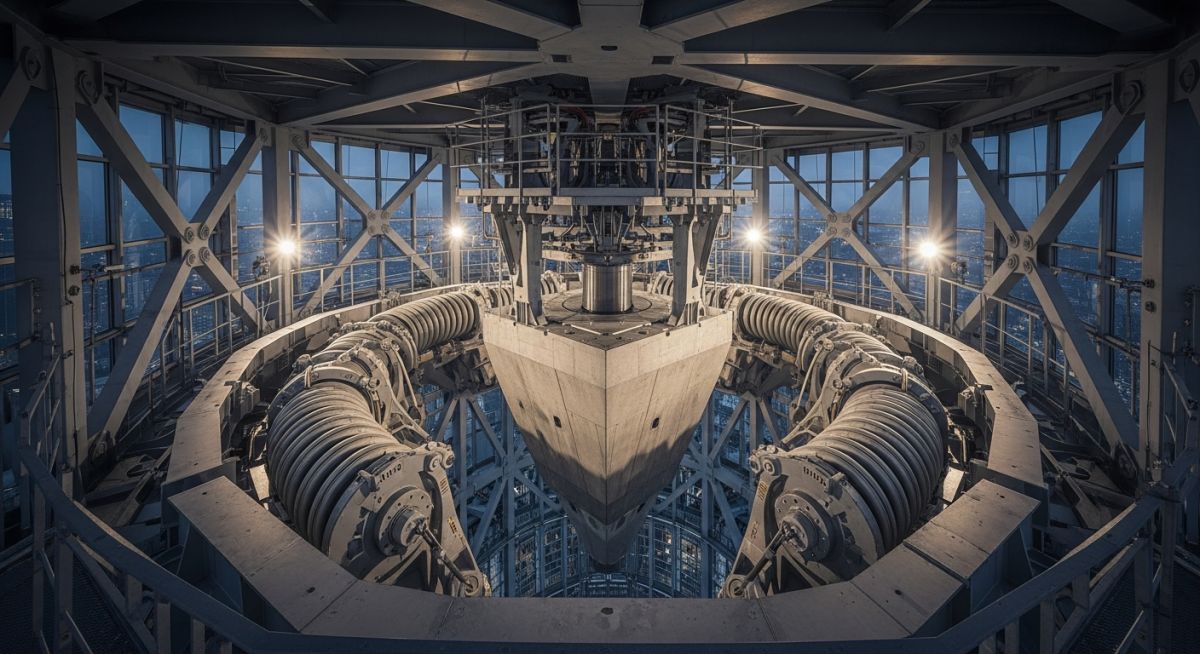
Verified by Engineering Committee Updated: January 2026 Vibration Absorbers: Types, Working, Specification, Applications, and Advantages Vibration absorbers are critical mechanical devices designed to mitigate or eliminate undesirable oscillations in machinery and structures by introducing a secondary mass-spring system tuned to the offending frequency. Unlike traditional isolation methods that simply block transmission, an absorber actively transfers the kinetic energy of the primary system into a secondary auxiliary mass, ensuring structural integrity and operational precision in high-stress engineering environments. What is a Vibration Absorber? A vibration absorber is a secondary mass-spring system attached to a primary structure to reduce its steady-state vibration at a specific resonant frequency. By tuning the absorber to the excitation frequency, the energy of the primary mass is transferred to the auxiliary absorber mass, effectively neutralizing the motion of the original system. Article Contents What is a Vibration Absorber in Mechanical Engineering? Fundamental Physics: How Does a Vibration Absorber Work? Industrial and Structural Applications of Vibration Absorbers Technical Design Considerations for Vibration Absorbers Categorizing the Primary Types of Vibration Absorbers Key Advantages of Vibration Absorbers in Rotating Equipment Engineering Standards: Specifying a Vibration Absorber for Purchasing Technical Comparison: Vibration Absorber vs. Vibration Dampener Market Landscape: Leading Vibration Absorber Manufacturers Engineering Verdict: Conclusion on Vibration Control Technical Knowledge Check Question 1 of 5 Next Question Quiz Completed! Restart Quiz What is a Vibration Absorber in Mechanical Engineering? In the domain of structural dynamics, vibration absorbers are auxiliary devices consisting of a secondary mass and spring system that are attached to a primary vibrating structure. The primary purpose of these devices is to neutralize the steady-state vibration of a machine or building by introducing an equal and opposite force. Unlike isolators, which reduce the transmission of force to the ground, vibration absorbers focus on eliminating the motion of the source itself. These systems are often termed Dynamic Vibration Absorbers (DVA) or Tuned Mass Dampers (TMD). They are most commonly deployed in situations where a machine operates at a constant speed that coincides with the resonant frequency of its supporting structure, leading to high-amplitude oscillations that could cause fatigue failure or operational instability. Fundamental Physics: How Does a Vibration Absorber Work? The operation of vibration absorbers is based on the principle of harmonic anti-resonance. When a primary system is subjected to a cyclic force at a specific frequency, the absorber is "tuned" so that its own natural frequency matches the excitation frequency. At this specific point, the absorber exerts a force on the primary mass that is exactly equal in magnitude but opposite in direction to the external excitation force. Resonant Frequency and Energy Transfer in Vibration Absorbers When vibration absorbers are correctly tuned, the primary mass remains nearly stationary, while the secondary absorber mass oscillates vigorously. Effectively, the vibrational energy is "sucked" out of the main structure and trapped within the auxiliary system. This is mathematically described by the Two-Degree-of-Freedom (2-DOF) model. One critical side effect of adding vibration absorbers is that the original single resonant peak of the system is split into two new resonant peaks—one at a lower frequency and one at a higher frequency. Therefore, the engineer must ensure that the machine's operating range does not pass through these two new frequencies during startup or shutdown. Industrial and Structural Applications of Vibration Absorbers The versatility of vibration absorbers makes them indispensable in various fields, ranging from civil engineering to aerospace. High-Rise Skyscrapers: Large-scale vibration absorbers, known as Tuned Mass Dampers, are installed near the top of buildings like Taipei 101 to counteract wind-induced sway and ensure occupant comfort. Electrical Transmission Lines: Small weights called Stockbridge dampers are attached to power lines to prevent aeolian vibration caused by crosswinds. Industrial Piping Systems: In oil and gas facilities, vibration absorbers are clamped onto piping to mitigate acoustic induced vibration (AIV) or flow-induced vibration (FIV). Bridges and Footways: Absorbers are used to control rhythmic vibrations caused by pedestrian footfall or synchronous lateral excitation. Technical Design Considerations for Vibration Absorbers Engineering effective vibration absorbers requires precise calculation and material selection. A poorly designed absorber can inadvertently increase the vibration of a system rather than reduce it. Design Factor Engineering Requirement Mass Ratio Typically 1% to 10% of the primary system's effective mass. Tuning Accuracy The absorber's natural frequency must match the excitation within +/- 1%. Damping Factor Inclusion of damping allows the absorber to work over a wider frequency range. Space Constraints Requires sufficient clearance for the auxiliary mass to oscillate. When designing vibration absorbers, the mass ratio is the most influential variable. A larger mass ratio provides a wider "suppression band" (the range of frequencies over which vibration is effectively reduced) but adds significant weight and cost to the overall structure. Categorizing the Primary Types of Vibration Absorbers Engineering solutions for vibration absorbers are broadly classified by their energy consumption and their ability to adapt to changing excitation frequencies. Passive Vibration Absorbers These are the most common type of vibration absorbers. They consist of a fixed mass and spring arrangement. While highly reliable and cost-effective, their main limitation is that they are only effective for a very narrow frequency band. If the machine's speed fluctuates, the absorber may become ineffective. Active and Semi-Active Vibration Absorbers Modern vibration absorbers in high-tech industries often utilize sensors and actuators. Active absorbers use a controller to apply an anti-phase force, while semi-active systems use Magnetorheological (MR) fluids to change the stiffness of the spring in real-time, allowing the absorber to "track" the machine's frequency. Impact Vibration Absorbers This specialized variant uses a free-moving mass within a container. Energy is dissipated through collisions between the mass and the container walls. These vibration absorbers are particularly useful in aerospace applications where wide-frequency noise must be suppressed. Key Advantages of Vibration Absorbers in Rotating Equipment Integrating vibration absorbers into industrial assets provides several mechanical and economic benefits that traditional damping cannot achieve. Fatigue Life Extension: By neutralizing resonant motion, vibration absorbers drastically reduce the alternating stress on welds, bolts, and shafts, preventing premature cracking. Precision and Accuracy: In machining or laboratory environments, vibration absorbers ensure that structural oscillations do not interfere with high-tolerance measurements or cutting operations. Noise Reduction: Since vibration is the source of structure-borne noise, absorbers help facilities comply with OSHA noise regulations by quieting resonant panels and housings. Zero Energy Consumption: Passive vibration absorbers require no external power, making them a "install and forget" solution for remote assets. Engineering Standards: Specifying a Vibration Absorber for Purchasing When purchasing vibration absorbers, engineers must provide a detailed specification sheet to ensure the device performs as intended under site conditions. Reference to ISO 20816 or ASME B31.3 is often necessary for piping and machinery vibration limits. Essential Specification Data: Excitation Frequency (Hz/RPM): The specific frequency targeted for cancellation. Primary Mass (kg): The total weight of the structure the absorber is mounted on. Operating Temperature: Critical for selecting elastomeric vibration absorbers. Maximum Displacement: The allowable physical travel of the auxiliary mass. Technical Comparison: Vibration Absorber vs. Vibration Dampener The terms "absorber" and "dampener" are frequently confused. While both are used for vibration control, they rely on entirely different mechanical principles. Feature Vibration Absorbers Vibration Dampeners Core Principle Energy Transfer (Neutralization) Energy Dissipation (Heat) Frequency Range Narrowband (Tuned) Broadband Components Mass and Spring Viscous Fluid or Friction Plates Effect on Resonant Peak Splits peak into two new ones Reduces the height of the peak Market Landscape: Leading Vibration Absorber Manufacturers Selecting high-quality vibration absorbers requires partnering with vendors that provide verified dynamic testing data. In 2026, the following companies lead the global market: Lord Corporation Specializes in aerospace and high-performance industrial vibration absorbers and MR fluid semi-active systems. Mason Industries The industry leader in large-scale structural absorbers and HVAC vibration absorbers. VICODA (GERB Group) Global experts in piping vibration absorbers and massive Tuned Mass Dampers for bridge engineering. Getzner Werkstoffe Specializes in advanced polyurethane-based vibration absorbers for railway and industrial foundations. Vibration Absorbers Tuning Calculator Calculate the required spring stiffness (k) for an undamped vibration absorber based on your target excitation frequency and chosen absorber mass. Target Excitation Frequency (Hz) Absorber Mass (kg) Calculate Stiffness Reset Required Spring Stiffness (k) 0.00 N/m To neutralize vibration at 0 Hz, your spring must provide this exact stiffness for the 0 kg mass. Engineering Formula: The natural frequency of the absorber must match the excitation frequency: f = (1 / 2π) × √(k / m) Rearranged for stiffness: k = m × (2πf)2 Case Study: Mitigating Structural Resonance Using Vibration Absorbers 📊 Project Data Asset Type: Offshore Gas Lift Centrifugal Compressor Operating Speed: 2,880 RPM (48 Hz) Problem Area: Cantilevered steel mezzanine deck Initial Vibration: 18.5 mm/s RMS (Danger Zone) ⚠️ Failure Analysis A spectral analysis revealed that the local natural frequency of the mezzanine deck was exactly 47.8 Hz. This nearly perfect match with the compressor's operating speed caused mechanical resonance. Traditional stiffening was impossible due to deck weight limits on the platform, and standard rubber mounts failed to provide sufficient attenuation at this high energy level. The Engineering Fix The reliability team designed and installed four passive vibration absorbers tuned specifically to 48 Hz. Each absorber consisted of a 250 kg auxiliary steel mass supported by high-precision helical springs. By attaching these vibration absorbers to the antinode (the point of maximum displacement) of the deck beam, the kinetic energy was transferred from the mezzanine floor to the absorber masses. 💡 Lessons Learned Vibration Reduction 82% Drop From 18.5 to 3.2 mm/s Implementation Cost USD 12,400 Material and installation Structural Safety Zero Cracks Stopped weld fatigue growth Conclusion: The use of vibration absorbers proved to be the only viable solution that didn't violate platform weight restrictions while successfully neutralizing the destructive resonant forces of the compressor. Frequently Asked Questions about Vibration Absorbers What is the difference between a tuned mass damper (TMD) and a standard vibration absorber? In engineering practice, the terms are often used interchangeably. However, a "standard" vibration absorber usually refers to an undamped mass-spring system used for narrowband frequency cancellation in machinery. A Tuned Mass Damper (TMD) typically incorporates a damping element (like a viscous fluid) to broaden its effective frequency range, making it suitable for large-scale structural applications like wind-sway in skyscrapers. How do you determine if a machine requires vibration absorbers instead of just isolation? Isolation mounts are used to stop vibration from reaching the foundation. If the machine itself is vibrating excessively due to resonant frequency issues, isolation won't help—the machine will still shake violently on its mounts. In this case, vibration absorbers are required to actively neutralize the force at the source and reduce the physical displacement of the machine housing. Can vibration absorbers be used to mitigate seismic activity and earthquakes? Yes, but they are usually part of a larger seismic strategy. While passive vibration absorbers help reduce the response to specific frequencies, seismic events are broadband. Engineers often use "active" or "semi-active" Dynamic Vibration Absorbers (DVA) that can adjust their properties in milliseconds to counteract the unpredictable rhythmic forces of an earthquake. What are the risks if the excitation frequency of the machine changes? This is a critical design risk for passive vibration absorbers. If the machine speed shifts away from the absorber's tuned frequency, the absorber becomes ineffective. Worse, if the speed shifts into one of the two "sideband" resonant peaks created by the absorber, the vibration amplitudes can actually become higher than they were without the absorber. Variable-speed machinery often requires damped or active absorber systems. Summary of Engineering Best Practices The implementation of vibration absorbers is a powerful technique for managing structural resonance and protecting high-value industrial assets. By mathematically tuning a secondary mass to provide an anti-phase force, engineers can neutralize destructive oscillations that traditional isolation and damping cannot reach. As structural and mechanical systems become lighter and more flexible, the reliance on high-precision vibration absorbers will continue to grow. Success in these applications requires accurate frequency identification, precise mass-stiffness tuning, and a clear understanding of the resulting dynamic shift in the system's natural frequencies. 📚 Recommended Resources: Piping Engineering Read these Guides 📄 Piping Engineering Disciplines: Layout, Material & Stress Guide 2026 📄 Piping Engineering Certification Course: 2026 Career Guide 📄 45+ Piping Engineering Courses on Sale | EPCLAND – Just $1 to $8 📄 Master Piping Engineering: Your Complete Course Blueprint 🎓 Advanced Training 🏆 Complete Course on Piping Engineering 🏆 Piping Engineering Interview Preparation Course: 500+ Q&As 🎥 Watch Tutorials What is Piping Engineering Piping Engineering Basics: Codes and Standards (Full Lecture)