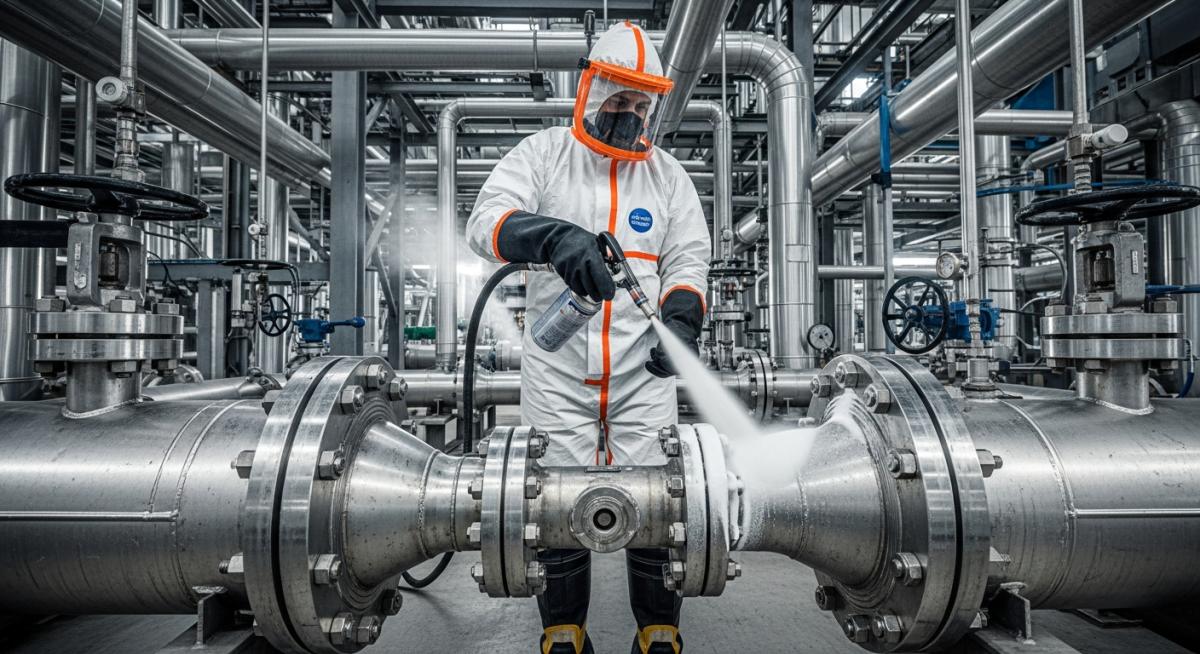
✅ Verified for 2026 by Epcland Engineering Team Mastering the ASME B31.3 Sensitive Leak Test: 2026 Engineering Standards The ASME B31.3 Sensitive Leak Test is a critical diagnostic procedure used in the process piping industry to identify minute atmospheric leaks that standard hydrostatic or pneumatic tests might miss. Unlike high-pressure structural integrity tests, this specialized examination focuses on identifying leak paths in systems where even trace amounts of fluid escape could lead to environmental hazards or process contamination. Technical Definition Per ASME B31.3 Section 345.8, a sensitive leak test is a pneumatic examination performed at a pressure of at least 105 kPa (15 psi) or 25% of the design pressure, whichever is lesser. It utilizes the "Gas bubble test method for piping" to detect leaks through the application of a specialized foaming solution. Quick Navigation Theory & Code Requirements Testing Procedures Refinery Case Study Frequently Asked Questions 2026 Engineering Proficiency Quiz Question 1 of 5 Previous Next The Science and Standards of ASME B31.3 Sensitive Leak Test The ASME B31.3 Sensitive Leak Test is governed by Section 345.8 of the piping code. In 2026, this test remains the gold standard for verifying the integrity of Category M fluid services and systems where moisture contamination is a critical risk. Unlike a standard pneumatic test, which evaluates structural strength, the sensitive leak test is designed to find microscopic leak paths through a controlled, low-pressure gas application. Core Physics The test relies on the pressure differential between the internal piping and the atmosphere. By utilizing the Gas bubble test method for piping, engineers can visually identify the exit point of gas molecules as they react with a low-surface-tension surfactant. 2026 Code Limits Maximum test pressure is capped at 25% of the design pressure or 105 kPa (15 psi). This ensures that the Pneumatic leak testing safety procedures are followed to prevent catastrophic energy release during the inspection of complex joints. Visual Inspection Standards Step-by-Step Procedure Executing a successful Piping system soap bubble examination requires meticulous surface preparation. Any oil, grease, or slag must be removed to ensure the surfactant can bridge potential leak orifices. For ASME B31.3 Category M Fluid Service leak testing, the examination must cover every individual weld, threaded joint, and flange seal. Pressure Calculation Formula Test Pressure (Pt) Calculation: Pt = Min(0.25 * Pd, 105 kPa) Where: Pd = System Design Pressure Pt = Sensitive Leak Test Pressure kPa = Kilopascals (15 psi equivalent) Acceptance Criteria & Sensitivity Levels In 2026, Leak testing sensitivity levels for 2026 focus on the "No Visible Leak" criteria. This means no continuous bubble formation is permitted for a duration that allows a full 360-degree inspection of each joint. Parameter Metric Requirement Imperial Requirement Min Test Pressure 105 kPa 15 psi Max Pressure Limit 25% Design Pressure 25% Design Pressure Hold Time Duration of Examination Duration of Examination Agent Application Immersion or Surfactant Immersion or Surfactant Case Study: ASME B31.3 Sensitive Leak Test Failure Analysis In early 2026, a major chemical refinery underwent a critical retrofit of its hydrocracking unit. The project involved replacing 400 linear feet of stainless steel piping integrated with moisture-sensitive catalysts. Traditional hydrostatic testing was strictly prohibited, as any residual water would deactivate the catalyst, resulting in a multi-million dollar loss. The engineering team opted for the ASME B31.3 Section 345.8 requirements, utilizing a high-sensitivity nitrogen-based pneumatic approach. Figure 1: Detection of micro-fissure using bubble-forming solution on a 4-inch flange. Project Data Location: Gulf Coast Refinery Complex Equipment: Catalyst Feed Lines (316L SS) Conditions: 2026 Retrofit, Ambient Temp Test Agent: Dehydrated Nitrogen + Surfactant Technical Result Test Pressure: 105 kPa (15.2 psi) Detection Time: 12 Seconds to bubble formation Root Cause: Improper gasket seating ROI: Prevented 14-day catalyst drying delay Problem & Analysis During the initial ramp-up to 25% design pressure, the team performed a Piping system soap bubble examination. While standard pressure gauges remained steady, the sensitive surfactant revealed a stream of micro-bubbles at a difficult-to-access flange connection. The Gas bubble test method for piping proved its value here; the leak was too small to be heard but significant enough to allow oxygen ingress over time, which would have poisoned the sensitive process environment. Solution & Result The joint was depressurized, inspected, and found to have a microscopic score mark on the flange face. By replacing the gasket and re-machining the surface in-situ, the system successfully passed the 2026 compliance audit. This prevented a catastrophic catalyst failure, saving the refinery an estimated 1.2 million USD in rework and downtime. The ASME B31.3 Sensitive Leak Test confirmed that low-pressure precision is often more valuable than high-pressure force in specialty chemical environments. 2026 Tech Integration: Beyond the Bubble While the Gas bubble test method for piping remains the code-mandated minimum, leading EPC firms in 2026 are augmenting human inspection with digital verification. Integrating these technologies ensures a "Zero-Leak" turnover for critical Category M systems. 🔊 Acoustic Imaging Modern acoustic cameras (e.g., Fluke ii900 series) can visualize ultrasonic frequencies generated by gas escaping at low pressures (15 psi). ✔ Validation: Confirms "No Leak" status in hard-to-reach overhead joints. ✔ Speed: Scans 50ft of pipe in seconds before applying surfactant. 📊 IoT Pressure Decay Smart pressure transmitters now log data at 10ms intervals, detecting micro-transients that analog gauges miss. ✔ Compliance: Generates an immutable PDF audit trail for the client. ✔ Sensitivity: Detects pressure drops < 0.01 psi over the hold period. ⚠️ CRITICAL SAFETY: Stored Energy Even at 105 kPa (15 psi), a pneumatic test stores lethal kinetic energy. 💥 Per ASME PCC-2 guidelines, you must calculate the stored energy (E) in Joules before testing. If E > 100,000,000 Joules, the test requires a remote bunker. For Sensitive Leak Tests, ensure exclusion zones are calculated: Simple Energy Formula (Adiabatic): E = 2.5 * P_test * V_system * [1 - (P_atm / P_test)^0.286] *Where P is absolute pressure (Pa) and V is volume (m³). Epcland Field Tip: The "Double-Check" Method For Category M lines, do not rely on the sensitive leak test alone. Perform a Helium Mass Spectrometer sniff test if the process fluid is lethal (e.g., H2S or HF Acid). The sensitive bubble test detects 10-4 std cc/sec, but Helium sniffer probes can detect down to 10-9 std cc/sec, offering a 100,000x safety margin improvement. Expert Insights: ASME B31.3 Sensitive Leak Test FAQ Why is the ASME B31.3 Category M Fluid Service leak testing so strict? Category M services involve toxic or lethal fluids where even a microscopic release can be fatal. The 2026 standards mandate the sensitive leak test because traditional hydro-tests may not reveal small gas-leak paths that toxic vapors could exploit. What are the best surfactants for a Piping system soap bubble examination? In 2026, engineers prefer high-viscosity, low-chlorine foaming agents that are non-corrosive to stainless steel. These solutions are specifically designed to produce stable bubbles even at the minimum 15 psi pressure required by the code. Can I skip the pneumatic leak testing safety procedures for low pressure? Absolutely not. Even at 105 kPa (15 psi), compressed gas stores significant potential energy. Safety zones and gradual pressure ramping remain mandatory under ASME B31.3 to protect personnel during the inspection. What defines the required Leak testing sensitivity levels for 2026? Sensitivity is defined by the ability of the chosen Gas bubble test method for piping to detect a leak rate of approximately 0.0001 standard cubic centimeters per second (std cm3/s) or better, depending on the surfactant's quality and the inspector's dwell time. Final Engineering Summary The ASME B31.3 Sensitive Leak Test is an indispensable tool in the modern mechanical engineer's arsenal. By adhering to 2026 safety protocols and precision bubble-forming techniques, facilities can ensure the integrity of moisture-sensitive and high-hazard piping systems. Whether managing a refinery retrofit or a new-build Category M service, the transition from high-pressure force to low-pressure sensitivity is the key to long-term operational safety. Epcland Engineering Technical Series - Doc ID: B31.3-2026-SLT