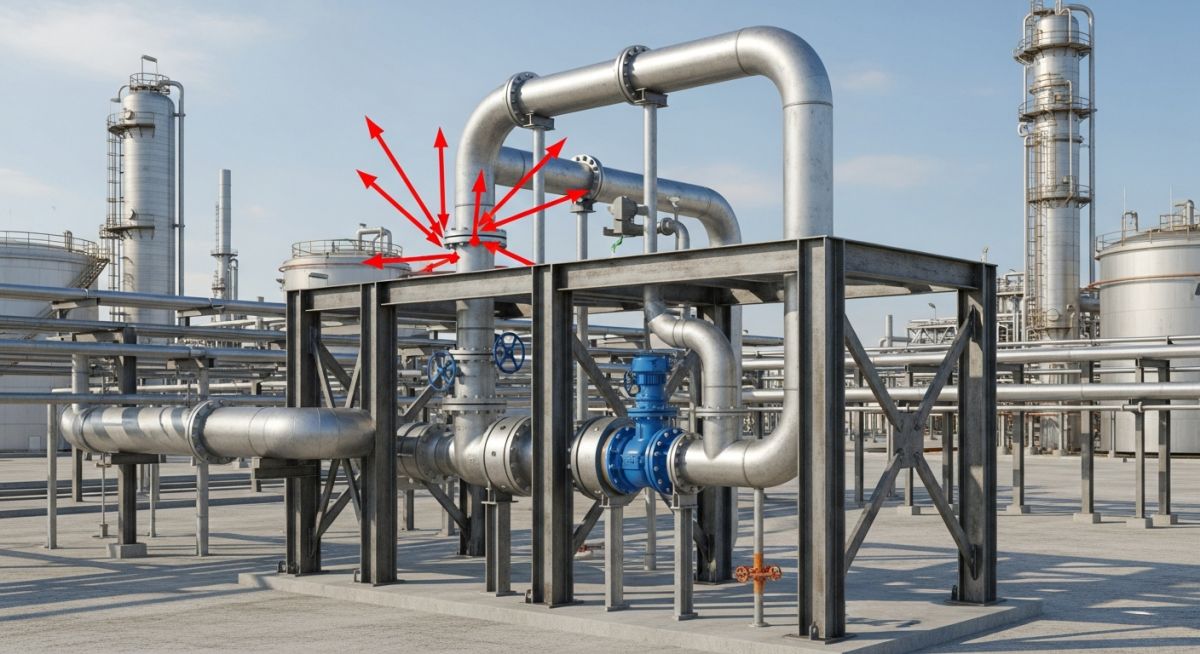
The Hidden Cause of Recurring Flange Leaks: A Refinery Case Study Flange Leak Diagnostics The Problem Root Cause Analysis Case Study Prevention Open main menu The Problem Root Cause Analysis Case Study Prevention The Hidden Cause of Recurring Flange Leaks You've replaced the gasket and re-torqued the bolts, but the leak returns. This interactive guide reveals the often-overlooked root cause—piping misalignment—and provides a permanent solution based on a real-world refinery case study. The Costly Cycle of Failure Recurring leaks are more than an inconvenience; they represent a significant drain on resources and a major safety risk. The cycle of temporary fixes often masks a deeper, more fundamental problem. This section visualizes the typical costs and explains why simple fixes fail. Symptoms vs. Root Causes: Why Simple Fixes Fail Standard procedure for a leak involves replacing the gasket and re-torquing bolts. While essential, these actions address the symptom, not the root cause. If underlying stresses from misalignment exist, the new gasket is destined to fail, continuing the costly cycle. ✗ Temporary Fix: Re-torquing bolts only temporarily redistributes uneven stress. ✗ False Hope: A new gasket provides a short-lived seal before deforming under the same chronic stress. ✓ Permanent Solution: Identifying and correcting the root cause (like misalignment) is the only way to break the cycle. Breakdown of Operational Impact Root Cause Analysis: Unmasking Misalignment A proper flange seal relies on perfect alignment and uniform gasket compression. When pipes are misaligned, they introduce powerful external forces that gaskets aren't designed to handle. Interact with the diagrams below to understand the three primary types of misalignment and how they compromise seal integrity. Angular Parallel (Offset) Rotational Angular Misalignment Flange faces are not parallel, creating a wedge-shaped gap. When bolted, one side of the gasket is crushed while the other is under-compressed, creating a clear leak path. Parallel Misalignment (Offset) Flange faces are parallel but their centerlines are offset. This subjects the gasket to shear forces and uneven radial compression, pushing it out of place and causing failure. Rotational Misalignment Flange faces are rotated relative to each other, making bolt hole alignment difficult. Forcing the bolts introduces twisting stress on the gasket and uneven bolt load. Pro-Tip From The Field: A Refinery Case Study Theory is important, but real-world experience is invaluable. This case study details how a refinery solved a chronic heat exchanger flange leak by moving beyond simple fixes to find and correct the root cause. Click through the timeline to follow their diagnostic journey. Step 1: The Problem & Initial Fixes A critical heat exchanger flange developed leaks every few months, causing unplanned shutdowns. The maintenance team repeatedly replaced gaskets and re-torqued bolts, but the leak always recurred within weeks, indicating a deeper issue. Step 2: The Deep Dive Investigation During a shutdown, a root cause analysis began. Failed gaskets showed severe, uneven compression. When unbolted, the pipes "sprung" apart. Finally, laser alignment checks provided definitive proof: a significant angular misalignment was present. Step 3: The Permanent Fix The solution was structural. A section of the misaligned piping was cut out. A new, precisely-measured spool piece was fabricated and installed using laser alignment to ensure a stress-free connection. Pipe supports were also adjusted. Step 4: Lessons Learned & Best Practices The permanent fix eliminated the recurring leaks. Key takeaway: Don't just treat symptoms. Invest in root cause analysis. For chronic leaks, always suspect misalignment. Precision in fabrication and installation prevents costly future failures. Prevention & Best Practices for Flange Integrity Mastering flange reliability requires a proactive approach. The following best practices, when implemented correctly, can prevent leaks from occurring in the first place. Click each category to expand. Precision in Installation ▾ Meticulous Alignment: Never use bolts to pull flanges into place. Use laser alignment tools to verify parallelism and concentricity before bolting. Proper Pipe Support: Ensure supports are correctly installed and spaced to prevent sagging and transfer of external loads onto flanges. Controlled Bolting: Use calibrated torque wrenches and follow a multi-pass star pattern to achieve uniform bolt load. Advanced Leak Detection ▾ Acoustic Detection: Use ultrasonic devices to "hear" high-frequency sounds from small leaks, even through insulation. Thermal Imaging: Use infrared cameras to spot temperature anomalies around a flange that indicate a leak. VOC Sniffers: Pinpoint leaks of invisible hydrocarbon gases in chemical or refinery services. Regular Inspection Regimes ▾ Visual Inspections: Conduct regular walk-downs to look for corrosion, bolt degradation, or changes in pipe support. Flange Management Program: Track the history of every critical joint (gasket type, torque values, leak history) to identify problem areas. Continuous Training: Ensure maintenance personnel are regularly trained on the latest flange assembly and troubleshooting techniques. © 2024 Flange Leak Diagnostics. An interactive guide for maintenance professionals. This content is for informational purposes only. Always follow your facility's specific safety and maintenance procedures.