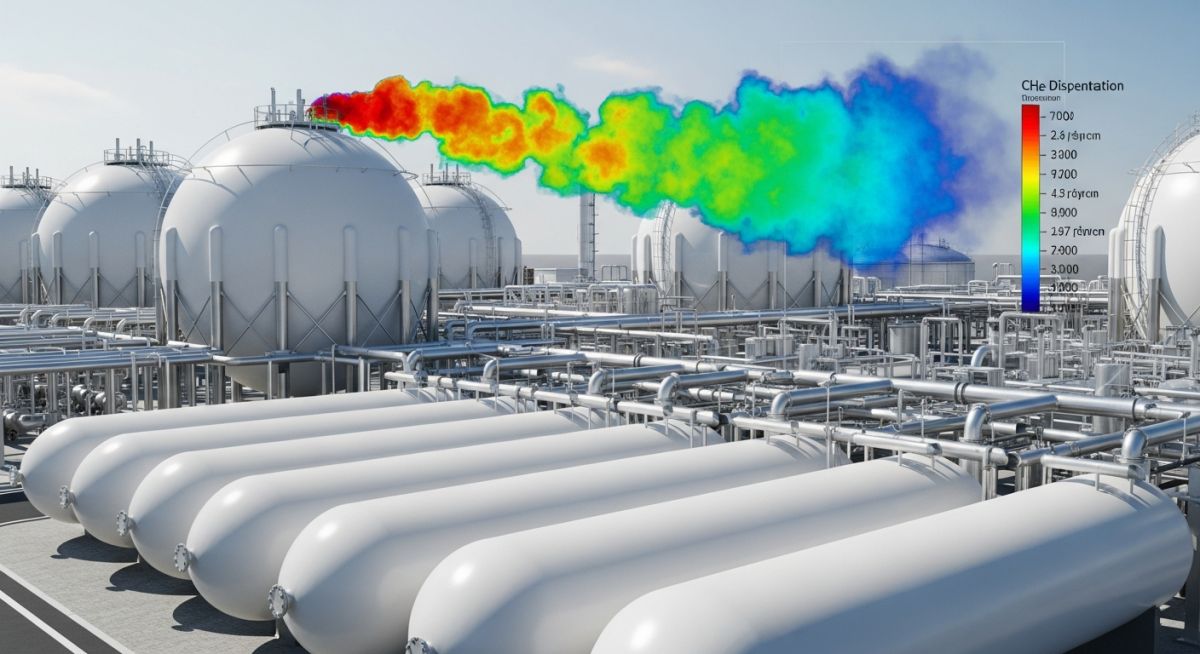
Verified for 2026 Standards OISD & PESO Compliant Hydrogen Dispersion Study for OISD-STD-241: Optimizing Interspacing in 2026 The execution of a Hydrogen Dispersion Study for OISD-STD-241 is the definitive technical requirement for modern green hydrogen projects in 2026 seeking to transition from prescriptive safety distances to optimized, risk-based siting. Under the latest PESO SMPV (Unfired) Rules, project developers must leverage high-fidelity Computational Fluid Dynamics (CFD) to justify interspacing reductions and ensure the integrity of high-pressure storage assets. What is a Hydrogen Dispersion Study for OISD-STD-241? It is a site-specific technical analysis that maps the Lower Flammability Limit (LFL) of potential hydrogen leaks. In 2026, it serves as the engineering justification to reduce standard 2-meter interspacing between vessels by proving that site-specific physics, such as buoyancy and momentum, prevent flammable cloud interaction with adjacent equipment. Table of Contents 1. The Role of Hydrogen Dispersion Study for OISD-STD-241 in Risk-Based Siting 2. Modeling Momentum vs. Buoyancy in Hydrogen Dispersion Study for OISD-STD-241 3. Technical Justification for Distance Reductions under PESO SMPV Rules 4. Scenario-Specific Modeling for Bullets and Spheres 5. Software Validation for Hydrogen Dispersion Study for OISD-STD-241 Engineering Competency Quiz Question 1 of 5 Restart Quiz The Role of Hydrogen Dispersion Study for OISD-STD-241 in Risk-Based Siting In 2026, the Hydrogen Dispersion Study for OISD-STD-241 has evolved from a supplementary report to a core design document. Traditional prescriptive siting relies on fixed distance tables (e.g., 2 meters between horizontal bullets). However, for land-constrained Indian green hydrogen hubs, the industry is moving toward "Risk-Based Safe Distances." This methodology uses site-specific physics to determine if equipment is safe, rather than relying on generalized averages. Transitioning from Prescriptive Distances to Site-Specific Physics Engineering standards such as ASME B31.12 for hydrogen piping and OISD-STD-241 emphasize that the "one size fits all" approach to spacing is insufficient for high-pressure systems. A dispersion study allows engineers to visualize the consequence of a leak based on local topography, prevailing wind speeds, and congestion levels. This ensures that the Hydrogen Dispersion Study for OISD-STD-241 provides a safety margin that is both robust and commercially viable. Mapping the Flammable Envelope: LFL and UFL Dynamics The primary objective is mapping the Lower Flammability Limit (LFL) and the Upper Flammability Limit (UFL). For hydrogen, the LFL is 4 percent by volume. A Hydrogen Dispersion Study for OISD-STD-241 identifies the maximum radius of this 4 percent cloud under various leak scenarios (e.g., 5mm or 10mm "credible" failures). If the study indicates the flammable cloud reaches an adjacent storage vessel, the interspacing must be adjusted, or mitigation measures must be introduced. Modeling Momentum vs. Buoyancy in Hydrogen Dispersion Study for OISD-STD-241 Hydrogen possesses unique physical properties compared to heavier hydrocarbons like LPG. In 2026 modeling, two distinct phases of a release are analyzed: Momentum and Buoyancy. High-Pressure Jet Paths (250-700 bar) and Adjacent Vessel Safety At pressures ranging from 250 bar to 700 bar, a release is initially momentum-dominated. The gas acts as a high-velocity jet that can travel horizontally for 5 to 12 meters before its kinetic energy dissipates. During a Hydrogen Dispersion Study for OISD-STD-241, engineers must ensure that neighboring vessels are not positioned directly in this potential "jet path" to avoid immediate flame impingement in the event of ignition. The Coanda Effect in Horizontal Hydrogen Bullets A critical finding in recent 2026 studies is the Coanda Effect. Under specific wind conditions, a hydrogen plume can "attach" to the curved surface of an adjacent bullet or the ground rather than rising immediately. This phenomenon effectively traps the gas at lower elevations, potentially mandating a side-to-side gap larger than the standard 2-meter baseline. This level of detail is only possible through 3D CFD modeling within a Hydrogen Dispersion Study for OISD-STD-241. Technical Justification for Distance Reductions under PESO SMPV Rules In 2026, the PESO (Petroleum and Explosives Safety Organization) SMPV Rules allow for the optimization of plant layouts if a project developer can provide high-fidelity technical evidence. A Hydrogen Dispersion Study for OISD-STD-241 serves as this evidence, moving the project from a "compliance-only" design to an "engineered-safety" design. Using QRA and 3D CFD to Validate Fire Barrier Effectiveness When land is constrained, the installation of Reinforced Cement Concrete (RCC) fire-rated walls can allow for reduced interspacing. A Hydrogen Dispersion Study for OISD-STD-241 uses 3D CFD to model how these barriers interact with a gas release. The simulation must prove that the wall successfully deflects the flammable cloud away from adjacent 700-bar bullets, preventing a "domino effect" or "cascading failure" across the storage bank. Vent Stack Height Optimization and Gas Pooling Prevention Improperly sized vent stacks can lead to hydrogen "pooling" at high elevations, especially near the top curvature of spheres or overhead cable trays. Through modeling, the Hydrogen Dispersion Study for OISD-STD-241 determines the minimum safe discharge height and exit velocity to ensure that the gas disperses below 4 percent LFL before it can interact with any potential ignition sources in the "Z-zone" or upper plant structures. Parameter Prescriptive (Standard) Risk-Based (Dispersion Study) Inter-vessel Spacing Fixed 2m (or vessel diameter) Optimized based on 4 percent LFL Radius Mitigation Credit None (Standard Distances) Validated RCC Walls / Water Curtains Regulatory Path SMPV Table 4 Compliance QRA + CFD Submission to PESO Scenario-Specific Modeling for Bullets and Spheres Different storage geometries require unique focus areas within a Hydrogen Dispersion Study for OISD-STD-241. Trapping Points and Curvature Accumulation in Hydrogen Spheres Because hydrogen is significantly lighter than air (density approx. 0.089 kg/m3 at STP), it tends to accumulate in "dead zones" or pockets. In large-scale spheres, a Hydrogen Dispersion Study for OISD-STD-241 focuses on the underside curvature. If a leak occurs at the bottom nozzle, the gas may "trap" against the sphere's skin, creating a localized explosive concentration that prescriptive tables do not account for. Key Physics: Momentum vs Buoyancy (Froude Number) To determine if a hydrogen release is momentum-driven or buoyancy-driven, engineers calculate the Densimetric Froude Number (Fr): Fr = u / (g * d * ( (rhoa - rhog) / rhog ) )0.5 Where: u = release velocity, g = gravity, d = leak diameter, rhoa = air density, and rhog = gas density. In a Hydrogen Dispersion Study for OISD-STD-241, high Fr values indicate jet-like behavior where interspacing is critical. Software Validation for Hydrogen Dispersion Study for OISD-STD-241 For 2026 projects, PESO and OISD authorities strictly mandate the use of validated software. Tools such as FLACS and Ansys Fluent are the industry benchmarks for 3D CFD, as they can accurately model the complex turbulence and sub-grid congestion present in a hydrogen bullet park. Simplified tools like PHAST are typically reserved for initial screening or flat-terrain dispersion profiles. Hydrogen Dispersion Study for OISD-STD-241 Calculator Estimate the initial Jet Momentum Distance for a high-pressure hydrogen release. This tool helps engineers determine if a Hydrogen Dispersion Study for OISD-STD-241 is required for interspacing justification based on the 2026 4 percent LFL boundary. Storage Pressure (bar) Typical range: 250 to 700 bar. Leak Diameter (mm) OISD "credible failure" standard: 5 to 12 mm. Calculate Distance Reset Estimated 4 percent LFL Jet Radius: 0 m Comparison of OISD-STD-241 vs. ISO/TR 15916: Global Alignment in 2026 For multinational energy firms operating in India, aligning the Hydrogen Dispersion Study for OISD-STD-241 with international benchmarks like ISO/TR 15916 (Basic considerations for the safety of hydrogen systems) is a critical compliance step. While OISD provides the mandatory framework for PESO approval, ISO provides the underlying safety philosophy used for global risk management. Prescriptive vs. Performance-Based Frameworks The OISD-STD-241 standard is historically prescriptive, meaning it provides specific numerical distances for equipment separation. In contrast, ISO/TR 15916 is performance-based, emphasizing that safety distances should be derived from the "consequence of failure." In 2026, the use of a Hydrogen Dispersion Study for OISD-STD-241 acts as the bridge, allowing Indian projects to meet international performance standards while satisfying local prescriptive mandates. Key Differences in Interspacing Philosophy Feature OISD-STD-241 (India) ISO/TR 15916 (International) Primary Focus Static separation distances for Unfired Pressure Vessels. Risk-informed design and material compatibility. Dispersion Requirement Mandatory for reduction of Table 4 distances. Recommended for all high-pressure siting. Mitigation Credit Allows RCC walls with CFD validation. Focuses on passive ventilation and leak detection. Harmonizing Dispersion Parameters In 2026, a Hydrogen Dispersion Study for OISD-STD-241 typically incorporates ISO-recommended atmospheric stability classes (e.g., Pasquill Class D and F) to ensure the simulation is conservative. This harmonization ensures that an Indian green hydrogen plant is considered safe not only by PESO inspectors but also by international insurers and technology partners. Sensor Placement Optimization: Enhancing Safety with 3D Coordinates In 2026, a Hydrogen Dispersion Study for OISD-STD-241 is no longer just about sitting distances; it is the primary tool for Detector Layout Optimization (DLO). By using dispersion heat maps, engineers can identify the exact 3D coordinates where a leaked gas cloud is most likely to accumulate, ensuring that gas detectors and flame scanners are positioned for maximum effectiveness. Mapping Cloud Travel for T90 Response Times The "T90" time—the time it takes for a sensor to reach 90 percent of the actual gas concentration—is critical for preventing escalations. Through a Hydrogen Dispersion Study for OISD-STD-241, CFD simulations model various leak sizes and wind directions. This allows engineers to place sensors in the direct path of "momentum jets" and "buoyant plumes," significantly reducing detection latency compared to standard grid-based placement. 3D Modeling vs. Prescriptive Spacing Traditional standards might suggest a detector every 5 meters. However, a Hydrogen Dispersion Study for OISD-STD-241 often reveals that because hydrogen rises so rapidly, detectors placed at the "breathing zone" (1.5m high) may completely miss a high-pressure release. In 2026, dispersion-led designs mandate: High-Level Detectors: Placed at the top curvature of spheres where buoyant gas pools. Jet-Path Scanners: Optical flame detectors aligned with the most probable 700-bar leak trajectories. Stagnation Zone Monitoring: Sensors located in "dead zones" identified by the 3D CFD where wind flow is minimal. Note: Under the 2026 PESO safety guidelines, any reduction in inter-vessel spacing typically requires a corresponding increase in "Detection Coverage Factor," which must be validated by the Hydrogen Dispersion Study for OISD-STD-241. Explosion Overpressure (VCE) Modeling: From Dispersion to Blast Analysis In 2026, a comprehensive Hydrogen Dispersion Study for OISD-STD-241 often serves as the precursor to a Vapor Cloud Explosion (VCE) analysis. While dispersion mapping identifies where the gas goes, blast modeling calculates the physical impact if that gas cloud finds an ignition source. This is vital for determining the safe siting of control rooms and administrative buildings. The Link Between Congestion and Overpressure Hydrogen's high flame speed means that if a cloud disperses into a congested area (such as a bank of 700-bar bullets or complex piping manifolds), the resulting explosion can undergo Deflagration-to-Detonation Transition (DDT). A Hydrogen Dispersion Study for OISD-STD-241 identifies these "congested volumes." Engineers then apply the Multi-Energy Method (MEM) or Baker-Strehlow-Tang (BST) models to calculate the overpressure (measured in psi or bar). Siting Occupied Buildings Under 2026 Guidelines Overpressure (psi) Structural Impact OISD-STD-241 Requirement 0.5 to 1.0 psi Window breakage; minor structural damage. Safe distance for non-blast resistant buildings. 3.0 to 5.0 psi Heavy damage to steel frames; collapse of unreinforced walls. Mandatory blast-resistant construction (RCC). 10.0+ psi Total destruction of standard buildings. Strict exclusion zone for all personnel. Mitigating Blast Risk Through Design By integrating blast results with the Hydrogen Dispersion Study for OISD-STD-241, designers can implement "Passive Mitigation." This includes increasing the gap between vessel clusters to prevent cloud coalescence or orienting the long axis of bullets away from occupied areas. In 2026, PESO auditors look for this integrated approach to ensure that a localized leak does not escalate into a site-wide catastrophe. Case Study: Hydrogen Dispersion Study for OISD-STD-241 in a High-Density Storage Hub Project Data (2026) Asset: 12 x 700-bar Horizontal Hydrogen Bullets. Constraint: Limited 0.5-acre plot requiring reduced 1.5m interspacing. Standard Gap: 2.0m (Per OISD-STD-241/SMPV Table 4). Failure Analysis & Modeling Initial 3D CFD modeling identified that a 10mm "credible" flange leak at 700 bar created a momentum-dominated jet reaching 8.4 meters. Under the standard 2m gap, a leak from the center bullet would result in direct flame impingement on three adjacent vessels if ignited, leading to potential structural failure. Engineering Fix & Lessons Learned By conducting a comprehensive Hydrogen Dispersion Study for OISD-STD-241, engineers designed a staggered RCC fire barrier system. The study proved that: Barriers deflected the 4 percent LFL cloud vertically. The Coanda Effect was neutralized by integrated ventilation gaps. PESO approved a reduced 1.5m interspacing with the validated 4-hour fire-rated walls. Figure 1: CFD Visualization of Gas Deflection via RCC Barriers (2026 Modeling). Frequently Asked Questions Is a 3D CFD simulation mandatory for all PESO SMPV Rules 2026 submissions? ▼ While prescriptive distances in OISD-STD-241 can be followed for standard layouts, a 3D CFD simulation is mandatory if you intend to justify "risk-based safe distances" that are shorter than the standard tables. PESO requires this high-fidelity data to verify that the 4 percent LFL envelope does not impact adjacent equipment. How does Lower Flammability Limit (LFL) mapping affect land acquisition costs? ▼ Accurate LFL mapping through a Hydrogen Dispersion Study for OISD-STD-241 allows developers to optimize the plant footprint. By proving safety through physics rather than broad margins, you can pack storage vessels closer together, significantly reducing the total acreage required and lowering land acquisition costs for 2026 green hydrogen projects. Can jet fire momentum-dominated release scenarios be mitigated with water curtains? ▼ Yes. A dispersion study can model the "scrubbing" or "dilution" effect of high-pressure water curtains. If the study proves that the water curtain successfully breaks the momentum of the jet and reduces the concentration below the 4 percent LFL threshold, PESO may grant credits for reduced spacing. How does the Coanda Effect influence Quantitative Risk Assessment (QRA)? ▼ In a QRA, the Coanda Effect increases the probability of a "delayed ignition" or "flash fire" because the gas plume remains closer to the ground or equipment for a longer duration. A Hydrogen Dispersion Study for OISD-STD-241 quantifies this risk, allowing engineers to adjust ventilation or sensor placement to mitigate the hazard. Conclusion In 2026, the Hydrogen Dispersion Study for OISD-STD-241 is the cornerstone of safe and efficient hydrogen infrastructure. By moving beyond the 2-meter prescriptive baseline and utilizing 3D CFD modeling, project architects can design storage facilities that are not only compliant with PESO SMPV Rules but are also optimized for high-density industrial applications. As the green hydrogen sector scales, the transition to risk-based interspacing will remain the primary method for balancing engineering safety with commercial viability. #GreenHydrogen2026 #ProcessSafety #OISDStandards 📚 Recommended Resources: OISD-STD-241 Read these Guides 📄 45+ Piping Engineering Courses on Sale | EPCLAND – Just $1 to $8 🎓 Advanced Training 🏆 OISD-STD-241: A Practical Guide to Hydrogen Safety in India 🎥 Watch Tutorials Hydrogen Plant Safety Requirements | OISD-STD-241 Course (Part 2) The Dangers of Hydrogen | OISD-STD-241 Hydrogen Safety Course (Part 1) Hydrogen Pipelines & Blending in India | OISD-STD-241 Course (Part 5)