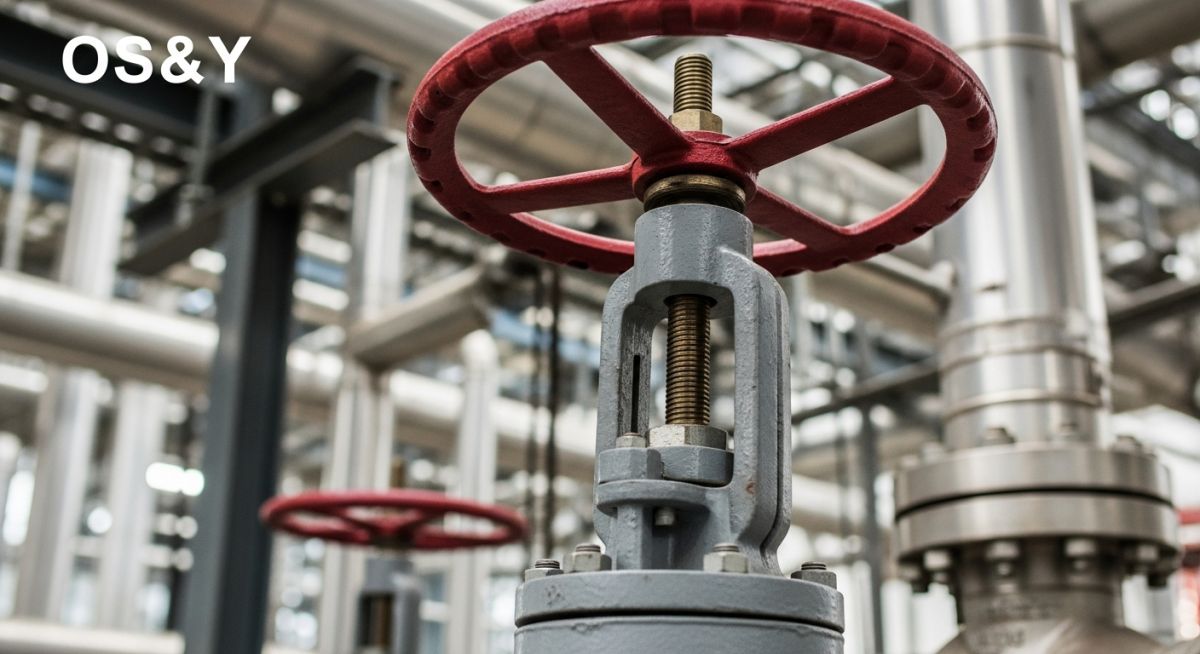
Verified for 2026 by Epcland Piping Team Valve Stems: The Critical Link in Piping Systems (2026 Engineering Guide) The Valve Stem is arguably the most stressed component in any manual or actuated valve. Acting as the mechanical bridge between the operator (handwheel/actuator) and the internal closure element, the stem must withstand high torque, axial thrust, and internal pressure while maintaining a leak-proof seal. This guide explores the engineering mechanics, material standards, and failure modes of valve stems in modern EPC projects. What is a Valve Stem? A Valve Stem is a machined metal shaft that transmits motion from the external control device to the internal disc, ball, or plug to open or close the valve. It passes through the valve bonnet and is sealed by packing material to prevent leakage. Stems are classified primarily by their movement: Rising Stems (OS&Y) provide visual indication of position, while Non-Rising Stems (NRS) are used where vertical space is limited. Read on to verify the specific material grades required for corrosive service. Table of Contents 1. What is a Valve Stem? (Definition & Role) 2. Classification: Types of Valve Stems 3. Valve Stem Materials & Metallurgy 4. Valve Stem Packing & Sealing 5. Functions & Operational Importance 6. Case Study: Stem Thread Galling QUIZ Test Your Valve Knowledge 1. What is the primary function of a valve stem? A) To support the valve body weight B) To transmit motion/torque to the closure element C) To filter debris from the fluid 2. What does "OS&Y" stand for in valve terminology? A) Open Stem & Yoke B) Outside Screw and Yoke C) Oil Seal and Yield 3. Which type of valve stem is ideal for limited vertical space (e.g., underground)? A) Rising Stem B) Non-Rising Stem (NRS) C) Extended Stem 4. "Galling" is a common failure mode caused by what? A) High fluid velocity B) Friction between similar metals (Cold Welding) C) Packing degradation 5. What component prevents process fluid from leaking up the stem? A) The Handwheel B) The Yoke Nut C) The Gland Packing Question 1 of 5 Next 1. What is a Valve Stem? (Definition & Mechanical Role) In the hierarchy of valve components, the Valve Stem acts as the transmission shaft. It physically connects the external operator (Handwheel, Gearbox, or Actuator) to the internal closure element (Disc, Gate, Ball, or Plug). Its primary engineering function is to convert the Torque applied at the handle into the Thrust required to seat or unseat the valve disc against the differential pressure of the fluid. The Critical Interface: Thread Mechanics Most linear valves (Gate and Globe) rely on a threaded mechanism to move the stem. Acme Threads: The industry standard for valve stems. They are trapezoidal, robust, and self-locking (meaning the valve won't drift open under pressure). V-Threads: Rarely used in industrial valves because they are prone to binding and are weaker under heavy thrust loads. 2. Classification: Types of Piping Valve Stems Valve stems are categorized based on their movement and thread location. The choice between these types impacts maintenance schedules, vertical clearance requirements, and thread corrosion. Figure 1: Comparison of Rising Stem (Left) vs. Non-Rising Stem (Right) mechanisms. Type A Rising Stem (OS&Y) OS&Y stands for Outside Screw and Yoke. In this design, the threads are machined on the upper part of the stem, located outside the valve body. ✔Thread Protection: Threads are not exposed to the process fluid, preventing corrosion and fouling. ✔Visual Indication: Operators can instantly tell if the valve is Open (stem is up) or Closed (stem is down) from a distance. ✔Lubrication: Threads are accessible for easy greasing. ❌Clearance: Requires significant vertical space to operate. Type B Non-Rising Stem (NRS) In an NRS valve, the stem rotates but does not move vertically. The threads are located at the bottom of the stem, inside the valve body, engaging with the gate. ✔Compact: Ideal for underground applications or tight spaces (e.g., ships, manholes). ❌Thread Corrosion: Threads are constantly wetted by the process fluid, leading to faster wear. ❌No Visual Check: You cannot see the valve position; you must rely on a separate position indicator. Feature Rising Stem (OS&Y) Non-Rising Stem (NRS) Primary Use Oil & Gas, Steam, Hazardous Fluids Water Distribution, Underground, Ships Lubrication Easy (External fitting) Difficult (Internal) Failure Mode Stem Bending Thread Corrosion/Stripping 3. Valve Stem Materials & Metallurgy (Critical for EPC) Selecting the wrong stem material is the #1 cause of valve seizure. The stem must not only resist corrosion from the fluid but also possess high tensile strength to handle the actuator torque without twisting or snapping. Standard Service: 13Cr (Type 410) For general oil, gas, and steam applications, the industry standard is 410 Stainless Steel (commonly referred to as "13 Chrome"). Why? It is martensitic, meaning it can be heat-treated to a high hardness. This hardness makes the threads durable and resistant to wear. Limitation: It has moderate corrosion resistance and is not suitable for sour service (H2S) unless NACE compliant. Corrosive Service: 316 SS vs. 17-4PH For corrosive fluids, 316 Stainless Steel is often requested. However, 316 is an austenitic steel (soft). Using a soft stem with a soft nut often leads to catastrophic thread galling. Therefore, high-strength alloys like 17-4PH or Duplex Stainless Steel (2205) are preferred for stems in corrosive environments. Common API 600 Trim Material Chart (Stem Selection) Trim # Stem Material Typical Service Trim 1 410 SS (13Cr) Oil, Steam, General Purpose Trim 5 410 SS (Hard Faced) High Pressure Steam Trim 8 410 SS (13Cr) Universal Trim (Standard for EPC) Trim 10 316 SS Corrosive / Sea Water Trim 12 316 SS High Corrosive / Acid ⚠️ The Engineering Rule of Hardness To prevent thread galling (cold welding), the Valve Stem should have a hardness at least 50 Brinell Hardness Numbers (HB) higher than the Valve Disc or Yoke Nut. This ensures that if wear occurs, it happens on the cheaper, replaceable nut rather than the expensive stem. 4. Valve Stem Packing & Sealing The space between the moving stem and the stationary valve bonnet is sealed using "Packing." In 2026, standard packing is no longer sufficient; Low-E (Low Emission) packing is mandatory for most petrochemical projects. The Stuffing Box This is the chamber where the packing rings (typically Graphite or PTFE) are inserted. A "Gland Follower" is tightened by bolts to compress the rings against the stem, creating a seal. Stem Finish (Ra) The stem surface must be extremely smooth (Ra < 0.8 µm) and perfectly straight. A rough stem acts like a file, shredding the packing material every time the valve is cycled, leading to leakage. Low-E Standards (API 622 / 624) To comply with EPA regulations and ISO 15848, modern valve stems must pass rigorous testing: API 622: Tests the packing material itself for leakage < 100 ppm. API 624: Tests the entire valve (stem + packing) over 310 mechanical cycles and thermal cycles to ensure leakage stays below 100 ppm. 🦾 Valve Stem Thrust Load Calculator Calculate the theoretical Axial Thrust force the valve stem must overcome to close against line pressure. This force dictates the required stem diameter and actuator torque. *Calculation assumes full differential pressure across the seat area. Friction factors omitted for simplicity. Valve Size (NPS) inch Differential Pressure PSI Calculate Stem Load Effective Seat Area 0.00 in² Required Stem Thrust 0 Lbs Force needed just to resist pressure. Bonus: Field Engineer's Maintenance Toolkit Preventive maintenance is the key to extending valve life. Use this Stem Inspection Checklist during your next shutdown, and reference the glossary for component identification. Safety Warning Never attempt to loosen the gland bolts or remove a stem while the valve is under pressure. Always verify LOTO (Lock Out Tag Out) and depressurization before starting work. 1 Stem Inspection Protocol Thread Check: Inspect ACME threads for burrs, chips, or signs of galling. Straightness: Verify stem is not bent (roll on a flat surface if removed). Surface Finish: Check the packing area for scoring or pitting (Ra < 0.8µm). Nut Interface: Ensure the Yoke Nut rotates freely without binding. Lubrication: Apply fresh Lithium-based Moly grease to threads. Corrosion: Look for rust near the gland follower (crevice corrosion). 2 Quick Glossary Backseat A seating surface on the stem that seals against the bonnet when fully open, isolating the packing. Gland Follower The bushing that compresses the packing material into the stuffing box. Yoke Nut (Stem Nut) The internally threaded nut held in the yoke that rotates to move the stem up or down. Blowout Proof Stem A safety design where the stem has a shoulder that prevents it from being ejected by internal pressure if the packing fails. Lantern Ring A spacer ring inside the packing set used to allow lubricant injection or leak-off monitoring. Pro Tip If you hear a "squealing" noise when operating a gate valve, stop immediately. This is the sound of threads galling. Apply lubricant or risk total seizure. 6. Case Study: The "Seized Stem" Nightmare (Galling Failure) Failure Analysis: Offshore Platform 2026 The Challenge: Valve Stuck at 50% Travel Context: During a scheduled turnaround on an offshore acid injection skid, operators attempted to close a 4-inch 316 Stainless Steel Gate Valve. The valve moved halfway and then locked solid. No amount of force on the handwheel could move it up or down. The Root Cause Galling (Cold Welding): The valve manufacturer had supplied both the Stem and the Yoke Nut in the same grade of 316 Stainless Steel. When two similar metals with high friction coefficients slide against each other under load, they tear microscopic chunks of material, which instantly fuse together. The Consequence The valve was rendered inoperable. To fix it, the line had to be depressurized, and the valve bonnet was cut open. The stem threads were completely stripped and fused to the nut. The Engineering Fix: Hardness Differential The reliability engineer replaced the seized components with a revised material specification: Component A Stem (Remained 316 SS) Kept 316 for corrosion resistance against the acid. Component B Yoke Nut (Changed to Nitronic 60) Nitronic 60 is a high-strength alloy specifically designed to resist galling. Alternatively, Aluminum Bronze nuts are often used as a cheaper anti-galling solution. Lesson Learned Always ensure a hardness difference of at least 50 HB between the stem and the nut. Never specify "All 316SS Construction" without verifying the trim details for moving parts. Frequently Asked Questions What is "Backseating" a valve stem? Backseating is a safety feature where a shoulder on the stem mates with a seat on the underside of the bonnet when the valve is fully open. This isolates the packing chamber from the line pressure, potentially allowing the packing to be replaced while the valve is in service (though this is a high-risk operation and rarely recommended today). Can a bent valve stem be repaired? No. You should never attempt to straighten a bent valve stem. Bending it back causes work-hardening and micro-cracking, creating a weak point that will likely snap under thrust load, potentially launching the handwheel like a projectile. Always replace a bent stem. How often should valve stems be lubricated? For OS&Y valves exposed to the elements, stems should be greased every 3 to 6 months depending on the environment (salty air requires more frequent attention). Lack of lubrication increases the torque required to operate the valve, which can lead to actuator burnout or manual strain injury. Why do some stems have a "Smooth Finish" vs "Rough Finish"? The area of the stem that passes through the packing must be polished smooth (RMS 32 or better) to seal effectively. The upper threaded portion is rougher to hold grease. Using a rough stem in the packing area will destroy the seal in cycles. Final Thoughts on Valve Reliability The valve stem is the only moving part that breaches the pressure boundary. Its failure isn't just a maintenance annoyance—it's a major safety hazard. Whether you select an OS&Y design for visibility or an NRS for compactness, prioritizing Material Hardness and Packing Quality is non-negotiable in 2026. Explore Epcland Valve Courses © 2026 Epcland Engineering. All Rights Reserved. Content Verified by Atul Singla (Senior Piping Engineer). Recommended Reading on Valve Stem ASME B31.4: Liquid Pipeline Systems Design Guide ASME B31.4 covers the design and construction of pipeline systems for liquids... Plug Valves: A Detailed Guide for Professionals Introduction In industries where fluid control is critical, plug valves play an... Needle Valves: A Detailed Guide Learn everything about needle valves, including their working, components, applications, and advantages. Understanding Butterfly Valves: A Detailed Guide Learn everything about butterfly valves — from working principles and types to... Related Courses Valve Material Specifications (VMS): Comprehensive Guide Discover the comprehensive Valve Material Specification (VMS) course tailored specifically... Piping Engineering Essentials: Types of Valves and Their Functions Valves are the heart of any process piping system, enabling...