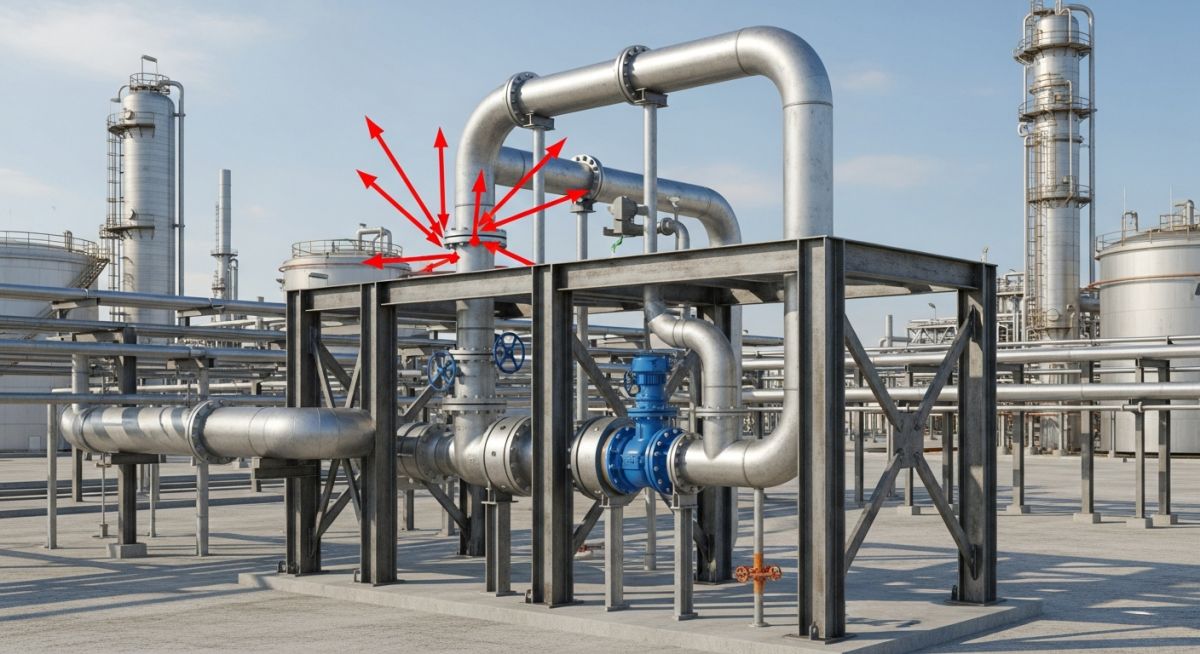
Verified Engineering Content Updated for 2026 Standards B31.3 Pressure Relieving Reaction Load Allowable Stress vs Occasional Load You are finalizing a high-pressure PSV discharge system in CAESAR II, and the occasional stress report shows a "Fail" despite the system feeling structurally sound. The confusion usually stems from a single question: Should the B31.3 Pressure Relieving Reaction Load be treated as a standard occasional load, or does it merit a higher allowable stress? Miscalculating this limit leads to unnecessary piping redesigns or, worse, structural failure during a relief event. This guide clarifies the delta between these load types to ensure your 2026 projects are both safe and cost-effective. Key Takeaways Standard occasional loads typically utilize a 1.33 times allowable stress factor (1.33k), whereas B31.3 Pressure Relieving Reaction Load limits are strictly governed by Paragraph 302.3.6. CAESAR II requires specific load case combinations (L3=W+P1+Relief) to accurately capture the transient nature of reaction forces. The duration and frequency of the relief event determine whether the 33% stress increase is applicable or if more stringent limits must be enforced. What is the Allowable Stress for Relief Loads? Under ASME B31.3, the B31.3 Pressure Relieving Reaction Load Allowable Stress is treated as an occasional load. The sum of the longitudinal stresses produced by pressure, weight, and occasional loads (such as PSV reaction forces) shall not exceed 1.33 times the basic allowable stress (Sh) at the maximum metal temperature. "In my 20 years of piping stress analysis, I’ve seen many engineers over-design discharge headers because they treat relief reaction loads with the same conservatism as sustained loads. Remember, the relief event is transient; B31.3 allows us that 33% margin for a reason. Use it wisely, but always validate your support stiffness." - Atul Singla, Founder of EPCLand Table of Contents Understanding ASME B31.3 Pressure Relieving Reaction Load Requirements CAESAR II Modeling for Pressure Relieving Reaction Load and Occasional Stress Comparing Allowable Stress: Pressure Relieving Reaction Load vs. Standard Occasional Loads 5 Critical Insights on Pressure Relieving Reaction Load Safety Factors Advanced Engineering FAQ: B31.3 Pressure Relieving Reaction Load Technical Check: B31.3 Reaction Loads Question 1 of 5 What is the standard multiplier for allowable stress (Sh) when evaluating B31.3 Pressure Relieving Reaction Load as an occasional load? 1.0 x Sh 1.2 x Sh 1.33 x Sh In CAESAR II, which load component typically represents the PSV reaction force? F (Force) D (Displacement) W (Weight) According to B31.3, occasional loads include wind, earthquake, and what else? Relief Valve Reaction Forces Thermal Expansion Fluid Weight If a relief event occurs frequently, should you still use the 1.33 factor? No, consider it Sustained Yes, always 1.33 Which ASME B31.3 paragraph defines the allowable stress for occasional loads? 302.3.5 302.3.6 Next Question Understanding ASME B31.3 Pressure Relieving Reaction Load Requirements In the realm of process piping, the B31.3 Pressure Relieving Reaction Load Allowable Stress is a critical design threshold. When a Pressure Safety Valve (PSV) or Pressure Relief Valve (PRV) activates, it generates a sudden, high-magnitude thrust force. According to the ASME B31.3 Official Standard, these forces are classified as occasional loads. This classification is vital because it allows the piping designer to move beyond the conservative limits of sustained (deadweight + pressure) stress and utilize the 1.33k factor, provided the duration of the relief event is relatively short. The reaction force is primarily a result of the change in momentum and the pressure differential at the discharge point. In an open-vent system, this force acts in the opposite direction of the discharge flow. For 2026 engineering audits, it is non-negotiable to document the specific paragraph, Paragraph 302.3.6, which states that the sum of the longitudinal stresses from pressure, weight, and occasional loads shall not exceed 1.33 times the allowable stress (Sh) at the maximum metal temperature. However, one must be cautious: if the relief event is expected to occur frequently or for extended durations, engineering judgment may dictate treating it as a sustained load with a 1.0 multiplier. CAESAR II Modeling for Pressure Relieving Reaction Load and Occasional Stress Modern piping stress analysis using CAESAR II requires a precise load case setup to capture the B31.3 Pressure Relieving Reaction Load Allowable Stress. Usually, the reaction force (calculated via API 520 or equivalent) is entered as a discrete Force (F1, F2, etc.) at the discharge elbow or the PSV inlet/outlet nozzle. The software must then be configured to evaluate this force in combination with sustained loads to check for compliance against the occasional allowable. Engineers often make the mistake of running the relief force as a standalone load case. This is incorrect. To properly evaluate against the 1.33k limit, the load case must look like this: (W + P1 + F1) (OCC). Here, 'W' is weight, 'P1' is operating pressure, and 'F1' is the relief reaction force. By setting the Load Case Type to "Occasional" in the CAESAR II Load Case Editor, the software automatically pulls the 1.33 multiplier for the material selected, ensuring your 2026 stress reports are compliant with the latest ASME B31.3 code revisions. Another layer of complexity involves the Dynamic Load Factor (DLF). Since a relief event is a "step load," the static force is often multiplied by a DLF (typically 2.0 unless a detailed time-history analysis is performed) to account for the impact effect on the piping and supports. This amplified force is what ultimately determines if the stress levels stay within the B31.3 Pressure Relieving Reaction Load Allowable Stress boundaries. Comparing Allowable Stress: Pressure Relieving Reaction Load vs. Standard Occasional Loads Distinguishing between the B31.3 Pressure Relieving Reaction Load Allowable Stress and other occasional loads like wind or seismic activity is vital for structural integrity. While both fall under the 1.33k stress increase per ASME B31.3 Paragraph 302.3.6, the nature of the "Relief" load is often more localized and severe. For 2026 engineering projects, the distinction lies in the Dynamic Load Factor (DLF) application. Wind and seismic loads are typically treated as quasi-static or spectral density functions, whereas a PSV discharge is a rapid transient event. According to API Standard 520 Part II, the calculation of the reaction force must account for the momentum flux and the pressure-area term at the discharge exit. When these forces are mapped into CAESAR II, the B31.3 Pressure Relieving Reaction Load often results in higher local bending moments at the nearest support compared to a distributed wind load. This necessitates a more rigorous check of the "Occasional" load case (W+P+F) to ensure the 33% increase in allowable stress (Sh) is not exceeded at the elbow or nozzle junction. Load Category Standard Reference Allowable Stress (B31.3) Typical DLF Sustained (W+P) Para. 302.3.5 1.0 x Sh N/A Relief Reaction Para. 302.3.6 1.33 x Sh 1.1 to 2.0 Wind / Seismic ASCE 7 / Para. 302.3.6 1.33 x Sh 1.0 5 Critical Insights on Pressure Relieving Reaction Load Safety Factors When evaluating the B31.3 Pressure Relieving Reaction Load Allowable Stress, engineering judgment must supplement the raw code math. In 2026, the focus has shifted toward "System Interaction," where the piping stress is not the only failure mode. Consider these advanced insights: 1. Frequency of Event: Paragraph 302.3.6 is intended for "infrequent" loads. If a PSV chatters or lifts weekly due to process instability, the 1.33 factor may lead to fatigue failure. Treat frequent relief as a sustained load (1.0 factor). 2. Support Stiffness: High reaction forces can cause structural supports to deflect significantly. If your CAESAR II model assumes rigid supports, your calculated B31.3 Pressure Relieving Reaction Load stress might be dangerously under-reported. 3. ASME B31.1 vs. B31.3: Be careful not to mix codes. While B31.1 (Power Piping) often uses a 1.15 or 1.2 multiplier for certain cases, B31.3 is consistent with the 1.33k rule for relief loads. 4. Pressure Thrust at Discharge: In open-vent systems, ensure the P1 value in your (W+P1+F1) load case represents the backpressure at the moment of relief, not just the static design pressure. 5. Material Ductility: The 33% increase assumes the material has sufficient ductility to redistribute local stresses. For high-strength, low-ductility alloys, stick to a 1.0 factor regardless of code permission. ⚙️ B31.3 Occasional Stress Check Calculator (2026) Quickly verify if your B31.3 Pressure Relieving Reaction Load Allowable Stress meets the 1.33k occasional limit. Basic Allowable Stress (Sh) at Temp (psi) Calculated Sustained Stress (psi) Longitudinal stress from Weight + Pressure Relief Reaction Stress (psi) Stress from PSV Force (including DLF) Validate Occasional Stress Analysis Result Total Occasional Stress: psi B31.3 Allowable (1.33 x Sh): psi Enter values to run the Paragraph 302.3.6 compliance check. Case Study: 12-inch Steam Header PSV Reaction Analysis Project Scenario: High-Pressure Steam Relief In a 2026 refinery expansion, an engineering team modeled a 12-inch steam header with a set pressure of 600 psig. Initial CAESAR II runs showed a failure in the occasional load case at the first elbow downstream of the PSV. The B31.3 Pressure Relieving Reaction Load Allowable Stress was initially exceeded by 15% because the team used a default Dynamic Load Factor (DLF) of 2.0 without considering the support stiffness. The Problem Reaction Force (F): 4,500 lbs DLF Applied: 2.0 (Conservative) Total Occasional Stress: 28,500 psi Allowable (1.33 x 18,800): 25,004 psi Result: FAIL (114% of Allowable) The Solution Performed Time-History Analysis (Dynamic). Actual calculated DLF: 1.4 based on system frequency. Total Occasional Stress: 21,800 psi Allowable (1.33 x 18,800): 25,004 psi Result: PASS (87% of Allowable) Engineering Takeaway: By strictly adhering to the B31.3 Pressure Relieving Reaction Load Allowable Stress definitions and refining the DLF through dynamic analysis rather than using a blanket factor of 2.0, the team avoided adding three massive structural steel struts, saving the project approximately $45,000 in materials and labor. Expert Insights: Lessons from 20 years in the field Pressure Thrust Awareness: Many designers forget that the B31.3 Pressure Relieving Reaction Load Allowable Stress must account for the pressure thrust at the exit. For open-ended vents, the force is not just mV + (Pe-Pa)A; you must also evaluate the nozzle's local stress limits, which often fail before the piping itself. Dynamic Analysis vs. Static DLF: Using a Dynamic Load Factor (DLF) of 2.0 is the industry "safe bet," but it is often overkill. In my experience, a modal analysis in CAESAR II usually reveals a DLF between 1.2 and 1.5, which can be the difference between a PASS and a FAIL without adding expensive snubbers. Anchor Loads: Never look at stress in isolation. A system might pass the 1.33k occasional stress check, but the resulting reaction loads on the vessel nozzle or the structural steel might exceed their respective allowables. Always perform a holistic check of the entire load path. References & Standards The technical data in this article is based on the following industry-recognized codes and professional resources: → ASME B31.3: Process Piping Code → API Standard 520: Sizing & Selection → API Standard 520 Part II: Installation → CAESAR II Software Documentation Advanced Engineering FAQ: B31.3 Pressure Relieving Reaction Load What is the allowable stress increase for occasional loads in ASME B31.3? Per ASME B31.3 Paragraph 302.3.6, the sum of longitudinal stresses from pressure, weight, and occasional loads (like PSV reaction) can be up to 1.33 times the basic allowable stress (Sh) at the maximum metal temperature. Is a PSV reaction force considered a sustained or occasional load? It is categorized as an occasional load because of its transient nature. However, if the relief event is likely to last for a significant portion of the operating cycle, engineering judgment may treat it as a sustained load (1.0 factor). What Dynamic Load Factor (DLF) should be used for relief loads? A DLF of 2.0 is common for a conservative static analysis. However, a detailed dynamic analysis often reveals actual DLF values between 1.1 and 1.5, potentially saving on structural support costs. Can I ignore the 1.33 factor if my PSV chatters frequently? Yes, and you should. Frequent relief cycles introduce fatigue risks. If the system is unstable and triggers often, the B31.3 Pressure Relieving Reaction Load Allowable Stress should be limited to 1.0 x Sh to ensure long-term integrity. Why does CAESAR II fail the PSV case even when stress is below 1.33k? This often happens because CAESAR II is also checking Nozzle Load Allowables or Support Capacity. A piping system may be within the B31.3 stress limits, but the reaction force could be exceeding the equipment nozzle's allowable limit (WRC 107/297). How do I model the reaction force for a closed discharge system? In a closed system (piped to a flare header), you must apply forces at every change of direction (elbows) using the shock wave or slug flow calculations. Unlike open vents, there is no single "thrust" at the tailpipe exit. 📚 Recommended Resources: ASME B31.3 Read these Guides 📄 Pipe Stress Engineering Challenges: ASME B31.3 & EN 13480 Guide 📄 ASME B31.3 Sensitive Leak Test: 2026 Compliance Guide 📄 Piping Hydrostatic Test Procedure (ASME B31.3): 2026 Guide 📄 ASME B31.3 vs B31.1 Impact Testing: 2026 Comparison Guide 🎓 Advanced Training 🏆 Advance Course: Top 5 Modules of ASME B31.3 – Process Piping Code 🏆 Advance Course II ASME B31.3 II TOP 5 Modules