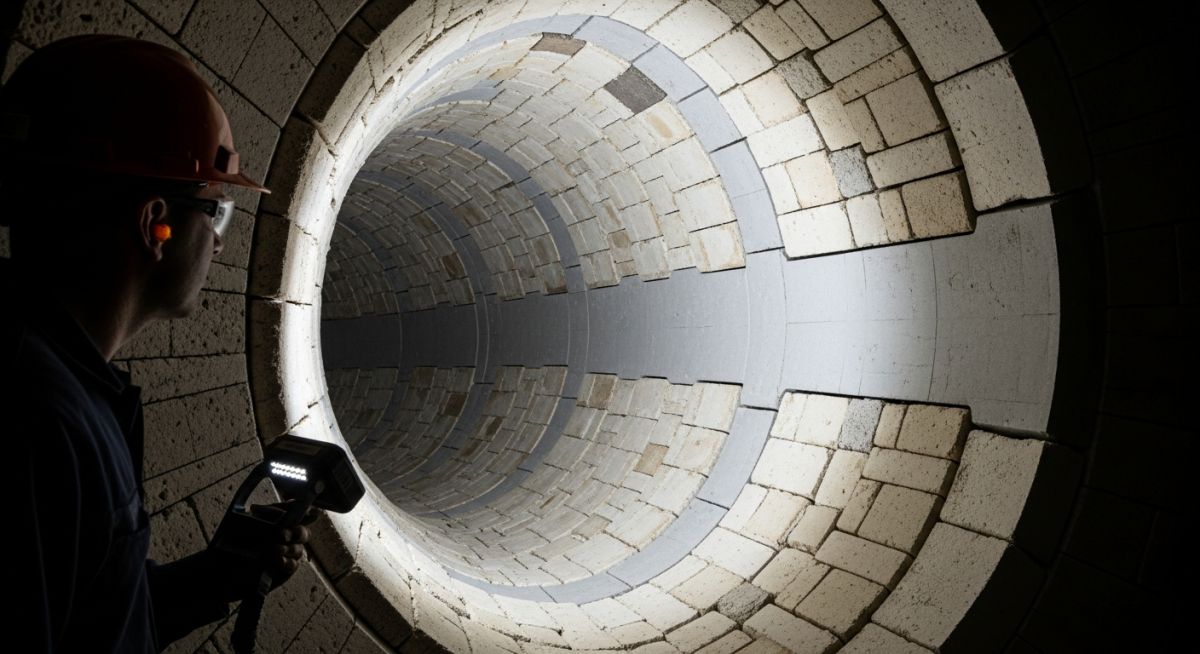
Standard Compliant: ASME / API 2026 Verified by Epcland Engineering Review Board What is a Refractory Lining? Materials, Selection, and Types of Refractory Lining Imagine a furnace operating at 1,500 degrees Celsius. Without a robust Refractory Lining, the outer steel shell would lose its structural integrity in minutes, leading to catastrophic plant failure. Yet, many engineers still struggle with premature lining spalling or choosing the wrong chemical grade for slag resistance. In this technical deep-dive, we move beyond basic definitions to explore the heat-transfer physics, material science, and stress analysis required to design a Refractory Lining that survives the harshest 2026 industrial environments. Key Engineering Takeaways Material Selection: Understanding why high-alumina content is critical for acidic slag resistance but vulnerable to thermal shock. Design Integrity: The role of V-anchors and Y-anchors in supporting monolithic Refractory Lining systems. Piping Stress: How to account for the differential thermal expansion between the steel pipe and the ceramic lining. What is a Refractory Lining? A Refractory Lining is a protective layer of high-temperature resistant materials (ceramics or minerals) applied to the internal surfaces of furnaces, kilns, and pipes. It functions as a thermal barrier to protect the structural shell from extreme heat, chemical erosion, and mechanical abrasion while maintaining process temperature. "In my 20 years of furnace auditing, 70% of Refractory Lining failures aren't caused by heat—they are caused by poor dry-out schedules and improper anchor spacing. Treat your refractory as a dynamic structural element, not just 'dead' insulation." — Atul Singla, Founder of Epcland Table of Contents 1. What is a Refractory Lining? 2. Primary Purpose of Refractory Lining in Industrial Furnaces 3. Classifying Refractory Lining Materials by Chemistry 4. Major Types of Refractory Lining: Bricks vs. Monolithics 5. Determining Optimum Refractory Lining Thickness 6. Engineering Criteria for Selecting Refractory Lining 7. Design Considerations for Refractory Lined Pipes 8. Stress Analysis and Expansion Joints in Refractory Lined Pipes 9. Refractory Lining Installation and Dry-out Protocols 10. Common Failure Modes in Refractory Lining Systems Refractory Lining Knowledge Check Validate your expertise on industrial thermal barriers Next Question → 🏆 Assessment Complete! Restart Quiz What is a Refractory Lining? In high-temperature industrial processing, a Refractory Lining serves as the critical interface between extreme thermal energy and structural containment. Chemically, these linings are composed of non-metallic materials designed to maintain their physical and chemical properties at temperatures exceeding 1,000°C (1,832°F). The Refractory Lining is not a static shell; it is a complex engineering system designed to resist thermal shock, accommodate volumetric expansion, and withstand the corrosive nature of molten slags and process gases. Modern 2026 engineering standards classify a Refractory Lining based on its installation method (shaped vs. unshaped) and its chemical behavior (acidic, basic, or neutral). The efficiency of a thermal reactor is directly proportional to the integrity of its Refractory Lining, as any breach in this barrier leads to "hot spots" on the external steel shell, potentially resulting in catastrophic mechanical deformation or "burn-through." Primary Purpose of Refractory Lining in Industrial Furnaces The deployment of a Refractory Lining serves three primary engineering objectives: Thermal Containment: By acting as a high-resistance thermal insulator, the Refractory Lining ensures that the heat generated within the process remains concentrated on the workload, significantly improving thermal efficiency and reducing fuel consumption. Structural Protection: Most industrial shells are made of carbon steel, which loses significant yield strength above 450°C. The Refractory Lining ensures the "cold-face" temperature of the steel remains within safe metallurgical limits. Chemical and Erosion Resistance: In Fluid Catalytic Cracking Units (FCCU) or Cement Kilns, the Refractory Lining must withstand the abrasive force of high-velocity particles and the chemical "attack" of molten oxides or acidic gases. Classifying Refractory Lining Materials by Chemistry Selecting the correct Refractory Lining requires an understanding of chemical compatibility. Using an acidic lining in a basic slag environment will result in a rapid chemical reaction, forming a low-melting-point liquid (eutectic) that causes the lining to wash away. Chemical Class Primary Materials Best For Acidic Silica (SiO2), Fireclay Glass melting, Acidic slag environments Basic Magnesite (MgO), Dolomite Steel making (Basic Oxygen Furnaces) Neutral Alumina (Al2O3), Chromite General purpose, high-temp stability Major Types of Refractory Lining: Bricks vs. Monolithics The physical form of the Refractory Lining dictates the installation speed and mechanical longevity. In 2026, the industry has seen a massive shift toward monolithic solutions due to the reduction in "joints," which are traditionally the weakest points of any lining. 1. Shaped Refractories (Bricks): These are pre-fired units. They offer high density and predictable performance but require skilled masonry and contain numerous joints that can be penetrated by gases or molten metal. 2. Monolithic Refractories (Unshaped): These include castables, plastics, and ramming mixes. They are installed as a single jointless piece. Refractory Lining of this type relies heavily on anchor systems and precise water-to-cement ratios to achieve the desired strength. Determining Optimum Refractory Lining Thickness Calculating the thickness of a Refractory Lining is a delicate balance between thermal insulation and mechanical stability. In 2026, engineers utilize the Fourier’s Law of Heat Conduction to ensure the "Cold Face" temperature of the steel shell does not exceed 150°C to 200°C, preventing atmospheric corrosion and structural softening. A Refractory Lining that is too thick increases the weight load on the shell and can lead to excessive internal stresses, while a lining that is too thin risks "hot spots" and energy inefficiency. Engineering Criteria for Selecting Refractory Lining Selection of a Refractory Lining is governed by the API Standard 936 (Refractory Installation Quality Control) and ASTM C24 (Pyrometric Cone Equivalent). Engineers must evaluate these five critical parameters: Selection Parameter Engineering Significance Target Value (Typical) Bulk Density Impacts structural weight and heat storage. 1,800 - 3,000 kg/m3 Cold Crushing Strength (CCS) Ability to withstand mechanical loads during transit/startup. > 50 MPa (for dense castables) Permanent Linear Change (PLC) Measures shrinkage/expansion after heating. < 0.5% at 1,400°C Thermal Conductivity (k) Rate of heat transfer through the lining. 0.5 - 2.5 W/m⋅K Design Considerations for Refractory Lined Pipes Refractory Lined Pipes are prevalent in hot blast mains and petrochemical transfer lines. Unlike furnace walls, the Refractory Lining in a pipe must resist high-velocity gas erosion. A common design utilizes a dual-layer approach: a lightweight insulating backup layer to protect the steel shell and a dense, abrasion-resistant "hot face" layer. Stress Analysis and Expansion Joints in Refractory Lined Pipes The most significant challenge in Refractory Lined Pipes is the mismatch in the Coefficient of Thermal Expansion (CTE) between the refractory (ceramic) and the steel shell. Steel expands significantly faster than ceramic. If the Refractory Lining is cast monolithically without adequate expansion joints, it will crack (spall) as the steel shell expands away from it during startup. Stress analysis per ASME B31.3 must account for the added weight of the lining and the stiffness it contributes to the piping system. High-performance ceramic fiber paper is often used at Refractory Lining joints to act as a "cushion" for this volumetric expansion. Refractory Lining Installation and Dry-out Protocols The longevity of a Refractory Lining is determined during the first 48 hours of its life. Dry-out is the process of heating the lining slowly to remove "free water" and "chemically combined water." In 2026, advanced moisture sensors are often embedded in the lining to monitor vapor pressure. If the heating rate exceeds 25°C/hour during the critical 100°C - 300°C window, the internal steam pressure can exceed the lining's tensile strength, leading to explosive spalling. Refractory Lining Thermal Estimator Quickly estimate Shell Temperature based on Lining Thickness (2026 Engineering Model) Hot Face Temperature (°C) Lining Thickness (mm) Thermal Conductivity (W/m⋅K) Dense Firebrick (1.2) High Alumina (1.8) Insulating Castable (0.2) Calculate Estimates Estimated Shell Temperature -- °C Heat Loss: -- W/m² Shell Status: -- *Simplified calculation assuming Ambient Temp: 30°C and Surface Emissivity: 0.9. For ASME-grade certified designs, use multi-layer FEA analysis. Refractory Lining Failure Case Study: FCCU Reactor Hot Spot The Problem In early 2026, a refinery reported a localized "hot spot" reaching 350°C on the external shell of a Fluid Catalytic Cracking Unit (FCCU). The internal Refractory Lining was a 100mm thick hex-mesh reinforced abrasion-resistant castable. Thermal imaging confirmed that the Refractory Lining had partially detached, allowing high-velocity catalyst particles to bypass the insulation and erode the carbon steel shell directly. The Solution & Root Cause Root Cause: Post-mortem analysis revealed "differential expansion" issues. The hex-mesh was incorrectly welded, causing the Refractory Lining to buckle under thermal cycling. Repair: Implementation of API 936 compliant installation procedures, utilizing high-alumina low-cement castables with improved vibration casting techniques. Outcome: Shell temperatures stabilized at 145°C, extending the turnaround cycle by 4 years. Engineering Insight: Always ensure the anchor metallurgy matches the shell's thermal expansion coefficient to prevent "mechanical decoupling" of the lining during operation. Expert Insights: Lessons from 20 years in the field 01 The "Dry-Out" Trap: Never rush the initial heating phase of a Refractory Lining. In 2026, we still see major failures because contractors skip the hold-periods at 120°C and 350°C, where physical and chemical water is released. Accelerated heating is the leading cause of internal delamination. 02 Anchor Metallurgy: For process temperatures above 900°C, standard carbon steel anchors will oxidize and fail. Always specify SS310 or SS316 anchors for your Refractory Lining to ensure long-term mechanical bonding to the shell. 03 Permeability vs. Erosion: In FCCUs or high-velocity gas lines, a Refractory Lining must have low permeability. If the process gas can penetrate the lining, it will cause "back-side corrosion" on the steel shell, which is invisible until a blowout occurs. Refractory Lining: Frequently Asked Questions How often should a Refractory Lining be inspected? For continuous operations like cement kilns or refineries, a Refractory Lining should undergo a visual and ultrasonic inspection during every scheduled turnaround (typically every 2–4 years). External infrared thermography should be performed monthly to detect "hot spots" during operation. What causes "spalling" in a Refractory Lining? Spalling is the cracking or flaking of the Refractory Lining surface. It is primarily caused by rapid thermal cycling (thermal shock) or the expansion of moisture trapped within the lining pores during a poorly executed dry-out. Can I use firebricks instead of castables for a curved pipe? While firebricks provide excellent density, they are difficult to install in tight radii. For complex geometries like Refractory Lined Pipes or elbows, monolithic castables or "ramming mixes" are preferred as they create a seamless, joint-free lining that conforms to the shape. Why does Alumina content matter in Refractory Lining? High-alumina (Al2O3) increases the Refractoriness Under Load (RUL) and enhances resistance to chemical attack. Most heavy-duty industrial Refractory Lining systems use 45% to 90% alumina content depending on the temperature requirements. What is the role of an expansion joint in a lining? An expansion joint in a Refractory Lining allows the ceramic material to expand without creating internal compressive stresses. These gaps are typically filled with compressible ceramic fiber paper to maintain the thermal seal. Does a thicker lining always mean better insulation? Not necessarily. While a thicker Refractory Lining reduces heat loss, it also increases the weight and the thermal gradient across the material. In 2026, many designs favor "dual-layer" linings—a thin, dense hot-face with a lightweight, high-insulation backup layer. References & Standards API Standard 936: Refractory Installation Quality Control Guidelines ASME B31.3: Process Piping Standards for Refractory Lined Systems ASTM C24: Standard Test Method for Pyrometric Cone Equivalent (PCE) ISO 1927: Monolithic Refractory Products (Classification and Testing) 📚 Recommended Resources: Piping engineering Read these Guides 📄 Piping Engineering Disciplines: Layout, Material & Stress Guide 2026 📄 Piping Engineering Certification Course: 2026 Career Guide 📄 45+ Piping Engineering Courses on Sale | EPCLAND – Just $1 to $8 📄 Master Piping Engineering: Your Complete Course Blueprint 🎓 Advanced Training 🏆 Complete Course on Piping Engineering 🏆 Piping Engineering Interview Preparation Course: 500+ Q&As 🎥 Watch Tutorials Piping Engineering Basics: Codes and Standards (Full Lecture) What is Piping Engineering